
Line List, Valve List and Instrument Index Explained
The three engineering lists that sit beside every P&ID: what each contains, who owns it, how it is built, and how procurement turns it into purchase packages.
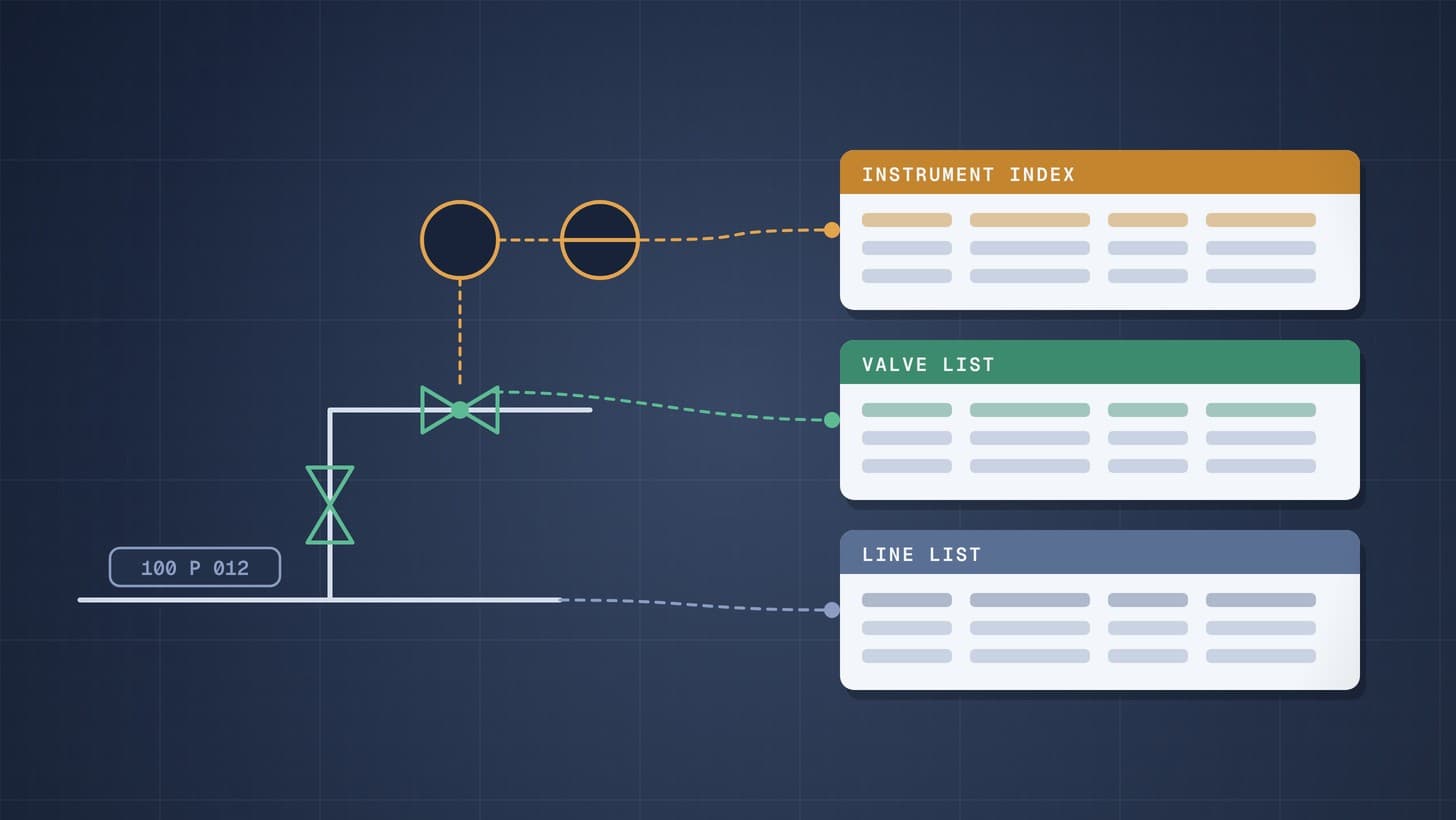
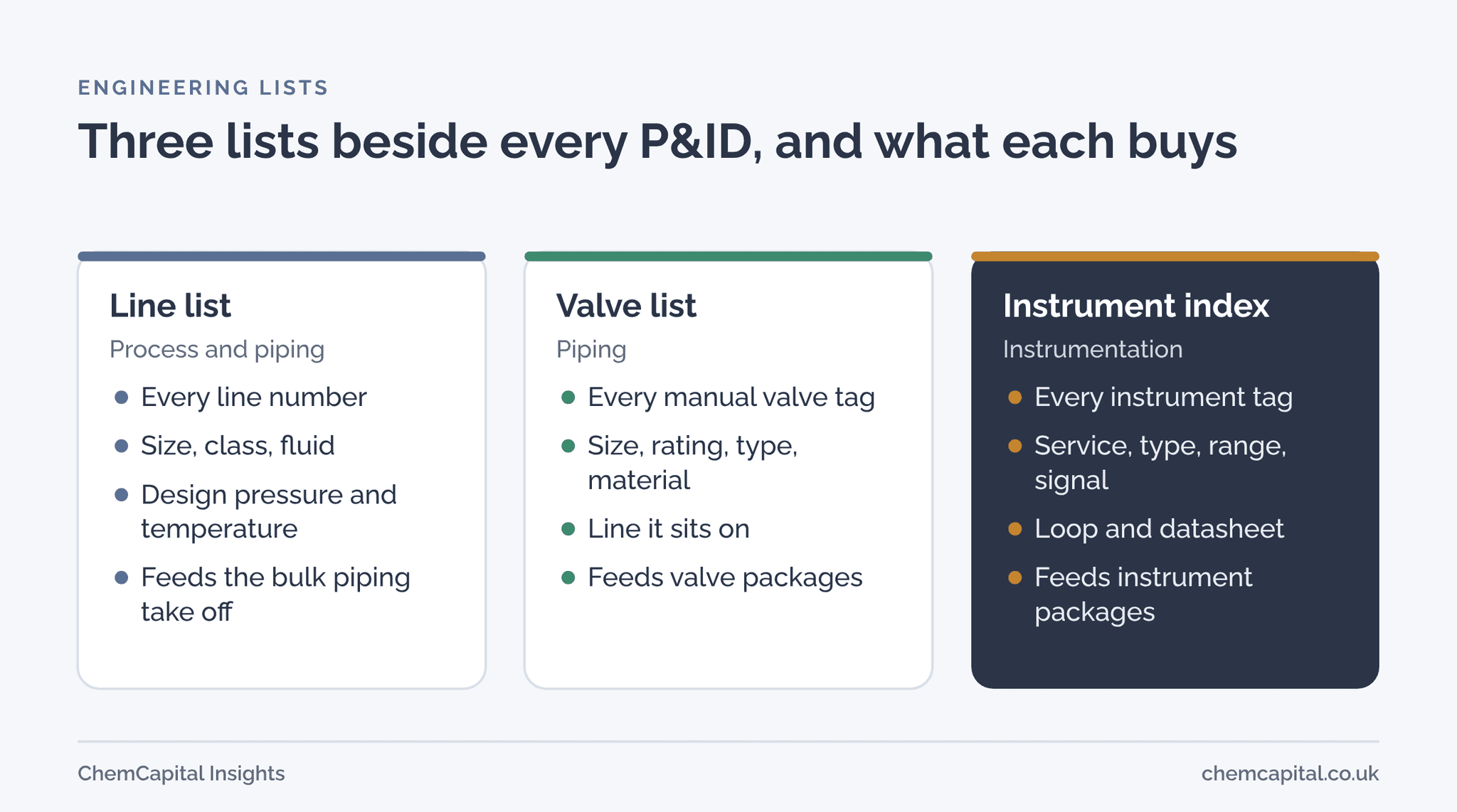
Three engineering lists sit beside every P&ID (piping and instrumentation diagram). The line list records every pipe line: its number, size, fluid, start and end points, piping class, operating and design conditions, insulation and test requirements. The valve list records every manual valve: its tag, size, pressure rating, type, materials and the line it sits on. The instrument index records every instrument tag: its service, type, location, range, signal, loop and datasheet. Procurement turns them into purchases: bulk piping materials from the line list, valve packages from the valve list, and instrument packages from the instrument index.
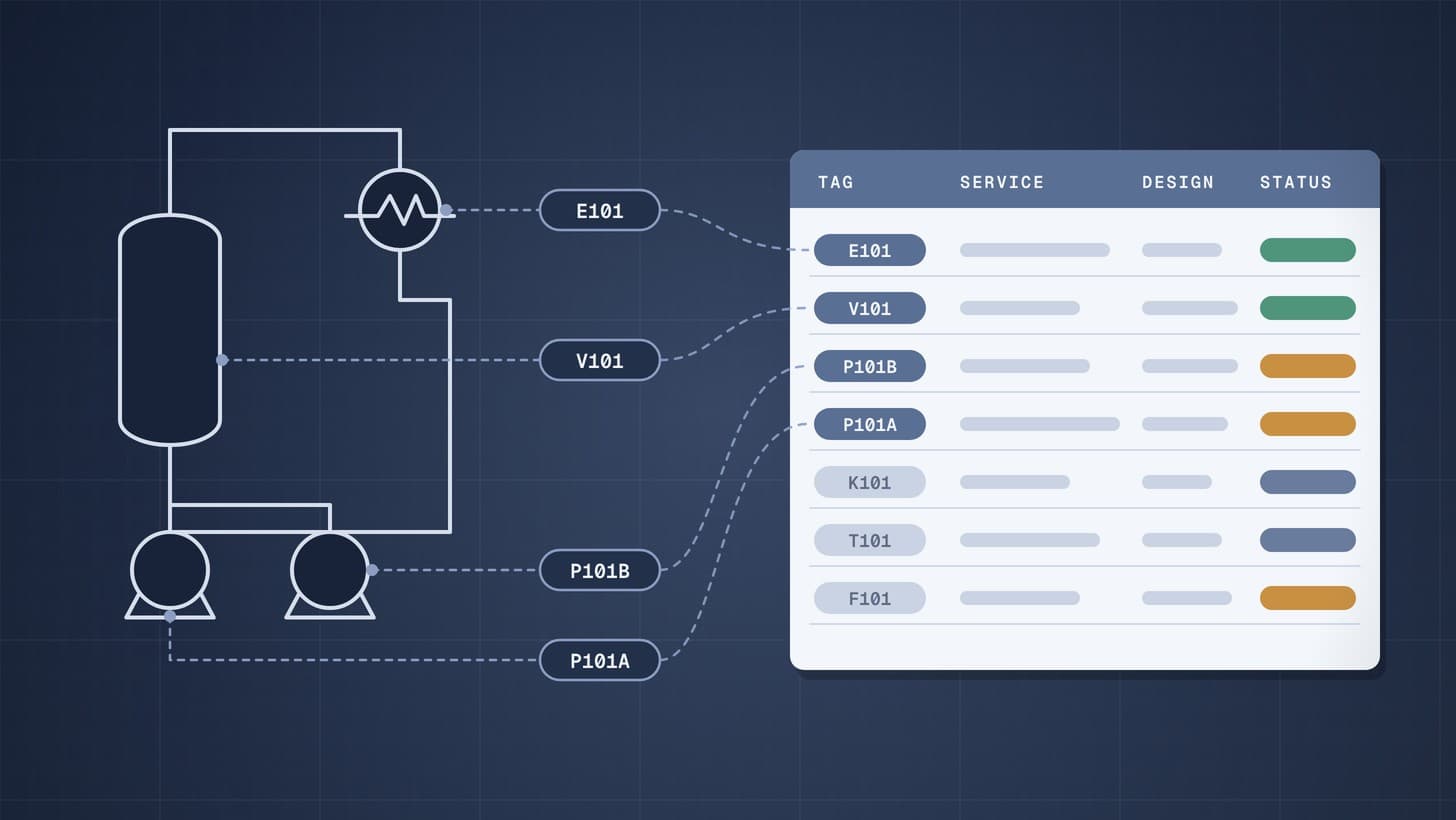
Together with the equipment list, they turn a drawing into quantities a supplier can price.
Why this matters now
Two things are changing how these lists are made. The instrument tags they rely on follow ISA 5.1, the International Society of Automation's standard for identifying instrumentation and control functions, which was updated in 2024 with a new title, new symbols and its guidance annexes moved into separate technical reports [1]. And design data is becoming machine readable: DEXPI, the open exchange format for P&IDs, carries piping topology and attributes, not just graphics [2], so lists can be generated from the design instead of typed from it. Our P&ID reading guide covers the symbols themselves.
Join ChemCapital to streamline sourcing and connect with verified partners
Whether you're buying or supplying, ChemCapital gives you the tools to manage the complete procurement cycle in one platform.
The line list
Process engineers usually start the line list from the P&IDs and the heat and material balance; piping engineers complete it. The Process Industry Practices standard for P&IDs, PIC001, sets out what information belongs on the drawing itself [3]; the line list holds the rest in table form.
| Column | What it holds | Illustrative entry |
|---|---|---|
| Line number | Unique number, usually area, fluid code, sequence and class | 100 P 1023 A1B |
| Size | Nominal diameter | DN 80 |
| Fluid | Fluid code and name | P, process solvent |
| From and to | Start and end points | Pump P101A discharge to vessel V102 |
| Piping class | Specification that sets materials and ratings | A1B, carbon steel, Class 150 |
| Operating pressure and temperature | Normal conditions | 6 bar g, 40 °C |
| Design pressure and temperature | Basis for mechanical design | 10 bar g, 80 °C |
| Fluid service category | Category under the piping code | Normal fluid service |
| Fluid group for PED or PER | Group 1 or 2 | Group 1, flammable |
| Insulation | Type and thickness | None |
| Test | Pressure, medium | Hydrostatic, 15 bar g |
| P&ID | Drawing and revision | PID 100 sheet 2, rev C |
Two columns carry regulatory weight. The process piping code ASME B31.3 has separate chapters for Category M fluid service, high pressure piping and high purity piping [4], so the fluid service category on the line list decides which rules apply. In Great Britain, the pressure equipment regulations classify piping by fluid group, maximum allowable pressure and nominal size [5], which the line list must make possible to work out.
The valve list
The valve list is usually owned by the piping engineer and generated from the P&IDs and piping classes. Control valves and relief valves often sit in the instrument index or their own lists, but are cross referenced here.
| Column | What it holds | Illustrative entry |
|---|---|---|
| Valve tag | Unique tag | HV 1023 |
| Line number | Line the valve sits on | 100 P 1023 A1B |
| Size and rating | Nominal size and pressure class | DN 80, Class 150 |
| Type | Ball, gate, globe, butterfly, check, diaphragm | Ball, full bore |
| End connections | Flanged, welded, threaded | Flanged, raised face |
| Materials | Body, trim, seats | Carbon steel body, stainless trim, PTFE seats |
| Operator | Lever, gear, actuator | Lever |
| Position | Locked open or closed, if required | Locked open |
| Package | Procurement package | PK07 manual valves |
The instrument index
The instrument engineer owns the index. Tags follow ISA 5.1 conventions, where the letters show what is measured and what the instrument does: in FT 101, F is flow and T is transmitter. Each instrument then gets a datasheet; ISA publishes standard specification forms for process measurement and control instruments [6].
| Column | What it holds | Illustrative entry |
|---|---|---|
| Tag | ISA style tag | FT 101 |
| Service | What it measures, in words | Solvent feed to reactor |
| Type | Measuring principle | Coriolis flowmeter |
| Location | Line or equipment | Line 100 P 1023 A1B |
| Range | Calibrated range and units | 0 to 50 m³/h |
| Signal | Output and protocol | 4 to 20 mA with HART |
| Loop | Control loop number | Loop 101 |
| Hazardous area | Zone and protection required | Zone 1, flameproof |
| Datasheet | Reference and revision | IDS FT101 rev A |
| Package | Procurement package | PK10 flow instruments |
| Status | Preliminary, for enquiry, ordered | For enquiry |
How procurement uses the three lists
Line list to bulk piping. Piping take offs by piping class turn lines into quantities of pipe, fittings, flanges, gaskets and bolts. Buy these as bulk packages by class, with a margin for site losses agreed with construction.
Valve list to valve packages. Group valves by type, rating and material, so each supplier quotes what it makes well. Ask for unit prices, because valve quantities change with every P&ID revision.
Instrument index to instrument packages. Group by measurement type, such as pressure, temperature, flow, level and analysers, with control valves as their own package. Each line goes out with its datasheet.
Practical example
In this illustrative example, a 12 sheet P&ID set for a solvent recovery unit produces these lists.
| List | Items | Packages |
|---|---|---|
| Line list | 140 line numbers in 4 piping classes | 4 bulk piping packages, one per class |
| Valve list | 260 manual valves | 3 packages: ball and plug, gate and globe, check valves |
| Instrument index | 85 tags: 30 pressure, 25 temperature, 12 flow, 8 level, 10 control valves | 5 packages, one per type |
When revision C of the P&IDs adds six pressure instruments and one line, the index grows to 91 tags and the line list to 141 lines. Because each list has a status and revision column, procurement can see at once which packages need an addendum and which have not yet gone out.
Where ChemCapital fits
ChemCapital's P&ID to RFQ builds these lists from the design. Its DEXPI import reads equipment, instruments, valves, nozzles, pipe segments and signals where the file follows supported structures, and existing Excel or CSV lists can be imported with column mapping. Every extracted tag gets a confidence score and a review step, more than 300 tag patterns are recognised as standard, accepted items are grouped into procurement packages, and a revised drawing shows what changed side by side.
Ready to turn your P&IDs into purchase packages? Start free with ChemCapital.
Frequently asked questions
What is a line list in piping?
A line list is a table of every pipe line on the P&IDs, giving each line's number, size, fluid, start and end points, piping class, operating and design conditions, insulation and test requirements. Piping design, stress analysis, purchasing and testing all work from it.
What is the difference between an instrument index and an instrument list?
In most projects they mean the same thing: a register of every instrument tag with its service, type, location, range, signal and datasheet reference. Some teams keep a simpler list early and a fuller index later.
Who owns the line list, valve list and instrument index?
Usually the process and piping engineers share the line list, the piping engineer owns the valve list, and the instrument engineer owns the instrument index. Ownership should be written in the project's document list so changes go through one person.
Continue reading
Informational only, not procurement or legal advice. Cited names, frameworks, and statistics belong to their respective owners.
Join ChemCapital to streamline sourcing and connect with verified partners
Whether you're buying or supplying, ChemCapital gives you the tools to manage the complete procurement cycle in one platform.
Get started freeRelated articles
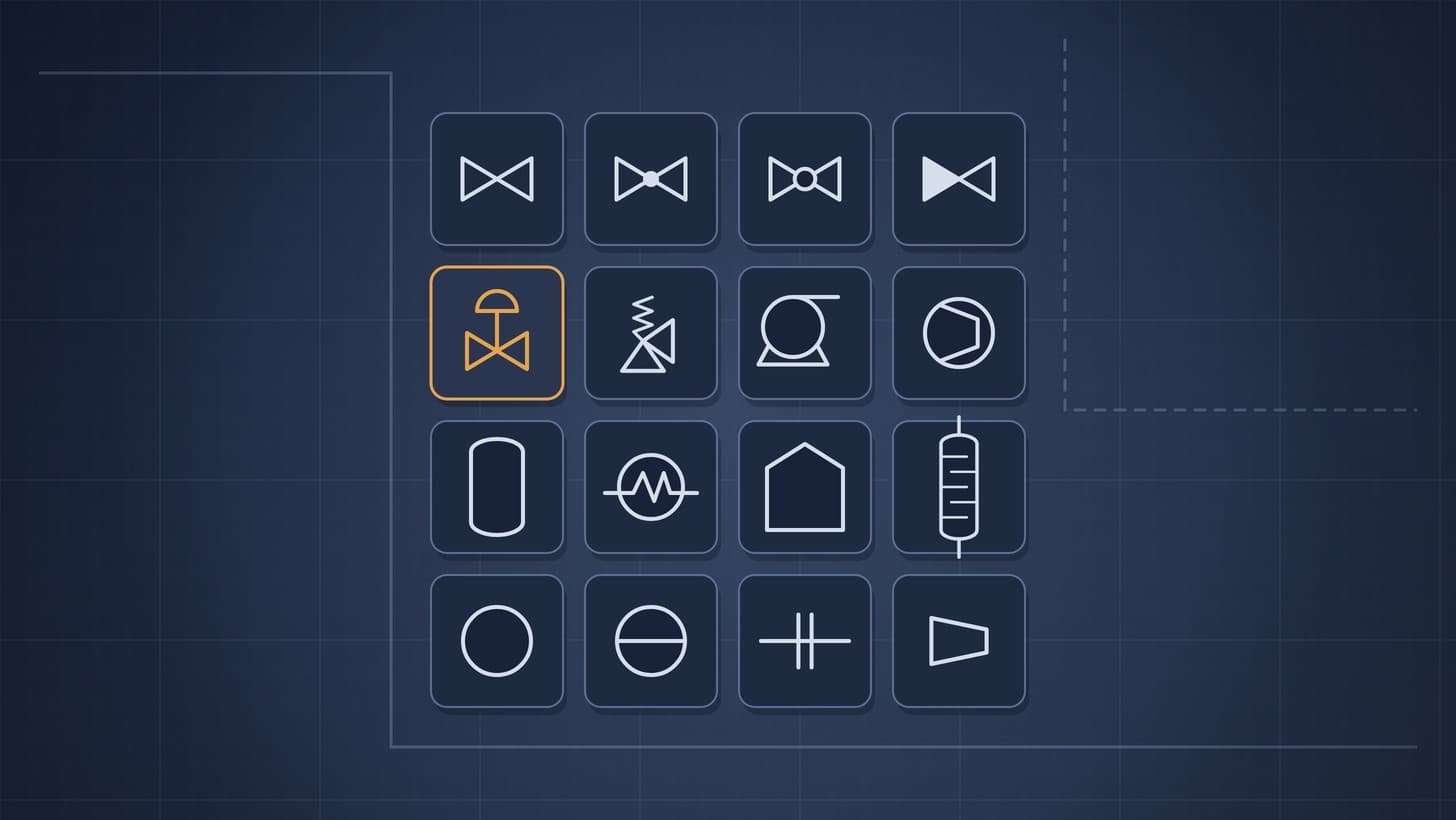
P&ID Symbols: Valves, Pumps, Vessels and Instruments
A plain reference to common P&ID symbols for lines, valves, pumps, vessels, heat exchangers and instruments, and what each tells a buyer about what must be quoted.
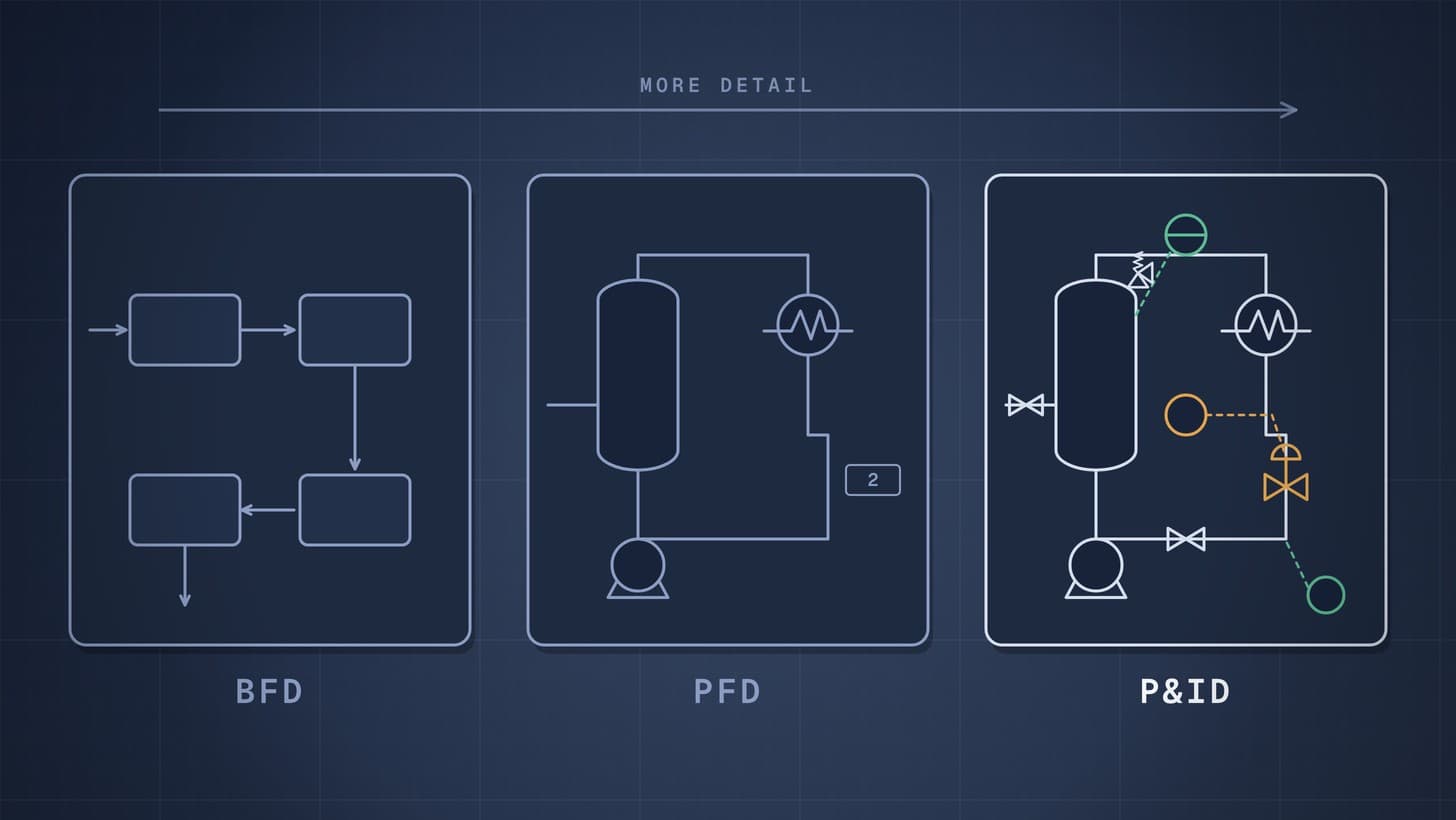
PFD vs P&ID vs Block Flow Diagram: Which Drawing a Quote Needs
What a block flow diagram, a PFD and a P&ID each show and leave out, when each exists, and which one a supplier needs to price equipment at each estimate stage.
Process Equipment List: What to Include, with a Free Template
What a process equipment list is, the columns procurement actually needs, how to keep it under revision control, and how it turns into RFQ packages.