
NPSH Explained: NPSHa vs NPSHr with a Worked Example
NPSHa is what your suction system gives a pump; NPSHr is what the pump needs. How to calculate NPSHa, what margin to ask for and how to check it on pump bids.
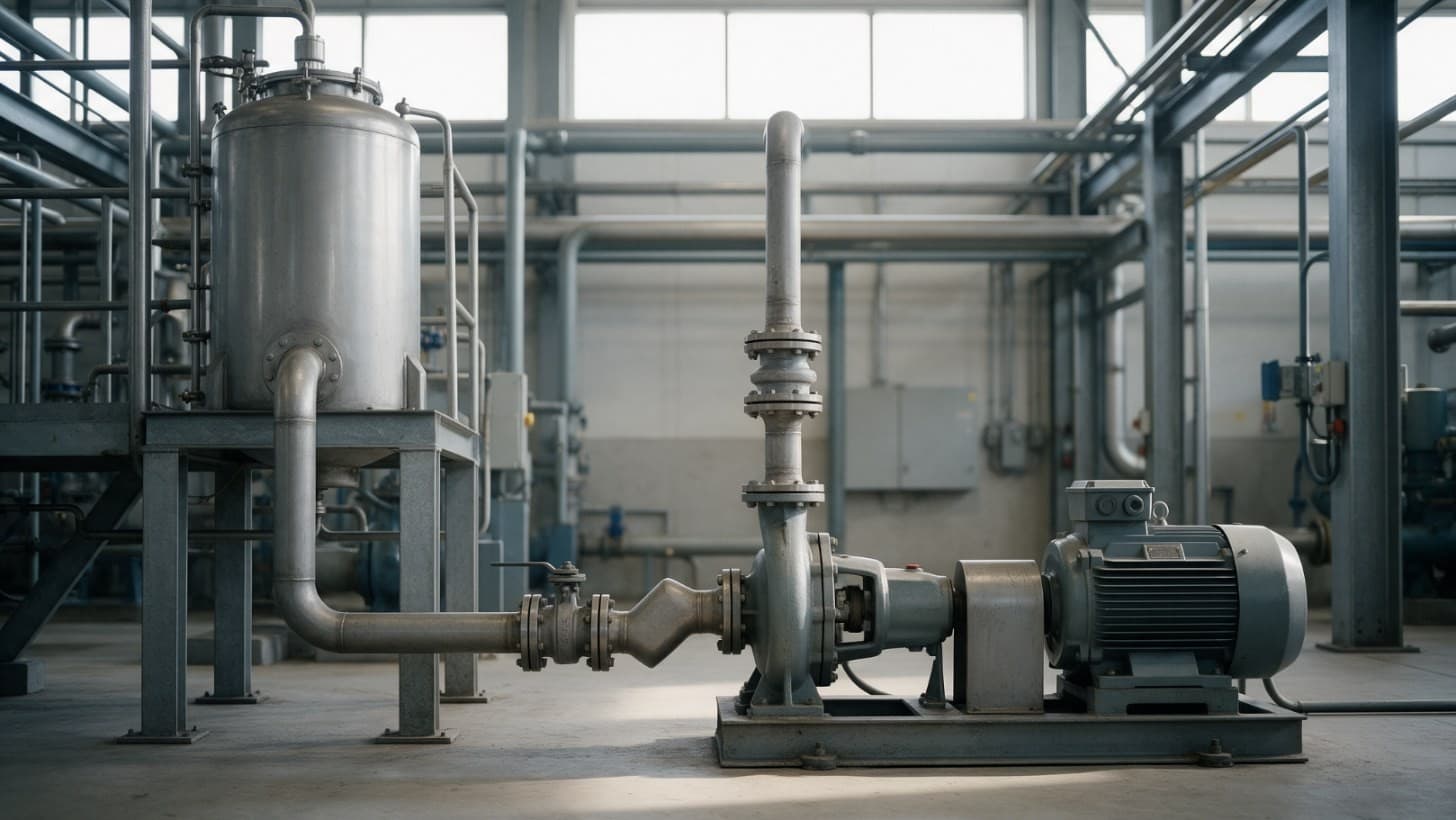
NPSH, or net positive suction head, tells you how far the liquid at a pump's inlet is from boiling: the absolute pressure there less the liquid's vapour pressure, expressed as metres of liquid [1]. NPSHa (available) is what your suction system delivers. NPSHr (required) is what the pump needs, as stated by its manufacturer. NPSHa should always exceed NPSHr, with a margin, at every flow the pump will run [2].
Why this matters now
When the pressure at the impeller inlet falls to the vapour pressure, vapour bubbles form and then collapse as pressure recovers inside the impeller. The collapse can erode metal, and the signs are noise, rough running and lost head and efficiency [3].
The Hydraulic Institute (HI), an ANSI accredited standards developer [4], has published a 2024 edition of its NPSH margin guideline, ANSI/HI 9.6.1. It measures margin from the manufacturer's NPSHR instead of NPSH3, because not all manufacturers publish NPSH3, and expects published NPSHR to be at least the tested NPSH3 [2]. HI also notes that faster pumps that put more energy into the liquid can wear out early if the margin is too small [4].
Join ChemCapital to streamline sourcing and connect with verified partners
Whether you're buying or supplying, ChemCapital gives you the tools to manage the complete procurement cycle in one platform.
NPSHa and NPSHr in plain words
NPSHa is a property of the system. HI defines it as the total head of the liquid where it enters the first stage impeller, in absolute terms, after taking off its vapour pressure head [2]. Put simply: the pressure the liquid has in hand, above boiling, at the impeller.
NPSHr is a property of the pump: the least NPSH it needs to deliver its stated performance for a particular flow, speed and liquid [2]. In 1932 HI took it as the NPSH at which cavitation cuts total head by 3%, now written NPSH3, because 3% was the smallest head drop it could measure consistently [1]. Manufacturers find it by holding flow steady and lowering suction pressure until head falls 3%, usually on water at 20 °C; on a multistage pump only the first stage counts [6].
NPSH3 is not a safe operating point. At NPSHa equal to NPSH3, cavitation has already cost the pump 3% of its head. Allan Budris, a professional engineer writing in WaterWorld, stresses that NPSHR does not mark where cavitation begins; eliminating it at flows above the onset of suction recirculation typically takes four to five times NPSH3 or more [7].
The NPSHa formula
Working from the liquid surface in the suction vessel, in metres of the liquid pumped [2]:
NPSHa = (Ps minus Pv) ÷ (ρ × g) + Hz minus Hf
With Ps and Pv in pascals (1 kPa is 1,000 Pa), ρ in kg/m³ and g in m/s², the first term is in metres of liquid.
- Ps: absolute pressure on the liquid surface: atmospheric for a vented tank (use the lowest expected at the site, allowing for altitude and weather), gas pressure for a closed drum. Never gauge.
- Pv: vapour pressure of the liquid at pumping temperature, also absolute.
- ρ and g: density at pumping temperature, and 9.81 m/s².
- Hz: height of the lowest liquid level above the impeller centreline; negative if the liquid is below the pump [6].
- Hf: friction losses from vessel to pump, including entry losses, valves and fittings [5], at the flow being checked.
HI's 2024 guideline advises using the lowest NPSHa the system will see [2].
Vapour pressure: the term that moves most
Water properties are from NIST [8]; the heads are our calculation, with g at 9.81 m/s² and, as an illustrative assumption, 101.325 kPa absolute on a vented tank.
| Water temperature | Vapour pressure (kPa abs) | Vapour pressure head (m) | Atmosphere less vapour pressure, as head (m) |
|---|---|---|---|
| 20 °C | 2.34 | 0.24 | 10.11 |
| 80 °C | 47.41 | 4.97 | 5.66 |
| 90 °C | 70.18 | 7.41 | 3.29 |
From 20 °C to 90 °C, the same tank loses 6.82 m of NPSHa.
What usually causes low NPSHa
- Hot liquid, as the table shows.
- Liquid at its boiling point in a closed vessel. Ps equals Pv, so NPSHa is only static height less friction.
- Low level or suction lift, which shrink or reverse Hz [6].
- Suction losses, which can grow occasionally or gradually over the life of the system [6].
- Flow above rated. Friction rises and NPSHr rises with flow, so the margin shrinks from both sides [6].
How much NPSH margin to ask for
Margin is a difference in metres or a ratio: 1.1 means NPSHa is 10% above NPSHr [6]. The 2024 edition of ANSI/HI 9.6.1 gives recommendations for ten market segments and takes NPSHR as the reference; earlier editions used NPSH3 [2].
Michael Smith Engineers, a UK pump supplier, summarises selected 2012 edition recommendations as below; where two values are given, use whichever needs the greater NPSHa [6].
| Application (ANSI/HI 9.6.1, 2012 edition) | Ratio, NPSHa ÷ NPSH3 | Or margin in metres |
|---|---|---|
| Petroleum and hydrocarbon process, typical (not vertical canned pumps) | 1.1 | 1.0 m |
| Chemical process, typical | 1.1 to 1.2 | 0.6 m to 1.0 m |
| Building services, open systems | 1.0 to 1.1 | 0.6 m |
| General, often a standard catalogue pump | 1.1 | 1.0 m |
HI says less margin is needed in the preferred operating region (POR) around the best efficiency point than in the wider allowable operating region (AOR) [1]. In the guideline each value applies to the POR or the AOR, and for chemical process pumps the higher figures apply in the AOR to pumps with high suction specific speed, an index of suction performance. Check the current edition before writing numbers into a specification.
Budris reports that high suction energy pumps on water at around 30 °C typically need a ratio of 1.5 to 2.0 within the AOR [7]. More is not always better: the guideline cautions against excessive margin, which can push the selection away from the best pump and add cost [7].
What to check on a vendor datasheet and curve
Make sure every bidder's NPSHr means the same thing:
- Basis. NPSH3 or another criterion? Under the 2024 guideline, published NPSHR should be at least the tested NPSH3 [2].
- Flow range. NPSHr rises with flow [6], so read it at the highest flow you will run.
- Impeller and speed. The curve must match the offered impeller and speed; KSB notes NPSHR is largely a matter of testing, especially when converting between speeds, sizes or liquids [5].
- Corrections. KSB finds NPSH3 lower on hot water and hydrocarbons than on cold water and shows a correction factor [5]. The API 610 pump standard does not allow a hydrocarbon correction [9], so compare every bid on uncorrected cold water NPSHr and treat any benefit from the liquid as extra margin.
- Datum. KSB refers NPSH to the impeller centre and notes that values referred to other levels can differ [5]. On vertical pumps, check NPSHa uses the same datum.
Practical example
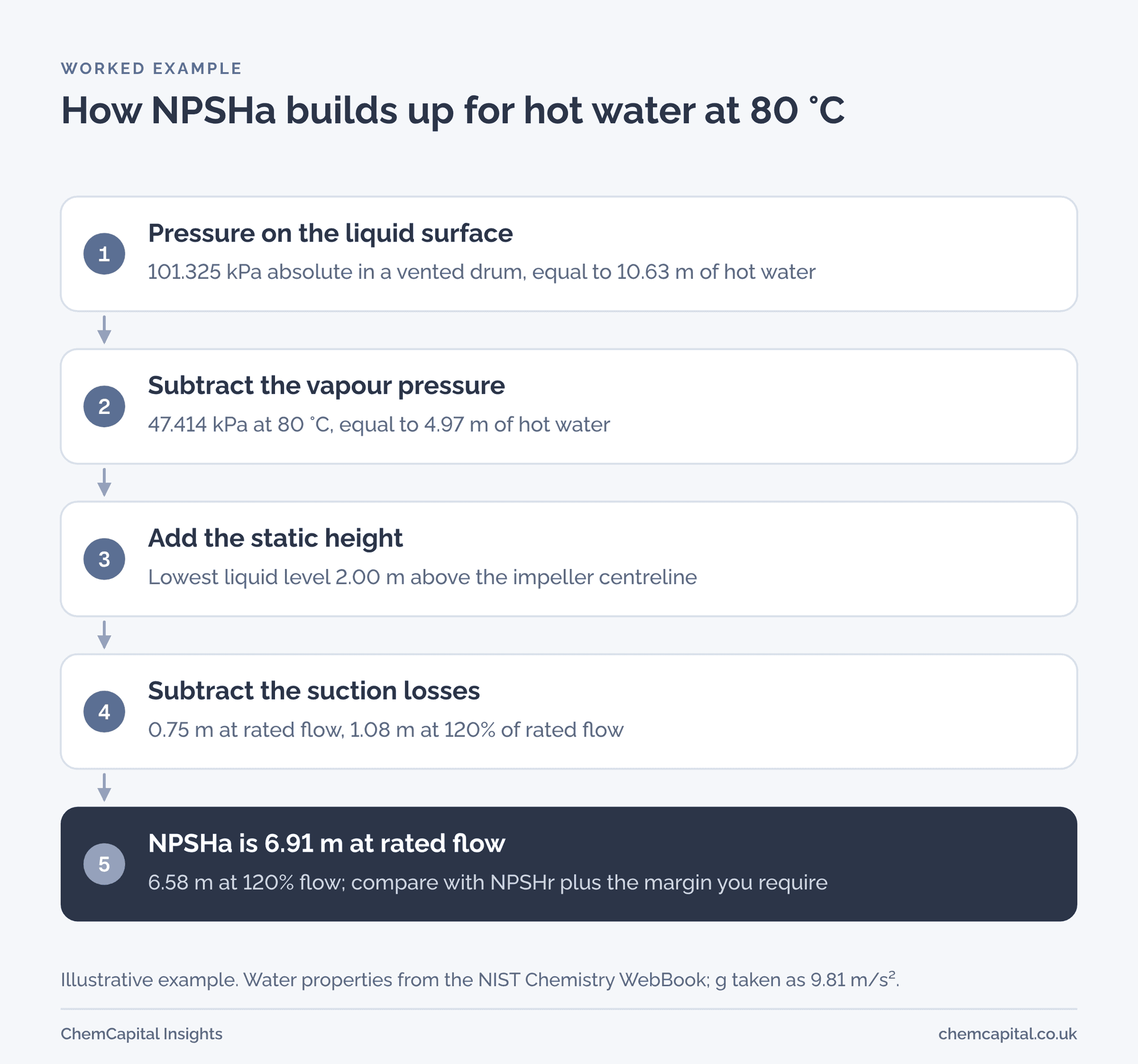
All figures are illustrative except the water properties. A vented suction drum holds water at 80 °C, with its lowest operating level 2.00 m above the centreline of a horizontal end suction pump. Suction losses are 0.75 m at rated flow. At the maximum of 120% of rated flow, scaling with the square of flow, they become 0.75 × 1.2² = 1.08 m. We take 101.325 kPa absolute on the surface for simplicity; a design check would use the lowest expected at site. NIST gives water at 80 °C a vapour pressure of 47.414 kPa and a density of 971.77 kg/m³ [8].
- Pressure head: 101,325 ÷ (971.77 × 9.81) = 10.63 m
- Vapour pressure head: 47,414 ÷ (971.77 × 9.81) = 4.97 m
- NPSHa at rated flow: 10.63 minus 4.97 plus 2.00 minus 0.75 = 6.91 m
- NPSHa at 120% flow: 10.63 minus 4.97 plus 2.00 minus 1.08 = 6.58 m
The specification takes the top of the chemical process range: a ratio of 1.2 or 1.0 m, whichever needs more NPSHa. Two bids arrive:
| Check | Bidder A | Bidder B |
|---|---|---|
| NPSHr at rated flow | 3.2 m | 4.9 m |
| NPSHr at 120% flow | 4.5 m | 6.3 m |
| Ratio at rated flow (6.91 m available) | 2.16 | 1.41 |
| Ratio at 120% flow (6.58 m available) | 1.46 | 1.04 |
| NPSHa needed at 120% flow | 5.50 m | 7.56 m |
| Result | Passes, 1.08 m to spare | Short by 0.98 m |
At 120% flow Bidder B has 0.28 m in hand (6.58 minus 6.30). On cold commissioning water at 20 °C it would seem fine, with 11.03 m available at 120% flow. The trouble starts when the plant runs hot.
Bidder B is not automatically out. Raising the drum's low level by 1.00 m gives 7.58 m at 120% flow, only 0.02 m above the 7.56 m needed, so in practice you would raise it further, cut suction losses or change the impeller, and price that before award.
Put NPSH into the RFQ, then compare like with like
Give every bidder the same suction data, including NPSHa at rated and maximum flow and the margin you require, and ask for NPSHr across the flow range on a stated basis. See our guides to technical bid evaluation and the quotation comparison sheet.
AI Quotation Comparison puts supplier quotes side by side on commercial, technical, delivery, compliance and risk. It extracts price, lead time, materials, certifications and scope from uploaded quotes for you to review, and flags quotes with mandatory gaps. The NPSH check stays with your engineer. You can try it with up to three quotes without signing up.
Ready to compare pump bids on the same basis? Start free with ChemCapital.
Frequently asked questions
What is the difference between NPSHa and NPSHr?
NPSHa is a property of your suction system: the absolute pressure head reaching the impeller less the liquid's vapour pressure head. NPSHr is a property of the pump, given by the manufacturer and usually taken as NPSH3, the NPSH at which head falls 3%, and NPSHa must exceed it with a margin.
How do you calculate NPSH available?
Take the absolute pressure on the liquid surface minus the vapour pressure, divide by density times g, add the height of the lowest liquid level above the impeller and subtract the suction friction losses. Check it at the highest flow, the hottest liquid temperature, the lowest liquid level and the lowest pressure on the liquid surface, because that is where NPSHa is lowest.
What is a good NPSH margin?
The Hydraulic Institute guideline ANSI/HI 9.6.1 gives recommendations by application; for the applications summarised here, the 2012 edition gave ratios from 1.0 to 1.2 over NPSH3, or a minimum margin such as 0.6 m to 1.0 m, whichever is greater. Pumps with high suction energy or running away from the best efficiency point need more, so check the current edition.
What happens if NPSHa is lower than NPSHr?
The pump cavitates: vapour bubbles form and collapse inside the impeller, head and efficiency fall, the pump runs noisily and roughly, and the metal can erode. Even with NPSHa equal to NPSH3 the pump has already lost 3% of its head, which is why a margin is needed.
Continue reading
Informational only, not procurement or legal advice. Cited names, frameworks, and statistics belong to their respective owners.
Join ChemCapital to streamline sourcing and connect with verified partners
Whether you're buying or supplying, ChemCapital gives you the tools to manage the complete procurement cycle in one platform.
Get started freeRelated articles
How to Read a P&ID: A Line by Line Guide for Engineers and Buyers
How to read a P&ID line by line: equipment tags, line numbers, valves and ISA instrument letters, and what a buyer takes from the drawing to build RFQs.
Control Valve Sizing: Kv and Cv Formula with a Worked Example
How to size a control valve for liquid: Kv and Cv defined, the sizing equation in metric and US units, choked flow checks, the datasheet a vendor needs and a worked example.

Technical Bid Evaluation for Process Equipment: Step by Step
A technical bid evaluation decides which bids meet your specification before prices are compared. The steps, who takes part, common mistakes and a pump example.