
Quotation Comparison Sheet: Layout and Worked Pump Example
How to build a quotation comparison sheet for process equipment that levels scope, Incoterms, currency, payment terms and energy before ranking, with a worked pump example.
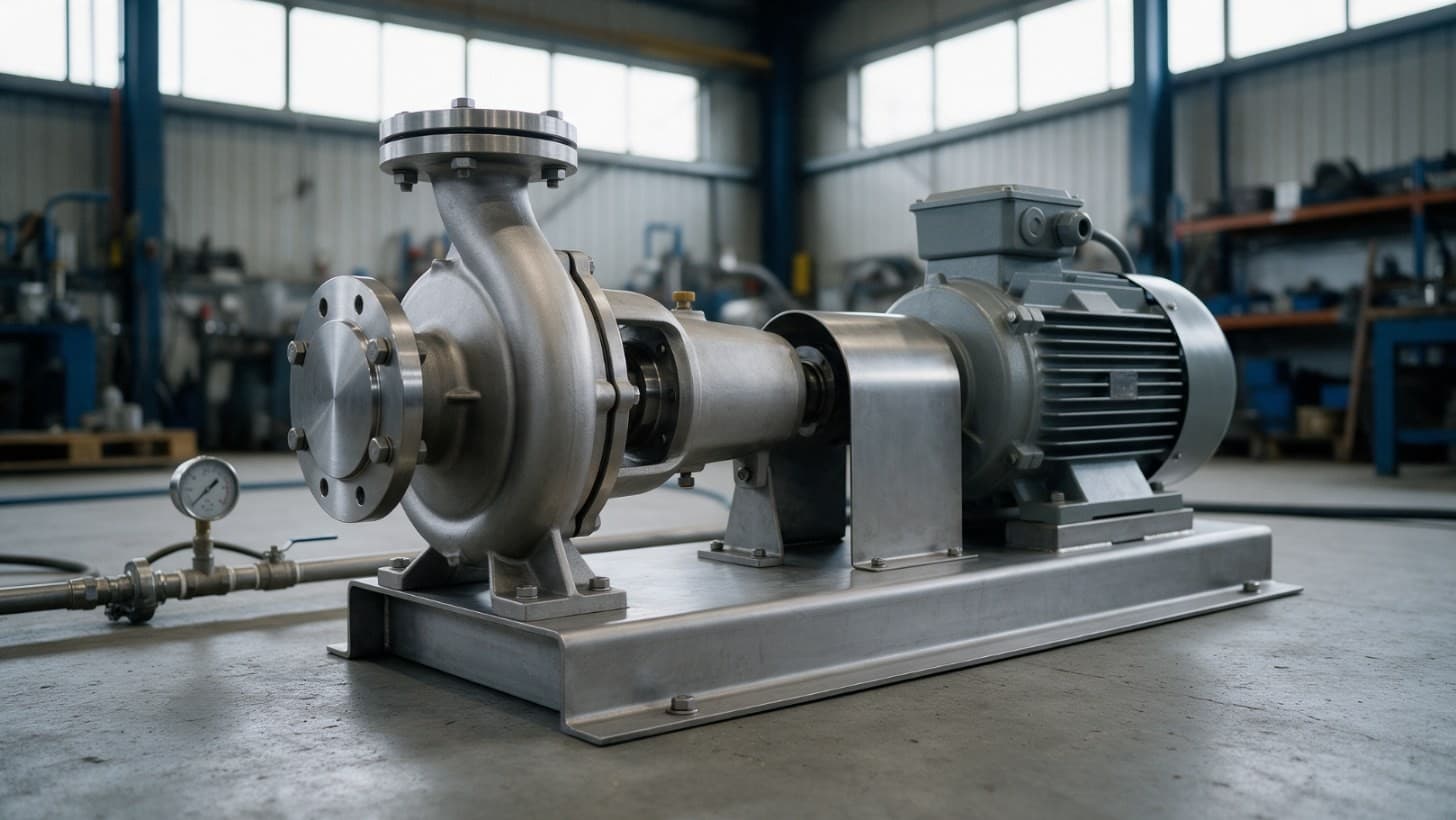
A quotation comparison sheet puts every supplier's offer into the same rows so you can compare like with like. For process equipment it only works if you level the quotes before you rank them: price any missing scope, bring every offer to delivery at your site in one currency, charge for advance payments and add running cost. In the pump example below, the lowest price as quoted becomes the highest levelled capital cost, and the highest quoted price gives the lowest lifecycle cost.
The same document is also called a bid tab (bid tabulation) or a comparative statement.
Why this matters now
Equipment quotes rarely arrive on the same basis. One supplier quotes ex works in euros, another delivered to site in sterling, a third leaves out the material certificates you asked for. Incoterms rules, the eleven three letter trade terms published by the International Chamber of Commerce, set out who pays for and carries the risk of each part of the journey [1]. Under EXW (ex works) the seller makes the goods available to the buyer at its premises or another named place; under DAP (delivered at place) the seller brings them to your named site, ready for unloading [2].
Running cost matters even more for rotating equipment. By the Hydraulic Institute's estimate, buying a medium size industrial pump system accounts for roughly a tenth of what it costs over 15 to 20 years of service, while energy takes about 40% and maintenance about 25% [3]. Government figures put the average UK non domestic electricity price at 24.14p per kWh in the first quarter of 2026 including Climate Change Levy, and a provisional 17.47p for manufacturers excluding the levy [4].
Public buyers have a legal reason too. Since 24 February 2025, section 23 of the Procurement Act 2023 has required contracting authorities to explain how tenders will be assessed and the relative importance of the award criteria, for example by weighting or ranking. Section 2 also brings in privately owned utilities for utilities contracts and excludes devolved Scottish authorities [5]. For everyone else, the same discipline makes any award easier to defend. This is general information, not legal advice.
Create and manage RFQs in minutes
ChemCapital handles the entire procurement cycle, from structured RFQs and supplier comparisons to formal purchase orders and delivery tracking.
The quotation comparison sheet layout
Use one column per supplier. Keep each supplier's figures untouched and add your adjustments underneath, one per row, so anyone can trace how a quoted price became a levelled one. Send a price schedule with the RFQ (request for quotation) so every supplier fills in the same breakdown, and define the evaluation method in the tender documents, as the Higher Education Procurement Association also advises [6].
| Row | What goes in it | Formula in words |
|---|---|---|
| 1. Quote details | Supplier, reference, date, validity, firm or budgetary | Copy from the quote |
| 2. Mandatory gate | Pass or fail on each must have item: materials, design code, hazardous area rating, certificates | A fail that clarification cannot fix stops the column |
| 3. Quoted price | Price as offered, net of VAT, in the quote currency | Copy from the quote |
| 4. Exchange rate | One rate and its date for every column | Fixed before quotes are opened |
| 5. Quoted price in £ | Row 3 times row 4 | |
| 6. Options needed | Priced extras the RFQ requires, such as testing | Sum of required options in £ |
| 7. Scope gaps | Required items neither included nor priced | Highest price another bidder quoted for the item, or your own estimate |
| 8. Delivery to site | Incoterm and named place as quoted | Forwarder's cost to your site, including clearance and any duty |
| 9. Payment terms | Advance and stage payments | Payment times months early, divided by 12, times annual cost of money |
| 10. Levelled capital cost | Rows 5 to 9 added together | |
| 11. Delivery date | Weeks to site against your need date | Flag or reject if late; do not price it in |
| 12. Energy per year | Absorbed power at your duty point, from the data sheet | kW divided by motor efficiency, times hours, times price per kWh |
| 13. Energy, present value | Row 12 times the present value factor | |
| 14. Other running costs | Maintenance or consumables, only where they differ | Present value of the difference |
| 15. Lifecycle cost and rank | Open clarifications, accepted deviations | Rows 10, 13 and 14 added; rank compliant quotes here |
Row 2 is a gate, not a score: a failing quote is clarified or rejected, never levelled into contention. Score technical quality and supplier risk separately, as our guide to technical bid evaluation explains.
Levelling rules to fix before you open the quotes
Write them at the top of the sheet so nobody can later tune them to favour a supplier.
Scope gaps. Price a missing item at the highest price any other bidder quoted for it, so no supplier gains by leaving something out. The lifecycle cost guide from the Hydraulic Institute, Europump and the US Department of Energy counts testing and inspection and spare parts as initial cost, a useful checklist [7].
Delivery basis. Bring every quote to the same Incoterm and named place, usually DAP at your site. Get a forwarder's door to door cost, with clearance and any duty, for each quote that stops short.
Payment terms. Money paid early has a cost: charge each advance payment at your cost of money for the months it is early.
Running cost. For pumps, fans and compressors, add energy at the duty point. The same guide says it is practical, and may be essential, to compare options on a present or discounted value, and that energy is often one of the largest costs, particularly for pumps running more than 2,000 hours a year [7]. Grundfos says lifecycle analysis typically covers 10 to 20 years [8]. Ask for absorbed power at your duty point, guaranteed on the performance test, not a catalogue best efficiency figure. Hold all suppliers to the same test acceptance grade and agree the remedy if the test shows more; a small gap can sit inside test tolerance.
Only firm offers belong on the sheet; a budgetary quote should not decide an award.
Practical example
A buyer needs one end suction centrifugal pump in 316 stainless steel for 100 m³/h at 50 m head, with a 22 kW motor, a witnessed performance test, EN 10204 3.1 material certificates and two years of recommended spares, on site within 16 weeks. All figures are illustrative. All three quotes meet the duty point with a safe NPSH margin (net positive suction head, the pressure above boiling at the pump inlet), pass the gate and meet the date.
The rules, fixed in advance: £0.85 per euro; 8% a year cost of money; standard payment 30 days after delivery; electricity at 20p per kWh, between the two government averages above; 6,000 running hours a year; 94% motor efficiency for all three; equal maintenance; and 10 years discounted at 8%, a present value factor of 6.71.
- Supplier A quotes €19,800 ex works from its EU factory, 14 weeks plus about a week in transit. Testing (€1,160) and certificates (€300) are priced options, spares are not quoted, and it wants 30% with order and 70% before dispatch.
- Supplier B quotes £19,450 DAP your site in 15 weeks, everything included, spares itemised at £1,350, payment 30 days after delivery.
- Supplier C quotes £17,950 FCA (free carrier) at its UK works in 13 weeks, meaning it hands the pump to the carrier you nominate [2]. Testing and certificates are included, spares are not, and it wants 50% with order.
| Line | Supplier A | Supplier B | Supplier C |
|---|---|---|---|
| Quoted price in £ | 16,830 | 19,450 | 17,950 |
| Options needed | 1,241 | 0 | 0 |
| Scope gap: spares at B's price | 1,350 | 0 | 1,350 |
| Delivery to site | 1,450 | 0 | 380 |
| Payment terms at 8% | 268 | 0 | 239 |
| Levelled capital cost | 21,139 | 19,450 | 19,919 |
| Absorbed power, kW | 18.2 | 17.9 | 19.2 |
| Energy per year | 23,234 | 22,851 | 24,511 |
| Energy over 10 years, present value | 155,900 | 153,330 | 164,469 |
| Levelled lifecycle cost | 177,039 | 172,780 | 184,388 |
| Rank | 2 | 1 | 3 |
Supplier A's invoice is £18,071 with options. Its 30% is paid about 4.5 months before your standard date and its 70% about 1.25 months before: 18,071 × (0.3 × 4.5 + 0.7 × 1.25) ÷ 12 × 8% = £268. Supplier C's first half, £8,975, is about four months early: 8,975 × 4 ÷ 12 × 8% = £239. The £1,450 and £380 are forwarder quotes. Supplier B's pump uses 17.9 ÷ 0.94 × 6,000 × £0.20 = £22,851 of electricity a year, and £22,851 × 6.71 = £153,330.
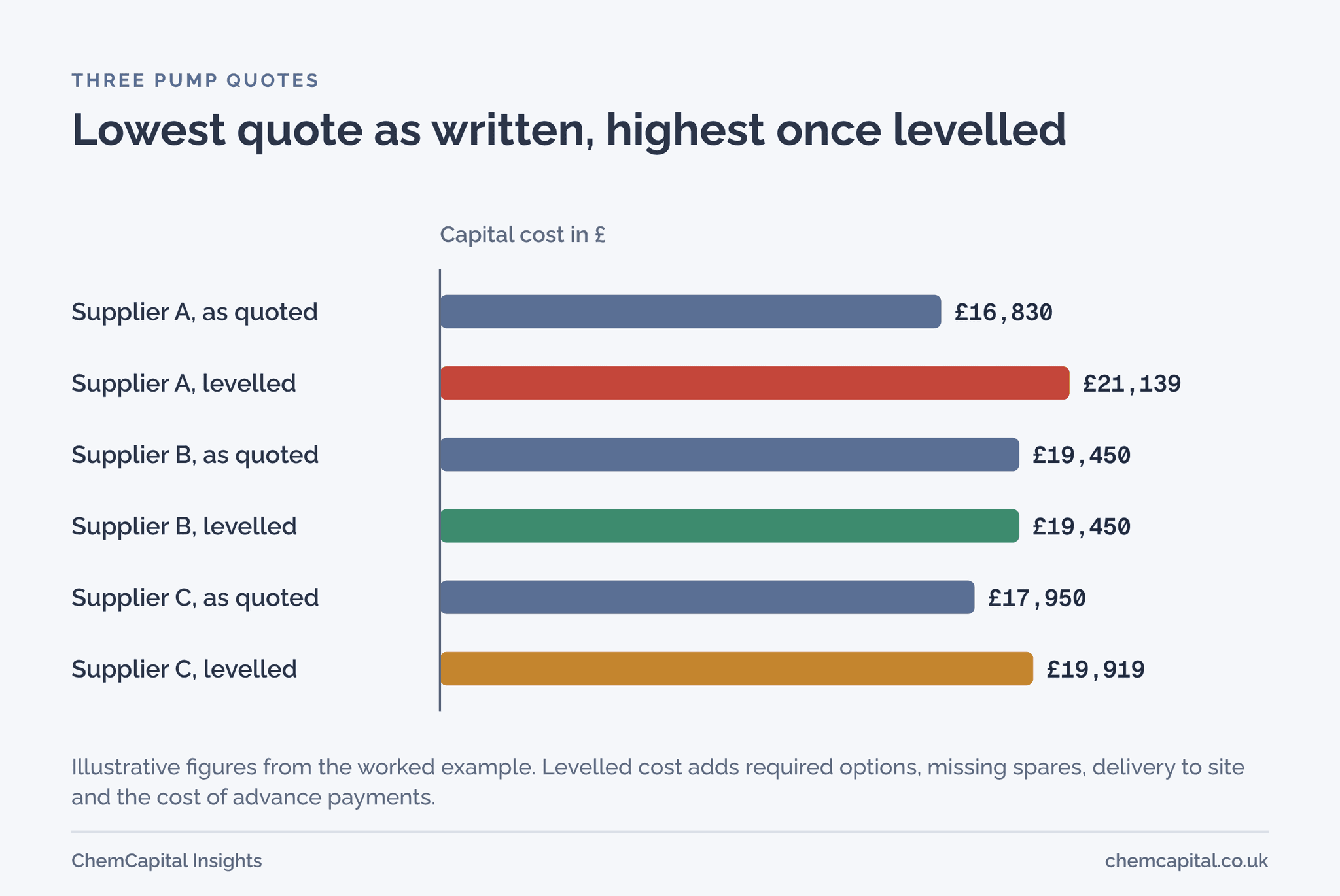
Levelling adds £4,309 to Supplier A, about 26% on its headline price, and moves it from cheapest to dearest on capital cost. Supplier C's extra 1.3 kW of absorbed power costs about £1,660 a year, which turns a £469 capital gap with B into £11,608 over ten years in present value terms.
Before award, clarify and record the answers: would A include spares, or C accept standard payment terms? Here neither would close the gap.
From spreadsheet to a decision you can defend
A spreadsheet works for one package. Across a dozen, with mixed currencies and revised quotes, every manual adjustment invites error.
ChemCapital's AI quotation comparison tool extracts price, lead time, materials, certifications and scope from uploaded quotes for you to check, and computes weighted scores with a rules based engine. Quotes with mandatory gaps, such as a missing required certification, are flagged and kept out of the ranking. It adds a plain English summary, and you make the decision. Try it on up to three quotes without signing up.
Ready to compare your next equipment package side by side? Start a free 14 day ChemCapital trial, with no credit card needed.
Frequently asked questions
What is a quotation comparison sheet?
It is a table with one column per supplier and one row per cost or requirement, used to compare quotes on the same basis. It is also called a bid tab or comparative statement, and for process equipment it should level scope, delivery, currency, payment terms and running cost before ranking.
How do you compare quotes with different Incoterms?
Bring every quote to the same delivery point, usually DAP at your site, by adding your forwarder's cost for each part of the journey the supplier has not covered. Under EXW the seller only makes the goods available at its premises, so loading, export clearance and transport fall to you.
Should the cheapest quote always win?
Only if it is still the cheapest after levelling and it passes every mandatory requirement. In our illustrative pump example, the lowest quoted price became the highest levelled capital cost once required options, missing spares, freight and advance payments were added.
How do you include energy cost when comparing pump quotes?
Take the absorbed power at your duty point from each data sheet, divide by motor efficiency, multiply by running hours and your electricity price, then convert to a present value over your evaluation period. The Hydraulic Institute, Europump and US Department of Energy guide notes that energy is often one of the largest lifecycle costs, particularly for pumps running more than 2,000 hours a year.
Continue reading
Informational only, not procurement or legal advice. Cited names, frameworks, and statistics belong to their respective owners.
Create and manage RFQs in minutes
ChemCapital handles the entire procurement cycle, from structured RFQs and supplier comparisons to formal purchase orders and delivery tracking.
Start for freeRelated articles
Where to Find Pharma and Chemical Plant Projects Before They Go to Tender: the 2027 Pipeline
Twenty pharma and chemical plant projects checked against owner or government announcements, the buying timeline on each, and where to watch for the next ones for free.
TEMA Heat Exchanger Types: How to Read AES, BEM and AEU
How to decode the three letter TEMA type, what AES, BEM, AEU and other common types mean for cleaning, expansion, leaks and cost, and how to compare bids that differ.
Safety Valve vs Relief Valve vs Bursting Disc: How to Choose
How safety valves, relief valves and bursting discs differ, when to fit a disc under a valve, the pressure terms that matter, GB duties and what to put in the RFQ.