
Technical Bid Evaluation for Process Equipment: Step by Step
A technical bid evaluation decides which bids meet your specification before prices are compared. The steps, who takes part, common mistakes and a pump example.

A technical bid evaluation (TBE) decides which bids meet your specification before anyone compares prices. Engineers check every bid against the datasheets and specifications, list each deviation and exclusion, close open questions in writing and finish with a list of technically acceptable bidders. Only those bids go on to the commercial evaluation, where price, delivery and terms are weighed.
Why this matters now
Bids for engineered equipment rarely match the enquiry line for line. One supplier offers a different material, another leaves out the seal system, a third answers half the datasheet. Open the prices first and the cheapest bid tends to look best, often because it offers the least.
UK public procurement law makes the same point. Under the Procurement Act 2023, a public contract can only go to a tender that both satisfies the buyer's requirements and is the best against the award criteria [1]. These are public procurement rules, but the logic holds for any buyer: acceptable first, best second.
Create and manage RFQs in minutes
ChemCapital handles the entire procurement cycle, from structured RFQs and supplier comparisons to formal purchase orders and delivery tracking.
Where the TBE sits
The TBE starts when bids arrive and ends before the commercial evaluation begins. Keep the two apart: ask for an unpriced technical offer with prices sent separately, or hide the price columns from the engineers.
The World Bank's two envelope process formalises this: price envelopes stay unopened in a secure place while the technical bids are evaluated, and only bidders that meet the technical requirements have their prices opened [2]. Scotland's public sector guidance, the Procurement Journey, adds that as good practice no evaluator should assess both the technical and the commercial elements [3].
Set the criteria before you open a bid
Fix the evaluation rules before the RFQ goes out, as our RFQ best practice guide recommends, and keep them once bids arrive. Cover three things:
- Mandatory requirements, judged pass or fail: duty point, materials, hazardous area rating, design codes, testing.
- Scored criteria, if you use them, with their weights: efficiency, maintainability, spares commonality, documentation.
- How the two combine: for example, lowest evaluated price among acceptable bids, or a weighted technical and commercial score with a minimum technical mark.
Buyers covered by the Act must state the relative importance of their criteria, and if failing a criterion disqualifies a tender, the assessment methodology must say so in advance [1]. Buyers outside the Act have more freedom, but the same discipline makes a result defensible. This is general information, not legal advice.
The TBE step by step
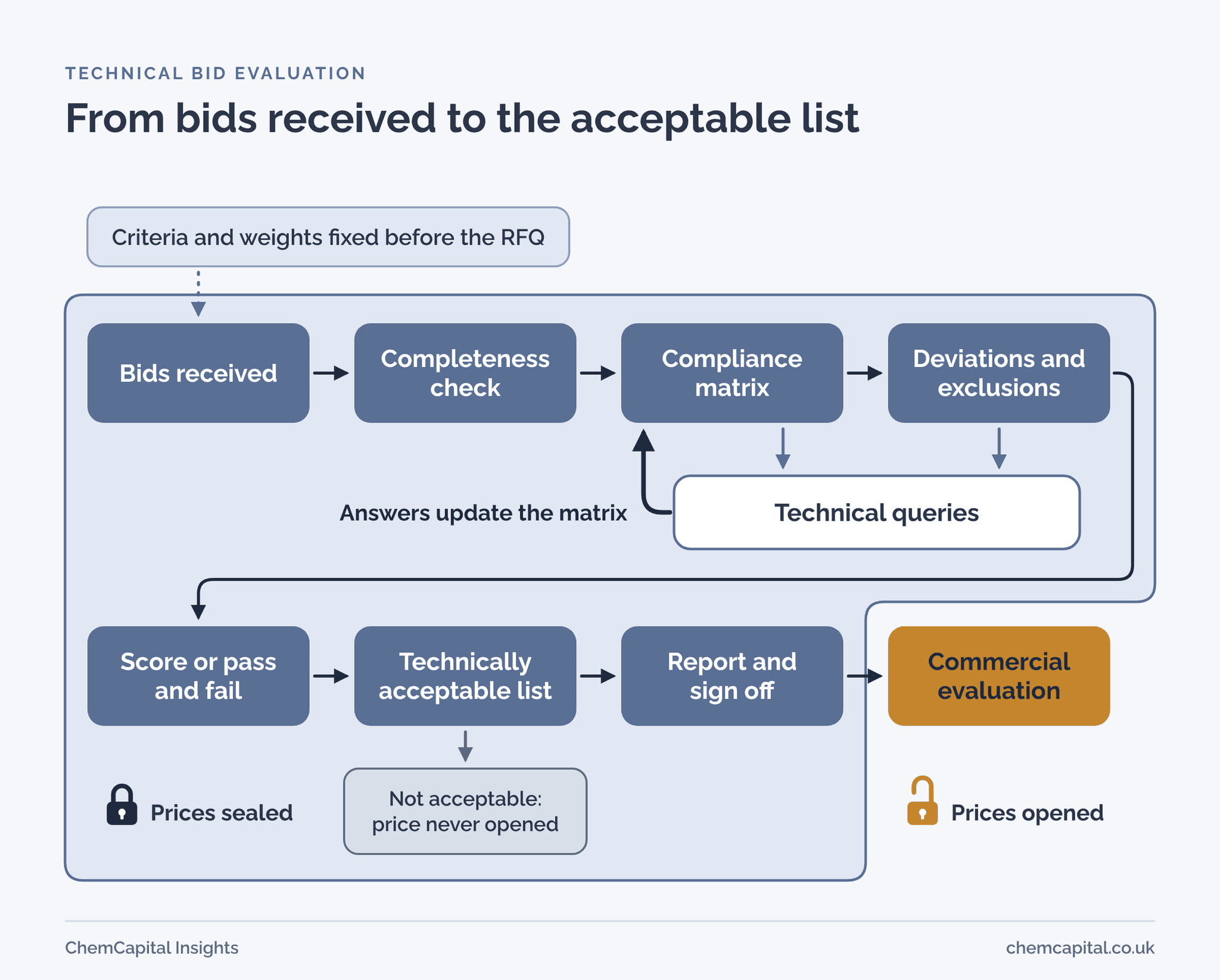
- Check completeness. Did each bidder return everything asked for: completed datasheets, drawings, performance curves, the inspection and test plan (ITP, the list of checks and who witnesses them) and a deviation list? Gaps become questions, not assumptions.
- Build the compliance matrix. This is the heart of any TBE template: one row per requirement from the datasheet and specification, one column per bid, and a status in each cell: complies, deviation, excluded or clarify. Judge what the bid says: Scottish guidance tells evaluators to read submissions at face value and not read between the lines [3].
- List deviations and exclusions. A deviation, or exception, is an offer that differs from what you asked for; an exclusion is scope the bid leaves out. The owning discipline accepts or rejects each deviation with a written reason, and alternatives are assessed one by one [4]. Exclusions go to the commercial team so prices can be brought to one scope.
- Raise technical queries. Ask in writing, with a deadline, and put the same question to every bidder it applies to. Scottish guidance says clarification explains a bid as submitted: it is no place to negotiate price or essential aspects, and every exchange must be recorded [5]. A query closes when the bidder answers in writing and the answer becomes part of the bid. An answer that changes the price or the equipment is a revised offer, not a clarification: give every bidder the same chance, or set it aside.
- Score, or pass and fail. Mandatory items pass or fail. For scored items, evaluators score independently, then agree final scores at a moderation meeting and record why [3].
- Issue the technically acceptable list. Each bid is acceptable, acceptable with recorded conditions, or not acceptable, with the reason. Only acceptable bids go forward.
- Report and sign off. Keep the criteria, matrix, query log, deviation decisions, scores and list in one report. CIPS expects a documented trail from start to finish, with each decision and its reason recorded and signed [4].
Who takes part
Procurement runs the process: timetable, bidder correspondence and query log. The technical assessment belongs to the technical members of the team, as CIPS advises [4]. In practice that means process, mechanical, materials, electrical and instrument engineers, each signing off their own rows. Quality assurance (QA) reviews the ITP, certificates and documents; health, safety and environment (HSE) checks hazardous area, noise and safety requirements.
Common mistakes
- Moving the criteria. Reweighting around one bidder's best feature turns an evaluation into a justification. Under the Act, a buyer may refine its criteria only in limited cases, and a refinement cannot add new ones [1].
- Scoring things you did not ask for. A clever extra may be worth having, but it is not in the criteria. Note it for the commercial discussion instead.
- Accepting "or equal" without evidence. Ask for proof. Even buyers covered by the Act, who must accept a true overseas equivalent to a UK standard they name, need not take a claimed one on trust and may ask for certification or test reports [6].
- Missing exclusions. They hide in notes, assumptions and standard terms, and a missed one leaves the commercial team comparing unlike scopes, as our budgetary versus firm quote guide shows.
Practical example
An EPC (engineering, procurement and construction) contractor is buying two centrifugal pumps, P201A/B, duty and standby, for a process stream containing chlorides. Three bids arrive, and prices stay sealed while the engineers build the matrix. The figures are illustrative.
| Requirement | Bid A | Bid B | Bid C |
|---|---|---|---|
| 40 m³/h at 55 m head | Complies | Complies | Complies |
| Duplex stainless wetted parts | Complies | Deviation: 316L | Complies |
| Dual seal and support system | Complies | Complies | Excluded: support system |
| Noise 85 dB(A) or less at 1 m | Clarify: not stated | Complies | Complies |
| Witnessed performance test | Complies | Complies | Complies |
Three technical queries go out, one for each open cell:
- Bid A gives 82 dB(A) at 1 m, from test data on the same pump size. Closed: complies.
- Bid B calls 316L suitable but, asked for evidence at the datasheet's chloride level, sends only a general brochure. The materials engineer, who specified duplex for this service, rejects the deviation.
- Bid C confirms the seal support system is outside its scope. Its seal meets the specification, so the bid stays acceptable and the exclusion goes to the commercial team.
| Bid | Result | Note for commercial |
|---|---|---|
| A | Acceptable | Noise answer now part of bid |
| B | Not acceptable | 316L deviation rejected |
| C | Acceptable with exclusion | Add seal support system |
Only now are prices opened, for A and C. In this example C quoted £2,500 less per pump than A, but an allowance of £2,900 per pump for the seal support system puts it £400 above. B's price is never opened: whatever it says, it is for a pump this service cannot use. The commercial comparison then follows our guide to comparing supplier quotations.
Line up the evidence before you rank
Building a compliance matrix by hand from three PDF quotations is slow work.
ChemCapital's AI Quotation Comparison takes up to three supplier quotations, extracts the price, lead time, materials, certifications and scope of each, and sets every offer side by side against your RFQ. As in a TBE, mandatory fails are flagged before anything is ranked, and the raw evidence stays attached to every extracted field. Scores across commercial, technical, delivery, compliance and risk follow your priorities, and your procurement and engineering teams own the final call.
Ready to rank only the bids that can do the job? Start a free 14 day ChemCapital trial, with no credit card needed.
Frequently asked questions
What is a technical bid evaluation?
A technical bid evaluation (TBE) checks each bid against the datasheets and specifications and decides which bids are technically acceptable. It runs after bids arrive and before prices are compared, so the commercial evaluation only ranks bids that can do the job.
What should a technical bid evaluation template include?
A compliance matrix with one row per requirement, one column per bid and a status in each cell: complies, deviation, excluded or clarify. Add the technical query log, the deviation decisions with reasons and a summary that lists each bid as acceptable or not, signed by each discipline.
What criteria are used in a technical bid evaluation?
Mandatory requirements from the datasheet and specification, such as duty point, materials, codes and testing, judged pass or fail. Some buyers add scored criteria such as efficiency or maintainability, with weights fixed before any bid is opened.
Continue reading
Informational only, not procurement or legal advice. Cited names, frameworks, and statistics belong to their respective owners.
Create and manage RFQs in minutes
ChemCapital handles the entire procurement cycle, from structured RFQs and supplier comparisons to formal purchase orders and delivery tracking.
Start for freeRelated articles

NPSH Explained: NPSHa vs NPSHr with a Worked Example
NPSHa is what your suction system gives a pump; NPSHr is what the pump needs. How to calculate NPSHa, what margin to ask for and how to check it on pump bids.

How to Read a P&ID: A Line by Line Guide for Engineers and Buyers
How to read a P&ID line by line: equipment tags, line numbers, valves and ISA instrument letters, and what a buyer takes from the drawing to build RFQs.

Control Valve Sizing: Kv and Cv Formula with a Worked Example
How to size a control valve for liquid: Kv and Cv defined, the sizing equation in metric and US units, choked flow checks, the datasheet a vendor needs and a worked example.