
Plate vs Shell and Tube Heat Exchanger: A Buyer's Comparison
When a plate heat exchanger beats shell and tube, and when it does not: limits by type, close approach, fouling, gaskets, UK rules, the RFQ datasheet and a worked bid example.
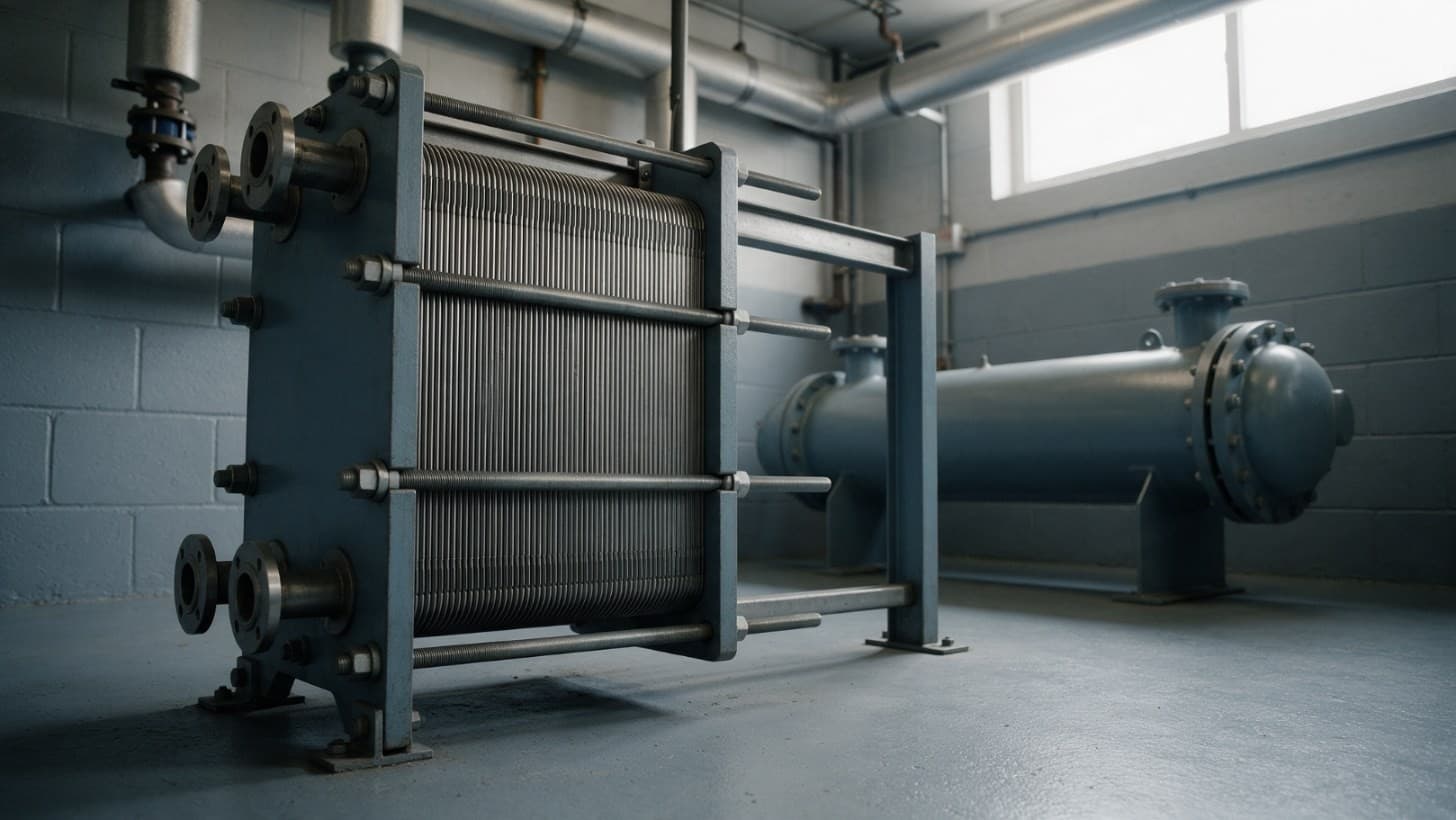
For most clean liquid to liquid duties at moderate pressure and temperature, a gasketed plate heat exchanger is the smaller, cheaper and more efficient choice. Corrugated plates give high heat transfer coefficients, counterflow allows a very close temperature approach, and capacity can be changed later by adding or removing plates [1]. Shell and tube is usually the safer choice when pressure or temperature exceeds what gaskets allow, or when a fluid carries solids or fouls heavily. Brazed and welded plate units sit in between: they have no elastomer gaskets, nickel brazed and welded designs run hotter and welded ones at higher pressure, but brazed units cannot be opened.
So the RFQ (request for quotation) must give both types the same information.
Why this matters now
An enquiry that states only the duty often brings back both types at very different prices. In the illustrative example below, the plate bid is less than half the price of the shell and tube bid. The gap is real, but it hides differences in fouling margin, gasket life, cleaning and spares, so price alone cannot rank them.
Join ChemCapital to streamline sourcing and connect with verified partners
Whether you're buying or supplying, ChemCapital gives you the tools to manage the complete procurement cycle in one platform.
Pressure and temperature limits by type
Limits vary by model, so check the data sheet for the model offered.
| Type | Sealing | Limits stated by the manufacturer | Cleaning |
|---|---|---|---|
| Gasketed plate | Elastomer gasket on each plate | Alfa Laval: generally minus 25 °C to 200 °C, up to about 25 bar, depending on model and gasket [1]. Kelvion NP series: up to 33 bar(g) design pressure [3] | Frame opens; plates cleaned without specialist tools [1] |
| Semi welded plate | Laser welded channels one side, gaskets the other | Kelvion HPL: up to 64 bar(g) design pressure on the welded side [3] | Gasketed side opens for cleaning (Kelvion LWC) [3] |
| Brazed plate | Stainless plates vacuum brazed with copper or nickel based filler | SWEP: standard maximum operating pressure 31 bar; 185 °C copper brazed, 350 °C nickel based [4] | Cannot be opened; cleaned in place |
| Welded plate (Alfa Laval Compabloc) | Plates laser welded end to end | Full vacuum to 42 barg; minus 100 °C to 400 °C [5] | Side panels removed for mechanical cleaning [5] |
| Shell and tube | Tubes fixed in tubesheets | Set by the pressure vessel code, materials and head type | Depends on the TEMA type |
SWEP notes that its pressure and temperature ratings are linked, and that ammonia needs nickel brazed units [4].
Heat transfer, footprint and close approach
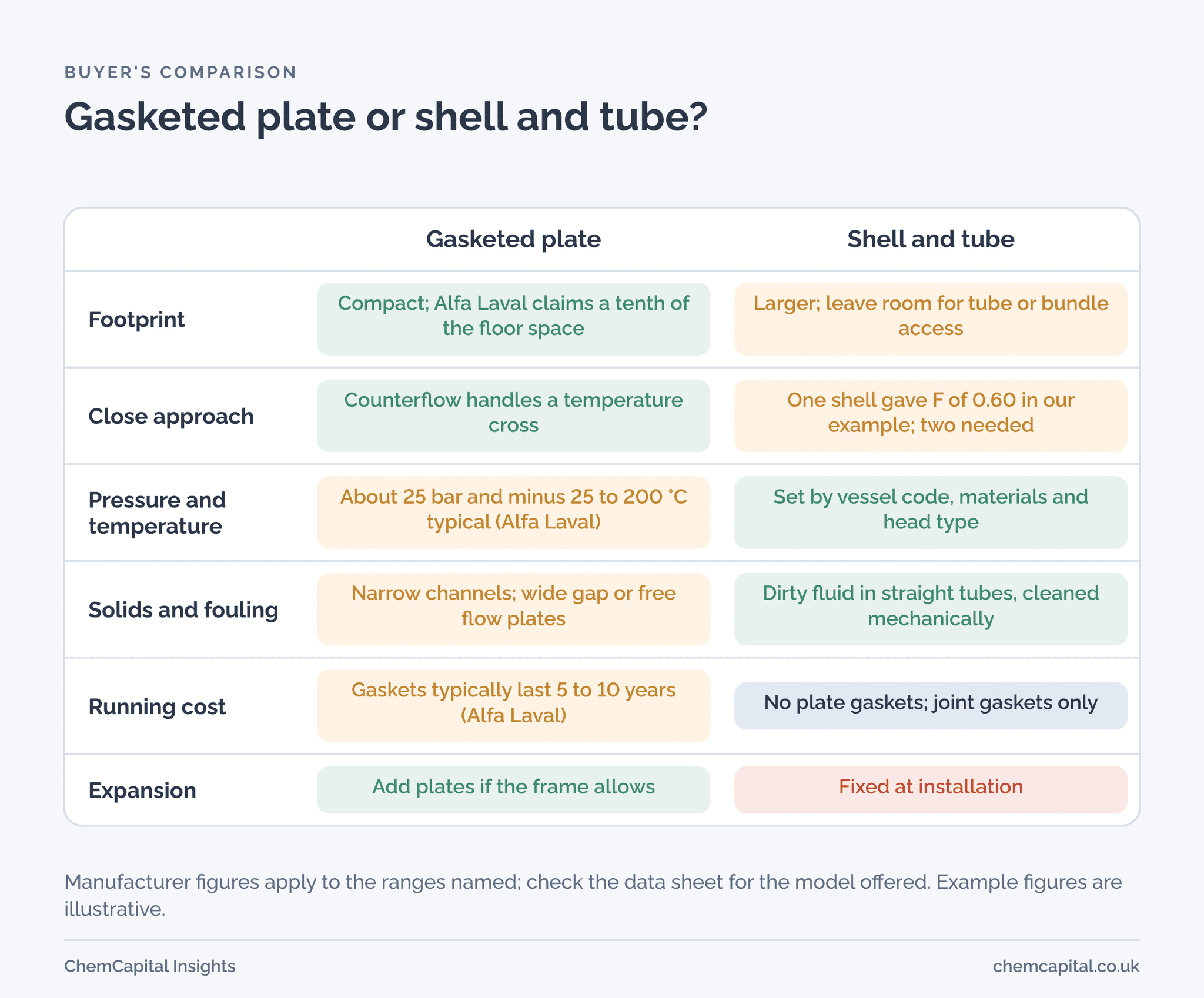
Corrugated plates make the flow highly turbulent, giving high heat transfer coefficients and some self cleaning, at the price of pressure drop [1]. Alfa Laval states its gasketed units achieve up to five times the heat transfer per unit area of shell and tube equivalents [1], and claims a tenth of the floor space, under a sixteenth of the weight and approaches as close as 1 °F, about 0.6 K [2]. Treat these as best case manufacturer figures.
The approach temperature is the gap between one stream's outlet and the other's inlet at the same end. Plates normally run in counterflow [1], so they can handle a temperature cross, where the hot stream leaves cooler than the cold stream leaves. A shell and tube with one shell pass and two tube passes is only partly counterflow, and its LMTD correction factor F, which scales down the log mean temperature difference, falls fast as a cross develops. NPTEL's design course says F should normally stay above 0.75, with more passes if it does not [6]. For a cross, that means more shell passes, such as shells in series, because extra tube passes alone do not help.
Fouling, solids and two phase duties
Narrow channels are the plate unit's main limit: fibres and coarse particles can bridge the inlet. For such fluids Alfa Laval offers wide gap plates [1] and Kelvion a free flow series [3].
Shell and tube tolerates heavy fouling better because the dirty fluid can go in straight tubes that are cleaned mechanically. Mechanical cleaning of the shell side depends on the construction, as our guide to TEMA heat exchanger types explains.
Plates can condense and evaporate: Kelvion lists both among its applications [3], and Alfa Laval offers Compabloc as a condenser and reboiler [5]. All the vapour has to pass through the plate ports, so for large vapour flows ask each bidder for the pressure drop at full load.
Gaskets, maintenance access and expansion
Gaskets are the plate unit's running cost. Alfa Laval says they typically last 5 to 10 years in normal service, and far less if the chemistry is harsh, the unit cycles hot and cold often, or it runs beyond its design conditions [1]. Each gasket must be compatible with the fluid it seals at the working temperature and pressure [1], including any CIP (clean in place) chemicals. Where the fluids must never mix, both makers offer double wall plates [1, 3]. Each gasket is also a leak path to atmosphere, so for hot, flammable or toxic fluids ask how a leak is contained, for example by a spray shield, or consider a welded design.
Access is the plate unit's strength: plates come out, are cleaned and swapped with ordinary tools, and no tube bundle has to be withdrawn [1, 2]. Capacity can be added by hanging more plates in the existing frame, whereas a shell and tube's capacity is fixed at installation [2].
UK rules: PE(S)R and PSSR
New equipment of either type with a maximum allowable pressure (PS) above 0.5 bar is covered by the Pressure Equipment (Safety) Regulations 2016. Above the lowest hazard thresholds it must carry the UKCA or CE mark, by self declaration or approved or notified body assessment depending on its category, with safety information in English. Small, low hazard units are built to sound engineering practice and must not carry either mark [9], so ask each bidder which category applies.
In use, the Pressure Systems Safety Regulations 2000 (PSSR) cover systems containing a relevant fluid: steam, a gas above 0.5 bar above atmospheric, or a liquid above that pressure whose vapour pressure would exceed 0.5 bar above atmospheric at its actual temperature or at 17.5 °C [7]. A steam heated exchanger will usually be in scope; a water cooler running well below boiling may not be. Where PSSR applies, the user needs a written scheme of examination, prepared or certified by a competent person, setting out what is examined and how often, including protective devices, each pressure vessel and any pipework whose failure could be dangerous [8]. Ask early what examination each type needs and price the spares it implies. This is general information, not legal advice.
What to put in the RFQ datasheet
Give every bidder, for either type:
- flows, temperatures and fluid properties on both sides, with any phase change
- allowable pressure drop on each side
- design pressure and temperature per side, design code and marking
- one fouling basis: fouling resistances or a percentage of extra surface
- materials for plates or tubes and seals, and the cleaning chemicals they meet
- solids content and maximum particle size
- cleaning method and maintenance space
- spares to price, such as a gasket set
Also ask for the TEMA type, or the plate type, gasket material and the frame's maximum plate count.
Practical example
Take an illustrative duty: cool 10 kg/s of a water based product (specific heat 4.0 kJ/kg K) from 80 °C to 35 °C, with cooling water entering at 25 °C and leaving at 40 °C.
- Heat duty: 10 × 4.0 × 45 K = 1,800 kW, needing 1,800 ÷ (4.18 × 15) = 28.7 kg/s of cooling water.
- End temperature differences: 40 K at the hot end (80 °C against 40 °C) and 10 K at the cold end (35 °C against 25 °C).
- Counterflow LMTD: 30 ÷ ln(4) = 21.6 K.
The product leaves 5 K below the cooling water outlet, a temperature cross. With one shell pass and two tube passes, F works out at 0.60, below the 0.75 guideline [6]; two such shells in series give 0.935.
| Item | Bid A: gasketed plate | Bid B: shell and tube |
|---|---|---|
| Arrangement | One plate pack, counterflow | Two shells in series |
| Correction factor F | 1.00, assumed | 0.935 |
| Service U (illustrative) | 4,000 W/m²K | 1,100 W/m²K |
| Area needed, Q ÷ (U × F × LMTD) | 20.8 m² | 81.0 m² |
| Area offered, 10% margin | 22.9 m² | 89.1 m² |
| Price ex works (illustrative) | £21,500 | £48,000 |
| Spare gasket set (illustrative) | £3,900 | Not applicable |
| Price plus gasket sets over 10 years | £25,400 (one set) to £29,300 (two) | £48,000 |
Bid B is not overpriced: its lower U and the cross need about four times the area, in two shells. Bid A stays cheaper even with two gasket changes, before fitting labour. Before awarding, check both used the same fouling basis, pressure drops are within limits, and the frame can take more plates. If the cooling water carried silt or fibres, the balance could shift towards Bid B.
Compare the bids on the same basis
Once both bids answer the same datasheet, AI Quotation Comparison puts them side by side on commercial, technical, delivery, compliance and risk. AI extracts price, lead time, materials, certifications and scope from each quote for you to review, and a quote with a mandatory gap is flagged and kept out of the ranking. You make the decision, and you can try it free with up to three quotes without signing up.
Ready to compare plate and shell and tube bids on equal terms? Start free with ChemCapital.
Frequently asked questions
Is a plate heat exchanger better than shell and tube?
For clean liquid to liquid duties at moderate pressure and temperature, a gasketed plate unit is usually smaller, cheaper and allows a closer temperature approach. Shell and tube is usually preferred above gasket pressure and temperature limits, and for heavily fouling or solids laden fluids.
What is the maximum pressure for a plate heat exchanger?
It depends on the type and model. Alfa Laval says gasketed units generally suit up to about 25 bar and minus 25 °C to 200 °C, Kelvion lists a gasketed series at up to 33 bar(g), SWEP rates its standard brazed units at 31 bar and Alfa Laval's welded Compabloc goes to 42 barg, so check the data sheet for the model offered.
How often do plate heat exchanger gaskets need replacing?
Alfa Laval says gaskets typically last 5 to 10 years under normal operating conditions. Harsh cleaning or process chemicals, frequent heating and cooling cycles, or running beyond the design conditions will wear them out much sooner, so price a spare gasket set with the bid.
Can a shell and tube heat exchanger handle a temperature cross?
Only to a limited extent in one shell with two tube passes, because the LMTD correction factor F falls quickly; NPTEL's design course advises keeping F above 0.75. The usual remedy is more shell passes, such as two shells in series: in our illustrative example one shell gave 0.60 and two gave 0.935, while a counterflow plate unit handled the cross in one pack.
Continue reading
Informational only, not procurement or legal advice. Cited names, frameworks, and statistics belong to their respective owners.
Join ChemCapital to streamline sourcing and connect with verified partners
Whether you're buying or supplying, ChemCapital gives you the tools to manage the complete procurement cycle in one platform.
Get started freeRelated articles
Where to Find Pharma and Chemical Plant Projects Before They Go to Tender: the 2027 Pipeline
Twenty pharma and chemical plant projects checked against owner or government announcements, the buying timeline on each, and where to watch for the next ones for free.
TEMA Heat Exchanger Types: How to Read AES, BEM and AEU
How to decode the three letter TEMA type, what AES, BEM, AEU and other common types mean for cleaning, expansion, leaks and cost, and how to compare bids that differ.
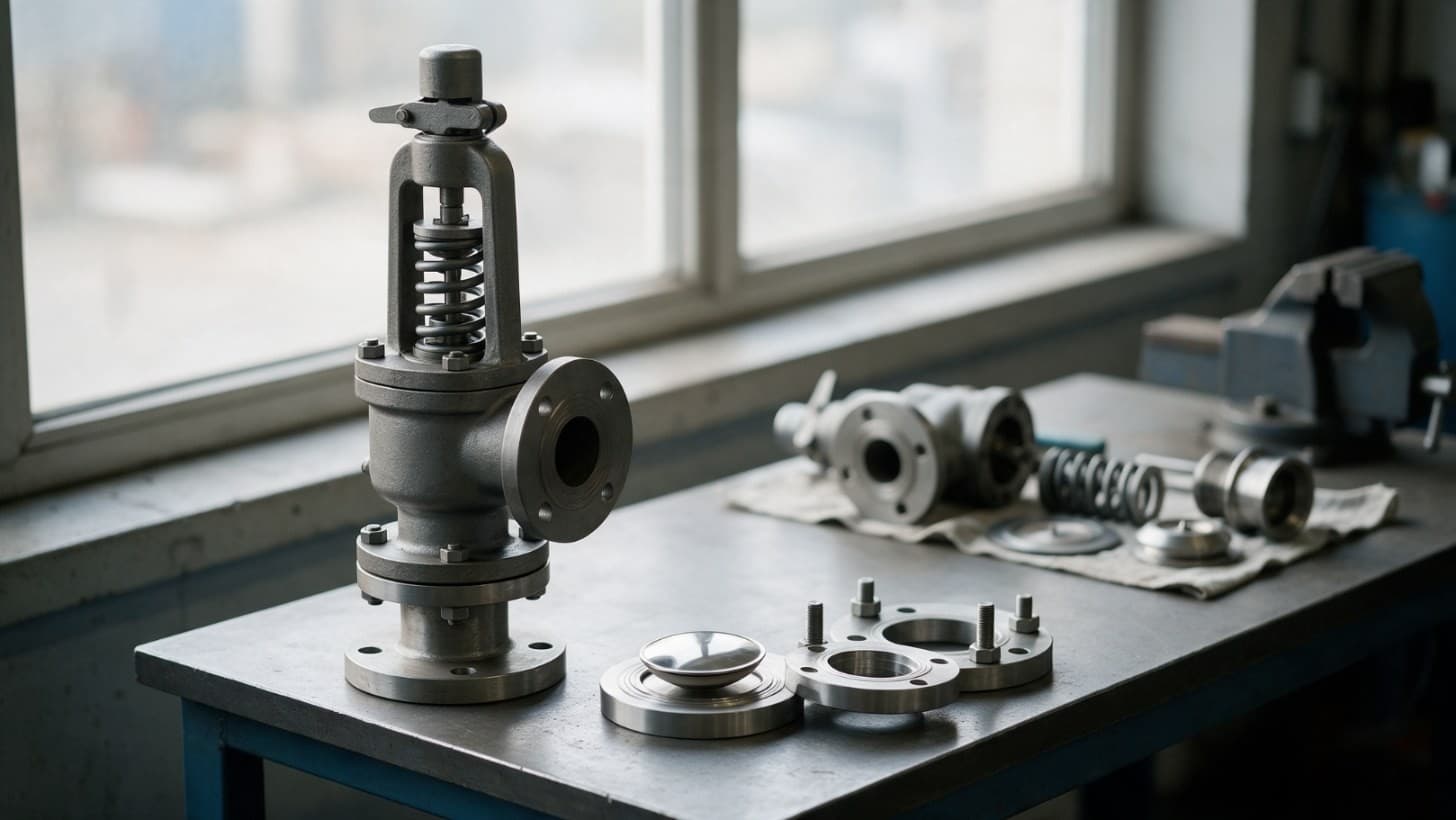
Safety Valve vs Relief Valve vs Bursting Disc: How to Choose
How safety valves, relief valves and bursting discs differ, when to fit a disc under a valve, the pressure terms that matter, GB duties and what to put in the RFQ.