
RFQ vs RFP vs RFI: Which to Send for Engineered Equipment
RFI, RFP or RFQ? When each fits an engineered equipment purchase, what each must contain, how they are evaluated, and how to use them in sequence, with a worked example.
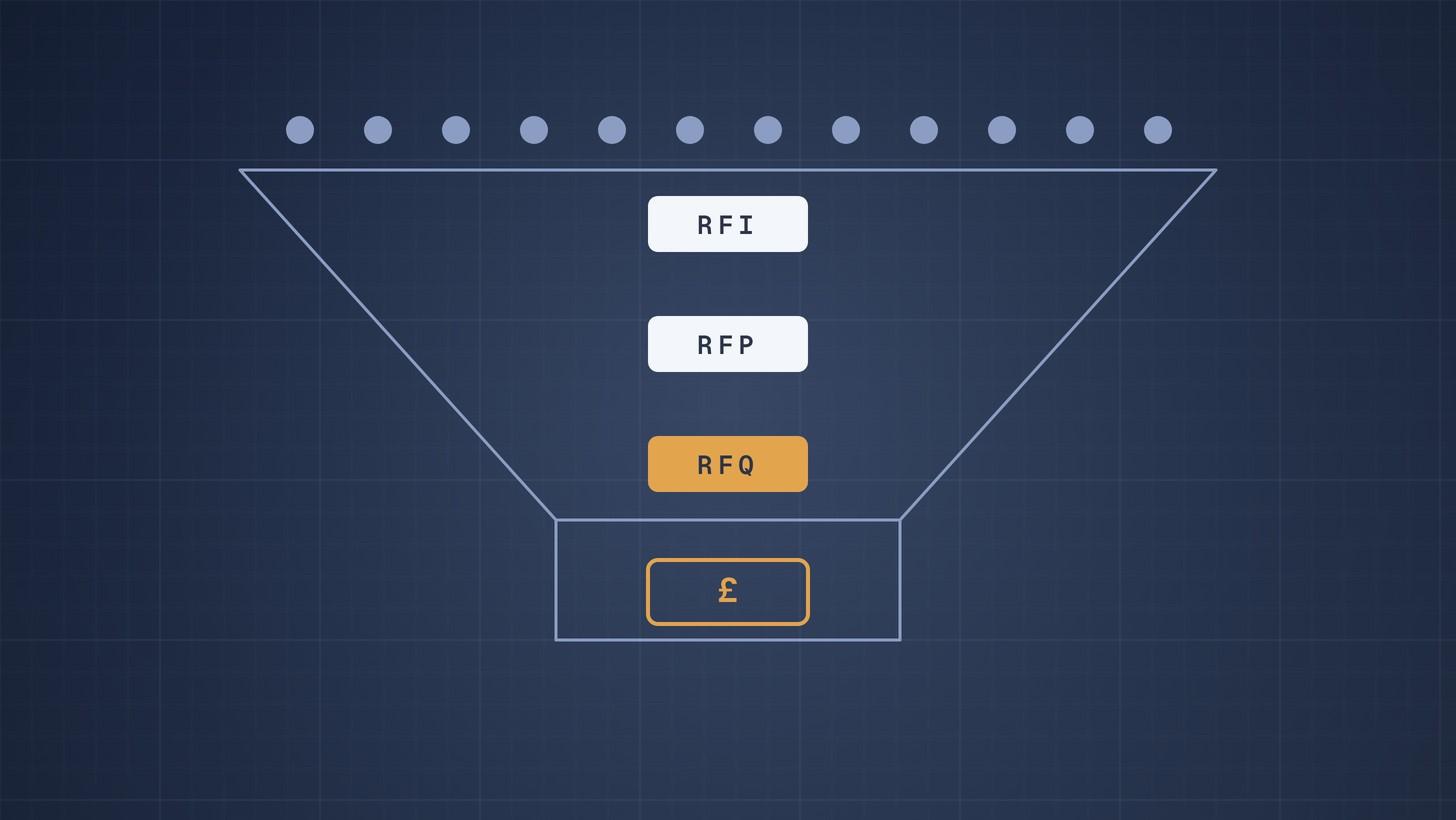
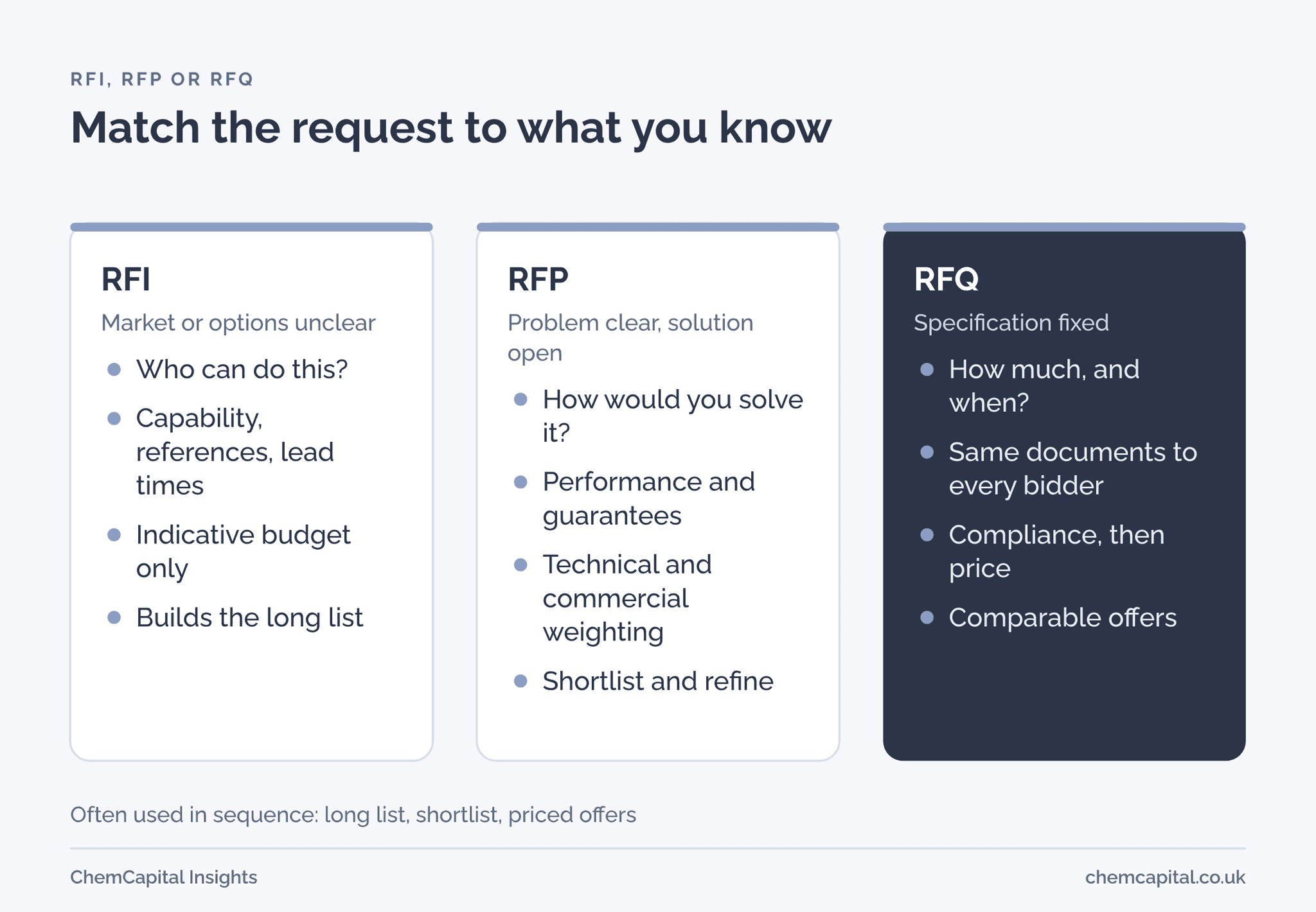
Send an RFI when you do not yet know who can supply or what the options are; it gathers information and commits nobody. Send an RFP when you know the problem but want suppliers to propose the solution, as with an engineered package that must meet a performance duty. Send an RFQ when the specification is fixed and you want comparable prices, as with standard valves, pumps to a data sheet or bulk pipework. Many equipment purchases use two or three in sequence.
The three in one table
| RFI | RFP | RFQ | |
|---|---|---|---|
| Question it asks | Who can do this, and how? | How would you solve this? | How much, and when? |
| What you know | The need, roughly | The problem and the performance you need | The exact specification |
| What suppliers send | Capabilities, references, approach, indicative cost | A technical and commercial proposal | A priced, compliant offer |
| Binding? | No | Proposal, often refined by negotiation | Offer against a fixed scope |
| How you evaluate | Shortlist by capability | Technical and commercial, weighted | Price and delivery, after compliance |
| Equipment example | Who can make a 10 m³ glass lined reactor? | A wastewater treatment package to meet a discharge consent | Ten DN50 ball valves to a valve data sheet |
The definitions follow common practice: an RFI gathers market information and builds a long list, an RFP asks for a solution to a defined problem, and an RFQ asks for prices for a clearly specified item [1].
Create and manage RFQs in minutes
ChemCapital handles the entire procurement cycle, from structured RFQs and supplier comparisons to formal purchase orders and delivery tracking.
When to send an RFI
Use an RFI early, when the market is unfamiliar or your requirement is still forming. Ask about capability, capacity, standards, references, typical lead times and rough budget prices. Simple System's guide describes the RFI's goal as gaining an overview of the market rather than a binding offer [1]. Projectmaterials notes that an optional RFI can gather supplier capabilities, lead times and stock, and help define scope, before the formal enquiry [2].
Public buyers in the UK have a formal version. Under the Procurement Act 2023, preliminary market engagement before a tender notice can be used, among other things, to develop requirements and identify capable suppliers; authorities must make sure participating suppliers are not unfairly advantaged, and publishing a preliminary market engagement notice "should be standard practice" [3].
Our RFI template for equipment suppliers gives the questions to ask.
When to send an RFP
Use an RFP when bidders may legitimately offer different solutions. In process plant that usually means engineered packages: a CIP skid sized by the supplier, a water treatment system guaranteed to a performance, a dust extraction system, or design and supply of a complete unit. Iowa State University's procurement guidance puts it simply: request proposals if you are uncertain whether an item or system is available, define the performance you need, and let suppliers propose [4].
An RFP needs a clear statement of the problem, the performance and guarantees required, constraints such as space, utilities and standards, the information you want back, and the evaluation criteria. Evaluation weighs technical merit heavily; Projectmaterials puts it at roughly 40 to 60% technical and 40 to 60% commercial, with 2 to 4 clarification rounds and a 6 to 12 week cycle [2].
When to send an RFQ
Use an RFQ when you can describe exactly what you want and expect every compliant offer to be interchangeable. The RFQ sends the same specification to every supplier, so quotes can be compared directly [1]. Tacto lists what goes in: detailed requirements and quantities, delivery dates, quality criteria, technical specifications, commercial and delivery terms, evaluation criteria and legal provisions [5]. Projectmaterials gives a typical cycle of 3 to 5 weeks, with price carrying roughly 60 to 70% of the weight [2].
Our RFQ template for process equipment has a structure you can copy.
Using them in sequence
For a new engineered package, a common path is RFI to build a long list, RFP to a shortlist, then a final priced round with the best two or three [1]. For a standard item from known suppliers, an RFQ alone is enough. Projectmaterials suggests splitting large projects so commodity materials go out as RFQs and engineered items as RFPs, in parallel, to shorten the overall cycle [2].
Other names you will meet
The labels vary by company and sector. An invitation to tender (ITT) or invitation to bid (ITB) usually works like an RFQ or an RFP with formal rules on submission and evaluation. An expression of interest (EOI) or prequalification questionnaire plays the role of an RFI with a qualification check attached. What matters is not the label but what the document asks for: information, a proposal or a price. Read the instructions to bidders to see which one you are dealing with.
Common mistakes
- Sending an RFQ for a solution. Projectmaterials warns that issuing an RFQ for a complex scope produces incomplete responses [2]. If bidders must design, ask for proposals.
- Sending an RFP for a commodity. Asking for proposals on standard valves invites variety you then have to normalise.
- Treating RFI answers as prices. Budget figures from an RFI are indicative; see our guide to budgetary versus firm quotes.
- Changing the specification mid RFQ without issuing a revision to every bidder.
Practical example
Illustrative. A site needs a new solvent recovery unit and the pumps and valves around it.
| Step | Document | To whom | Outcome |
|---|---|---|---|
| 1 | RFI on capability and references for solvent recovery units | 9 suppliers found through searches and contacts | Long list of 5 with relevant references |
| 2 | RFP with feed composition, recovery and purity guarantees, utilities | 5 suppliers | 3 credible proposals; 2 shortlisted |
| 3 | Final priced round on the agreed design | 2 suppliers | One award |
| In parallel | RFQ for transfer pumps and valves to data sheets | 4 suppliers each | Priced, comparable offers |
If you are the supplier
Answer the document you were sent, not the one you wish you had. An RFI rewards clear capability statements and relevant references; a long brochure does not help. An RFP rewards a solution explained in the buyer's terms, with the guarantees and assumptions spelled out. An RFQ rewards strict compliance and a price schedule that lines up with the buyer's items. If you think the buyer has chosen the wrong route, for example an RFQ that cannot be priced without design work, say so in a clarification before the deadline, not in your offer.
Where ChemCapital fits
ChemCapital's Supplier Discovery helps you build the long list an RFI needs, and AI quotation comparison lines up the offers that come back from RFQs and priced proposals.
Ready to send the right request to the right suppliers? Start a free 14 day ChemCapital trial, with no credit card needed.
Frequently asked questions
What is the difference between an RFQ, an RFP and an RFI?
An RFI gathers information about suppliers and options without commitment. An RFP asks suppliers to propose a solution to a defined problem. An RFQ asks for prices against a fixed specification so offers can be compared directly.
When should I use an RFP instead of an RFQ for equipment?
When bidders may legitimately offer different designs, such as engineered packages sized to a performance duty. Use an RFQ when the specification is fixed and offers should be interchangeable.
Is an RFI binding?
No. An RFI gathers market information and builds a long list; any prices given are indicative.
Can I use RFI, RFP and RFQ together?
Yes. A common path is an RFI to build a long list, an RFP to a shortlist and a final priced round, with standard items sent out as RFQs in parallel.
Continue reading
Informational only, not procurement or legal advice. Cited names, frameworks, and statistics belong to their respective owners.
Create and manage RFQs in minutes
ChemCapital handles the entire procurement cycle, from structured RFQs and supplier comparisons to formal purchase orders and delivery tracking.
Start for freeRelated articles
How to Ask for Feedback on a Lost Equipment Tender (With Email Template)
How equipment suppliers should ask for a debrief after losing a bid: when to ask, what to ask, what buyers can and cannot share, and how to use the answers. Includes a short email template.
Bid or No Bid? A Scorecard for Engineered Equipment RFQs
A simple bid or no bid scorecard for equipment suppliers: the gates to check first, seven weighted criteria, a worked example and a template you can copy.
Equipment Quotation Template: A Proposal Buyers Can Compare
A ten section quotation template for engineered equipment suppliers: cover letter, scope and battery limits, compliance and deviations, price schedule, delivery, commercial terms, exclusions and documents.