
Saipem Vendor Qualification: The SupplHi Platform, the Mandatory Carbon Questionnaire and Saipem7
How to qualify as a Saipem vendor: the SupplHi platform, what qualification checks, the compulsory Open es and Carbon Tracker steps, the delivery lessons Saipem gave its suppliers, and what the Subsea7 merger changes.
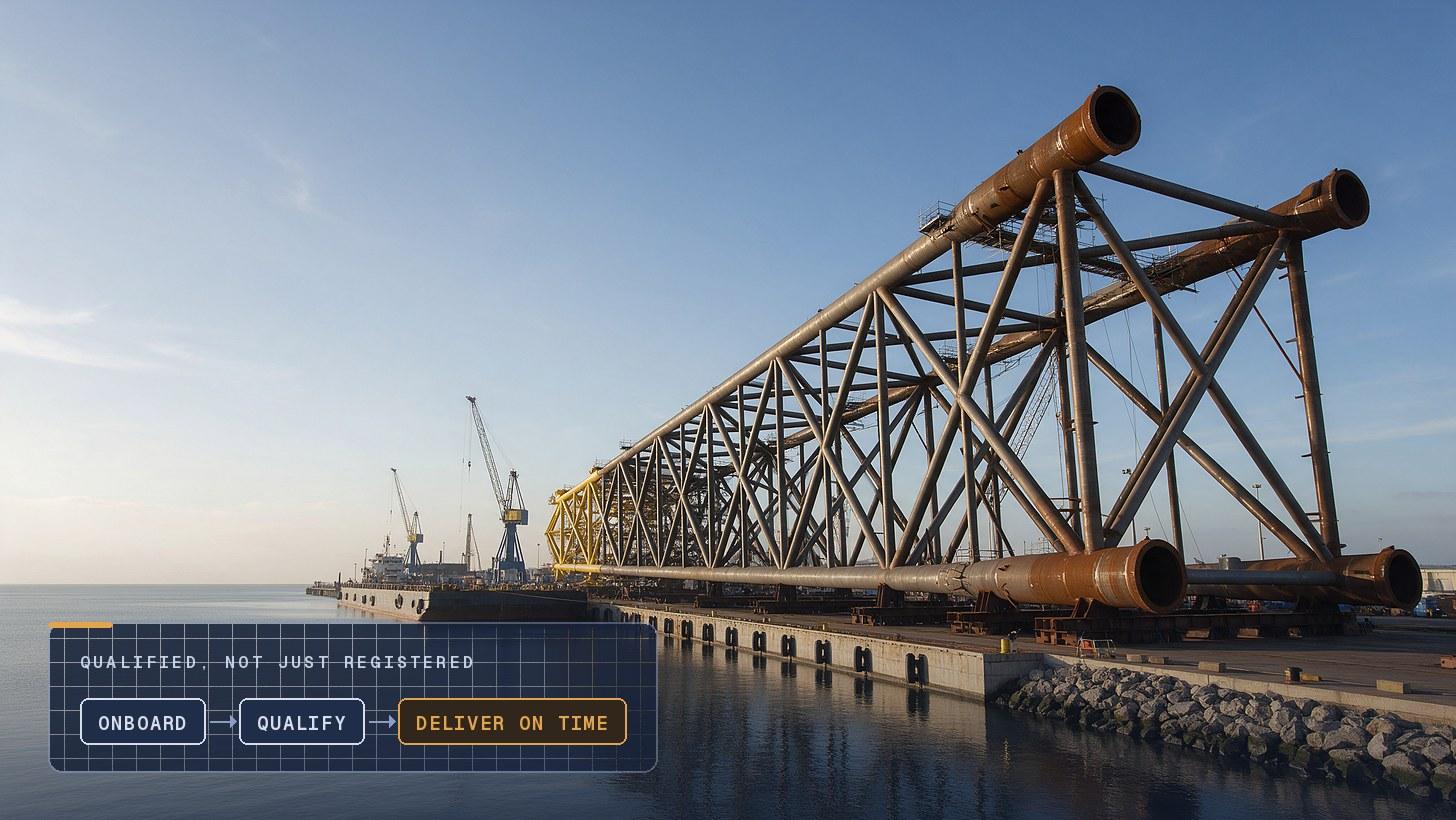
To become a Saipem vendor you are qualified, not just registered. Saipem says all its vendors must go through a qualification process to register on its platform, and it now runs vendor qualification management on the SupplHi platform linked from its own website [1]. Qualification checks technical and management capability, HSE compliance, financial, reputational and ethical reliability and sustainability management [2], and registration on Open es and Saipem's carbon questionnaire are compulsory parts of it [3]. Saipem reports almost 20,000 registered vendors across 1,758 product and service categories [2].
ChemCapital is not affiliated with Saipem or Subsea7. Qualification with Saipem happens only through its own platform and contacts, described below, and Saipem says it never asks for fees during supplier scouting or onboarding. Checked on 24 November 2026.
Qualification now runs through the SupplHi platform
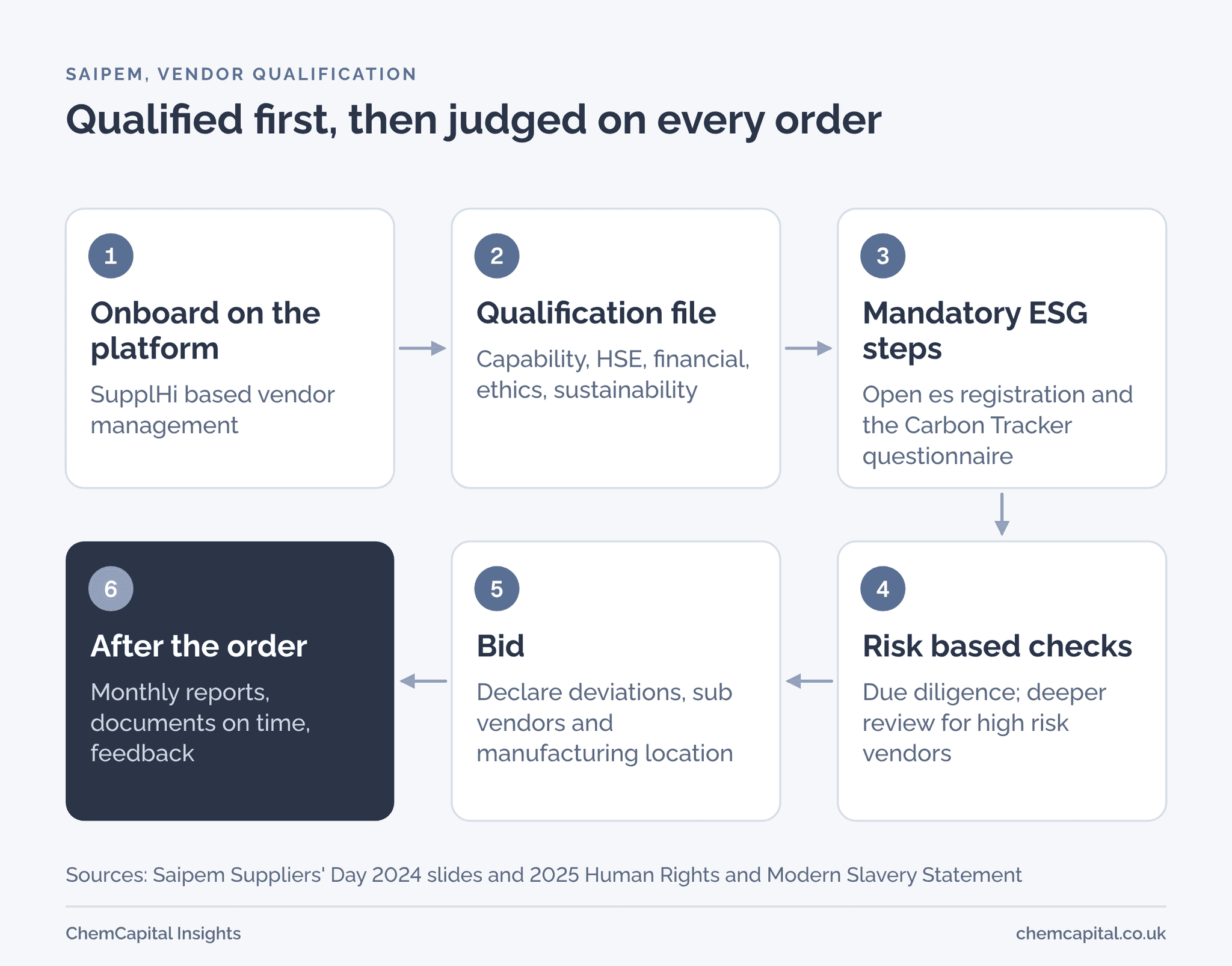
At its Suppliers' Day in November 2024, Saipem told vendors it had adopted SupplHi, a cloud based platform covering onboarding, assessment and vendor management, and its advice was direct: make sure you are onboarded on the platform [3]. Its sustainability pages now link vendor qualification management to the same platform [1], and vendor management questions go to vendor.management@saipem.com [3]. If you have a bookmark for an older Saipem qualification site, start again from the link on Saipem's own pages.
The volumes behind it are large. Saipem's Suppliers' Day slides gave about 12.7 billion euros purchased in 2024, about 40,000 purchasing documents, about 7,000 vendor qualification processes and about 3,400 vendor due diligence checks [3]. Its 2025 human rights statement reports 13.5 billion euros of goods and services ordered in 2025, 69 percent of it from local vendors [2].
Saipem qualification takes time and covers one buyer. List your products free on ChemCapital and say what you can certify, so other buyers can filter for it and invite you to quote.
What Saipem's qualification checks, and how deep it goes
| Area | What Saipem assesses | Source |
|---|---|---|
| Capability | Technical and management capability | [2] |
| HSE | Compliance; vendors at high HSE risk get an in depth review of management and performance documents | [2] |
| Financial, reputational and ethical | Reliability, with vendor due diligence on anti corruption, illegal conduct, human rights and reputation at qualification, contract award or periodic review | [2] |
| Sustainability | Sustainability management; Open es registration, the Carbon Tracker core questionnaire and a Saipem ESG questionnaire are mandatory in qualification | [3] [2] |
How deep the checks go depends on risk. Saipem sets each vendor's sustainability risk from its country, its sector and how critical the supply is, and high risk vendors get a more detailed assessment [2]. In 2025 it prepared 8,754 vendor due diligence reports, 3,166 of them for qualification [2]. A maker of critical rotating equipment from a high risk country should expect a heavier file than a distributor of standard fittings from a low risk one. Our guide to preparing for a customer quality audit covers the visit if one follows.
The carbon questionnaire is free, and it is compulsory
Two sustainability steps catch new vendors out because they sit inside qualification, not after it [3]:
- Open es. Registration is compulsory in qualification. Saipem joined the platform in 2021 and says more than 4,000 of its vendors are on it [1].
- Carbon Tracker. The core questionnaire is mandatory in qualification. Saipem describes it as a free tool that measures a vendor's greenhouse gas emissions to ISO 14064 part 1 and the GHG Protocol, validated by Bureau Veritas, with data you collect once and can reuse for other customers [3].
Saipem also told vendors it is adding minimum green requirements to bids for key commodities [3], and it is working towards interim Scope 3 targets under its 2025 to 2028 sustainability plan [1]. If you have never measured your emissions, the Carbon Tracker is a cheap way to start, and the figures will be asked for again by other customers.
Saipem told its suppliers what goes wrong after the order
Saipem's 2024 Suppliers' Day was unusually frank about delivery [3]. On its Saudi projects, the average weighted delay was 156 days, about 5.2 months, on a 16 month delivery. The lessons it drew for vendors were practical:
- Deviations declared too late. Declare deviations, including from the client's approved vendor list, and any change of manufacturing location at bid stage, because changes after award cause delays.
- Sub vendor lists missing. Send a clear and complete sub vendor list promptly after the purchase order.
- Progress reports late. Submit monthly progress reports on time, as the contract requires.
- Problems raised too late. Report delays early enough for a recovery plan to work.
- Documents late. Late vendor documents hold up Saipem's own design work, from plot plans to structural design.
- Inspections unplanned. Plan inspections carefully.
The first lesson points to a wider rule. On engineering, procurement and construction projects the client's approved vendor list can decide which makers Saipem may use, whatever Saipem's own qualification says. Our guide to EPC contractor vendor registration explains how the two lists work together.
Saipem owned its side too: it acknowledged supplier cash flow problems, payment backlogs and slow document approvals and deviation resolutions, and pledged to address them [3]. It also forecast about 63 billion euros of spend on key commodities over the following three years, about 20 billion on materials and 43 billion on services, with the peak in 2026 [3].
After each order Saipem asks for performance feedback. In 2025 it completed 1,363 feedback questionnaires: 91.3 percent positive, 7.4 percent neutral and 1.3 percent negative [2]. Our guide to writing a delivery delay letter covers how to raise a problem early and in writing.
Saipem7: what the merger with Subsea7 changes
Saipem and Subsea7 agreed in July 2025 to merge by absorbing Subsea7 into Saipem, which will be renamed Saipem7, stay headquartered in Milan and list in Milan and Oslo [4]. The combined group will have four businesses: offshore engineering and construction, run as "Subsea7, a Saipem7 Company"; onshore engineering and construction; sustainable infrastructures; and offshore drilling [4]. The companies expect about 300 million euros of yearly synergies from the third year, including improved terms with suppliers [4].
The deal had not closed when we checked. By 19 November 2026 the companies had 13 of 16 antitrust approvals and were targeting completion in early 2027 [5]. Neither company has announced changes to vendor qualification. Until it does, the route is Saipem's platform. After completion, watch for notices about which register serves the offshore company and which serves onshore work.
Saipem never charges for registration
Saipem warns of fake requests for quotation and tender documents carrying malicious attachments, including an October 2026 campaign that impersonated Saipem Romania, and of scammers asking companies to pay for registration in its vendor register [6]. Its answer is plain: it will never request fees or payments during supplier scouting or onboarding [6]. It adds that the official domain is saipem.com but that checking the domain alone is not enough, so verify any request through contacts on Saipem's own website and report suspicious messages to report.cyberevent@saipem.com [6].
Practical example
All figures are illustrative. A UK maker of pipeline ball valves completes Saipem's qualification on the SupplHi platform, registers on Open es and answers the Carbon Tracker core questionnaire, measuring its emissions for the first time. Qualified in its valve categories, it is invited to bid on an onshore gas project with a 16 month delivery.
The bid declares, up front, that the valve bodies will be cast by a partner foundry in another country, and lists the three sub vendors. After the order, the maker sends the sub vendor list in the first week, files its monthly progress report on the agreed day each month, and books inspections into the schedule. When a casting fails a test in month nine, it tells Saipem that week. A delay like the 156 day average Saipem reported would be about a third of a 16 month delivery; raising the problem in month nine leaves room for a recovery plan.
Being found while you qualify
Saipem's qualification is detailed and runs on its own timetable. Other buyers are searching in the meantime. On ChemCapital, buyers search by duty, size, material and certification and can invite you to quote before you are on their approved vendor list, and you can see what a free supplier listing includes.
Ready to be found by more buyers while Saipem qualifies you? List your company on ChemCapital. It is free to start.
Frequently asked questions
How do I become a Saipem vendor?
You go through Saipem's vendor qualification, which it now runs on the SupplHi platform linked from its website. Qualification checks technical and management capability, HSE, financial, reputational and ethical reliability and sustainability management, and includes compulsory Open es registration and a carbon questionnaire.
Is the Saipem Carbon Tracker questionnaire mandatory?
Yes. Saipem told its suppliers that the Carbon Tracker core questionnaire is mandatory in qualification. It describes Carbon Tracker as a free tool that measures a vendor's greenhouse gas emissions, with data that can be reused for other customers.
Does the Saipem and Subsea7 merger change vendor registration?
Not yet. As of 19 November 2026 the merger to form Saipem7 had 13 of 16 antitrust approvals and was targeted for early 2027. Neither company had announced changes to vendor qualification, so the route is still Saipem's platform.
Does Saipem charge a fee to register suppliers?
No. Saipem says it will never request fees or payments during supplier scouting or onboarding, and warns of scammers asking companies to pay for registration in its vendor register. Report suspicious messages to report.cyberevent@saipem.com.
Continue reading
Informational only, not procurement or legal advice. Cited names, frameworks, and statistics belong to their respective owners.
Be found by buyers who search by specification
Create your profile and list your products so buyers can find you and invite you to quote. It is free to start: list up to five products and quote on your first three RFQs at no cost.
List your products freeRelated articles
Achilles UVDB for Equipment Suppliers: What It Is, the Verify Audit and Whether You Need It
What Achilles UVDB is under the Procurement Act 2023, what the subscription and Verify audit cost in 2026, which Verify category fits a manufacturer, and what UVDB does not do.
Becoming an Anglian Water Supplier: Alliances, Frameworks and Scanmarket
Who delivers Anglian Water's £11bn AMP8 programme, how it buys directly on Scanmarket, the prequalification it accepts for goods, the Water Innovation Network for new products, and its payment terms.
Severn Trent Supplier Registration: Registered, Then Qualified
How Severn Trent registers suppliers on SAP Ariba, why qualified supplier status is what puts you in its teams' searches, how its tenders run, what is coming after AMP8, and its payment terms.