
Recommended Spares List: Commissioning, Operating and Insurance Spares
What a recommended spares list should hold: commissioning, two year operating and insurance spares, criticality, what to ask in the RFQ, and a pump and vessel template.
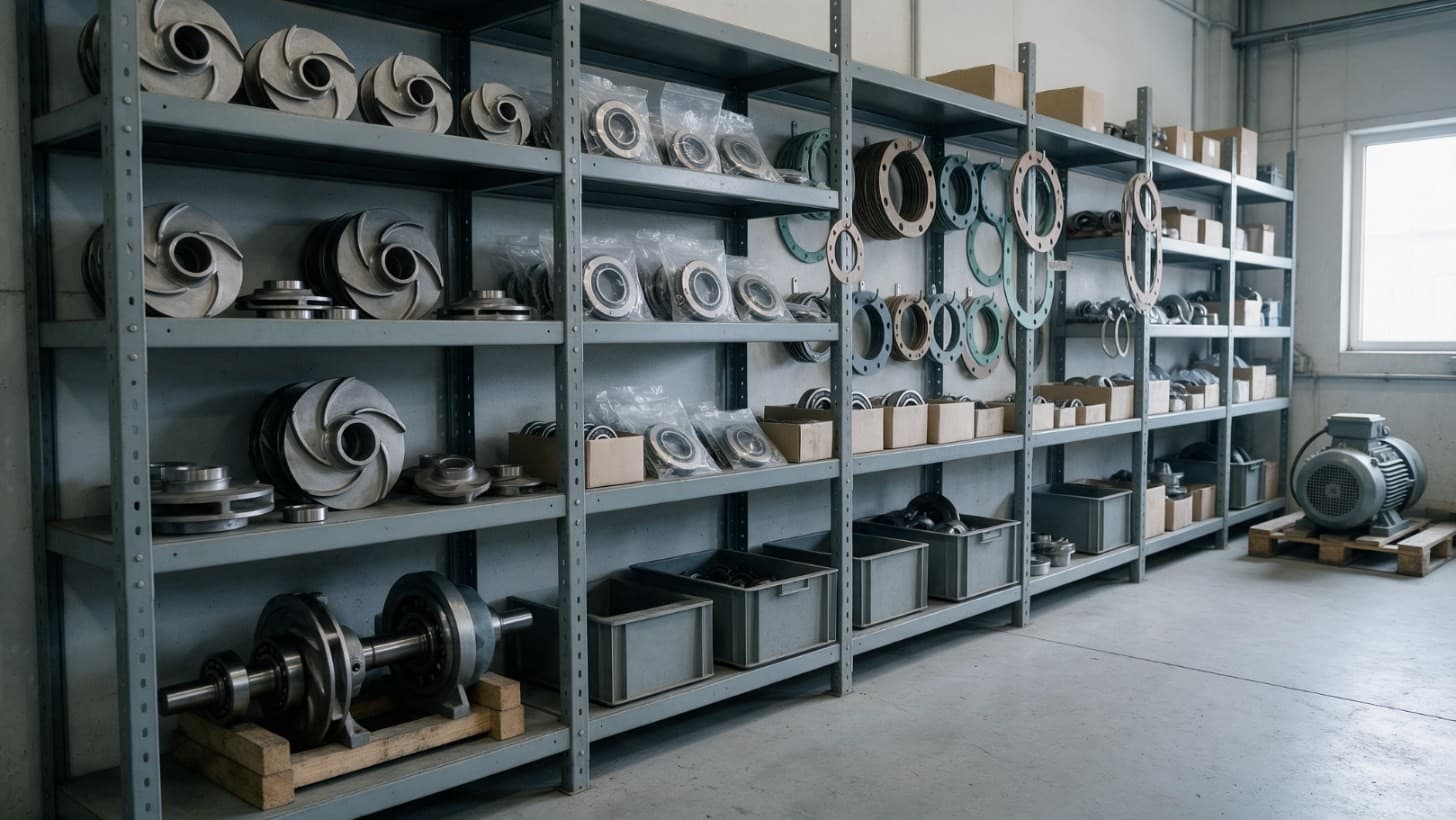
A recommended spares list is the supplier's priced list of the parts you should hold for new equipment, with part numbers, quantities and lead times. It is usually split into three tiers: commissioning spares, used during construction and start up; operating spares for an initial period, such as the first two years; and capital or insurance spares, parts that are not replaced routinely but whose failure, with no spare on the shelf, would stop production [1, 2].
Ask for it in the RFQ (request for quotation), priced line by line in your format, so bids can be compared. Then rank every line by criticality, and order the commissioning spares, and any insurance spares with long lead times, with the main purchase order.
Why this matters now
A vendor's list is a starting point, not a decision. In one Reliabilityweb case, an equipment vendor told a utility it needed $4.9 million of spares up front; a reliability review of about 1,500 pieces of equipment over 40 days produced a critical spares list of $2.2 million [3].
Holding too little is the other risk. At a paper mill, the initial spares list for a new medium voltage drive system was based on the OEM's (original equipment manufacturer's) recommendations, with no criticality review behind it. A later review found 102 components that needed spares, only 60 of them stocked. About half of the 42 missing items had to be available within 24 hours, against OEM delivery times of one to 16 weeks [4].
Wally Wilson of Life Cycle Engineering, writing in Plant Services, puts the annual carrying cost of a stocked part at 17% to 25% of its price [5]. After award, spares usually come from one supplier with no competing price, so test the spares offer in the RFQ.
Create and manage RFQs in minutes
ChemCapital handles the entire procurement cycle, from structured RFQs and supplier comparisons to formal purchase orders and delivery tracking.
The three tiers of spares
| Tier | What it covers | Pump and vessel examples | When to order |
|---|---|---|---|
| Commissioning and start up | Parts and special tools used during construction and commissioning [1, 2] | Seal repair kits; gaskets for joints opened after flushing, since a gasket should not be reused [6] | With the main order |
| Operating, or initial | Parts replaced routinely in early operation [1]; one SPIR guide's default is two years after start up [2] | Seals, bearings, wear rings, shaft sleeves, impellers, coupling parts, gaskets and O rings [7] | Priced in the bid; delivered before handover |
| Capital or insurance | Unique parts not replaced routinely [1], whose failure with no spare would stop production | A complete pump or rotating assembly for a critical service [7]; a bursting disc held against an unplanned burst | With the main order if the lead time exceeds the outage you can accept |
Names vary. The US Department of Energy calls the third tier critical spares [1], the SPIR guide records capital spares [2], and the consultancy IDCON sorts stock into critical, insurance, low risk and non stock [8].
A SPIR, or spare parts interchangeability record, is the supplier's record of the spares for each item of equipment. Its interchangeability data finds duplicate parts across equipment [2].
Rank every line by criticality
Criticality ranks how much a failure would hurt, and how fast. A team from operations, maintenance, engineering, stores and safety should do it [5]; IDCON adds that buyers are seldom the right people to answer [8]. For new equipment, the questions can go to the manufacturer, with the plant reviewing the answers [8].
For each line, ask:
- What does a failure affect: customer orders, safety, the environment [5]?
- How long until production stops, and is there an installed standby [8]?
- Can the failure be predicted [8, 5], early enough to order the part?
- How long does it take to reach and change the part, can the old one be repaired and restocked, and is there a substitute [8]?
- Is the lead time longer than the time within which the part must be available [4]?
A part that is critical, hard to predict and slower to arrive than you can wait belongs on the shelf. A Hydraulic Institute pump FAQ makes the same point: where loss of service cannot be accepted, keep a complete pump or rotating assembly; where some interruption is tolerable, keep the wear parts [7].
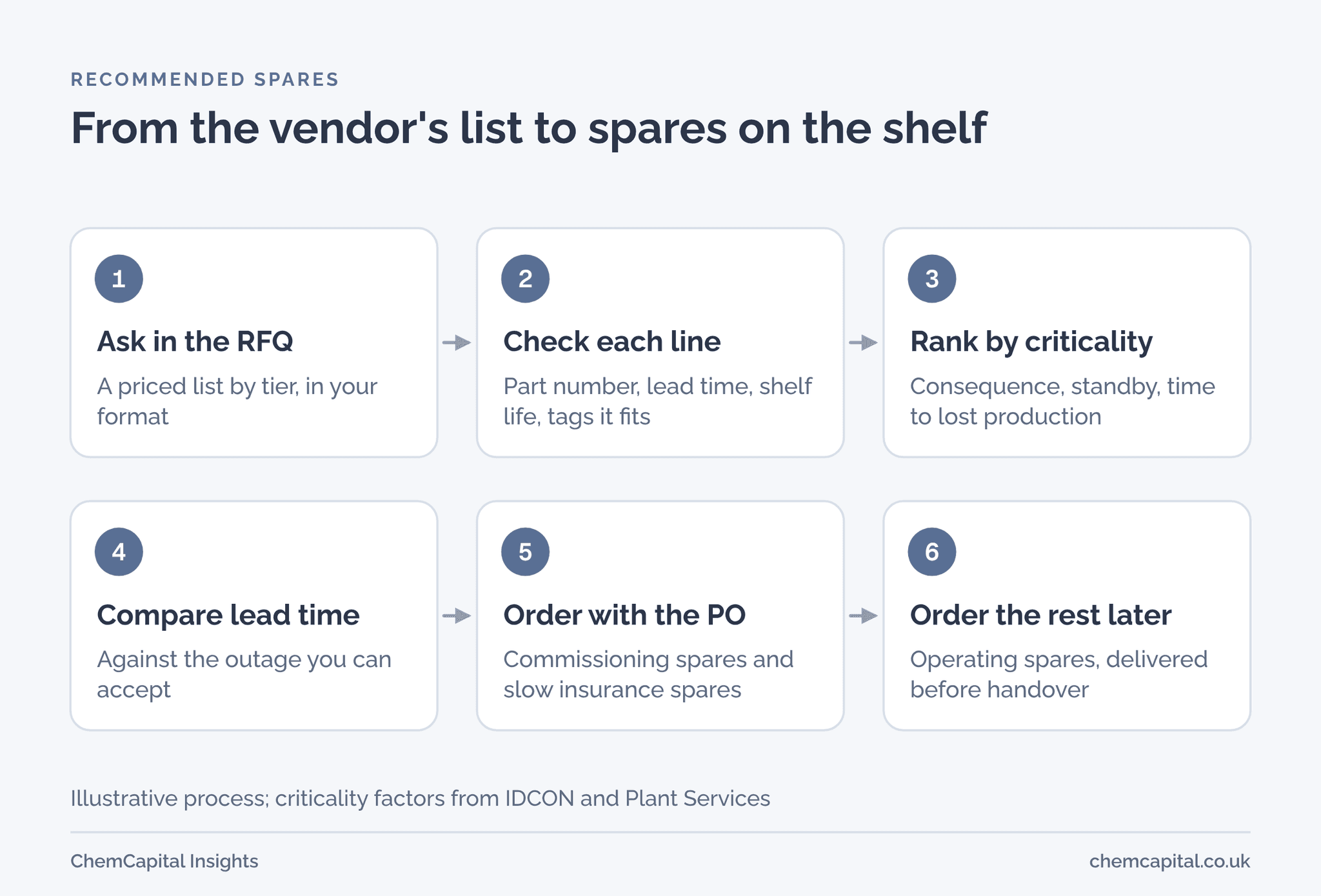
What to ask for in the RFQ
Ask every bidder for the spares list as a separate priced schedule in your format, split by tier. For each line, ask for:
- the original manufacturer's part number and name, and for bought in items such as bearings, the specification or type too [2]
- the drawing reference and position number [2]
- the quantity installed and the recommended quantity for each tier [2]
- the unit price and currency, and a lead time valid for the quoted Incoterms [2]
- the shelf life and storage conditions, especially for elastomers [9]
- the tag numbers each part fits, so interchangeable parts can be found [2]
- the special tools needed, listed with the commissioning spares [2]
Also ask how long the model will be supported, whether you will get notice before a part is discontinued, and for spares prices to stay valid for a stated period after award. Write into the order who supplies the commissioning spares and who replaces any that the supplier's commissioning team uses. This is general information, not legal advice.
Put the schedule in your quotation comparison sheet beside the equipment price: a cheaper bid may simply carry fewer spares.
When to order, and how long spares keep
Order commissioning spares with the main purchase order; they are needed before start up. Insurance spares with long lead times belong there too, since DOE asks projects to weigh the lead time to buy spares in the first year of operation [1]. See our guide to items with long lead times.
On obsolescence, DOE asks whether spares will still be available in future, and whether the knowledge of how to make them will be lost [1]. Where a part is obsolete, or comes from a single supplier that could go out of business, Wilson advises buying the remaining stock while it can still be had [5].
Shelf life limits how far ahead you can buy. ERIKS, citing ISO 2230, gives an initial storage period plus an extension after inspection: 5 plus 2 years for natural rubber, 7 plus 3 for nitrile, and 10 plus 5 for EPDM, FKM and silicone, stored below 25 °C at under 70% relative humidity [9]. Check the current edition. Rotating spares need care too: one not maintained in store could fail when fitted [5].
Practical example
Take an illustrative duty and standby pair of centrifugal pumps, P101A and P101B, and a stainless steel receiver, V201, with a manway, a sight glass and a bursting disc. All figures are illustrative; a real list adds part numbers.
| Item | Tier | Qty installed | Qty to hold | Unit price | Lead time | Shelf life or storage | Fits |
|---|---|---|---|---|---|---|---|
| Seal repair kit | Commissioning | 2 | 1 | £650 | 4 weeks | FKM, ISO 2230 group C | P101A and B |
| Mechanical seal cartridge | Operating | 2 | 1 | £3,200 | 8 weeks | FKM, group C | P101A and B |
| Bearing set | Operating | 2 | 1 | £420 | 2 weeks | Ask the maker | P101A and B |
| Wear rings and casing gasket | Operating | 2 | 2 | £460 | 6 weeks | Gasket: ask grade | P101A and B |
| Impeller, trimmed | Operating | 2 | 1 | £1,800 | 10 weeks | Not applicable | P101A and B |
| Coupling element | Operating | 2 | 1 | £150 | 2 weeks | Ask grade | P101A and B |
| Rotating assembly | Insurance, offered | 2 | 0 | £9,500 | 16 weeks | Needs care in store | P101A and B |
| Manway gasket | Commissioning | 1 | 2 | £120 | 3 weeks | EPDM, group C | V201 |
| Nozzle gasket set | Commissioning | 1 | 1 | £260 | 3 weeks | Ask grade | V201 |
| Sight glass and gaskets | Operating | 1 | 1 | £340 | 4 weeks | Gaskets: ask grade | V201 |
| Bursting disc | Insurance | 1 | 1 | £850 | 5 weeks | Ask the maker | V201 only |
The commissioning lines total £1,150, the operating lines £6,830 and the insurance line £850: £8,830 to hold.
The bidder also offered a rotating assembly at £9,500 with a 16 week lead time. With P101B as an installed standby and the wear parts in stock, a failure of P101A need not stop production, so the buyer declines it. It would have raised the list to £18,330 and, at 17% to 25% a year [5], cost about £1,600 to £2,400 a year to hold.
The bursting disc costs less than a tenth as much, but stays. If the maker specifies scheduled disc changes, those discs are operating spares; this one is held against an unplanned burst. V201 has no standby and cannot run without its relief device, so a five week wait means five weeks without the vessel. Hold a disc of the same specification and burst rating. Criticality, not price, decides what is held.
The commissioning lines and the disc go on the main purchase order; the operating lines follow the review, timed by the 10 week impeller.
Compare spares offers on equal terms
AI Quotation Comparison puts quotes side by side on commercial, technical, delivery, compliance and risk. AI extracts price, lead time, materials, certifications and scope from each uploaded quote for you to review, and a quote with a mandatory gap, such as excluded scope, is flagged and kept out of the ranking. You make the decision, and you can try it free with up to three quotes without signing up.
Ready to make the spares list part of every bid you compare? Start a free 14 day ChemCapital trial, with no credit card needed.
Frequently asked questions
What is a recommended spares list?
It is the supplier's list of the spare parts to hold for new equipment, with part numbers, quantities, prices and lead times. It is usually split into commissioning spares, operating spares for an initial period such as two years, and capital or insurance spares.
What is the difference between commissioning spares and operating spares?
Commissioning spares are parts and special tools used during construction and start up, such as gaskets for joints opened after flushing. Operating spares are the parts replaced routinely in early operation, such as seals, bearings and wear rings, priced for an initial period such as two years.
What are insurance spares?
Insurance or capital spares are parts that are not replaced routinely but whose failure would stop production for a long time if no spare were on the shelf, such as a pump rotating assembly for a critical service with no standby. Criticality and lead time matter more than price in deciding whether one is worth holding.
Should spares be ordered with the main equipment?
Order commissioning spares with the main purchase order, and insurance spares too when their lead time is longer than the outage you can accept. Operating spares can be priced in the bid and ordered after a criticality review, in time to arrive before handover.
Continue reading
Informational only, not procurement or legal advice. Cited names, frameworks, and statistics belong to their respective owners.
Create and manage RFQs in minutes
ChemCapital handles the entire procurement cycle, from structured RFQs and supplier comparisons to formal purchase orders and delivery tracking.
Start for freeRelated articles
Site Acceptance Test (SAT) Checklist for Process Skids
What a site acceptance test must prove once a skid is installed, how SAT differs from FAT and commissioning, a full SAT checklist and how to handle failed tests.

Punch List Categories and Mechanical Completion for Process Plant
What a punch list is, how category A, B and C items gate mechanical completion, start up and handover, who clears them, and a template for vendor equipment packages.
Payment Milestones, Retention and Bonds on Process Equipment Orders
How to tie payment milestones to evidence on process equipment orders, when to hold retention, and what advance payment guarantees, bonds and PCGs secure.