
Technical Query (TQ) Template: Raising and Closing Questions with Bidders
What a technical query is, when to raise one instead of a clarification or deviation, what a good TQ contains, and a register template you can use today.
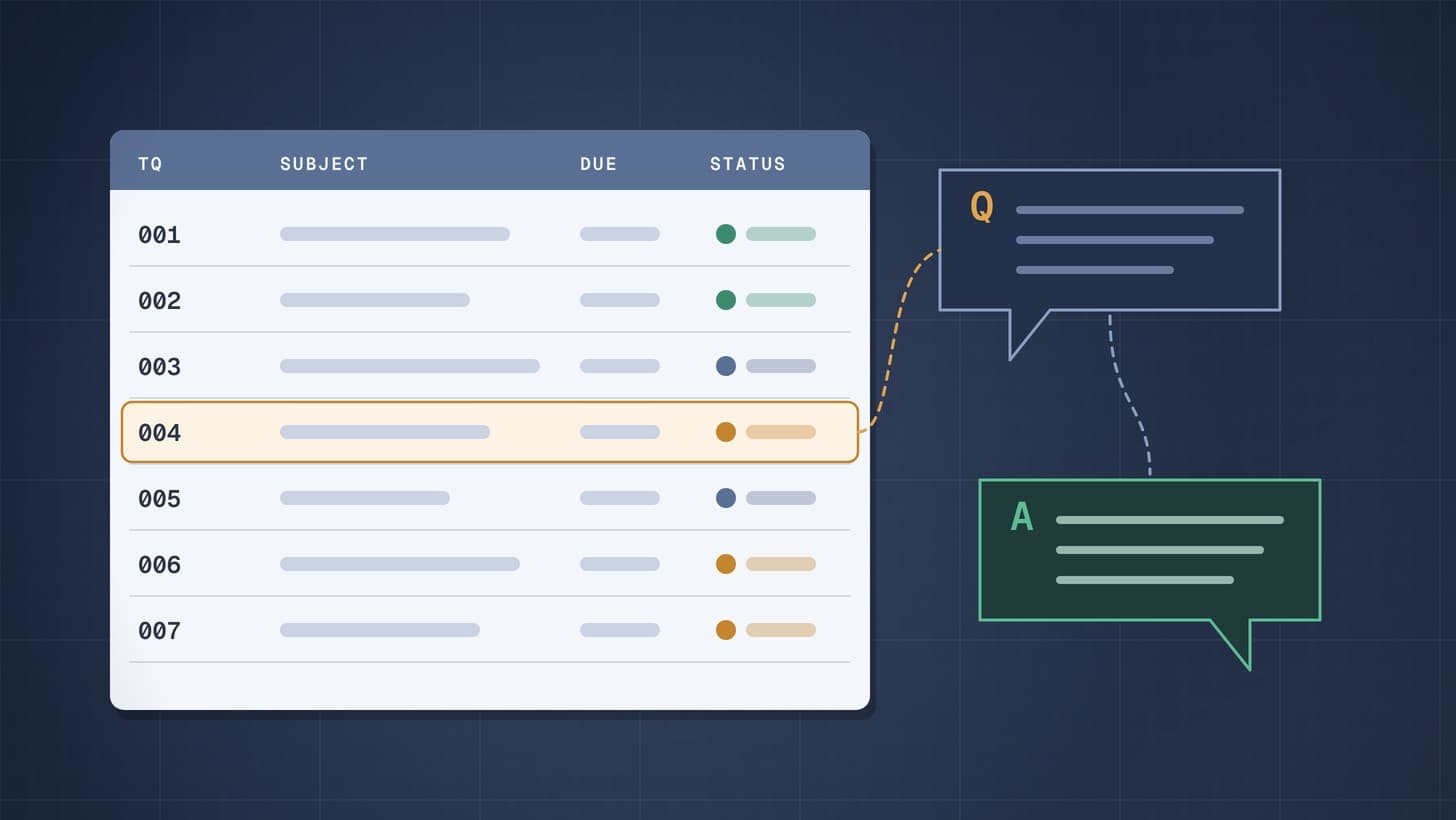
A technical query (TQ) is a formal written question about the technical requirements of a tender or contract. It is raised when something is unclear, conflicting, wrong or missing, or when someone wants to propose an alternative, and it is answered in writing so the answer becomes part of the record. In a process equipment tender, bidders raise TQs to the buyer, the buyer raises them to bidders during evaluation, and every agreed answer is carried into the purchase order.
This is general information, not legal advice.
Why this matters now
A Saudi government project manual puts the core rule plainly: a TQ is not an authorised change document [1]. Yet TQ answers change scope all the time. Project software now bundles TQs with formal contract administration, and in November 2024 the UK's Civil Engineering Contractors Association warned NEC users that an answer which changes the scope can slip through without the formal instruction it needs [2]. Equipment purchases face the same risk: a casual answer about a seal plan or a test can become a price claim months later.
For public buyers there is a second reason. Under the Procurement Act 2023, a contracting authority must treat suppliers the same unless a difference between them justifies different treatment [3], and government guidance asks for clarification answers to be made available to all bidders at the same time [4].
Join ChemCapital to streamline sourcing and connect with verified partners
Whether you're buying or supplying, ChemCapital gives you the tools to manage the complete procurement cycle in one platform.
TQ, clarification, deviation or change?
| Type | What it is | When | What happens to it |
|---|---|---|---|
| Clarification | A question about the process: dates, forms, how to submit | Before bids are due | Answered to all bidders |
| Technical query | A question about a technical requirement, or a proposed alternative | Before bids are due, during evaluation, or after award | Answered in writing and logged |
| Deviation | The bidder's statement that its offer does not meet a requirement | In the bid | Accepted, rejected or priced at evaluation |
| Change | An agreed change to scope, price or delivery | After award | Issued under the contract's change clause |
Deviations need their own place. Bharat Heavy Electricals' tender conditions require deviations to be listed in a separate schedule, say that deviations stated elsewhere in the bid will not be considered, and allow bids with deviations to be rejected or price loaded [5]. If a TQ answer does not satisfy the bidder, the point should become a listed deviation, not stay open.
What a good TQ contains
The procedure cited above asks for one subject per TQ, the originator's name, the information requested and the related documents, with sketches where useful [1]. Hexagon describes a TQ in its project software the same way: a managed exchange between stakeholders, holding the relevant documents and images, linked to documents or tags, with a reply deadline [6]. For equipment tenders, the template below adds two fields that save time: a proposed answer and an impact statement.
| Field | What to write | Illustrative entry |
|---|---|---|
| TQ number | Sequential, per package | PK03 TQ 007 |
| Date raised and raised by | Date, company and person | 3 November 2026, Bidder B, sales engineer |
| Reference | Document, revision, clause, line or tag | Pump datasheet DS P101 rev B, seal section |
| Requirement as written | Quote the requirement briefly | Seal to API 682, Plan 53A |
| Question | One question only | Is a bladder accumulator (Plan 53B) acceptable in place of 53A? |
| Proposed answer | What the raiser suggests | Offer Plan 53B; no change to seal faces |
| Impact | Price, delivery, compliance, or none | Adds about two weeks if 53A is kept |
| Reply needed by | Date | 10 November 2026 |
| Answer | Written reply, with who gave it | Plan 53A retained; 53B may be offered as an option |
| Shared with | All bidders, or confidential with reason | All bidders |
| Status | Open, answered, closed, became deviation | Closed |
| Carried into | Addendum, deviation list or PO clause | RFQ addendum 2 |
Running the register
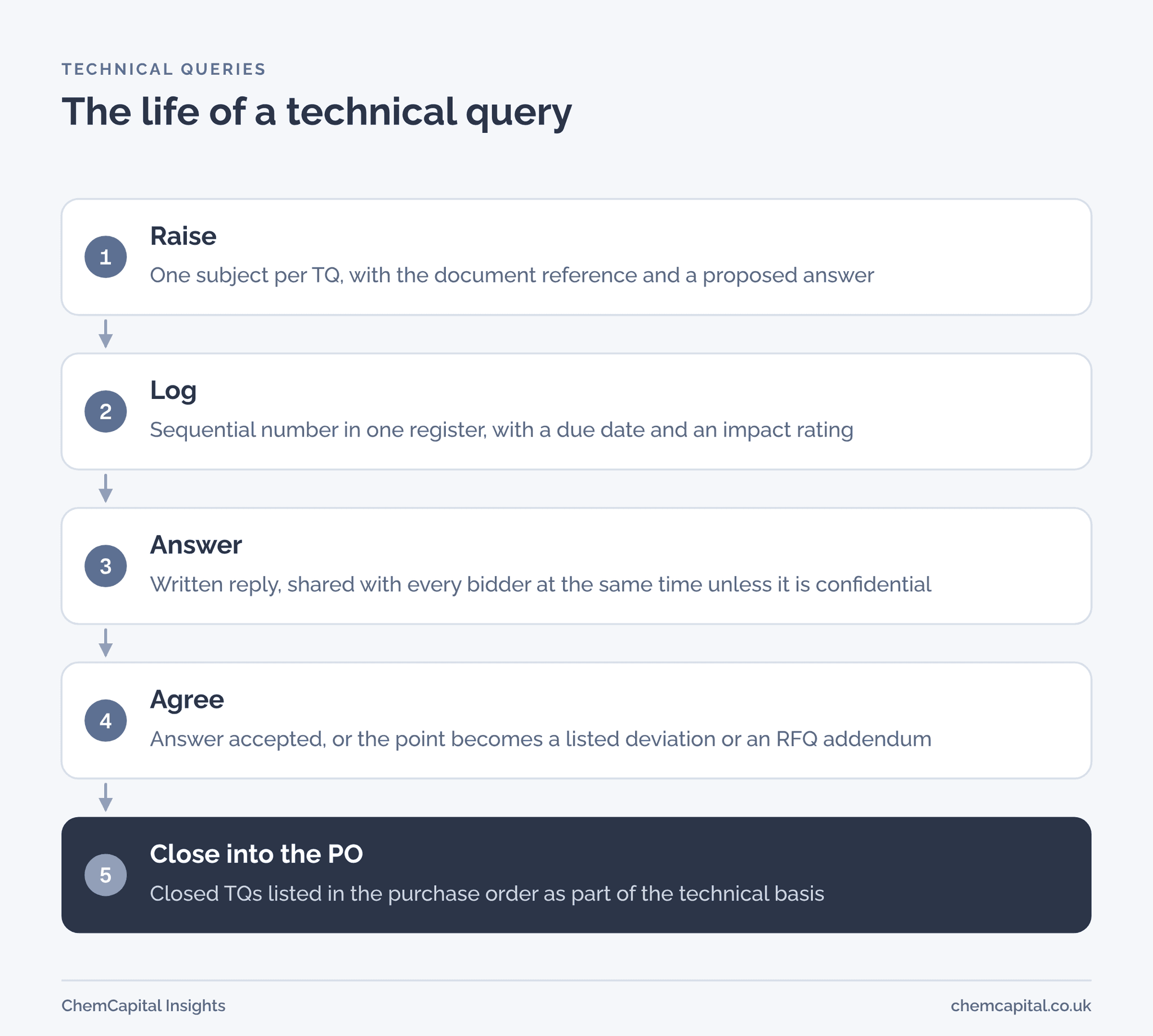
Keep one register per package, number TQs in sequence and never reuse a number. The project procedure above targets an answer within three working days and no more than two weeks unless the contract says otherwise [1]; for a tender, set your own deadline in the RFQ and say when the last TQ may be raised. CECA suggests adding a red, amber or green column to flag queries that could affect cost or time if they are not answered quickly [2].
Share answers with every bidder unless the question reveals one bidder's design or price, and record why when you keep one confidential. For the wider tender process, see our RFQ best practices.
Closing TQs into the purchase order
Before award, every TQ should be closed, turned into an RFQ addendum, or turned into a listed deviation that you have accepted or rejected. Our guide to technical bid evaluation shows where those deviations are scored.
Then list the closed TQs, by number and register revision, in the purchase order's technical documents. That turns a trail of emails into part of the contract. After award, keep using TQs for questions, but if an answer would change scope, price or delivery, issue it as a change under the contract [1, 2].
Practical example
In this illustrative example, four bidders on a package of three agitated vessels raise 18 TQs. Eleven are answered with no effect on price or scope. Four reveal gaps in the RFQ, so the buyer issues one addendum to all bidders. Three, from one bidder, ask to use a different gasket material; the buyer declines, and the bidder lists them as deviations. That is 11 + 4 + 3 = 18, all closed before evaluation, and the purchase order lists register revision 3 as part of the technical basis.
Where ChemCapital fits
In ChemCapital, each RFQ, purchase order and project has its own message thread, so questions and answers sit with the package they belong to. Buyers can ask for quote revisions with comments, every revision is kept, and interactions, revisions and decisions are logged with timestamps and linked to the person who made them. See how it works.
Ready to keep every bidder question and answer in one record? Start free with ChemCapital.
Frequently asked questions
What is a technical query in a tender?
It is a formal written question about the technical requirements, raised when something is unclear, conflicting, wrong or missing, or to propose an alternative. It is numbered, logged and answered in writing so the answer becomes part of the record.
What is the difference between a technical query and a deviation?
A technical query asks what a requirement means. A deviation is a bidder's statement that its offer does not meet a requirement, and it belongs in the bid's deviation list, where the buyer can accept it, reject it or price it.
Can a TQ answer change the scope of an order?
It should not. Many procedures state that a TQ is not a change document, so if an answer changes scope, price or delivery after award, it should be issued as a formal change under the contract.
Continue reading
Informational only, not procurement or legal advice. Cited names, frameworks, and statistics belong to their respective owners.
Join ChemCapital to streamline sourcing and connect with verified partners
Whether you're buying or supplying, ChemCapital gives you the tools to manage the complete procurement cycle in one platform.
Get started freeRelated articles
Heat Exchanger Datasheet Explained Line by Line (TEMA)
What each line of the TEMA shell and tube specification sheet means, which lines the buyer must fill, and which the thermal designer returns with the quote.

How to Fill In a Centrifugal Pump Datasheet for an RFQ (API 610)
A field by field guide to the buyer's side of an API 610 pump datasheet: liquid, flows, pressures, NPSH, scope, and what to check when bids come back.
Commercial Bid Evaluation: Levelling Price, Terms and Exclusions
How to level technically accepted equipment bids onto one basis: exclusions, options, delivery, payment terms, currency, warranty and lifetime costs, with a worked table.