
Heat Exchanger Datasheet Explained Line by Line (TEMA)
What each line of the TEMA shell and tube specification sheet means, which lines the buyer must fill, and which the thermal designer returns with the quote.
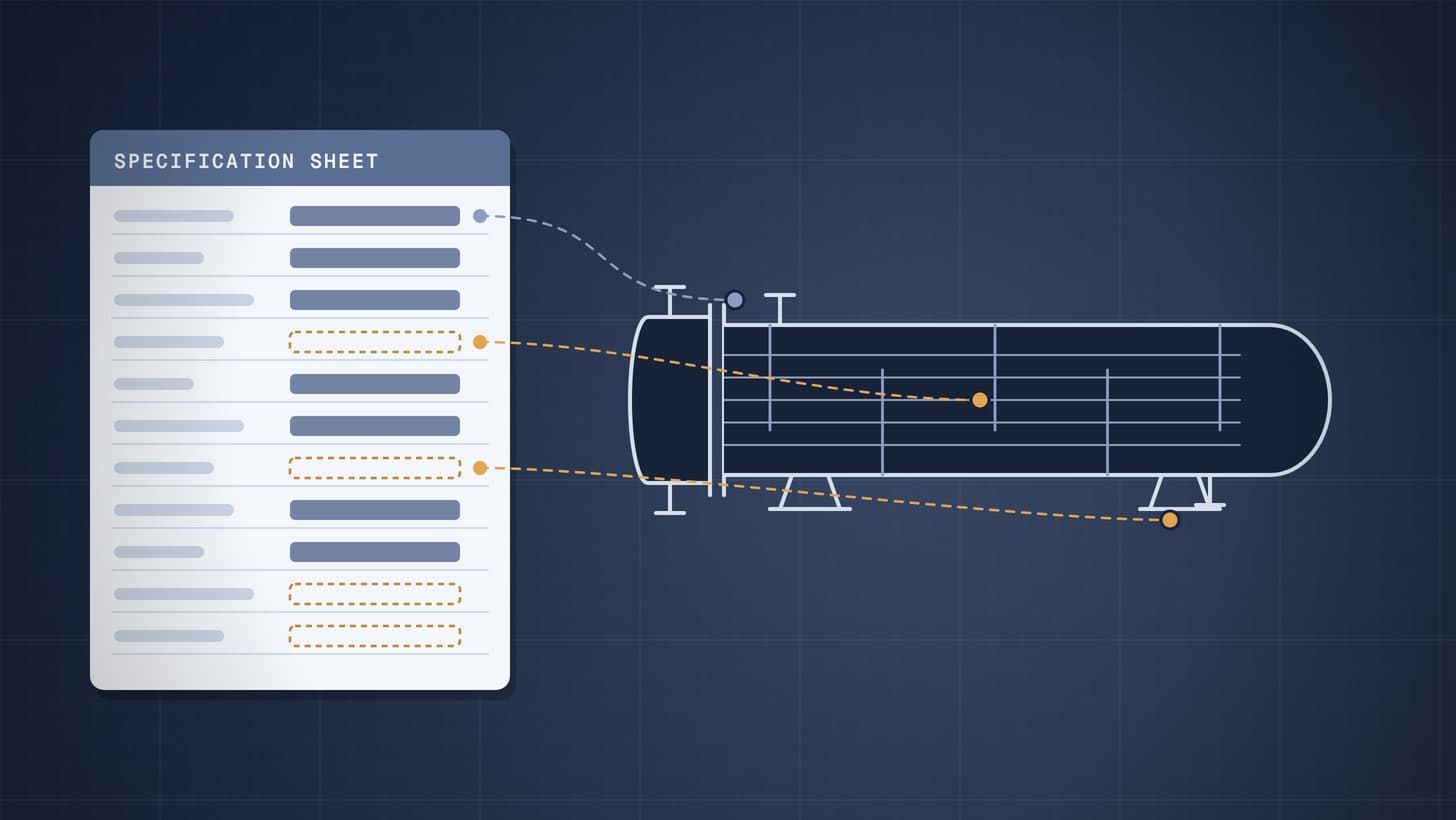
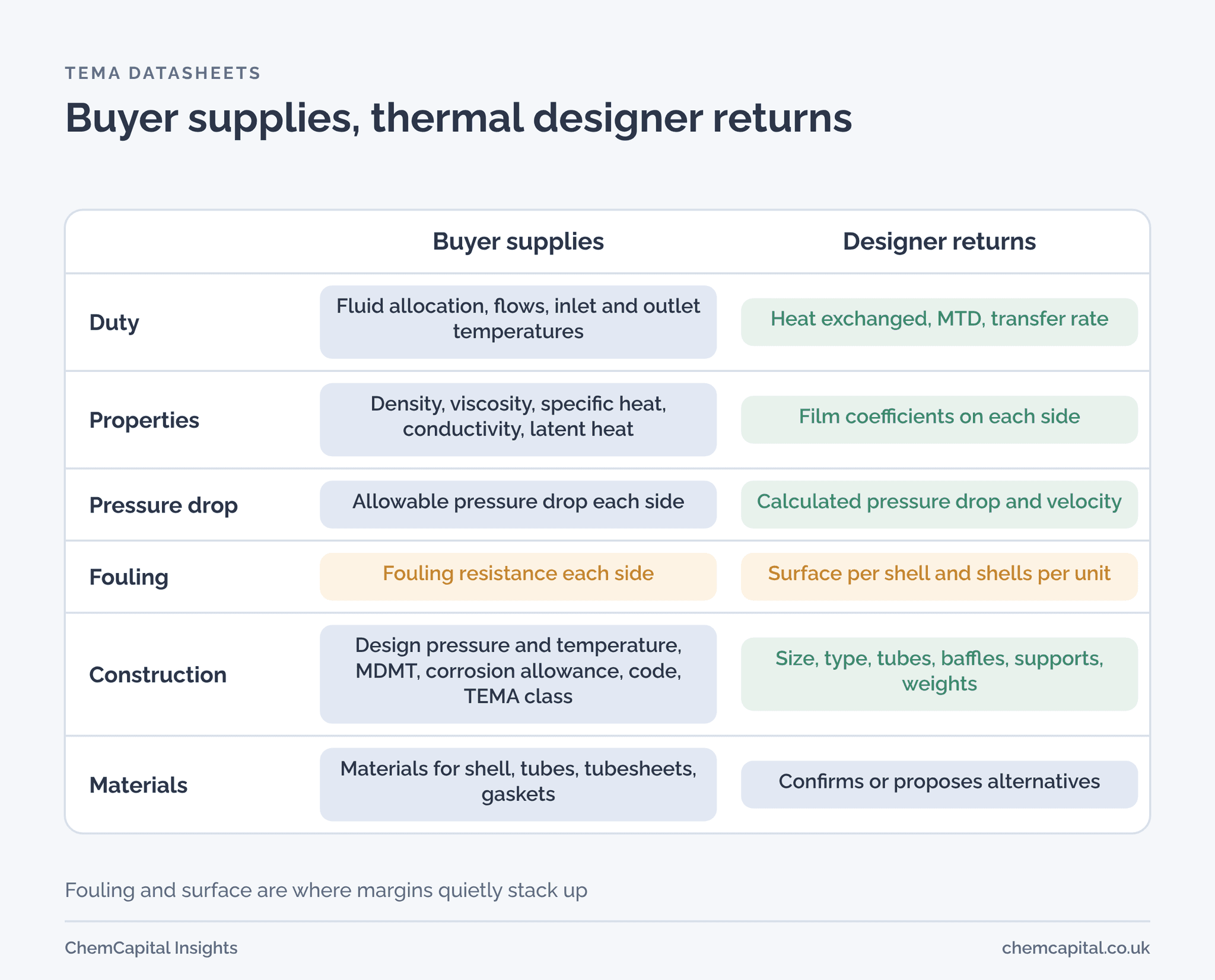
A TEMA heat exchanger datasheet, which TEMA calls the Heat Exchanger Specification Sheet, is the two page form that defines a shell and tube exchanger for quotation. The buyer fills in the duty: which fluid goes where, flows, temperatures, properties, allowable pressure drops, fouling resistances, design conditions, materials and TEMA class. The thermal designer, usually the fabricator, returns the size and type, surface area, coefficients, calculated pressure drops, tube and baffle details and weights.
Read it as a conversation in two halves. Your half has to be complete and consistent, or every bidder will design something different.
Why this matters now
TEMA, the Tubular Exchanger Manufacturers Association, issued the 2026 edition of its standards on 1 August 2026 [1, 2]. TEMA says the specification sheet has been revised to define the design requirements more fully [1]. The sheet is a free download in US customary and SI units, as PDF and Excel [2].
The recent revision of the sheet added a table for several design and operating conditions, which the designer needs to decide whether an expansion joint is required, a second page for an outline sketch, and fuller configuration and materials sections [3]. If your project template still carries an old one page form, those lines are missing.
Create and manage RFQs in minutes
ChemCapital handles the entire procurement cycle, from structured RFQs and supplier comparisons to formal purchase orders and delivery tracking.
The top block: service, size and type
The header names the job, item number and service of unit, a short description such as "product cooler" [4]. Next come size, horizontal or vertical, whether shells are connected in parallel or series, and the TEMA type. The type is three letters for the front head, shell and rear head: a BEM has a B front head, an E shell and an M rear head [5]. Our guide to TEMA heat exchanger types explains each letter. Size, surface per unit and shells per unit are normally the designer's answer, not yours [4].
Performance of one unit: the lines you must fill
This block carries the duty for each side, inlet and outlet [4].
- Fluid allocation. Which fluid goes in the shell and which in the tubes. A common rule is to put the dirtier, more corrosive or higher pressure fluid in the tubes, which are easier to clean and cheaper to make from alloy. If you have no view, say so and let the designer choose.
- Fluid quantity and phase. Total flow, split into vapour, liquid, non condensables, steam or water at inlet and outlet. This tells the designer whether there is condensing or boiling.
- Temperatures in and out on both sides.
- Properties: density, viscosity, specific heat, thermal conductivity and latent heat at inlet and outlet. Values at one temperature only are a frequent cause of poor designs in viscous service.
- Inlet pressure, in absolute units on the SI sheet.
- Pressure drop, allowable. Your limit for each side. The designer fills in the calculated value beside it.
- Fouling resistance. The allowance for dirt building up on each surface. Choose it carefully, because generous fouling factors oversize the exchanger [6].
The designer then returns velocity, film coefficients, heat exchanged, mean temperature difference (MTD) and the required transfer rate [4].
Construction of one shell, and page two
Here you give design pressure (internal and external), design temperature, MDMT (minimum design metal temperature, the coldest the metal may see), and corrosion allowance, the extra wall thickness that may be lost over the exchanger's life [4]. Nozzle sizes and ratings, tube count, diameter, length and pitch, baffle type and spacing, supports, impingement protection and weights are mostly the designer's answers, though you can fix any of them if your site standards require it.
Page two holds the design code, whether a code stamp is required, the TEMA class, customer inspection, cyclic service, the materials list and the table of design, operating and upset conditions [4]. TEMA class R is the most demanding and is used in refineries; class C is the least demanding, for general service; class B is for chemical service and is close to R without some of its extra requirements [5].
Template: who gives each line
| Line on the sheet | Buyer gives | Designer returns | Watch for |
|---|---|---|---|
| Service of unit, item number | Yes | Tag differs from the equipment list | |
| Size, type, surface, shells | Type if required by site standards | Yes | Type left open when maintenance needs a removable bundle |
| Fluid allocation | Yes, or "designer to choose" | Confirms | Fouling fluid on the shell side |
| Flows and phases | Yes | Heat balance does not close | |
| Temperatures in and out | Yes | Outlet temperatures that cross, needing more shells in series | |
| Fluid properties | Yes, at inlet and outlet | Checks | Properties at one temperature only |
| Allowable pressure drop | Yes | Calculated value | Limits so tight that velocity drops |
| Fouling resistance | Yes | Uses it | Fouling plus extra margin |
| Design pressure, temperature, MDMT | Yes | External pressure for vacuum service missing | |
| Corrosion allowance | Yes | Not stated for tubes and shell separately | |
| Design code, code stamp, TEMA class | Yes | Class B asked for when the site specifies R | |
| Materials | Yes | Confirms or proposes | Gasket and bolting materials blank |
| Tubes, baffles, supports, weights | Optional | Yes | Not checked against lifting limits |
Practical example
In this illustrative example, a product cooler takes 20,000 kg/h of liquid with a specific heat of 2.2 kJ/kg K from 90 °C to 40 °C. The duty is 20,000 ÷ 3,600 × 2.2 × 50, which is about 611 kW.
The draft datasheet shows cooling water at 50,000 kg/h from 28 °C to 38 °C. That side carries only 50,000 ÷ 3,600 × 4.18 × 10, about 581 kW, so the heat balance is out by 5%. To close it, the water flow must be about 52,600 kg/h. Fix this before the RFQ, or each bidder will choose its own answer.
With counterflow temperature differences of 52 K and 12 K, the log mean temperature difference is about 27.3 K. If a designer's service coefficient were 500 W/m² K and the MTD correction factor 0.85, the surface would be about 53 m². Now suppose process adds 10% to the duty and the designer adds 20% to the area: the exchanger grows to about 70 m², 32% larger. Chemical Processing describes a case where two 25% margins left an exchanger 56% oversized, so velocity fell and it fouled fast [7]. State margin once, on one line, and say where it applies.
Where ChemCapital fits
ChemCapital lets you send one structured RFQ with line items and attachments, such as the TEMA sheet and your materials specification, to several fabricators at once, and quotes come back in a consistent format. Incoming quotes are checked for missing fields, unit mismatches and scope differences before you compare prices. For the rest of the RFQ, see our RFQ best practices, and if a plate unit might suit the duty better, compare plate and shell and tube exchangers first.
Ready to get exchanger quotes you can compare line by line? Start a free 14 day ChemCapital trial, with no credit card needed.
Frequently asked questions
What is a TEMA datasheet?
It is the Heat Exchanger Specification Sheet published by the Tubular Exchanger Manufacturers Association, a two page form that defines a shell and tube exchanger. TEMA offers it as a free download in US customary and SI units, as PDF and Excel.
What does the buyer fill in on a heat exchanger datasheet?
The buyer gives the service, fluid allocation, flows, inlet and outlet temperatures, fluid properties, inlet pressures, allowable pressure drops, fouling resistances, design pressure and temperature, corrosion allowance, design code, TEMA class and materials. The thermal designer returns the size, type, surface, coefficients, calculated pressure drops, tube and baffle details and weights.
What is the difference between TEMA class R, C and B?
Class R is the most demanding and is used for refinery service, class C is the least demanding for general service, and class B is for chemical service. Class B is close to class R in scope but without some of its extra requirements.
Why should fouling resistance and design margin not both be generous?
Each one adds surface area, and the effects multiply. An oversized exchanger runs at lower velocity, which can make it foul faster, so state margin once and say where it applies.
Continue reading
Informational only, not procurement or legal advice. Cited names, frameworks, and statistics belong to their respective owners.
Create and manage RFQs in minutes
ChemCapital handles the entire procurement cycle, from structured RFQs and supplier comparisons to formal purchase orders and delivery tracking.
Start for freeRelated articles
How to Fill In a Centrifugal Pump Datasheet for an RFQ (API 610)
A field by field guide to the buyer's side of an API 610 pump datasheet: liquid, flows, pressures, NPSH, scope, and what to check when bids come back.
Commercial Bid Evaluation: Levelling Price, Terms and Exclusions
How to level technically accepted equipment bids onto one basis: exclusions, options, delivery, payment terms, currency, warranty and lifetime costs, with a worked table.
Pressure Vessel and Process Datasheets for Quotations
The difference between a process and a mechanical datasheet for vessels, the fields a fabricator needs to quote, and the omissions that cause requotes.