
Agitator and Impeller Types: How to Specify a Tank Agitator
Axial, radial and close clearance impellers matched to duty and viscosity, with baffles, seals, the power equation and what to put on an agitator datasheet.
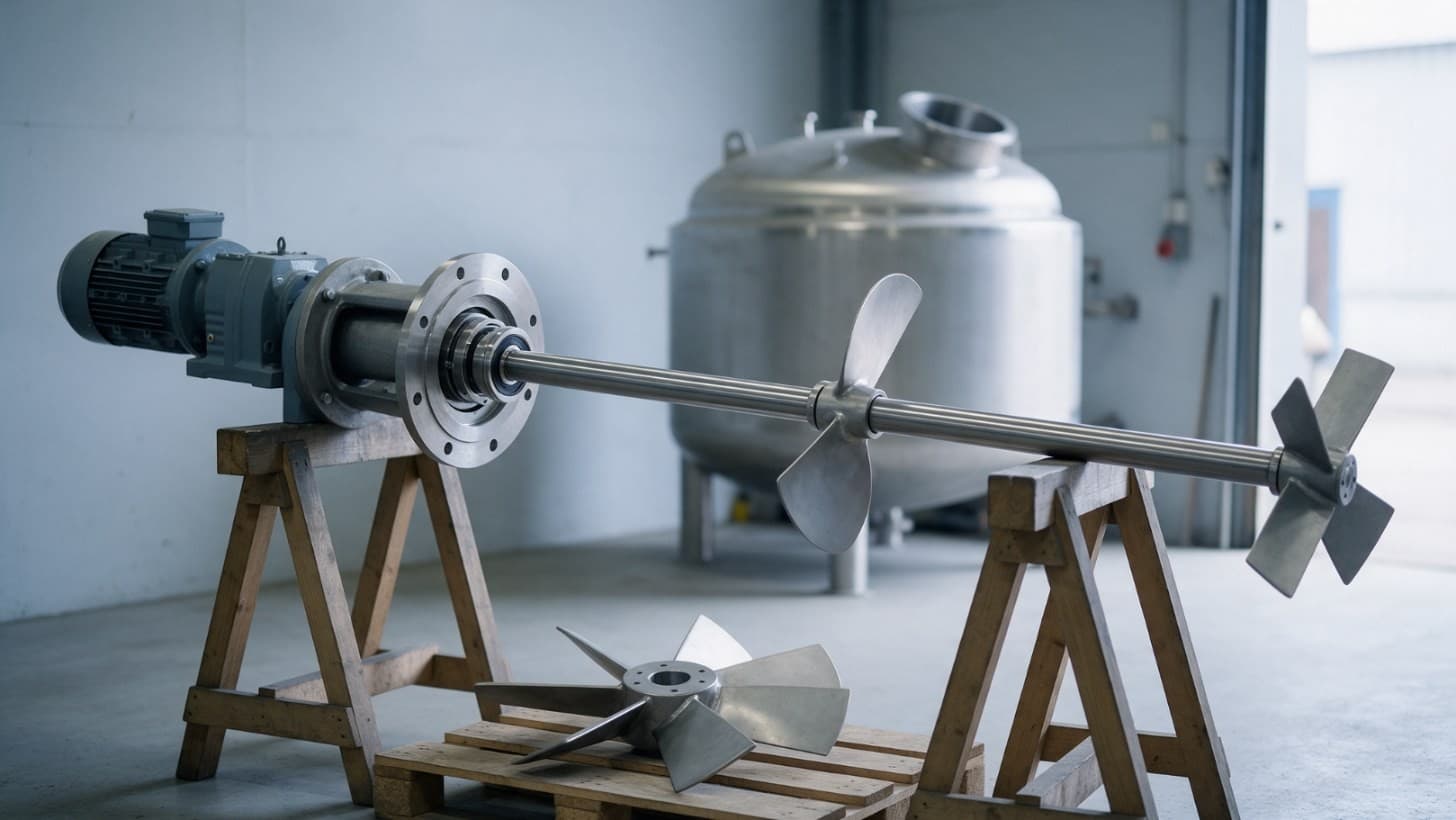
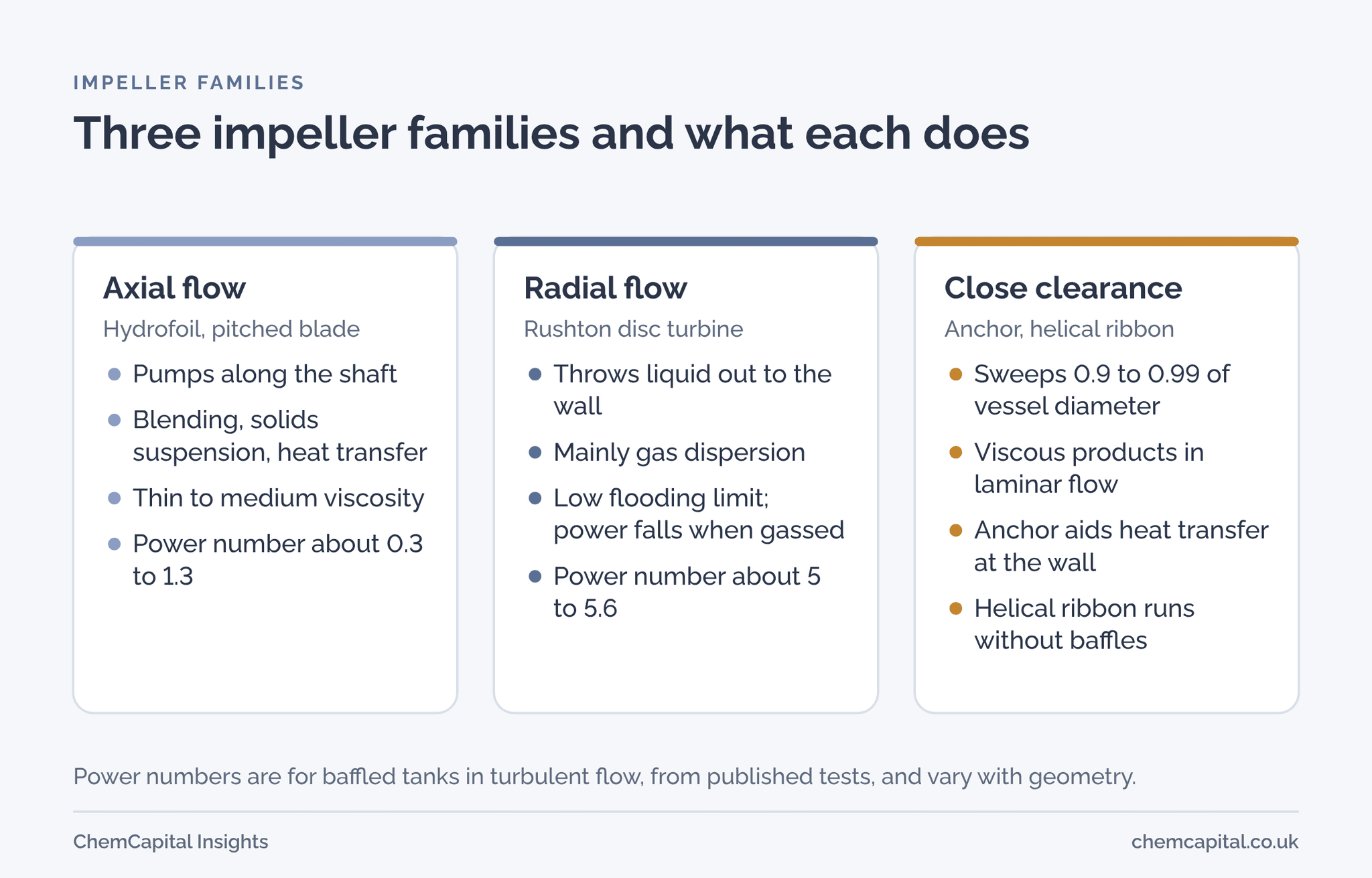
An agitator is a motor and gearbox, a shaft, a seal and one or more impellers, and the impeller decides what it can do. Impellers come in three families. Axial flow impellers, the hydrofoil and the pitched blade turbine, pump liquid along the shaft and suit blending, solids suspension and heat transfer in thin to medium liquids. Radial turbines, such as the six blade Rushton, push liquid out towards the wall and are used mainly to disperse gas. Close clearance anchors and helical ribbons sweep almost the full vessel diameter and handle very viscous products [1, 2, 3].
The impeller also sets the power. In one published test a Rushton turbine's power number was 5.55 against 0.36 for a hydrofoil [3]. On those figures, at the same speed and diameter, the Rushton draws about 15 times the power. A motor rating means little until the bidder states the impeller, diameter, speed and power number.
Why this matters now
An enquiry that says only "mixing tank with agitator" invites bids that cannot be compared: a hydrofoil from one vendor, a pitched blade turbine with a bigger motor from another, a Rushton from a third. A datasheet that states the duty, fluids and vessel, and asks every bidder for the same figures, lets you settle the choice during technical bid evaluation, before the nozzle and baffles are fixed.
Create and manage RFQs in minutes
ChemCapital handles the entire procurement cycle, from structured RFQs and supplier comparisons to formal purchase orders and delivery tracking.
Match the impeller to the duty and viscosity
Viscosity enters through the impeller Reynolds number, Re = ρND²/μ: density times speed in turns per second times impeller diameter squared, divided by viscosity. AIChE's CEP magazine treats flow as fully laminar below an Re of 10 and turbulent above 10,000. It sets out the conventional guide: hydrofoils for thin liquids in turbulent flow, pitched blade turbines for the transitional range, and close clearance designs, the helical ribbon for example, for viscous products in laminar flow. The same article argues that hydrofoils also work well in laminar duty [2].
| Impeller | Flow | Typical duties | Limits and notes | Power number, turbulent, baffled |
|---|---|---|---|---|
| Hydrofoil, usually three blades | Axial | Blending, solids suspension, heat transfer [4] | Traditionally thin liquids in turbulent flow; CEP argues they suit laminar duty too [2] | About 0.26 to 0.36 [3, 5] |
| Pitched blade turbine, typically four blades at 45° | Mixed axial and radial, usually grouped as axial [1, 3, 5] | Blending, solids suspension [2, 5] | EKATO quotes up to 20,000 mPa s [1] | About 1.2 to 1.3 [3, 5] |
| Rushton disc turbine, usually six flat blades | Radial | Mainly gas dispersion [1] | Relatively low flooding limit; power falls when gassed [1] | About 5.0 to 5.6 [3, 5] |
| Anchor or helical ribbon | Tangential (anchor), axial (ribbon) | Highly viscous products; anchor aids heat transfer at the wall [1] | Sweeps 0.9 to 0.99 of vessel diameter; ribbon supports rule out baffles [1] | Laminar duty; ask the vendor |
For blending and solids, axial impellers circulate the whole batch; in the university test, at equal power input, down pumping axial impellers gave shorter mixing times than radial turbines [3]. Tell bidders whether solids must just leave the bottom or be uniform, as these are different targets [6].
For gas, EKATO notes the Rushton's relatively low flooding limit, the gas rate at which the impeller is overwhelmed, and a large fall in power once gas flows [1]. Chemineer states its parabolic blade BT 6 has nearly six times the gas dispersing capability of a Rushton [4]. As gassed power is lower, check the motor also covers ungassed power.
Dispersing one liquid in another needs both shear and pumping. Chemineer offers its P 4 axial impeller for such immiscible blending, and an adjustable high shear impeller, ChemShear, for very fine dispersions [4]. Jacket choice for heat transfer is covered in our guide to jacketed vessels and glass lined reactors.
Baffles and shaft seals
Baffles are vertical plates on the vessel wall. Without them, thin liquids swirl round with the impeller and form a surface vortex [5, 7]. The usual arrangement is four flat plates, each one twelfth of the vessel diameter wide, at 90° spacing. Where fouling matters they can stand off the wall by a third of their width, and by half at higher viscosity [7].
Baffles also change the power. In one study, removing the baffles around an off centre hydrofoil in water cut measured power by about 40% at the same speed [7]. So the vendor's power figure must assume the baffles you will actually fit.
The seal is where the shaft enters the vessel. Lip seals suit low pressure. Packing in a stuffing box costs less but relies on a constant leak of lubricant along the shaft, unwelcome where contents are toxic or volatile. Mechanical seals are the usual choice for closed or pressure rated vessels and volatile products; one mixer maker quotes them from vacuum tight to 25 bar, and names shaft deflection among the main causes of seal failure [8]. For toxic or flammable contents, ask for a double mechanical seal: it has the lowest leakage, any leak goes into the vessel rather than to atmosphere, and it often needs a lubricating liquid supply [5].
Where the area is hazardous, put the zone on the datasheet. In Great Britain the Equipment and Protective Systems Intended for Use in Potentially Explosive Atmospheres Regulations 2016 cover mechanical as well as electrical equipment [9], so ask about the gearbox and seal, not only the motor. This is general information, not legal advice.
Power number, power and tip speed
Shaft power is P = Np × ρ × N³ × D⁵, with P in watts, ρ in kg/m³, N in turns per second and D in metres. In a baffled tank the power number Np is constant above an Re of about 10,000 [2] and depends on impeller and tank geometry. One university rig with D/T of one third measured 0.36, 1.19 and 5.55 for a hydrofoil, a down pumping pitched blade turbine and a Rushton, with power measured at the motor, so possibly including drive losses [3]. Chemineer's figures, in a 2008 presentation hosted by ISPE Boston, are 0.28, 1.3 and 5.0 for its HE 3, P 4 pitched blade and D 6 Rushton [5]. Below the turbulent range Np changes with Re, so ask for the vendor's power curve.
A 10% larger impeller at the same speed draws 61% more power, and 10% more speed draws 33% more. In turbulent flow power is proportional to density, so a factory run on water understates the power a denser product will need.
Two derived figures help compare bids: power per unit volume, in kW/m³, and tip speed, π × N × D. At equal power a low power number hydrofoil turns faster than a Rushton of the same diameter, so ask each bidder which figure they designed to.
What to put on the agitator datasheet
Based on Dynamix's application data sheet [6], give every bidder:
- the duty and how success is measured: blend time, solids off the bottom or uniform, gas rate or heat duty
- vessel diameter, height, heads, open or closed, and minimum, normal and maximum liquid levels
- baffles, coils and other internals
- each liquid's proportion, density and viscosity, and the final mixture's
- solids proportion, density, particle size, settling rate, and whether abrasive or sticky
- foaming, batch or continuous, and pressure, vacuum and temperature ranges
- wetted materials, top or side entry, nozzle size and preferred seal
- electrical supply, variable speed and hazardous area zone
Ask each bidder to return impeller type, diameter and speed, the power number used, absorbed power at the highest density (and ungassed), motor rating, tip speed and seal arrangement.
Practical example
Take an illustrative vessel 2.4 m in diameter, filled to 2.4 m, holding about 10.9 m³ of an aqueous product at 1,050 kg/m³ and 5 mPa s. Three bidders each propose a 0.8 m impeller (one third of the vessel diameter) at 84 rpm, or 1.4 turns per second. Power numbers are the university rig's [3], for illustration only.
- Re = 1,050 × 1.4 × 0.8² ÷ 0.005 = about 188,000, so flow is turbulent.
- ρ × N³ × D⁵ = 1,050 × 2.744 × 0.3277 = 944 W, multiplied by each power number.
| Item | Hydrofoil | Pitched blade turbine | Rushton turbine |
|---|---|---|---|
| Power number | 0.36 | 1.19 | 5.55 |
| Shaft power | 0.34 kW | 1.12 kW | 5.24 kW |
| Power per unit volume | 0.031 kW/m³ | 0.103 kW/m³ | 0.48 kW/m³ |
| Tip speed | 3.52 m/s | 3.52 m/s | 3.52 m/s |
Suppose the pitched blade bid has a 1.5 kW motor and a 95% efficient gearbox, both illustrative. At 1,050 kg/m³ the motor delivers 1.12 ÷ 0.95 = 1.18 kW, 79% of rating. If the batch can reach 1,300 kg/m³ and stays turbulent, shaft power rises to 1.39 kW and motor load to 1.46 kW, over 97% of rating. A water test at 1,000 kg/m³ shows only 1.07 kW. A rival bid with the same impeller at 0.88 m, 10% larger, draws about 1.81 kW if the power number holds, or 1.90 kW at the motor, beyond a 1.5 kW rating. So check every bid at the highest density.
Find agitator suppliers that fit the duty
Next comes who should receive the datasheet. Supplier Discovery finds suppliers from a plain text description, pasted RFQ or uploaded spec, extracts their published product parameters with source links and gives each a fit verdict, from Strong to Rejected. Nothing is sent automatically, and you can try three searches free without signing up.
Ready to send one agitator datasheet to the right suppliers? Start a free 14 day ChemCapital trial, with no credit card needed.
Frequently asked questions
What are the main types of agitator impellers?
There are three families: axial flow impellers such as hydrofoils and pitched blade turbines, radial flow turbines such as the Rushton, and close clearance anchors and helical ribbons. Axial impellers suit blending and solids suspension in thin to medium liquids, radial turbines mainly gas dispersion, and close clearance impellers very viscous products.
What is a Rushton turbine used for?
A Rushton turbine is a disc with usually six flat vertical blades that throws liquid outwards, and it is used mainly to disperse gas. It has a relatively low flooding limit and loses much of its power when gassed, and makers offer curved or parabolic blade turbines that handle more gas.
How do you calculate agitator power?
Shaft power equals the power number times density times speed cubed times impeller diameter to the fifth power, and in a baffled tank the power number is constant above an impeller Reynolds number of about 10,000. In our illustrative example a 0.8 m pitched blade turbine at 84 rpm in a liquid of 1,050 kg/m³ draws about 1.12 kW at the shaft.
Does a mixing tank need baffles?
Usually yes for thin liquids, because without baffles they swirl round with the impeller and form a vortex. The standard arrangement is four plates each one twelfth of the vessel diameter wide, while close clearance impellers such as helical ribbons run without baffles.
Continue reading
Informational only, not procurement or legal advice. Cited names, frameworks, and statistics belong to their respective owners.
Create and manage RFQs in minutes
ChemCapital handles the entire procurement cycle, from structured RFQs and supplier comparisons to formal purchase orders and delivery tracking.
Start for freeRelated articles
Where to Find Pharma and Chemical Plant Projects Before They Go to Tender: the 2027 Pipeline
Twenty pharma and chemical plant projects checked against owner or government announcements, the buying timeline on each, and where to watch for the next ones for free.
TEMA Heat Exchanger Types: How to Read AES, BEM and AEU
How to decode the three letter TEMA type, what AES, BEM, AEU and other common types mean for cleaning, expansion, leaks and cost, and how to compare bids that differ.
Safety Valve vs Relief Valve vs Bursting Disc: How to Choose
How safety valves, relief valves and bursting discs differ, when to fit a disc under a valve, the pressure terms that matter, GB duties and what to put in the RFQ.