
Air Operated Diaphragm Pumps (AODD): How to Size and Specify One
How an AODD pump works, how to size one from its curve and air consumption, body and diaphragm materials, ATEX and hygienic options, and the RFQ datasheet.
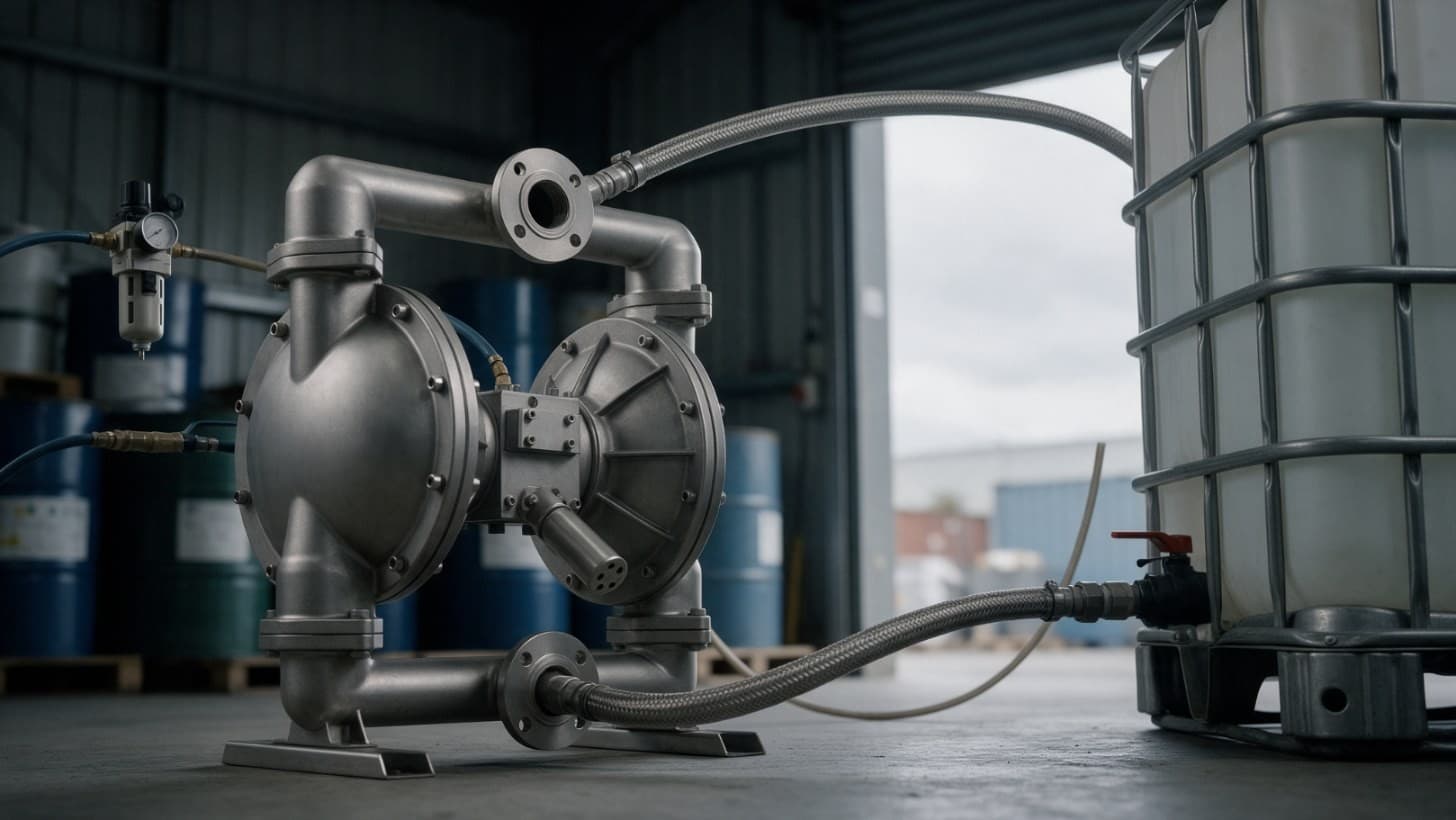
An air operated double diaphragm (AODD) pump moves liquid with two flexible diaphragms joined by a shaft and driven by compressed air, with check valves at the inlet and outlet [1, 2]. A standard pump cannot build more discharge pressure than the air pressure supplied [3]. You size one from its curve: mark your flow and discharge pressure, then read the air pressure and air volume the pump needs at that point [4]. Pick a size that meets the duty well below its maximum flow, because a small pump at full speed uses more air and makes more strokes than a larger one running slowly [5].
Why this matters now
AODD pumps are cheap and simple, so they often reach a purchase order with little more than a port size and a body material, yet the running cost is compressed air. The US Department of Energy puts the overall efficiency of a typical compressed air system as low as 10% to 15%, and says a 1 hp air motor needs about 7 to 8 hp of electricity at the compressor [8].
So a bid that is cheaper by one pump size can cost more within a year, as the example below shows.
Create and manage RFQs in minutes
ChemCapital handles the entire procurement cycle, from structured RFQs and supplier comparisons to formal purchase orders and delivery tracking.
How an AODD pump works
An air valve sends compressed air behind one diaphragm, which pushes liquid out of its chamber, while the shaft pulls the other diaphragm back to fill the second chamber. At the end of the stroke the valve switches sides [2]. Check valves, usually balls (Verder also offers cylinder valves), keep the liquid moving one way [1, 2, 3].
Three properties follow:
- It stalls rather than breaks. It keeps stroking until the discharge pressure equals the air pressure, then stops without damage and restarts when the pressure drops [2, 3]. Verder still advises a relief valve if the discharge line is rated below the air pressure [3].
- It tolerates dry running and primes itself. Tapflo quotes dry self priming up to 5 m but advises against long periods of dry running [7]; Verder gives dry lifts of 1 m to 5 m by size and valve type, and about 9 m once primed [3].
- It has no shaft seal and no motor. Solids pass and shear is low. The limits are air pressure, pulsating flow and air consumption [1].
The check valves set the largest solid: 2.2 mm to 11 mm across Verder's sizes, and 1.0 mm for Yamada's small NDP 15 [3, 6].
Reading the curve and sizing for a duty
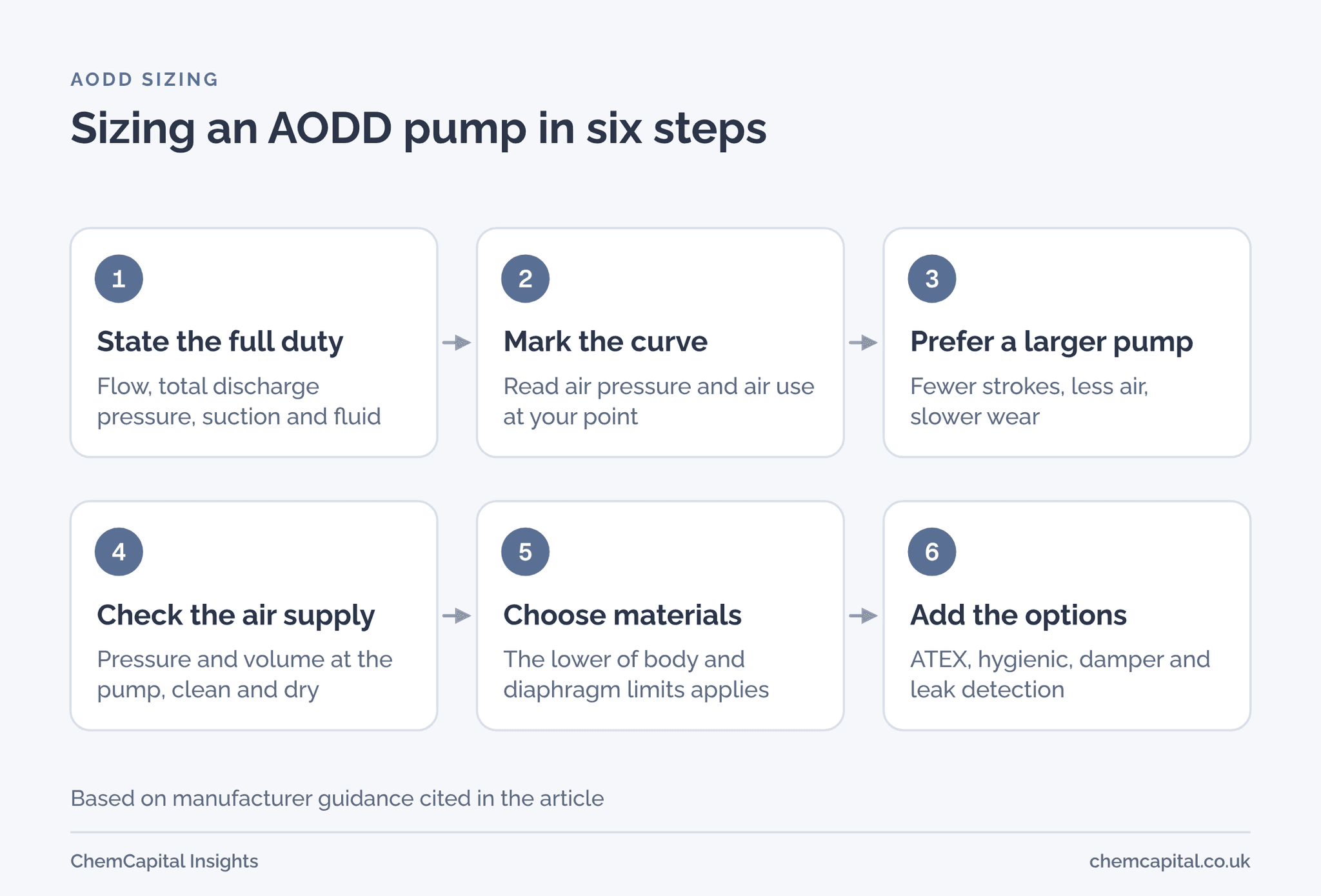
An AODD curve differs from the centrifugal curves in our guide to reading a pump curve. Flow runs along the horizontal axis and discharge pressure up the vertical axis, with one set of lines for air inlet pressure and another for air consumption [4]. To size a pump:
- Mark your flow and total discharge pressure on the chart.
- Read the air pressure line at that point: the air inlet pressure the pump needs.
- Read the air consumption line: the air volume, in Nm³/min (normal cubic metres per minute, air at reference conditions) or SCFM (standard cubic feet per minute), your supply must deliver [4].
PSG warns that if the air supply cannot deliver that volume, the pump may never reach its expected flow, however high the regulator gauge reads [4]. Setting the air higher than the duty needs only adds wear and air use [3].
Total discharge pressure includes static lift and friction in pipe and fittings. Viscous liquids raise friction, and diaphragm material changes the curve, so read the curve for the diaphragm offered [4].
Verder says a larger pump can use up to 50% less air. In its example a 1 inch pump needs 125 cycles a minute for 80 l/min where a 1.5 inch pump needs 32, and fewer strokes mean less wear on diaphragms, balls and seats [5].
Body and diaphragm materials
Body and diaphragm are chosen separately, and the lower temperature limit applies. Check the data sheet for the model offered.
| Material | Part | Maximum liquid temperature quoted |
|---|---|---|
| Polypropylene | Body | 82 °C whatever the diaphragm (Yamada) [6] |
| Polyethylene (PE) | Body | 70 °C, conductive grade available for ATEX (Verder) [3] |
| PVDF | Body | 120 °C with Hytrel or Viton diaphragms (Yamada) [6] |
| PTFE | Body | 100 °C to 120 °C by size, conductive grade available (Verder) [3] |
| Aluminium, 316 stainless steel | Body | No body limit listed by Yamada [6]; 110 °C for Tapflo's metal ranges [7] |
| Santoprene, Buna N, Neoprene | Diaphragm | 82 °C (Yamada) [6] |
| EPDM, PTFE | Diaphragm | 100 °C (Yamada) [6] |
| Hytrel, Viton | Diaphragm | 120 °C (Yamada) [6] |
Compatibility charts are only a start: concentration, temperature and mixtures change the answer. Ask each bidder to confirm in writing that body, diaphragms, balls, seats and O rings suit your fluid at its maximum temperature, including any cleaning fluid.
ATEX, hygienic versions and the air supply
For flammable liquids, specify a conductive pump with an earth point. In Verder's Pure plastic range, the ATEX versions are conductive PE or PTFE, marked II 2G and 2GD, with an earth connection whose continuity is checked after installation and regularly. Verder rules out pumping a non conductive flammable liquid with a non conductive pump, and where an ATEX pump has non conductive diaphragms it requires a conductive or water soluble liquid and monitoring to prevent dry running [3]. Check the marking against your own zone classification.
For food and pharma, Tapflo lists EHEDG certified aseptic pumps, and its pharmaceutical section refers to EHEDG, FDA and USP Class VI and to 316L stainless steel [7]. Ask for the certificate or material declaration behind each claim and which parts it covers.
Verder asks for clean, dry, oil free air, with a dryer or water separator where air quality is poor, and lists icing of the silencer or air valve as a reason a pump will not cycle, or stops after one cycle [3]. Each stroke sends a surge downstream [1]; Tapflo, which sells them, recommends an active damper that uses compressed air and a diaphragm to set its own pressure [7]. A larger pump gives fewer pulses, but each can be bigger [5].
When a diaphragm fails, liquid can escape through the air exhaust, so never restrict the exhaust, pipe it somewhere safe and consider leak detection [3].
When another pump is the better buy
| Duty | Usually the better buy | Why |
|---|---|---|
| Intermittent transfer, drum or IBC emptying, solids, risk of dry running or a closed outlet | AODD | Self priming, tolerates short dry running, stalls without damage, no seal or motor [1, 7] |
| Long hours moving a clean, thin liquid | Motor driven centrifugal | Air drive may be less efficient than a motor driven one [1, 8] |
| Abrasive fluid that wears check valves, or no compressed air on site | Peristaltic | Has no check valves to block or wear and needs no compressed air [2] |
| Viscous sludge, slurry or cream needing low pulsation flow | Progressive cavity | Low pulsation and gentle handling of viscous media; NETZSCH, which makes them, warns they are sensitive to dry running [9] |
What to put in the RFQ datasheet
- liquid, concentration, specific gravity, viscosity and temperature range
- solids content, largest particle and abrasiveness
- rated flow and total discharge pressure, with static lift and friction worked out
- suction conditions; Verder notes that inlet pressure above 25% of outlet pressure may stop the balls closing fast enough [3]
- hours per day, batch or continuous
- air pressure, volume and quality available at the pump
- materials for every wetted part, or a request for the bidder's recommendation
- ATEX zone, hygienic needs, damper and leak detection
Ask each bidder for the curve with your duty point marked, the air pressure, air use and cycles per minute there, the temperature limit and the price of a diaphragm and valve kit.
Practical example
Take an illustrative duty: 80 l/min of a water thin liquid against a total discharge pressure of 3 bar, for 2,000 hours a year. All figures are illustrative, including 0.11 kWh of compressor electricity per Nm³ of air and electricity at £0.25 per kWh, which puts air at about £0.03 per Nm³; Verder's example assumes €0.02 per Nm³ [5].
| Item | Bid A: 1 inch pump | Bid B: 1.5 inch pump |
|---|---|---|
| Displacement per cycle | 0.7 L | 2.0 L |
| Cycles per minute at 80 l/min | 114 | 40 |
| Air inlet pressure read from curve | 5.5 bar | 4.0 bar |
| Air consumption read from curve | 1.2 Nm³/min | 0.6 Nm³/min |
| Air per year | 144,000 Nm³ | 72,000 Nm³ |
| Compressor electricity per year | 15,840 kWh | 7,920 kWh |
| Air cost per year | £3,960 | £1,980 |
| Purchase price | £1,900 | £3,100 |
| First year total | £5,860 | £5,080 |
Bid B costs £1,200 more but saves £1,980 a year in air, paying back in about 7 months, and makes about a third of the strokes. Bid A also needs 5.5 bar at the pump, so check what the air main delivers on a busy shift.
Find suppliers that publish the data you need
Supplier Discovery searches the web for AODD pump suppliers from a plain text description, pasted RFQ or uploaded specification, extracts published product parameters with source links and gives each a fit verdict: Strong, Partial, Information Missing or Rejected. Certifications such as ATEX are shown as claimed, not verified, so ask for the certificate. Nothing is sent automatically, and you can attach suppliers to an RFQ. Then use our guide to technical bid evaluation.
Ready to find AODD pump suppliers for your duty? Start a free 14 day ChemCapital trial, with no credit card needed.
Frequently asked questions
How does an air operated diaphragm pump work?
An air valve sends compressed air behind one of two diaphragms joined by a shaft, pushing liquid out of that chamber while the other chamber fills, then switches sides at the end of each stroke. Check valves at the inlet and outlet keep the liquid moving one way.
How do you size an AODD pump?
Mark your flow and total discharge pressure on the manufacturer's curve, then read the air inlet pressure and air consumption at that point and check your air supply can deliver both. Choose a size that meets the duty well below its maximum flow, because a smaller pump at full speed uses more air and wears faster.
What is the maximum pressure of an air operated diaphragm pump?
A standard pump stalls when the discharge pressure equals the air pressure, so the air supply sets the limit: 7 bar for Verder's Pure range and 8 bar for most Tapflo models. Special high pressure versions for filter press feed go higher; Tapflo lists one rated at 16 bar.
What temperature can a polypropylene diaphragm pump handle?
Yamada limits its polypropylene pumps to 82 °C whatever the diaphragm, and Verder its PE pumps to 70 °C. The diaphragm can also set the limit: Yamada rates its PVDF pumps to 120 °C only with Hytrel or Viton diaphragms, while Santoprene is limited to 82 °C, so use the lower of the two.
Continue reading
Informational only, not procurement or legal advice. Cited names, frameworks, and statistics belong to their respective owners.
Create and manage RFQs in minutes
ChemCapital handles the entire procurement cycle, from structured RFQs and supplier comparisons to formal purchase orders and delivery tracking.
Start for freeRelated articles
Where to Find Pharma and Chemical Plant Projects Before They Go to Tender: the 2027 Pipeline
Twenty pharma and chemical plant projects checked against owner or government announcements, the buying timeline on each, and where to watch for the next ones for free.
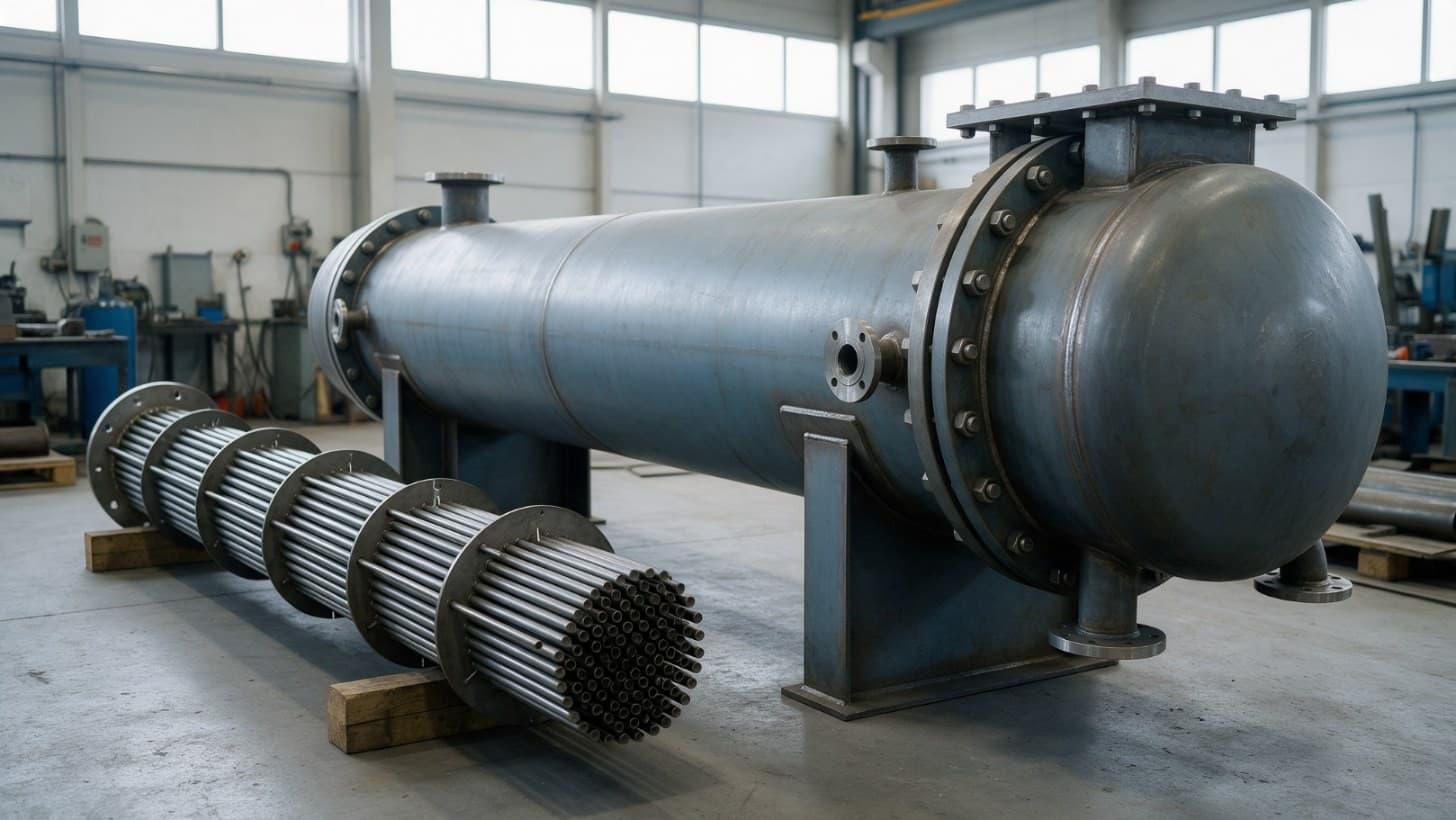
TEMA Heat Exchanger Types: How to Read AES, BEM and AEU
How to decode the three letter TEMA type, what AES, BEM, AEU and other common types mean for cleaning, expansion, leaks and cost, and how to compare bids that differ.
Safety Valve vs Relief Valve vs Bursting Disc: How to Choose
How safety valves, relief valves and bursting discs differ, when to fit a disc under a valve, the pressure terms that matter, GB duties and what to put in the RFQ.