
API 650 Storage Tanks: What Buyers Must Specify
What API 650 covers, when API 620 or BS EN 14015 fits better, roof types and venting, the data sheet choices that drive tank cost, and a worked two bid example.
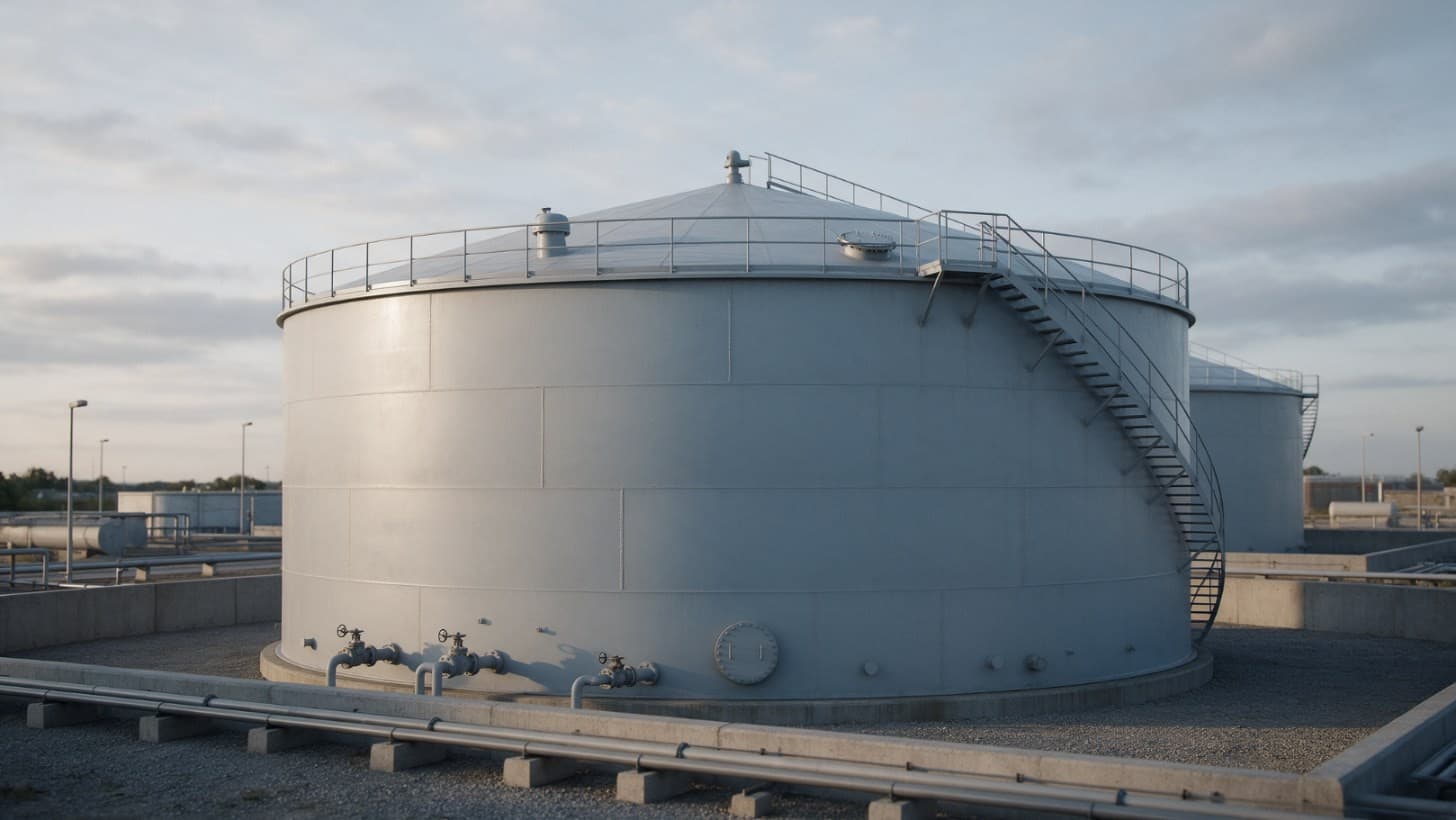
API 650 is the American Petroleum Institute standard for welded storage tanks, usually steel, that are vertical, cylindrical and above ground, with the whole bottom uniformly supported, holding liquid at close to atmospheric pressure. The base standard stops at a design temperature of 93 °C [1, 2], and Annex M extends it to 260 °C [1]. Annex F allows a small internal pressure, up to 2.5 psi gauge (17.2 kPa); above that, API 620 covers low pressure tanks up to 15 psig, or 103.4 kPa [3, 4]. BS EN 14015 is the European standard for comparable site built tanks [5].
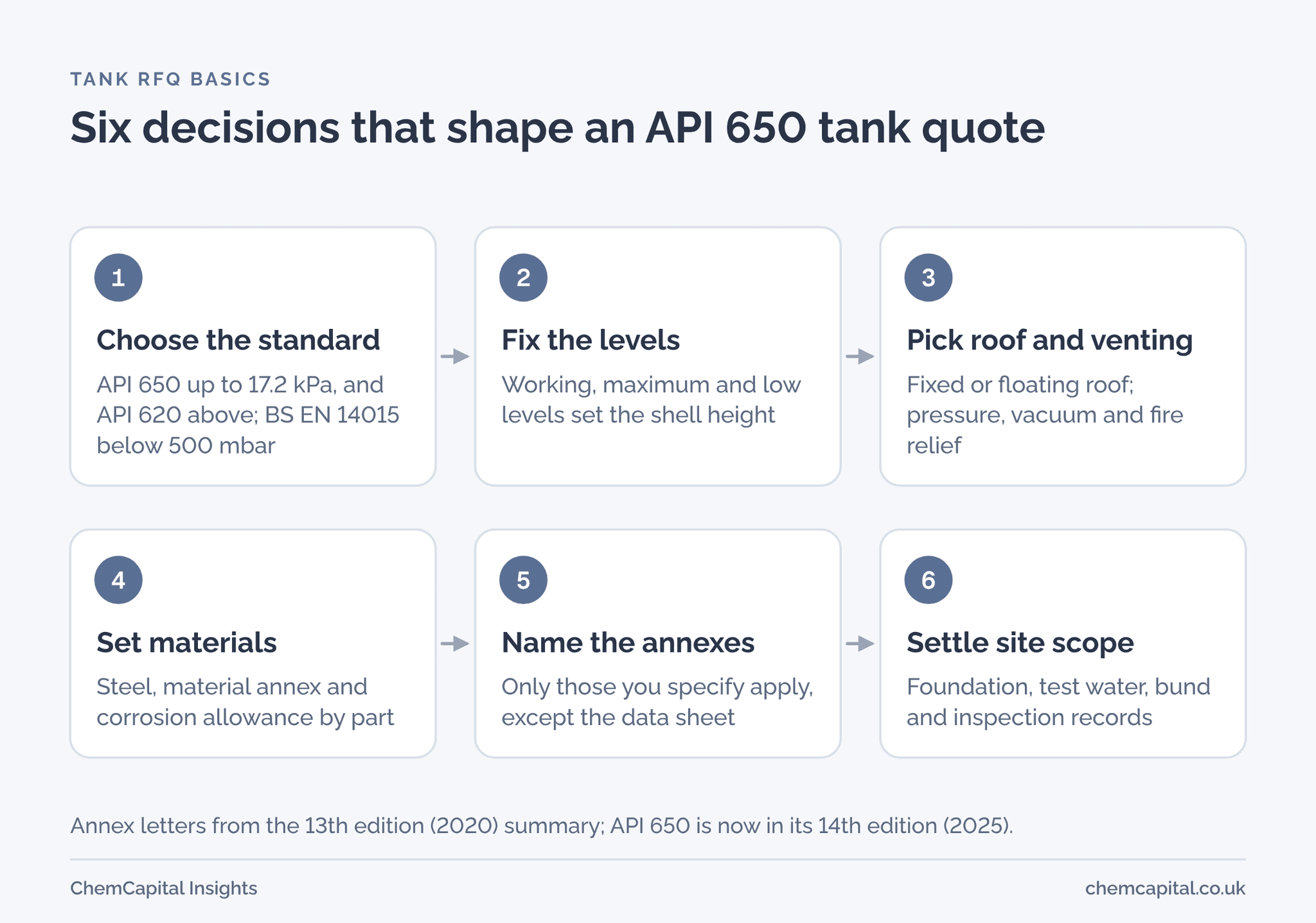
Writing "to API 650" on an enquiry settles less than it seems. Apart from the Annex L data sheet, an annex applies only when the purchaser specifies it [1]. The levels, design pressure and vacuum, roof, corrosion allowance and site scope are also yours to state, not the bidder's to assume.
Why this matters now
An enquiry that gives only a code and a volume leaves each bidder to fill those gaps. Quotes then differ in scope as much as price, and the technical bid evaluation turns into guessing what each bidder assumed.
In Great Britain, HSE guidance HSG176 expects tanks for flammable liquids to be built to a British, European or international standard, and covers venting, overfill protection and bunding. It complements the Approved Code of Practice for the Dangerous Substances and Explosive Atmospheres Regulations 2002 (DSEAR), and major hazard sites under COMAH also need formal emergency plans [6]. These choices shape the tank, so put them in the RFQ (request for quotation). This is general information, not legal advice.
Create and manage RFQs in minutes
ChemCapital handles the entire procurement cycle, from structured RFQs and supplier comparisons to formal purchase orders and delivery tracking.
API 650, API 620, BS EN 14015 or a shop built tank
Pressure, temperature and size usually decide the standard. API published the 14th edition of API 650 on 1 August 2025 [2], but the API 650 annex letters and limits below come from a summary of the 13th edition (March 2020) [1], so confirm them against the edition you specify.
| Standard | What it covers | Pressure | Temperature |
|---|---|---|---|
| API 650 | Welded, vertical, cylindrical, above ground tanks, open or closed top, bottom uniformly supported [1] | Close to atmospheric; Annex F up to 2.5 psi gauge (17.2 kPa) [3] | Up to 93 °C; Annex M up to 260 °C [1] |
| API 620 | Large carbon steel tanks welded on site for low pressure service, flat bottomed ones included, symmetrical about one vertical axis; 12th edition (2013, with addenda to 2021) [4] | Up to 15 psig (103.4 kPa) in the vapour space, the gas above the liquid [3, 4] | Metal up to 250 °F, about 121 °C [4] |
| BS EN 14015 | Site built, vertical, cylindrical, flat bottomed welded steel tanks, with or without floating roofs; not refrigerated tanks [5] | Below 500 mbar; vacuum up to 20 mbar [5] | Metal minus 40 °C to 300 °C [5] |
| API 650 Annex J | Tanks assembled completely in the shop, up to 6 m in diameter [1] | As API 650 | As API 650 |
| BS EN 12285 Part 2 | Shop built horizontal tanks, single or double skin, 800 mm to 3,000 mm diameter [7] | Up to 1.5 bar absolute [7] | Minus 20 °C to 50 °C [7] |
API 650 needs Annex V once the design vacuum exceeds 0.25 kPa, about 2.5 mbar [1], and tank pressure falls during emptying and cooling [6], so state the vacuum case. BS EN 14015 goes up to just under 500 mbar, nearly three times the 172 mbar of Annex F, so a 200 mbar tank stays within the European standard but needs API 620 in the API family. BS EN 14015 replaced BS 2654 [5]. Name one standard per tank.
Roof types and venting
Of the six tank designs in US EPA guidance, four are defined by their roof [8]:
- Fixed roof, usually cone or dome shaped, sometimes flat. It is the least expensive tank to build, but vapour leaves through the vents when the tank fills (working loss) and as it warms (breathing loss) [8].
- External floating roof, an open top shell with a pontoon or double deck roof that rises and falls with the liquid [1, 8].
- Internal floating roof, a floating deck under a permanent fixed roof [8], covered by Annex H [1].
- Domed external floating roof, usually a floating roof tank later given a fixed dome that keeps wind off the deck [8]. Annex G covers aluminium domes [1].
A floating roof minimises evaporation, with rim seals closing the gap at the shell [8], so it earns its cost on volatile products.
For flammable liquids, HSG176 asks for normal pressure relief, normal vacuum relief and emergency pressure relief. It recommends PV (pressure vacuum) valves, referring to BS EN ISO 28300, and a flame arrester on a fixed roof tank's vent where the flashpoint is below 23 °C, unless the liquid could polymerise or foul it. Emergency relief for fire engulfment can be larger vents, lifting hatches, a weak roof to shell joint or purpose built devices [6]. A weak roof joint is structural, so decide it before the roof is designed.
The data sheet decisions that drive cost
The Annex L data sheet is mandatory unless the purchaser waives it, and API 650 sets no fixed series of tank sizes [1], so the dimensions are yours to state. Corrosion allowance is extra plate thickness that can be lost in service without weakening the tank.
| Decision | What to state | Why it moves the price |
|---|---|---|
| Capacity and levels | Maximum working level, absolute maximum level [6], lowest level, any size limits | The shell is sized to your levels |
| Design conditions | Specific gravity, temperature, pressure and vacuum | Sets plate thickness and whether Annex F, M or V, or API 620, applies [1, 3] |
| Corrosion allowance | Millimetres for shell, bottom, roof and structure | Adds steel to every plate it covers |
| Materials | Carbon steel, or stainless (Annex S), duplex (Annex X), mixed (Annex SC) or aluminium (Annex AL) [1] | Each brings its own annex requirements |
| Nozzles | Size, rating, orientation, piping loads (Annex P), under bottom connections (Annex O) [1] | Reinforcement and fittings |
| Seismic | Site data if Annex E applies [1] | Changes the structural design |
| Foundation | Who designs and builds it; Annex B recommendations; leak detection (Annex I) [1] | Must be in or out of every bid |
| Testing | Test water supply and disposal; examination extent; ultrasonic in place of radiography (Annex U) [1] | Water, site time and inspection |
Our NDT methods guide compares radiography and ultrasonic testing. Tank size also drives the bund: HSG176 treats 110% of the largest tank, or 25% of the total if greater, as the normal minimum [6].
Inspection once the tank is in service
API 653 covers inspection, repair, alteration, relocation and reconstruction of tanks built to API 650 or its predecessor, API 12C [4]. BS EN 14015 does not cover in service inspection or repair [5].
EEMUA 159, now in its sixth edition (2025), covers tanks built to BS 2654, BS EN 14015, API 650, API 620 and other codes, and calls itself complementary to API 653 [9]. HSG176 calls for integrity management in line with EEMUA 159 where the alternative double bottom in BS EN 14015 is used [6]. Ask the builder now for what inspectors will need later: plate thicknesses by course, material certificates and foundation levels recorded during the water test.
Practical example
Take an illustrative carbon steel solvent tank with a fixed cone roof, 14 m in diameter with a 13 m shell. Its plan area is π ÷ 4 × 14² = 153.9 m², so the geometric capacity is 2,001 m³.
Set illustrative levels: 0.6 m at the bottom to keep the pump suction covered, and 1.0 m at the top for alarm margins. The working height is 11.4 m, giving 1,755 m³, or 88% of the geometric capacity. For 2,000 m³ between the levels you need 13.0 m of working height and a shell of about 14.6 m. State working capacity, or bidders may quote different tanks.
Two bids for the 13 m tank, with illustrative prices and rates:
| Item | Bid A | Bid B |
|---|---|---|
| Corrosion allowance, shell and bottom | 1.5 mm | 3.0 mm, as specified |
| Test water supply and disposal | Excluded | Included |
| Quoted price, erected | £380,000 | £405,000 |
| Extra 1.5 mm on 725.7 m²: 8,545 kg at £3,500 per tonne | £29,900 | None |
| Test water: about 2,000 m³ at £4 per m³ | £8,000 | None |
| Comparable price | £417,900 | £405,000 |
The shell is π × 14 × 13 = 571.8 m² and the bottom 153.9 m². At an assumed 7,850 kg/m³ for carbon steel, 1.5 mm more on both is about 8,545 kg. Treat that as an upper bound; the bidder's thickness calculation gives the real figure. Like for like, Bid A's £25,000 lead becomes a £12,900 deficit.
Find builders and send one data sheet
Supplier Discovery uses AI to search the web for tank fabricators from a description, pasted RFQ or uploaded specification, extracts published product parameters with source links, and gives each a fit verdict: Strong, Partial, Information Missing or Rejected. Certifications are shown as claimed, not verified, so check any API Monogram claim yourself; Annex Y covers marking by API licensees [1]. Nothing is sent automatically; you attach chosen suppliers to an RFQ. Three searches are free without signing up.
Ready to send one tank data sheet to every capable builder? Start a free 14 day ChemCapital trial, with no credit card needed.
Frequently asked questions
What is API 650?
API 650 is the American Petroleum Institute standard for welded, vertical, cylindrical, above ground storage tanks holding liquid at close to atmospheric pressure, with the whole bottom uniformly supported. The base standard covers design temperatures up to 93 °C, and in the 13th edition (2020) Annex M extends it to 260 °C; the 14th edition was published in August 2025, so check annex details against it.
What is the difference between API 650 and API 620?
API 650 tanks run close to atmospheric pressure, with Annex F allowing a small internal pressure of up to 2.5 psi gauge (17.2 kPa). API 620 covers large, field assembled, low pressure tanks with up to 15 psig (103.4 kPa) in the vapour space and metal temperatures up to 250 °F (about 121 °C).
Is BS EN 14015 the same as API 650?
Both cover site built, vertical, cylindrical, flat bottomed welded steel tanks (API 650 also covers small shop assembled tanks under Annex J), but the limits differ. BS EN 14015 covers design pressures below 500 mbar, vacuum of no more than 20 mbar and design metal temperatures from minus 40 °C to 300 °C, and it replaced BS 2654.
What are the main types of storage tank roof?
The main types are the fixed roof (cone or dome), the external floating roof, the internal floating roof under a fixed roof, and the domed external floating roof. US EPA guidance calls the fixed roof tank the least expensive to build, while a floating roof minimises evaporation of a volatile product.
Continue reading
Informational only, not procurement or legal advice. Cited names, frameworks, and statistics belong to their respective owners.
Create and manage RFQs in minutes
ChemCapital handles the entire procurement cycle, from structured RFQs and supplier comparisons to formal purchase orders and delivery tracking.
Start for freeRelated articles
Where to Find Pharma and Chemical Plant Projects Before They Go to Tender: the 2027 Pipeline
Twenty pharma and chemical plant projects checked against owner or government announcements, the buying timeline on each, and where to watch for the next ones for free.
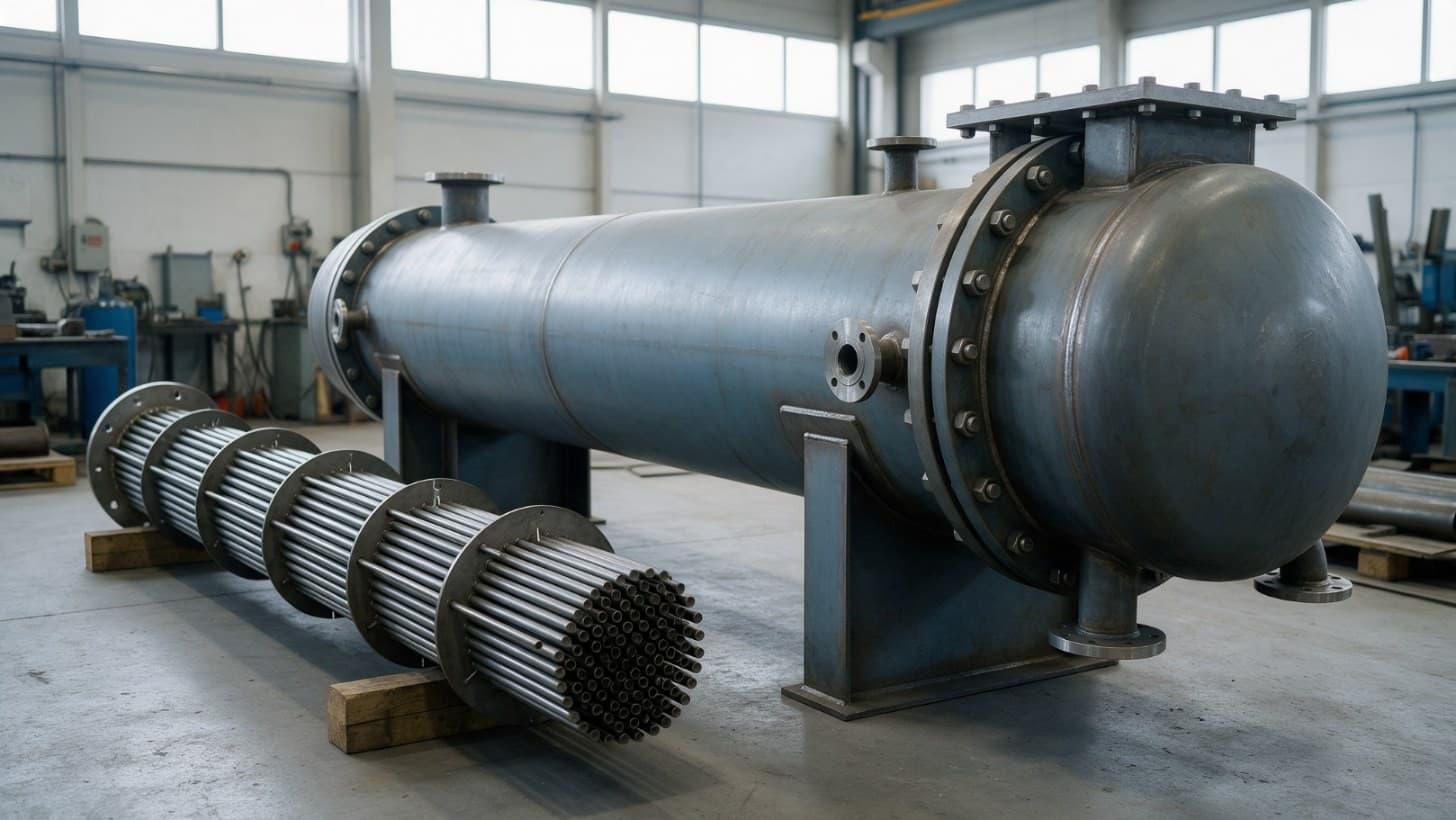
TEMA Heat Exchanger Types: How to Read AES, BEM and AEU
How to decode the three letter TEMA type, what AES, BEM, AEU and other common types mean for cleaning, expansion, leaks and cost, and how to compare bids that differ.
Safety Valve vs Relief Valve vs Bursting Disc: How to Choose
How safety valves, relief valves and bursting discs differ, when to fit a disc under a valve, the pressure terms that matter, GB duties and what to put in the RFQ.