
Approved Supplier for API and Fine Chemical Plants: What They Ask That Sterile Sites Do Not
API and fine chemical sites ask equipment suppliers for GMP evidence under ICH Q7 and safety evidence for hazardous areas, pressure and containment. What each requirement means for your approval pack, with an illustrative filter dryer example.
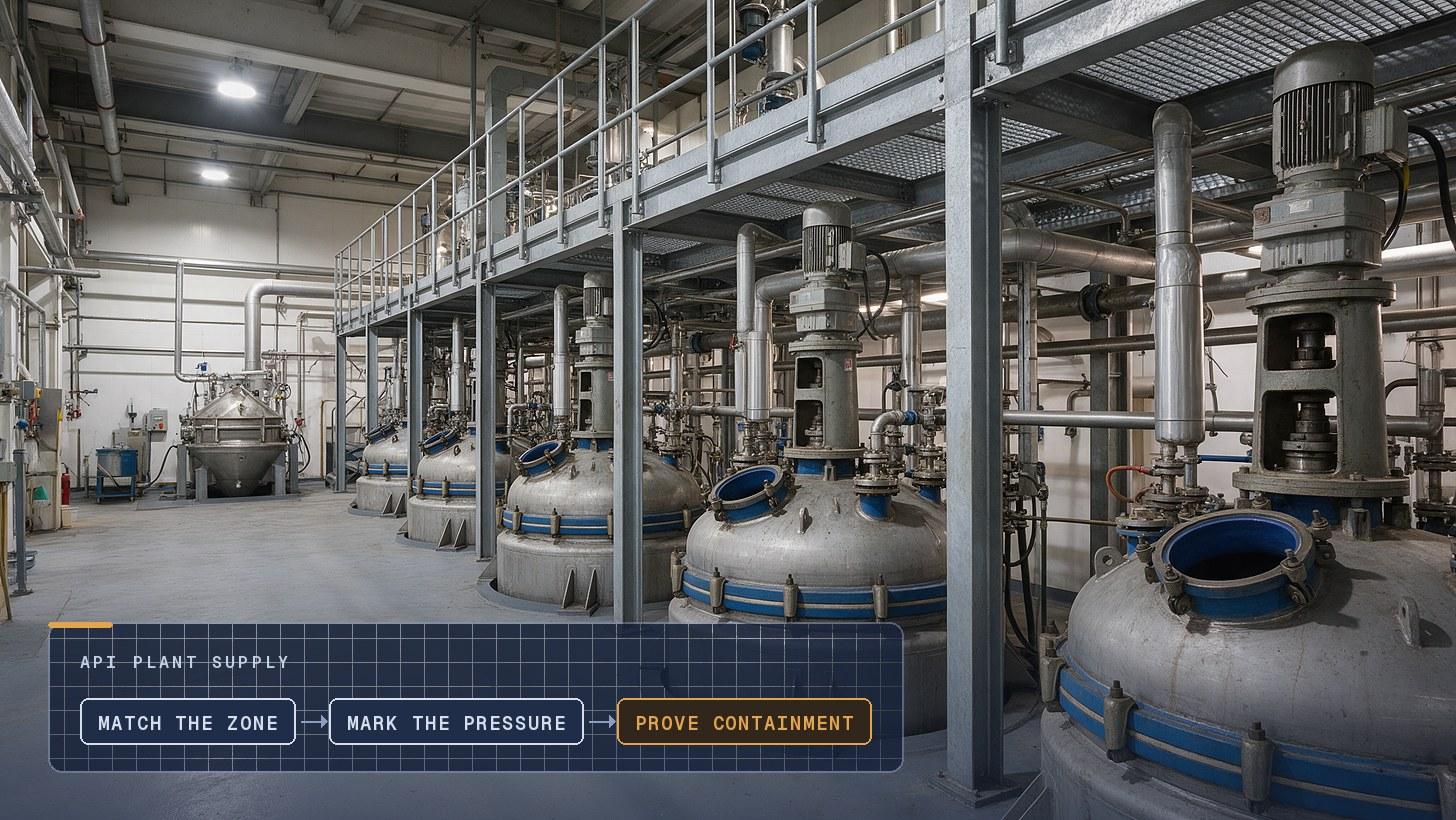
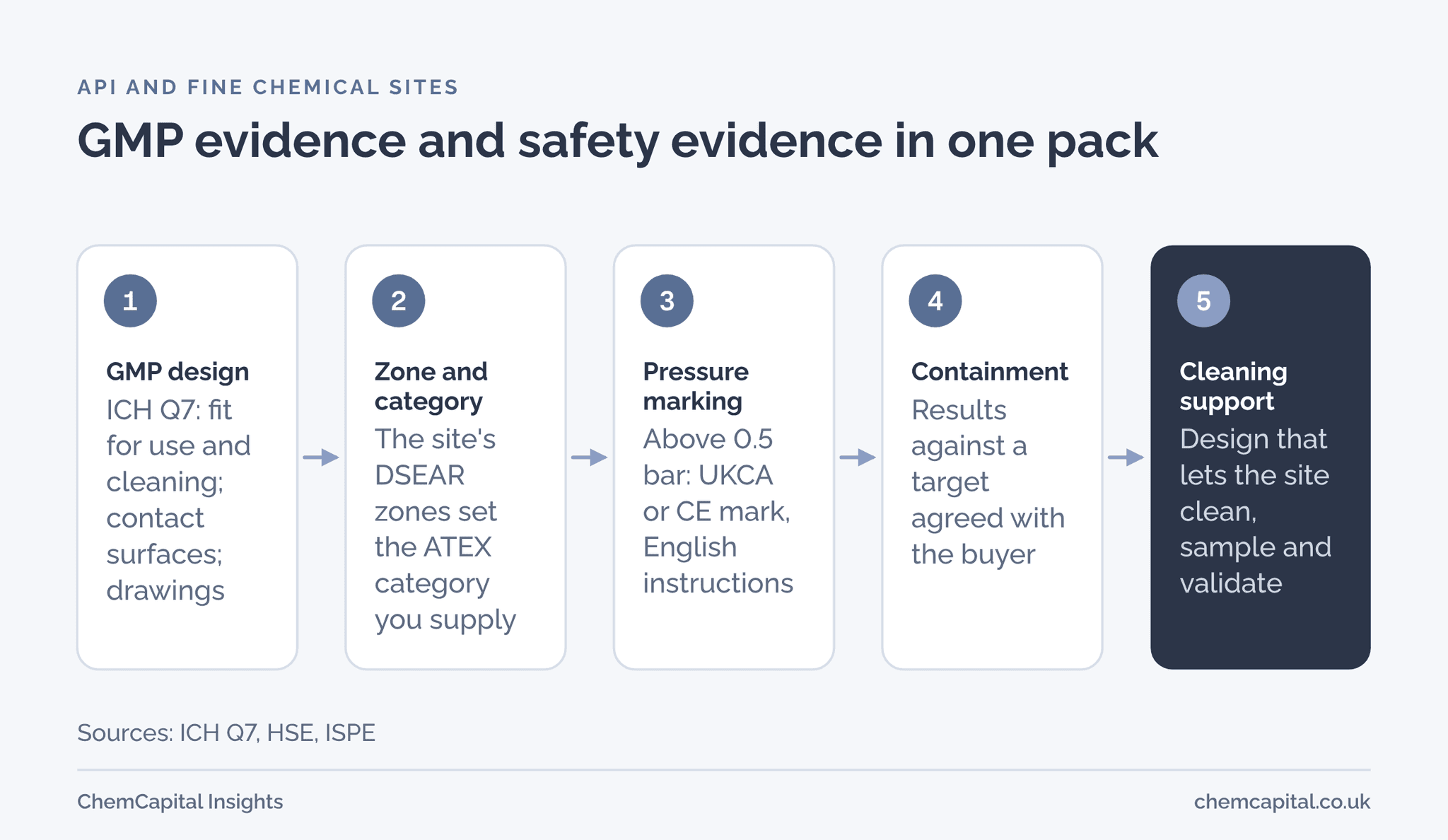
An API or fine chemical site asks an equipment supplier for two sets of evidence at once. The first is GMP evidence under ICH Q7: equipment designed for its use and for cleaning, contact surfaces that do not alter the product, current drawings and support for validated cleaning [1]. The second is safety evidence, because ICH Q7 leaves the safety of the people doing the work out of its scope [1]: equipment for the zones the site's explosion risk study defines, pressure equipment correctly marked, and, for potent compounds, containment performance measured against an agreed target [2] [3] [4]. This guide covers what that second set adds to the GMP pack.
ChemCapital is not affiliated with ICH, the EMA, the HSE or ISPE. This guide summarises their published texts; the buyer's own specification and risk assessments decide what you must supply. Checked on 24 November 2026.
Two regimes run side by side
ICH Q7, the GMP guide for active pharmaceutical ingredients, applies from the point where the API starting material enters the process, and it says plainly that it does not cover safety for the people doing the work or protection of the environment; those are left to the manufacturer and national law [1]. In Great Britain that national law includes DSEAR for explosive atmospheres and the Pressure Equipment (Safety) Regulations for pressure equipment [2] [3]. A synthesis plant handling flammable solvents under pressure lives under all three at once, so your approval pack has to answer all three.
Our guide to buying for sterile and biologics sites covers the hygienic document pack; this guide covers what API and fine chemical sites add.
API sites need equipment that answers GMP and safety questions together. List your products free on ChemCapital so their engineers can find you by duty, size, material and certification and invite you to quote.
What an API site asks for that a sterile site does not
| Requirement | What the site asks you for | Where it comes from |
|---|---|---|
| Hazardous area | Equipment marked with the group and category that suits each zone in the site's study | DSEAR zoning [2]; ATEX marking duty [5] [6] |
| Pressure | UKCA or CE marking and instructions in English for equipment above 0.5 bar maximum allowable pressure | Pressure Equipment (Safety) Regulations [3] |
| Containment | Containment performance test results against a target agreed with the buyer, for potent or toxic compounds | ISPE SMEPAC method [7] [4]; ICH Q7 dedicated or contained equipment [1] |
| Cleaning between products | Cleanable design, drawings, and information that supports the site's cleaning validation, including where residues can be sampled | ICH Q7 cleaning and cleaning validation [1] |
| Closed operation | Closed or contained equipment where appropriate, with precautions where it must be opened | ICH Q7 [1] |
| Operating substances | Lubricants and coolants that cannot compromise the product, food grade where possible | ICH Q7 [1] |
| Drawings | Current drawings of the equipment and critical installations, kept up to date | ICH Q7 [1] |
Hazardous areas: the site zones, you match the category
Under DSEAR the site must carry out a hazardous area study and record its conclusions as zones; DSEAR then links each zone to the equipment that may be installed there [2]. Equipment falls under the ATEX equipment rules when it is intended for a potentially explosive atmosphere and has its own potential source of ignition, and the manufacturer or supplier must mark it with the group and category it suits [5]. For non mining equipment, category 1 suits Zones 0 and 20, category 2 suits Zones 1 and 21, and category 3 suits Zones 2 and 22 [6]. Ask for the zone drawing before you quote; our guide to ATEX and DSEAR equipment explains the marking in detail.
Pressure equipment: marking and instructions
The Pressure Equipment (Safety) Regulations cover equipment and assemblies with a maximum allowable pressure above 0.5 bar. New equipment placed on the market in Great Britain must be UKCA or CE marked and come with instructions in English [3]. Jacketed reactors and filter dryers often fall inside that scope, so the declaration of conformity and the conformity assessment module belong in your pack from the first quote. Our guide to PED conformity assessment modules explains the routes.
Containment: agree the target, then prove it
ICH Q7 expects dedicated production areas or equipment for highly sensitising materials, and asks sites to consider them for highly potent or toxic ones unless inactivation or cleaning is validated [1]. Where a site shares equipment, containment and cleaning carry the load. ISPE's SMEPAC guide, in its third edition since December 2024, sets out standard methods for measuring the airborne emissions and surface deposits of a surrogate material processed in the equipment under defined conditions [7]. ISPE describes it as a way to verify that containment meets the target agreed between the equipment vendor and the purchaser, before purchase or later in the equipment's life [4]. Agree that target, the surrogate and the test conditions in the contract, not after delivery.
Cleaning support is part of the equipment
ICH Q7 asks for written cleaning procedures, cleaning between different materials on non dedicated equipment, justified residue limits, and normally validated cleaning, with a protocol that describes the equipment and sampling by swabbing, rinsing or other methods [1]. The site writes and validates that procedure, but it can only do so if your design lets it reach and sample the surfaces that matter. Our guides to glass lined reactors and agitated nutsche filter dryers cover the design points buyers check.
Practical example
All figures are illustrative. A European maker quotes a 1.0 square metre agitated nutsche filter dryer at £420,000 to a UK API site that handles flammable solvents and a potent intermediate. The site's DSEAR study classifies the room as Zone 1, so the drive motor and instruments must be category 2 or category 1 [6]. The dryer's maximum allowable pressure is well above 0.5 bar, so it ships UKCA or CE marked with English instructions [3].
The buyer also wants a containment test. The maker and the site agree a target, a surrogate and the operations to test, and the maker runs a SMEPAC style test at its works for £18,000, about 4.3% of the order value. Because the target was agreed in the contract, the result is accepted at the factory acceptance test rather than argued over on site.
Being found by API and fine chemical buyers
API sites need suppliers who can answer GMP and safety questions in the same pack. ChemCapital lists suppliers by what they make: buyers search by duty, size, material and certification and can invite you to quote before you are on their approved vendor list. You can see what a free supplier listing includes.
Ready to be found by API and fine chemical buyers? List your company on ChemCapital. It is free to start.
Frequently asked questions
Does ICH Q7 cover equipment safety?
No. ICH Q7 says it does not cover safety for the people doing the work or protection of the environment; those are left to the manufacturer and national law, which in Great Britain includes DSEAR and the Pressure Equipment (Safety) Regulations.
Which ATEX category does my equipment need?
It depends on the zone in the site's hazardous area study. For non mining equipment, category 1 suits Zones 0 and 20, category 2 suits Zones 1 and 21, and category 3 suits Zones 2 and 22. Ask for the zone drawing before you quote.
What is a SMEPAC test?
It is a containment performance test using ISPE's standard methods: a surrogate material is processed in the equipment under defined conditions and the airborne emissions and surface deposits are measured against a target agreed between vendor and purchaser.
Does pressure equipment for a UK API plant need UKCA marking?
Equipment with a maximum allowable pressure above 0.5 bar that is placed on the market in Great Britain must be UKCA or CE marked and supplied with instructions in English.
Continue reading
Informational only, not procurement or legal advice. Cited names, frameworks, and statistics belong to their respective owners.
Be found by buyers who search by specification
Create your profile and list your products so buyers can find you and invite you to quote. It is free to start: list up to five products and quote on your first three RFQs at no cost.
List your products freeRelated articles
Approved Supplier for Sterile and Biologics Sites: The Document Pack by Equipment Type
What a sterile or biologics site asks an equipment supplier for, by equipment type: vessels, valves, pumps, filter housings, skids, isolators and single use assemblies, traced to EU GMP Annex 1 and Annex 15, ASME BPE and GAMP 5.
Sustainability Requirements for Equipment Suppliers: SBTi, EcoVadis, TfS and PSCI
What pharma and chemical buyers now ask a 50 person equipment fabricator for on sustainability, which requests are firm and which are preferred, and what SBTi validation, EcoVadis, TfS, PSCI and UK Carbon Reduction Plans take.
Shell Supplier Qualification: The Profile Questionnaire and HSSE Assessment
Shell registers suppliers by invitation from its procurement data team. How the invitation, the Supplier Profile Questionnaire, ethics, financial and HSSE checks and the Ariba accounts work, and how to spot fake Shell vendor registrations.