
Agitated Nutsche Filter Dryer (ANFD): A Buyer's Guide
What an agitated nutsche filter dryer does, how to size it by cake volume and filter area, materials, pressure, OEB containment, and what the URS, RFQ and FAT must cover.
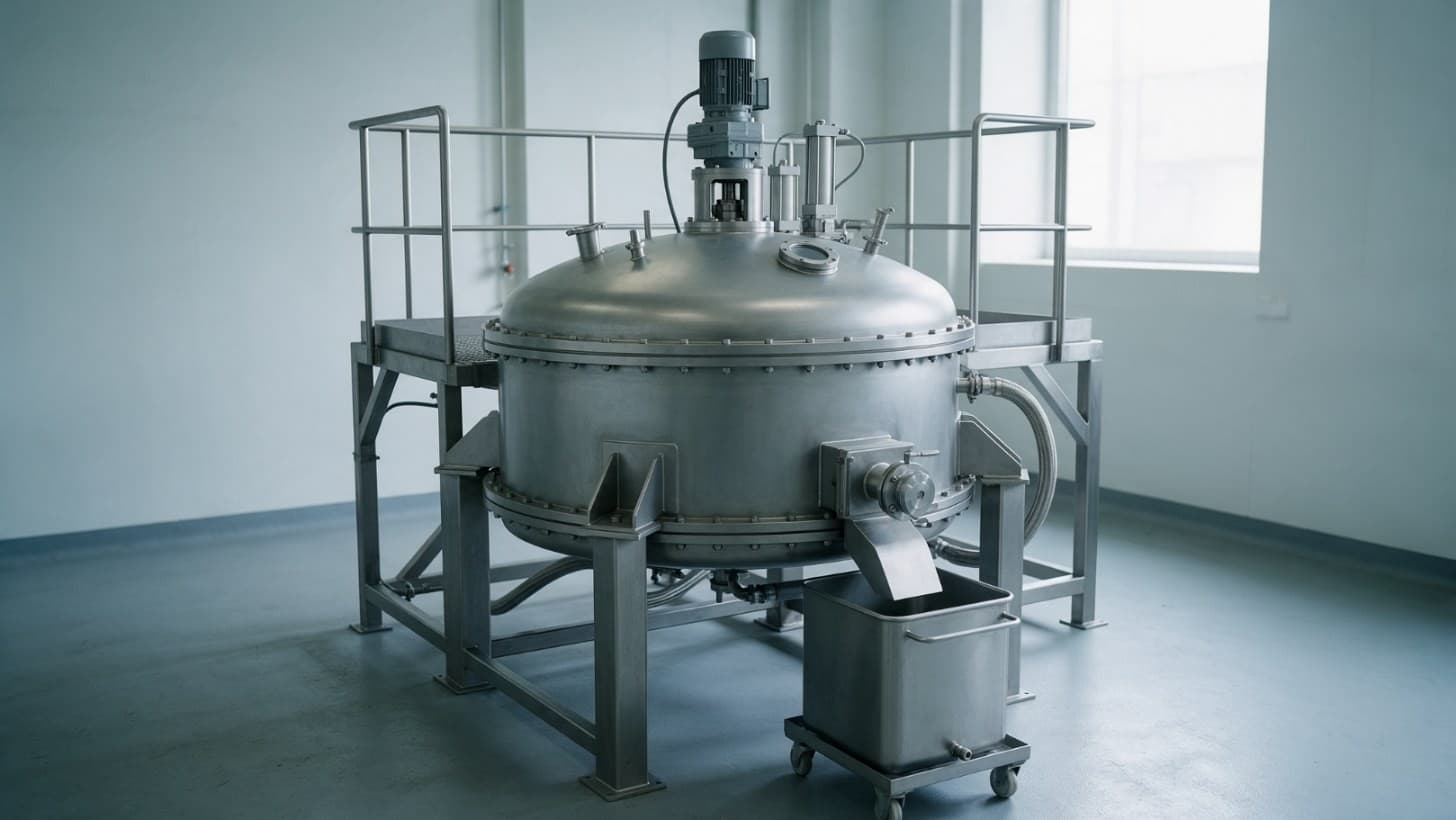
An agitated nutsche filter dryer (ANFD) is a closed, jacketed vessel with a flat filter plate in its base and an agitator that turns and travels up and down through the cake. In that one vessel it filters a slurry, washes the cake, reslurries it if needed, dries it and discharges the powder, so the product never moves between machines [1, 2]. A 2022 study by the University of Leeds and AbbVie calls agitated filter bed drying the pharmaceutical industry's preferred way to isolate active pharmaceutical ingredients (APIs) [3].
To buy one well, fix the cake volume per batch first; filter area and cake depth follow from it.
Why this matters now
Most ANFD options are fixed at order: heated agitator, discharge isolator, cleaning nozzles, filter plate and type of medium. Containment claims differ too: De Dietrich's pack off station comes in OEB4 or OEB5 versions [2], 3V Tech offers isolators up to OEB6 [4], and 3M's suggested banding table stops at OEB 5 [5]. Two bids that both say "OEB 5" may not promise the same thing, so the RFQ (request for quotation) must define the terms.
Create and manage RFQs in minutes
ChemCapital handles the entire procurement cycle, from structured RFQs and supplier comparisons to formal purchase orders and delivery tracking.
What an ANFD does in one batch
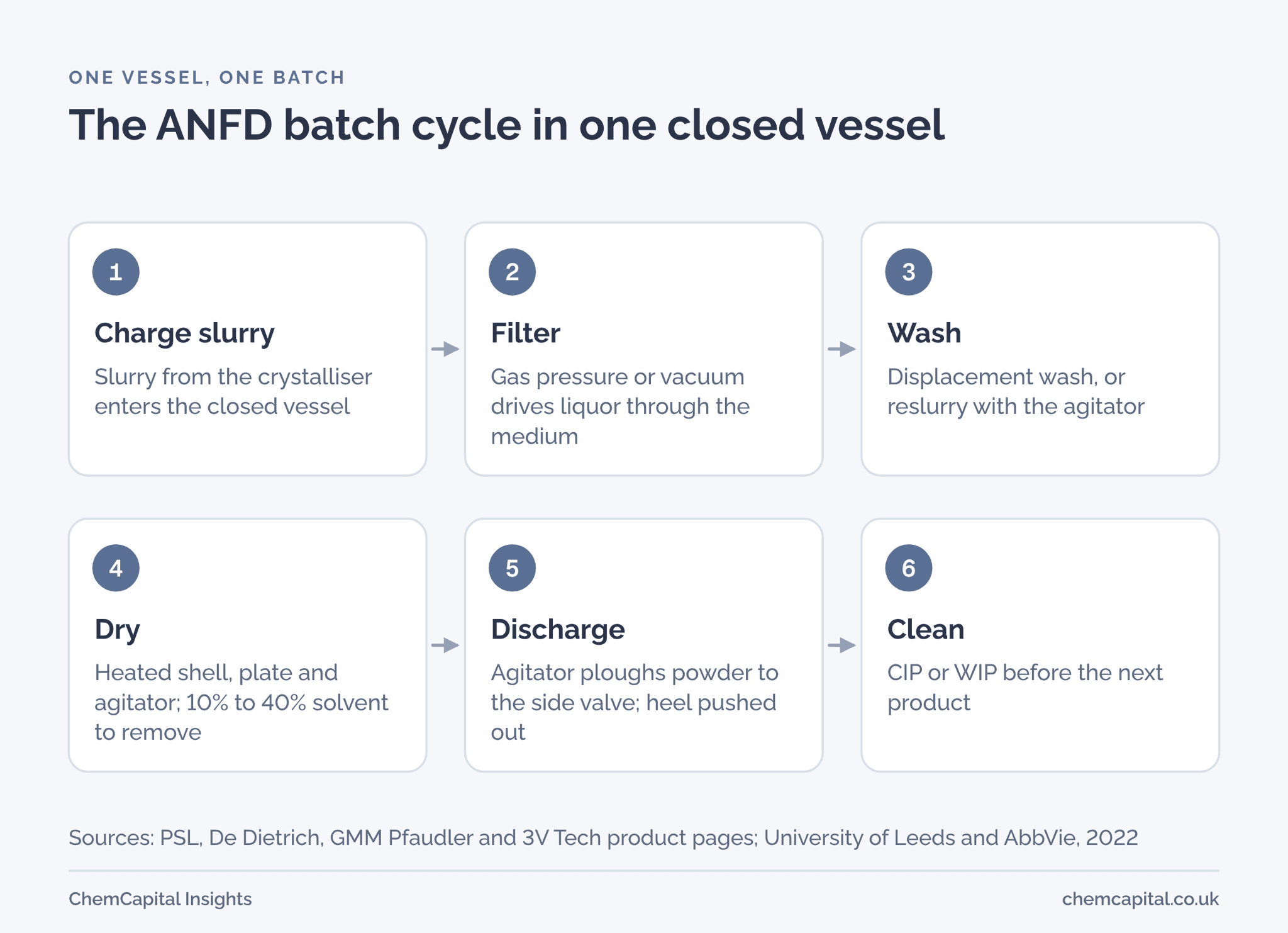
A nutsche is a flat bed filter: gas pressure or vacuum drives the liquid through a horizontal filter medium. The ANFD adds a jacket, an agitator and a sealed discharge, and works under both vacuum and pressure [1].
Filtration. As the mother liquor, the liquid the crystals formed in, drains, a cake builds up. PSL's agitator can run in either direction, levelling the cake one way and turning it over gently the other [1]. Levelling closes cracks that let gas or solvent bypass the cake.
Washing. Solvent is pushed straight through the cake, or the agitator resuspends the cake in solvent, a reslurry wash, before the liquid is pressed out [1].
Drying. Heat enters through the jacketed shell and, on many units, the filter plate and agitator; De Dietrich claims 15% to 20% faster drying with a heated shaft and agitator [2]. A filtered cake typically holds about 10% to 40% solvent, and drying can take hours to days [3].
Discharge. The agitator ploughs the powder to a side valve that seals against pressure and vacuum [1, 2]. What remains is the heel, a thin layer below the blade tips. De Dietrich pushes it out with nitrogen, quoting up to 99% efficiency [2].
Agitation and particle breakage
The Leeds study says blade shear can break crystals or cause agglomeration; typical industrial speeds are about 5 to 10 rpm, and as low as 2 rpm for fragile material [3]. In their laboratory tests a smaller gap between blades and base generally caused more breakage, and they warn against agitating a cake that is still wet [3]. Ask bidders for the speed range, lift control and minimum clearance, and trial your product first.
Sizing: batch volume, cake depth and filter area
Sizing starts with the solids, not the slurry. Lab filtration tests give the cake loading, kilograms of dry product per litre of wet cake. Then:
- cake volume per batch = dry product per batch ÷ cake loading
- cake depth = cake volume ÷ filter area
PSL's published sizes show the pattern [1]:
| Filter area | Cake volume | Cake height | Maximum liquid volume |
|---|---|---|---|
| 0.3 m² | 6 L to 120 L | 20 mm to 400 mm | 270 L |
| 0.6 m² | 12 L to 240 L | 20 mm to 400 mm | 600 L |
| 1.0 m² | 50 L to 400 L | 50 mm to 400 mm | 1,000 L |
A deeper cake slows filtration, washing and drying; a very shallow one gives the blades little to work on. The Leeds authors say a bed of two to three times the blade height is normal [3]. Check slurry and wash volumes against liquid capacity too.
Materials, pressure rating and containment
Four makers' published data differ widely:
| Maker and range | Filter area | Pressure and temperature | Wetted materials | Containment and cleaning |
|---|---|---|---|---|
| PSL ANFD [1] | 0.05 m² to 1.0 m² | No figures given | Stainless steel or alloy 22; PFA coating | Negative pressure, HEPA filtered |
| De Dietrich ANFD [2] | Up to 16 m² | Not stated | Stainless steel, Hastelloy; glass lined option | Pack off in OEB4 or OEB5; SIP option |
| GMM Pfaudler MAVAZWAG [6] | Not stated | PED or ASME design | Stainless steel, Hastelloy, special alloys; glass lined | Double seal filter base; CIP and SIP in GMP designs |
| 3V Tech Filtrodry FEP/XD [4] | Up to 8 m² | Minus 1 to plus 6 barg; minus 25 °C to 200 °C | 316L, duplex, alloy C22, titanium | Isolators up to OEB6; CIP spray balls |
Materials, media and ratings
Makers offer 316L stainless steel or nickel alloys such as alloy C22 for wetted parts [1, 4]. Where even Hastelloy C22, C276 or B3 is not resistant enough, De Dietrich and GMM Pfaudler offer glass lined units [2, 6]; De Dietrich presents its glass lined filter dryer as a lower investment alternative to an alloy C22 unit [7]. Glass has its own limits; see our guide to jacketed vessels and glass lined reactors.
PSL offers polypropylene, PEEK or PTFE cloth as a consumable, or sintered metal mesh, which costs more but is cleaned in situ [1]. State the internal finish as an Ra value; none of these maker pages gives one.
Rate each heating circuit as well as the vessel, and state the code and marking you need; in 3V Tech's range, minus 1 barg is full vacuum [4].
Containment, OEB and cleaning
An occupational exposure band (OEB) groups compounds by potency; each covers a range of occupational exposure limits (OELs), the airborne concentrations workers may be exposed to. In 3M's suggested table, OEB 3 covers OELs above 10 and up to 100 µg/m³, OEB 4 above 1 and up to 10 µg/m³, and OEB 5 below 1 µg/m³; 3M warns its tables may not suit every company [5]. So put the OEL in µg/m³ in the URS, with the containment test method. ISPE's SMEPAC guide (third edition, December 2024) sets out standard tests that run a surrogate powder through the equipment and measure what reaches the air and what settles nearby [8].
With the vessel closed, the weak points are the seals and the discharge. Cleaning must reach the dust filter too; De Dietrich's glass lined unit has a WIP (wash in place) device for both [7].
Flammable solvent is not the only hazard: the dried powder may form an explosive dust cloud. HSE lists dusts as well as solvents among the substances covered by DSEAR, the Dangerous Substances and Explosive Atmospheres Regulations 2002, under which employers must manage fire and explosion risk and classify places where explosive atmospheres can arise [9]. State the area classification for drives, instruments, discharge and dust filter, any nitrogen inerting, and give bidders the product's dust explosibility data. This is general information, not legal advice.
What the URS, RFQ and FAT must cover
Write the URS (user requirement specification) in process terms and let bidders propose the machine; our URS template gives the structure.
| Item | State in the URS and RFQ | Check at FAT |
|---|---|---|
| Capacity | Dry product per batch, cake loading, slurry and wash volumes | Filter area and working volume |
| Pressure | Vessel and jacket ratings, full vacuum, code | Pressure test record, vacuum hold |
| Materials | Wetted materials, filter medium, seals, finish | Material certificates, finish readings |
| Agitator | Speed range, lift travel, minimum clearance, seal | Rotation both ways, clearance measured |
| Containment | OEL in µg/m³, discharge interface, test method | Surrogate test, if specified |
| Cleaning | CIP (clean in place) or WIP coverage, SIP if sterile | Spray coverage, drain points |
| Controls | Recipes, interlocks, hazardous area rating | Sequence and interlock tests |
Our FAT checklist covers the factory acceptance test method.
Practical example
Take an illustrative intermediate: 150 kg of dry product per batch, lab cake loading 0.5 kg per litre. The cake is 150 ÷ 0.5 = 300 L, or 360 L with 20% allowed for growth, and the slurry is 750 L. Both bidders quote the 400 mm maximum cake height and liquid capacities in PSL's table [1].
| Check | Bid A: 0.6 m² | Bid B: 1.0 m² |
|---|---|---|
| Cake depth, 300 L | 500 mm | 300 mm |
| Cake depth with growth, 360 L | 600 mm | 360 mm |
| Slurry charge, 750 L | Two charges, 600 L capacity | One charge, 1,000 L capacity |
| Verdict | Too small for the batch | Fits with margin |
Bid A holds at most 0.6 m² × 0.4 m = 240 L of cake, or 120 kg of product, so every batch needs two loads. A lower price is no saving.
For Bid B, a reslurry wash at an illustrative 2 L of solvent per kg is 300 L; with 300 L of cake that makes 600 L, within 1,000 L. A 300 mm cake suits blades about 100 mm to 150 mm high [3]. At an illustrative 25% solvent by mass, the wet cake weighs 150 ÷ 0.75 = 200 kg and holds 50 kg of solvent; ask each bidder for the expected drying time and its basis.
Find makers who can build it
Supplier Discovery searches the web for filter dryer makers from a plain text description, pasted RFQ or uploaded spec. It extracts makers' published parameters with source links and gives each a fit verdict, from Strong to Rejected. Certifications are shown as claimed, not verified, nothing is sent automatically, and you can try three searches free without signing up.
Ready to find ANFD makers that match your URS? Start a free 14 day ChemCapital trial, with no credit card needed.
Frequently asked questions
What is an agitated nutsche filter dryer used for?
It separates solids from a slurry and dries them in one closed vessel: filtration, cake washing, reslurry and drying, then discharge as a powder. It is widely used to isolate and dry active pharmaceutical ingredients, where operators should not handle the product.
How do you size a nutsche filter dryer?
Divide the dry product per batch by the cake loading measured in the lab to get the cake volume, then divide by the filter area to get the cake depth and keep it inside the maker's working range. Then check that the slurry charge and any reslurry wash fit the vessel's liquid capacity.
What is the difference between a nutsche filter and a filter dryer?
A nutsche filter separates and washes the cake. A filter dryer adds a heated jacket and usually heated agitator blades, so the wet cake can be dried and discharged as a powder in the same unit.
What OEB can an ANFD achieve?
It depends on the seals and the discharge system, not the vessel alone, and band scales are not the same everywhere: makers quote isolators up to OEB6, while 3M's suggested table stops at OEB 5. So specify the OEL in µg/m³ and a test method such as ISPE SMEPAC.
Continue reading
Informational only, not procurement or legal advice. Cited names, frameworks, and statistics belong to their respective owners.
Create and manage RFQs in minutes
ChemCapital handles the entire procurement cycle, from structured RFQs and supplier comparisons to formal purchase orders and delivery tracking.
Start for freeRelated articles
Where to Find Pharma and Chemical Plant Projects Before They Go to Tender: the 2027 Pipeline
Twenty pharma and chemical plant projects checked against owner or government announcements, the buying timeline on each, and where to watch for the next ones for free.
TEMA Heat Exchanger Types: How to Read AES, BEM and AEU
How to decode the three letter TEMA type, what AES, BEM, AEU and other common types mean for cleaning, expansion, leaks and cost, and how to compare bids that differ.
Safety Valve vs Relief Valve vs Bursting Disc: How to Choose
How safety valves, relief valves and bursting discs differ, when to fit a disc under a valve, the pressure terms that matter, GB duties and what to put in the RFQ.