
PED Conformity Assessment Modules Explained for Manufacturers
Category decides which PED modules you may use; your production pattern decides which one you should use. Here is every module, what the notified body does, and how to choose.
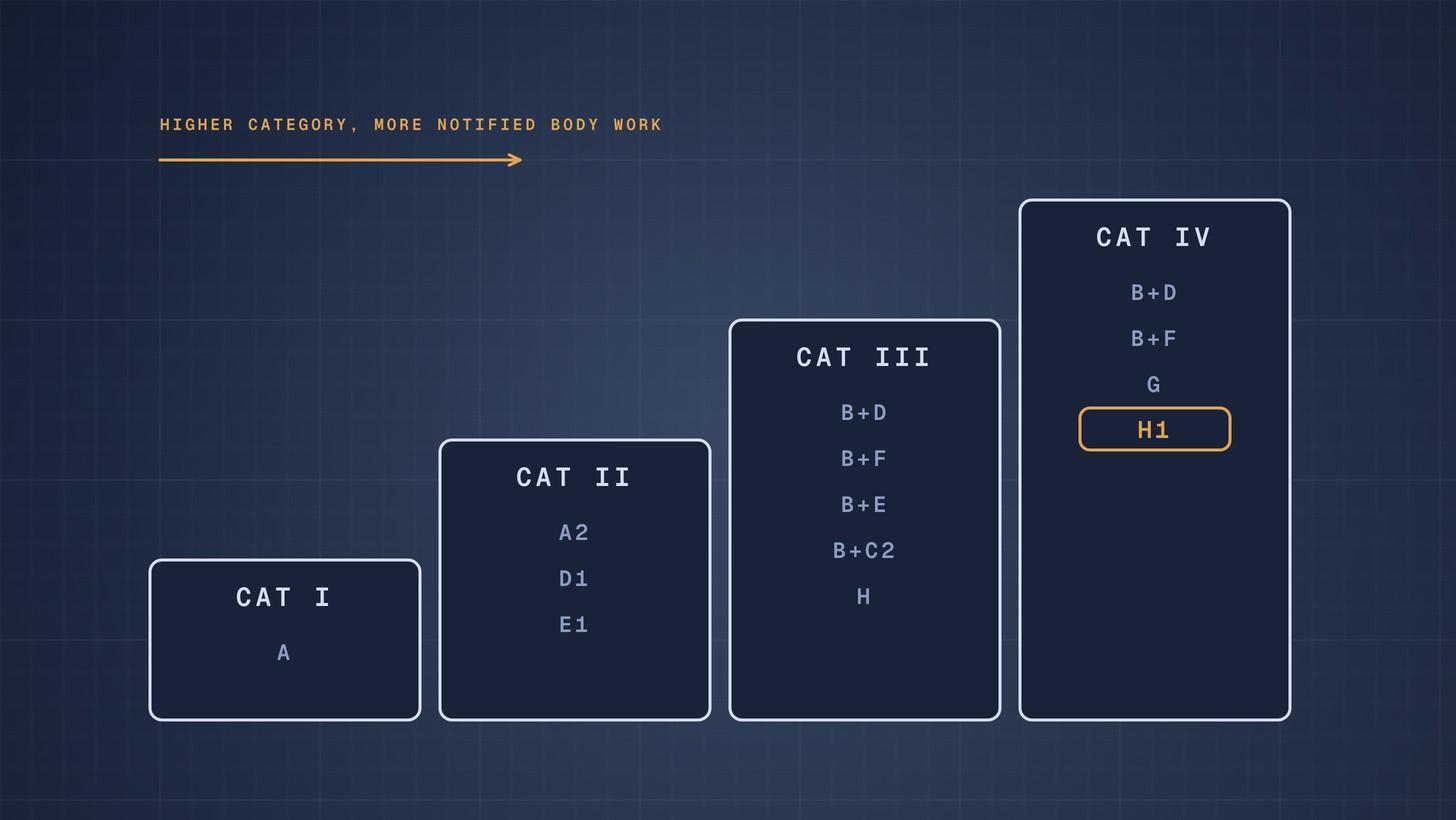
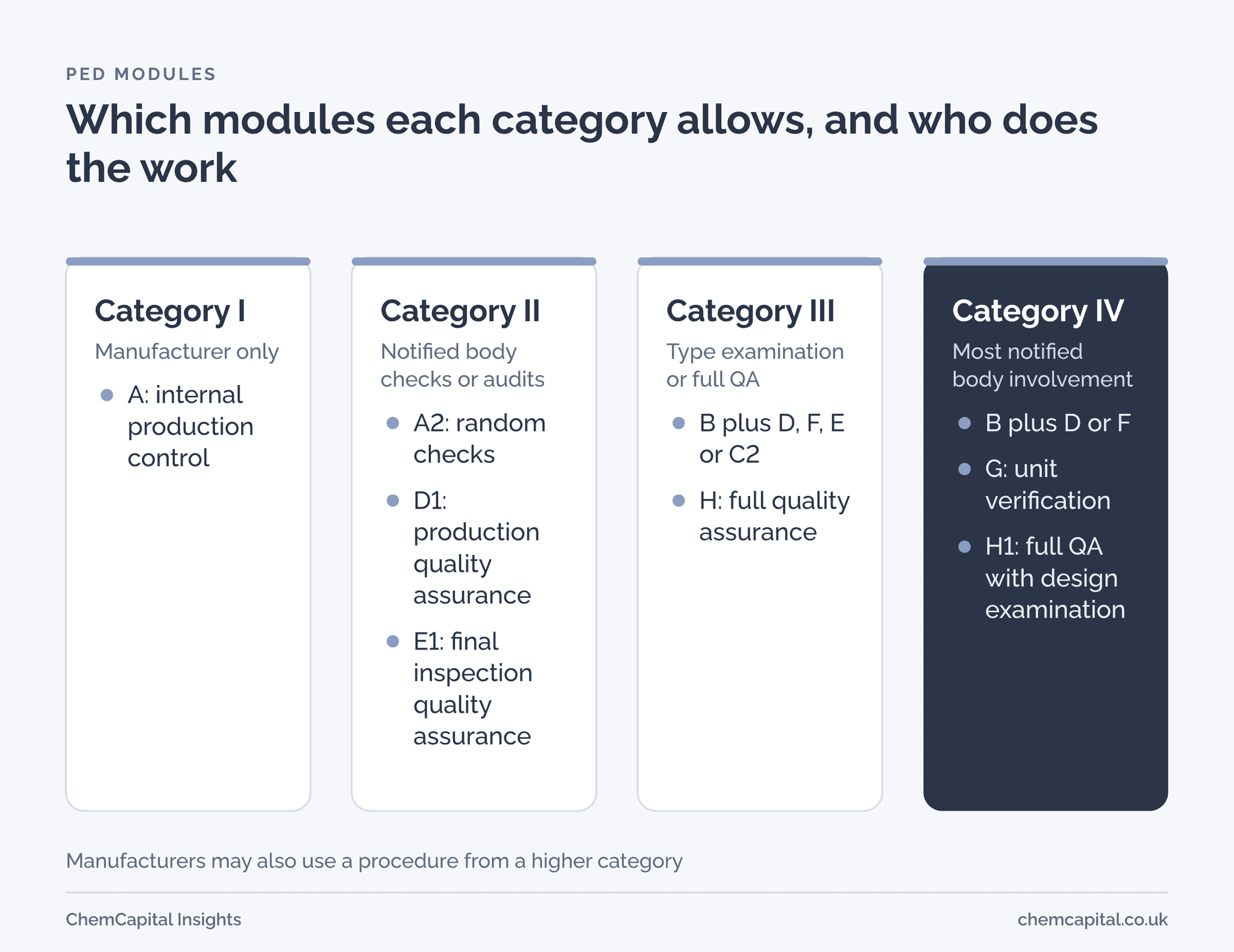
Under the Pressure Equipment Directive, the category of the equipment sets which conformity assessment modules you may use: Category I uses module A; Category II uses A2, D1 or E1; Category III uses B with D, F, E or C2, or module H; and Category IV uses B with D or F, module G, or module H1. Within those lists, the manufacturer chooses, and may also use a procedure from a higher category [1].
The choice matters commercially. It decides how often a notified body is in your workshop, what you pay it, and how quickly you can ship a one off vessel. This guide explains each module and how to choose.
Why this matters now
Buyers increasingly ask for the category and module on the datasheet, and check them against the declaration of conformity at delivery. Our guide to the EU declaration of conformity shows where the module appears. A supplier who answers "PED compliant" with no category or module looks less prepared than one who writes "Category III, module H, notified body 0000".
The directive is also specific about notified body visits. For quality assurance modules in Categories III and IV, the notified body must make unexpected visits and take samples for the final assessment, and must make at least two visits in the first year of manufacturing [1].
Access real procurement opportunities from global buyers
Join ChemCapital to get discovered by verified procurement teams across pharmaceutical, chemical, and industrial manufacturing.
The modules by category
Start with the category, which comes from fluid group, pressure and volume or size. Our article on PED and PER 2016 categories walks through it, and equipment below Category I falls under sound engineering practice instead.
| Category | Modules allowed under Article 14 [1] |
|---|---|
| I | A |
| II | A2, D1, E1 |
| III | B (design type) + D; B (design type) + F; B (production type) + E; B (production type) + C2; H |
| IV | B (production type) + D; B (production type) + F; G; H1 |
The modules themselves come from the EU's common framework for product legislation. That framework says the module should suit the type of product and the risk, should not be disproportionately burdensome, and where a third party is mandatory, the manufacturer should be able to choose between quality assurance and product certification routes [2]. That is why each category offers both kinds.
What each module means in your workshop
Kiwa, a notified body, summarises the notified body's role in each module [3]:
| Module | Name | What the notified body does |
|---|---|---|
| A | Internal production control | Nothing. You declare conformity yourself |
| A2 | Internal production control plus supervised checks at random intervals | Unexpected visits, takes samples, decides how much of the final assessment to check |
| B | EU type examination, as design type or production type | Examines technical documentation, assesses materials, approves joining procedures; for production type, also tests a specimen; issues a certificate |
| C2 | Conformity to type plus supervised checks at random intervals | Random checks and sampling against the approved type |
| D, D1 | Production quality assurance | Assesses your quality system, surveillance and periodic audits, unexpected visits; D adds proof test sampling for some equipment |
| E, E1 | Quality assurance of final inspection and testing | As D and D1, but focused on final inspection and testing |
| F | Product verification | Examines and tests each item, witnesses the final inspection and proof test, issues a certificate of conformity |
| G | Unit verification | Examines design and construction of each item, tests during manufacture, final inspection and proof test, issues a certificate |
| H | Full quality assurance | Assesses your whole quality system, including design; surveillance and audits |
| H1 | Full quality assurance with design examination | As H, plus an EU design examination certificate and closer surveillance with unexpected visits that include examining equipment |
Two details catch manufacturers out. First, under module H for a one off Category III vessel, the notified body carries out the final assessment for each unit, so you must share your production schedule [1]. Second, older datasheets and certificates from the 1997 directive used different names, such as A1, B1 and C1 [4]. If a buyer's template still asks for those, answer with the current 2014 directive module and say so.
How to choose
The category gives you the menu; your production pattern decides the order.
- One off or very low volume, Category III or IV. Unit verification (G) or a type examination plus product verification (B plus F) avoids building a quality system around the directive. You pay per item, and the notified body is involved at each one.
- Regular production of similar designs. A quality assurance route (D1 or E1 in Category II, H in Category III, H1 in Category IV) costs more to set up and audit, but each item then flows without the notified body examining it individually.
- Standard designs made in series. Type examination (B) once, then D, E or C2 for production, spreads the design review across many units.
- Mixed portfolios. Many fabricators hold full quality assurance for their regular products and use G for unusual one offs. Because you may use a higher category's procedure [1], G can cover a Category III item too.
The notified body's quality system work is not one visit. Kiwa describes surveillance, periodic audits with full reassessment every three years, unexpected visits, and assessment of changes to the system for the quality assurance modules [3]. Put those into your overhead before you compare against paying per item.
Questions to settle with your notified body
Before you commit to a route, get written answers to these:
- Which modules will you cover for our product range, and in which categories?
- For quality assurance routes, how many surveillance and unexpected visits should we expect each year, and how are they charged?
- For unit or product verification, how much notice do you need to witness a pressure test, and what happens if the date moves?
- How long does a design examination or type examination take from a complete submission?
- Which of our existing approvals, such as welding procedure and welder qualifications, can you rely on?
The answers turn the module table into a programme and a budget, and they show whether a notified body's way of working fits your workshop.
Practical example
Illustrative figures only; notified body fees vary widely by scope and country. A fabricator builds ten one off Category III vessels a year and is weighing per item verification against full quality assurance.
| Route | Fixed cost a year | Cost per vessel | Ten vessels a year |
|---|---|---|---|
| Module G on every vessel | £0 | £3,500 | £35,000 |
| Module H, quality system plus final assessment of each one off unit | £14,000 | £1,600 | £30,000 |
At ten vessels the routes cost about the same, and module H saves £5,000. At six vessels a year, G would cost £21,000 against £23,600 for H, so G is cheaper. The break even sits where 3,500 × n equals 14,000 + 1,600 × n, at about 7.4 vessels a year. Fees are only part of it: lead time on each vessel, internal quality staff and how often designs repeat matter too. Ask two notified bodies to quote both routes before you decide.
Selling into Great Britain
Great Britain applies the Pressure Equipment (Safety) Regulations 2016. Former UK notified bodies became UK approved bodies, kept their four digit numbers, and are listed on a UK register. CE marking continues to be recognised in Great Britain for many products beyond 2024, under rules in force since 1 October 2024, while equipment assessed by a UK approved body must carry the UKCA marking [5]. The GB guidance says its essential safety requirements are substantially the same as the EU's [5].
This is general information, not legal advice; check the current text before you rely on it.
If you are the buyer
Ask for the category, module and notified body number in the bid, and check them against the declaration of conformity and the nameplate at delivery. A supplier's module tells you how its quality system works: an H1 manufacturer has a notified body auditing its design and production; a G route means the notified body examined your specific item.
Where ChemCapital fits
Buyers shortlisting pressure equipment makers look for categories, modules and notified body approvals before they ask for a quote. Putting them on your profile answers the first question before it is asked. ChemCapital's supplier listings let you show the codes and approvals you hold.
Ready to show buyers your PED approvals up front? List your company on ChemCapital. It is free to start.
Frequently asked questions
What are the PED conformity assessment modules?
Category I uses module A. Category II uses A2, D1 or E1. Category III uses B with D, F, E or C2, or module H. Category IV uses B with D or F, module G, or module H1. The manufacturer chooses within the category and may use a higher category's procedure.
What is PED module H?
Full quality assurance. A notified body assesses the manufacturer's whole quality system, including design, manufacture, final inspection and testing, and carries out surveillance and audits. Module H1 adds a design examination certificate and closer surveillance for Category IV.
What is the difference between PED module A2, D1 and E1?
All three are allowed for Category II. A2 is internal production control with random checks by the notified body. D1 is production quality assurance. E1 is quality assurance of final inspection and testing.
Can a manufacturer use module G for Category III equipment?
Yes. Module G is listed for Category IV, and the directive allows a manufacturer to use a procedure from a higher category, so unit verification can cover Category III equipment too.
Does Category I equipment need a notified body?
No. Category I uses module A, internal production control, where the manufacturer declares conformity without a notified body.
Continue reading
Informational only, not procurement or legal advice. Cited names, frameworks, and statistics belong to their respective owners.
Access real procurement opportunities from global buyers
Join ChemCapital to get discovered by verified procurement teams across pharmaceutical, chemical, and industrial manufacturing.
List your companyRelated articles
Design Qualification (DQ) for GMP Equipment: What It Is and What the Vendor Provides
Design qualification is the documented check that a proposed equipment design meets the URS and GMP before it is built. Here is where DQ sits in EU GMP Annex 15, what evidence the vendor supplies, and a DQ checklist.
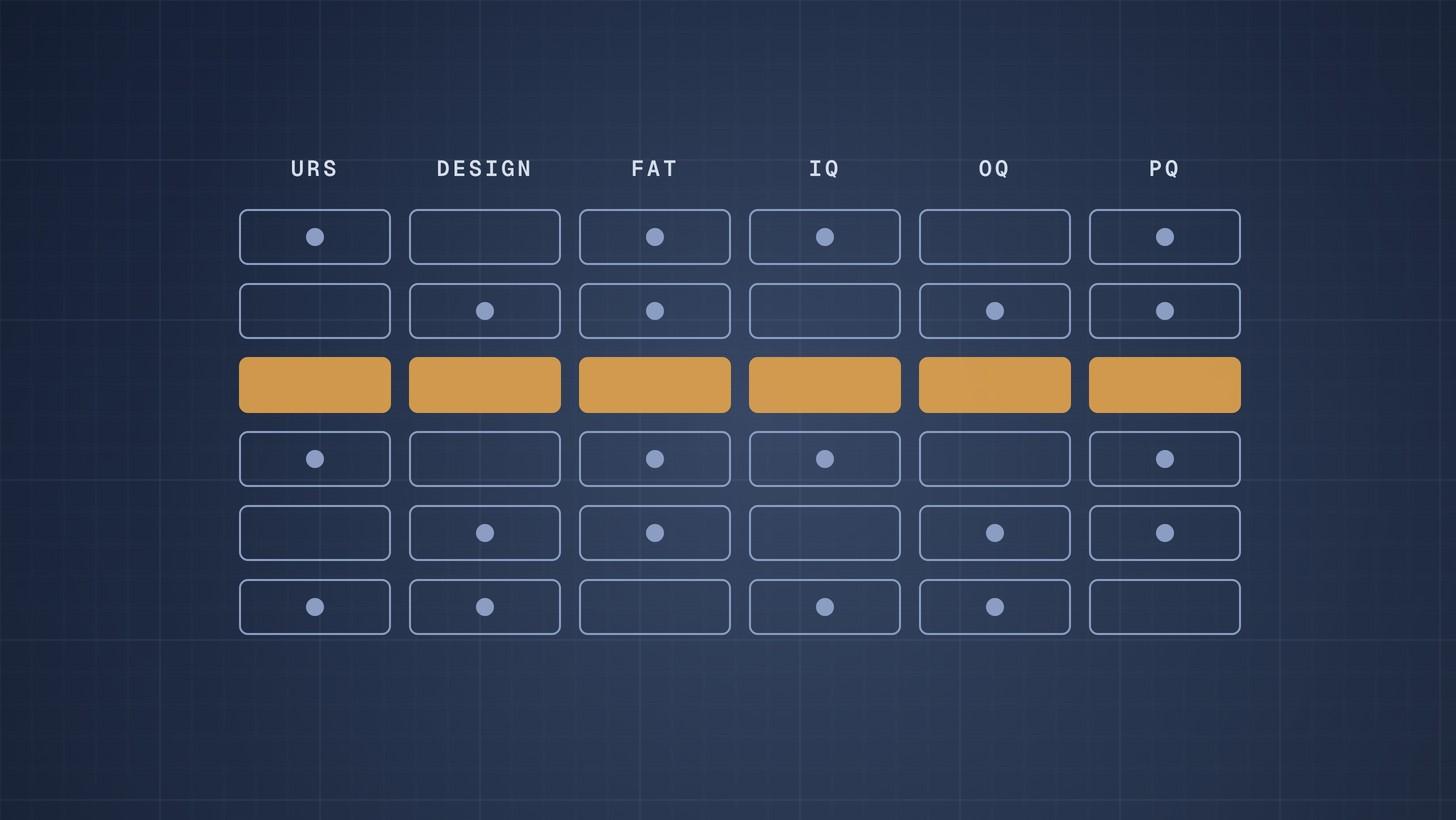
Requirements Traceability Matrix for GMP Equipment: From URS to PQ
A requirements traceability matrix links every URS line to the design document that meets it and the test that proves it, from DQ through FAT, SAT, IQ, OQ and PQ. Here is how to build one, with a template.
How to Prepare for a Customer Quality Audit as an Equipment Manufacturer
A practical guide for equipment makers facing a customer or vendor audit: the documents to have ready, how to run the walk through, the findings auditors raise most often and how to close them properly.