
Modular Process Skids: A Buyer's Guide to Scope, Testing and Cost
When a modular process skid beats stick built, how to set battery limits, which UK rules apply, FAT and road limits, and how to compare skid bids like for like.
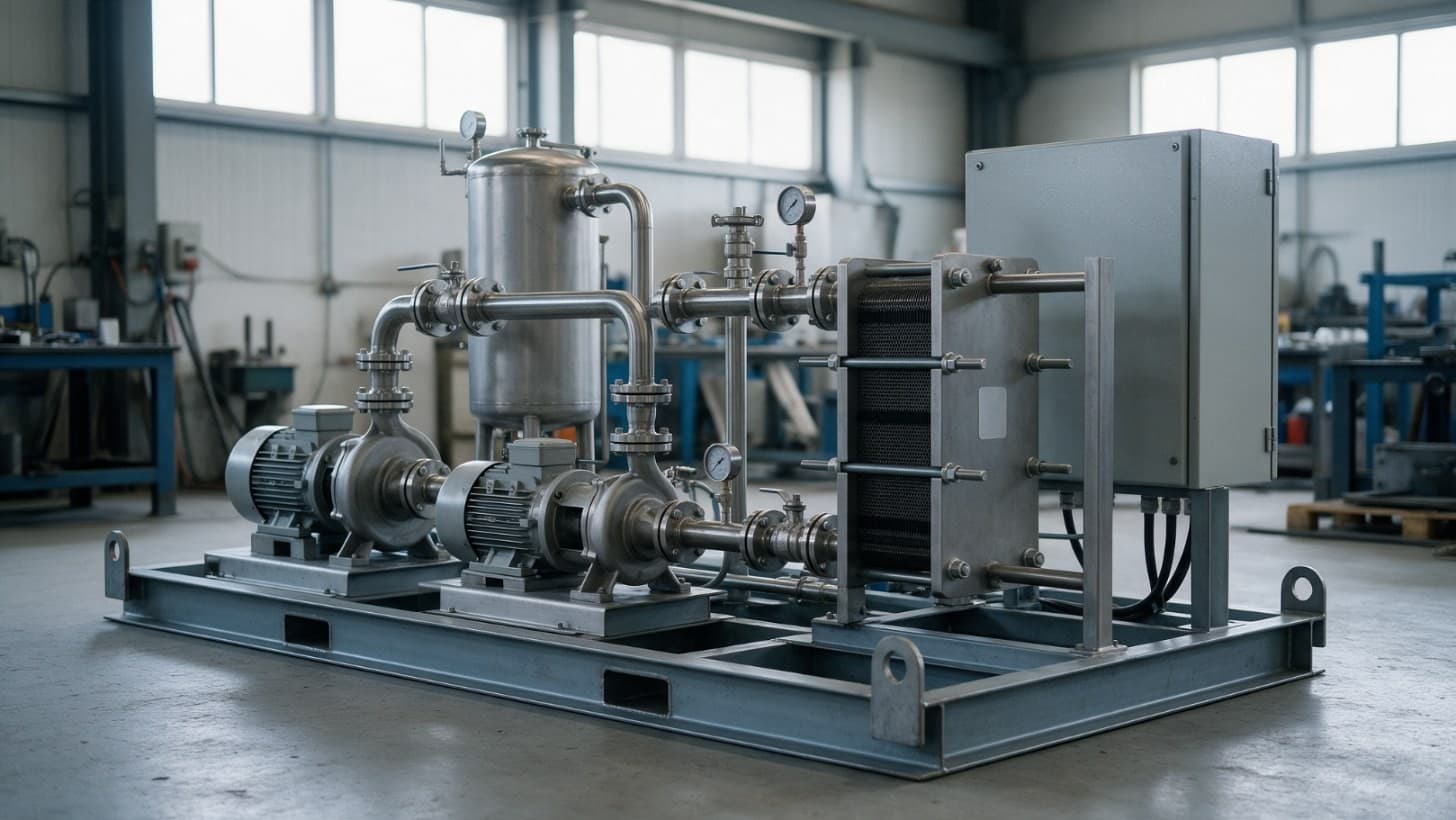
A modular process skid is a complete process unit, such as a dosing, heat transfer or CIP (clean in place) system, built on a steel frame in a fabricator's shop, tested there and shipped to site for connection. A skid usually beats building the same system on site when local labour is scarce or costly, when shop fabrication can run alongside civil works, and when the unit fits road transport limits. To buy one well, fix the battery limits and interfaces, agree the compliance route and the factory and site tests in the RFQ (request for quotation), and compare bids on the same scope.
Why this matters now
Skid quotes are hard to compare. One price may include the control panel, PLC (programmable logic controller) software, factory acceptance test (FAT), transport and site support; another may cover the frame and pipework and exclude the rest.
Regulation needs care too. A skid joining several items of pressure equipment can itself be the regulated product, and one with pumps and motors can fall under machinery law. Bids may arrive with UKCA or CE marking. GOV.UK says businesses can still use CE marking for the Great Britain market, with or without UKCA, under the Product Safety and Metrology etc. (Amendment) Regulations 2024, where product rules meet UK needs [1]. Machinery rules change on 20 January 2027. From that date, the CE route in Great Britain requires conformity with the EU Machinery Regulation (EU) 2023/1230, which repeals the old Machinery Directive, while machinery already placed on the market under the current rules can still be supplied [2]. A skid ordered now may be delivered after that date, so ask each bidder which mark and regulations they will declare against.
Create and manage RFQs in minutes
ChemCapital handles the entire procurement cycle, from structured RFQs and supplier comparisons to formal purchase orders and delivery tracking.
Skid or stick built: when each makes sense
AIChE describes a skid as a self contained process unit in a movable frame, and a stick built plant as one assembled wholly on its final site [3].
The main case for a skid is programme. Design, fabrication and testing run while the building or plinth is prepared, and the shop offers controlled conditions, one accountable supplier and documentation in a single format [4]. Paul Mueller, a skid maker, cites an undated ISPE case study of two units at an oral dosage facility in Puerto Rico, where the modular unit was finished more than six months sooner than the stick built one [4]. Treat that as one example, not a rule.
The case against is usually physical. A skid adds a steel frame, packs equipment tightly and must survive lifting and transport. Its design freezes earlier, so late changes cost more, and site work remains for foundations, interconnecting pipework, power and controls.
| Factor | Favours a skid | Favours stick built |
|---|---|---|
| Site labour | Local trades scarce or costly | Capable contractor already mobilised |
| Programme | Shop work can run alongside civil works | Site is ready and parallel work gains nothing |
| Design maturity | P&ID can be frozen early | Process still changing during construction |
| Size and weight | Fits a road trailer, or splits into modules | Large items that cannot share a frame |
| Plant outage | Short connection window on a running plant | New build with no outage constraint |
Define scope and battery limits before you ask for prices
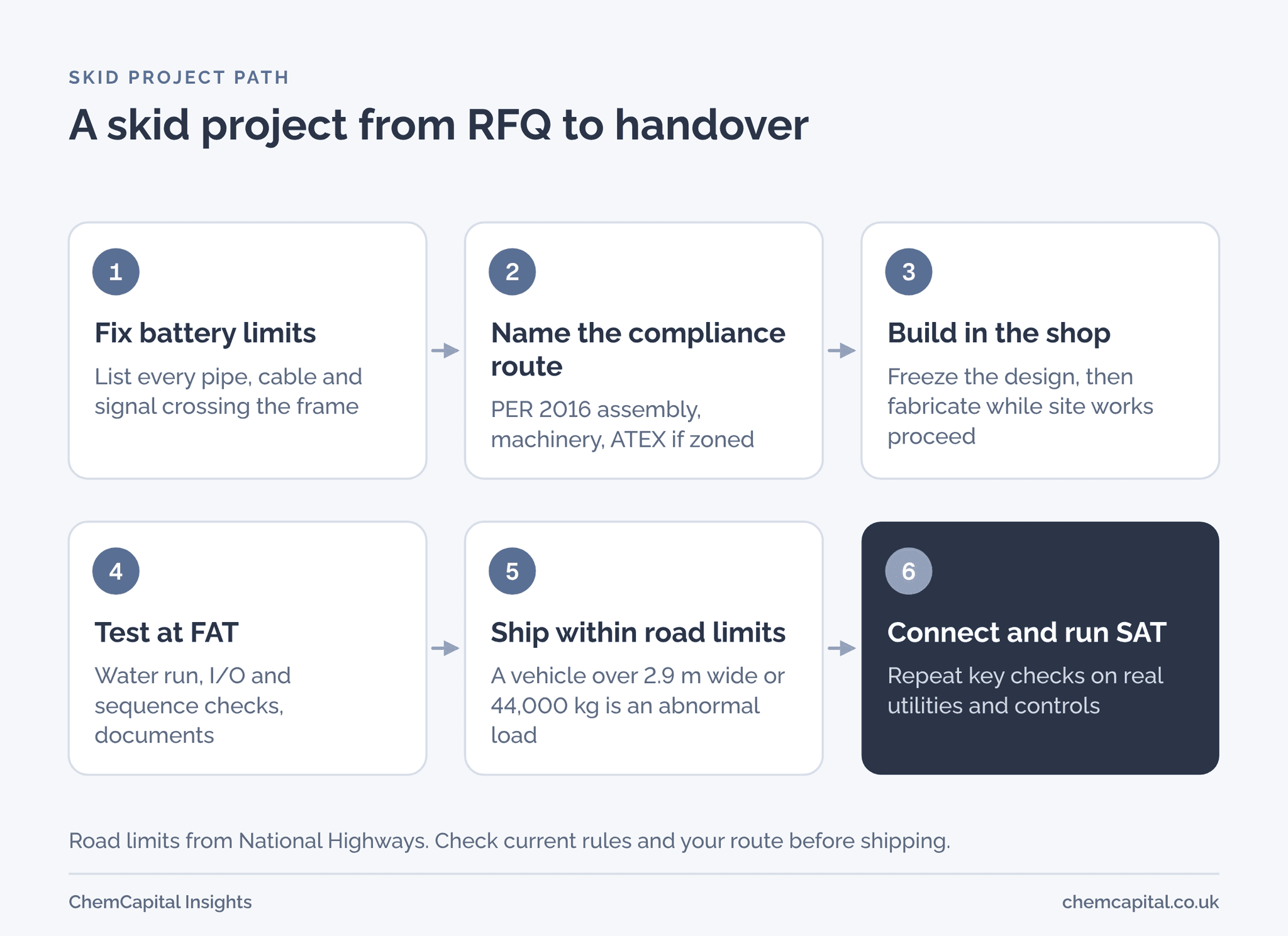
Battery limits are the boundary of the supplier's scope: every pipe, cable and signal that crosses the edge of the frame. Mark them on the P&ID (piping and instrumentation diagram) and list each one with its size, rating, end connection, position and who supplies the mating part.
Interfaces fall into five groups: process connections; utilities, with their conditions at the skid edge; controls, including whether the skid has its own PLC, who owns the software and which I/O (input and output signals) pass to the plant; structure, such as lifting points and loads; and documents.
RFQ scope checklist
| Item | State in the RFQ | Ask each bidder to confirm |
|---|---|---|
| Process duty | P&ID, design conditions, materials, design codes | Any deviation, with the reason |
| Battery limits | Connection list with sizes, ratings and positions | Each item supplied or excluded |
| Controls | PLC platform, protocol, I/O list, HMI (operator screen), panel location | Software scope, licences, access to source code |
| Compliance | Regulations expected; hazardous area zone, if any | Conformity route, marking and declarations |
| Testing | FAT and SAT scope, witness and hold points | Draft test protocols and FAT duration |
| Logistics | Delivery terms, site access, crane and lifting limits | Shipping dimensions and weight of each module |
| Documents | Drawing list, data book, manuals, spares list | Delivery date for each document |
Compliance: which GB rules can apply
This section covers Great Britain; for a site in Northern Ireland, GOV.UK has separate marking guidance [1].
Pressure equipment. Under the Pressure Equipment (Safety) Regulations 2016, an assembly is several pieces of pressure equipment put together by a manufacturer to form "an integrated and functional whole" [5]. Where an assembly needs conformity assessment, regulation 45 sets a global assessment in three parts: each item not already assessed, how the parts are integrated, and protection against going beyond its permissible operating limits [6]. Ask whether the bidder will assess and mark the skid as an assembly, or deliver separately marked items and leave the integration to someone else. Once installed, a skid holding steam or compressed gas may also need a PSSR written scheme of examination before it runs.
Machinery. A skid with pumps, agitators or other moving parts may be machinery. HSE's 2020 buying guide explains that partly completed machinery is supplied with a declaration of incorporation, and that the legal duties for the finished machine fall on whoever joins it to other equipment to complete it. It also cautions that a mark is not, on its own, proof that a machine is safe [7].
Hazardous areas. Under DSEAR (the Dangerous Substances and Explosive Atmospheres Regulations 2002), employers must divide areas where explosive atmospheres may form into zones and keep ignition sources out of them. Equipment for those zones should meet the 2016 EPS Regulations (on equipment for explosive atmospheres), which put the ATEX equipment directive into effect in Great Britain. Before a workplace with zoned areas first comes into operation, the employer must have a competent person or organisation verify the overall explosion safety measures [8]. Send the zone drawing with the RFQ.
This is general information, not legal advice.
Testing and transport
A FAT proves the skid at the fabricator, where faults are cheapest to fix: a water run, loop and I/O checks, sequence and alarm tests, and a document review. Agree the protocol, acceptance criteria and witnesses before order; our FAT checklist for process skids has the detail. The site acceptance test (SAT) repeats the key checks once the skid is connected to real utilities and the plant control system.
Transport sets the envelope. National Highways treats a vehicle as an abnormal load if it weighs more than 44,000 kg, is wider than 2.9 metres, has a rigid length over 18.65 metres, or has an axle load above 10,000 kg on a single non driving axle or 11,500 kg on a single driving axle. Moving one means notifying police, highway and bridge authorities, usually online through ESDAL (Electronic Service Delivery for Abnormal Loads) [9]. The weight includes the vehicle, so the skid must be well below it. The definition has no height limit, but bridges do, so ask for a route check. A large system can be split into modules, tested together at FAT and rejoined on site.
What drives the price of a skid
Skid bids usually differ most on six things:
- Materials and finish: 316L stainless with a hygienic finish costs more than carbon steel.
- Instrument and valve count: each instrument brings cabling, I/O, calibration and paperwork.
- Controls and software: often the easiest item to exclude.
- Compliance and documents: assembly assessment, approved body fees, pharma validation documents.
- Testing: FAT duration and witnessing.
- Logistics and site work: abnormal loads, crane lifts, installation and commissioning.
Practical example
A UK chemical plant asks three fabricators to quote a dosing skid: one tank, two pumps, a plate heat exchanger, 32 instruments and a local PLC panel. All figures are illustrative.
| Line | Bid A | Bid B | Bid C |
|---|---|---|---|
| Quoted price | £412,000 | £364,000 | £379,000 |
| PLC software | Included | Excluded, add £28,000 | Included |
| Transport to site | Included | Excluded, add £9,500 | Included |
| SAT support | Included | Excluded, add £7,500 | Excluded, add £6,000 |
| Assembly assessment | Included | Included | Excluded, add £12,000 |
| Like for like total | £412,000 | £409,000 | £397,000 |
On the quoted prices, Bid B looks £48,000 cheaper than Bid A. Priced to the same scope, the gap is £3,000. Bid C, which looked mid table, is now lowest.
Bid B's frame is 3.2 metres wide, over the 2.9 metre threshold, so moving it needs abnormal load notification; a narrower frame may cost less. Bid C's exclusion is a responsibility, not just a cost: the contract must say who carries out the assembly assessment. For the wider method, see technical bid evaluation for process equipment.
Put every bidder on the same scope
A skid RFQ works when every bidder prices the same battery limits, tests and compliance route. ChemCapital sends one structured RFQ to all your suppliers at once and lines up the replies side by side, so each bidder's exclusions sit next to the others. After award, supplier milestone updates and a timestamped audit trail keep every revision and decision on record.
Ready to get skid bids you can compare like for like? Start a free 14 day ChemCapital trial, with no credit card needed.
Frequently asked questions
What is a process skid?
A process skid is a packaged process system, with its equipment, piping, instruments and often a control panel, mounted on a steel base frame that can be lifted and moved. It is built and tested in a fabricator's shop, then connected to utilities and the plant on site.
Is a process skid an assembly under the Pressure Equipment Regulations?
It can be. Under the Pressure Equipment (Safety) Regulations 2016, several pieces of pressure equipment that a manufacturer joins into one working unit form an assembly. Where the regulations require conformity assessment, it covers each item, how they are integrated and protection against going beyond operating limits.
How big can a skid be for road transport in the UK?
National Highways treats a vehicle as an abnormal load if it weighs more than 44,000 kg, is wider than 2.9 metres, has a rigid length over 18.65 metres or exceeds set axle loads, and its movement must be notified to police, highway and bridge authorities. The weight figure includes the vehicle, so the skid itself must be well under 44,000 kg; splitting a large skid into modules can keep each loaded vehicle inside the limits.
What is the difference between FAT and SAT for a skid?
The factory acceptance test proves the skid at the fabricator before shipment, when faults are cheapest to fix. The site acceptance test repeats the key checks after the skid is connected to real utilities and the plant control system.
Continue reading
Informational only, not procurement or legal advice. Cited names, frameworks, and statistics belong to their respective owners.
Create and manage RFQs in minutes
ChemCapital handles the entire procurement cycle, from structured RFQs and supplier comparisons to formal purchase orders and delivery tracking.
Start for freeRelated articles
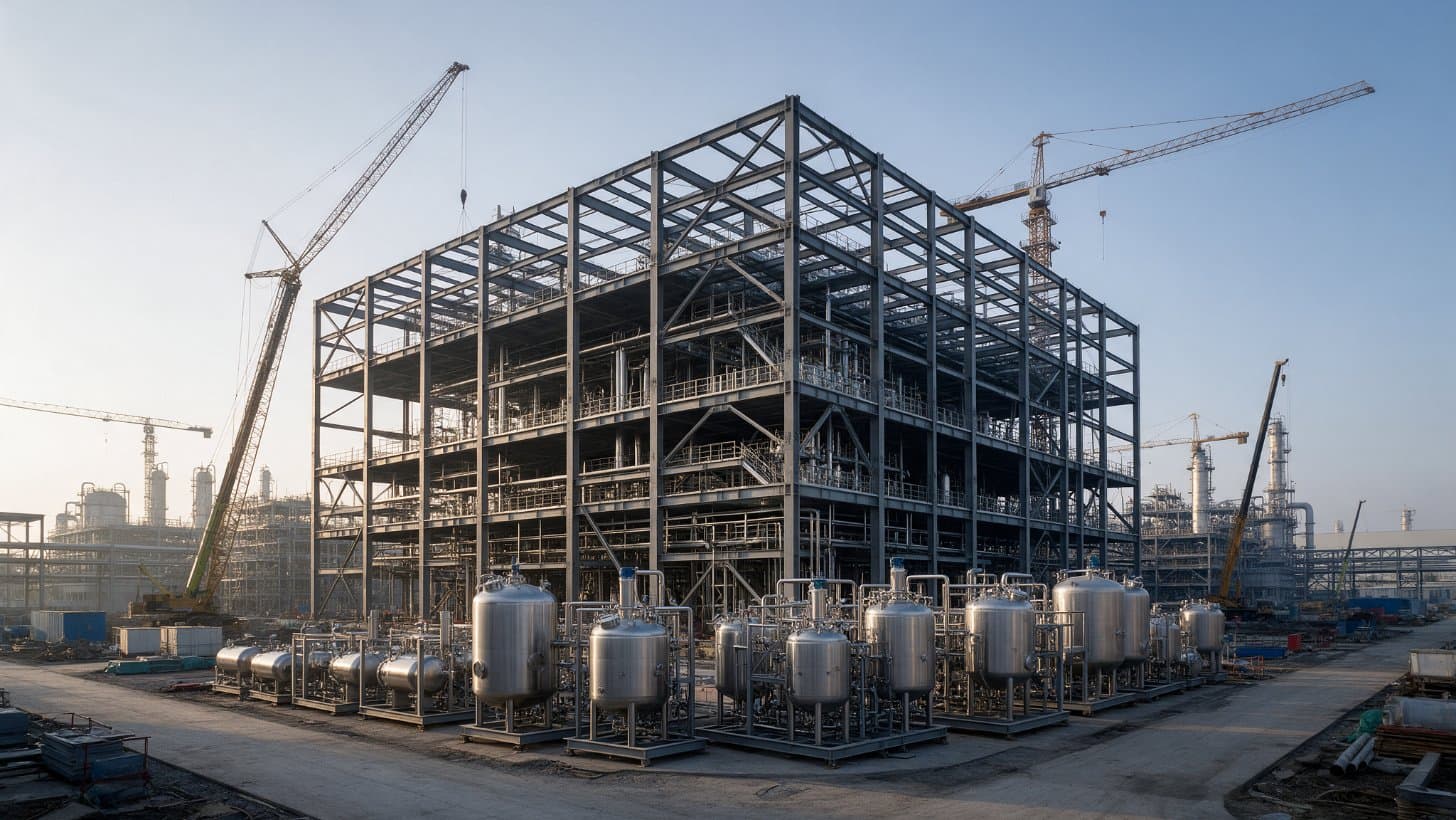
Where to Find Pharma and Chemical Plant Projects Before They Go to Tender: the 2027 Pipeline
Twenty pharma and chemical plant projects checked against owner or government announcements, the buying timeline on each, and where to watch for the next ones for free.
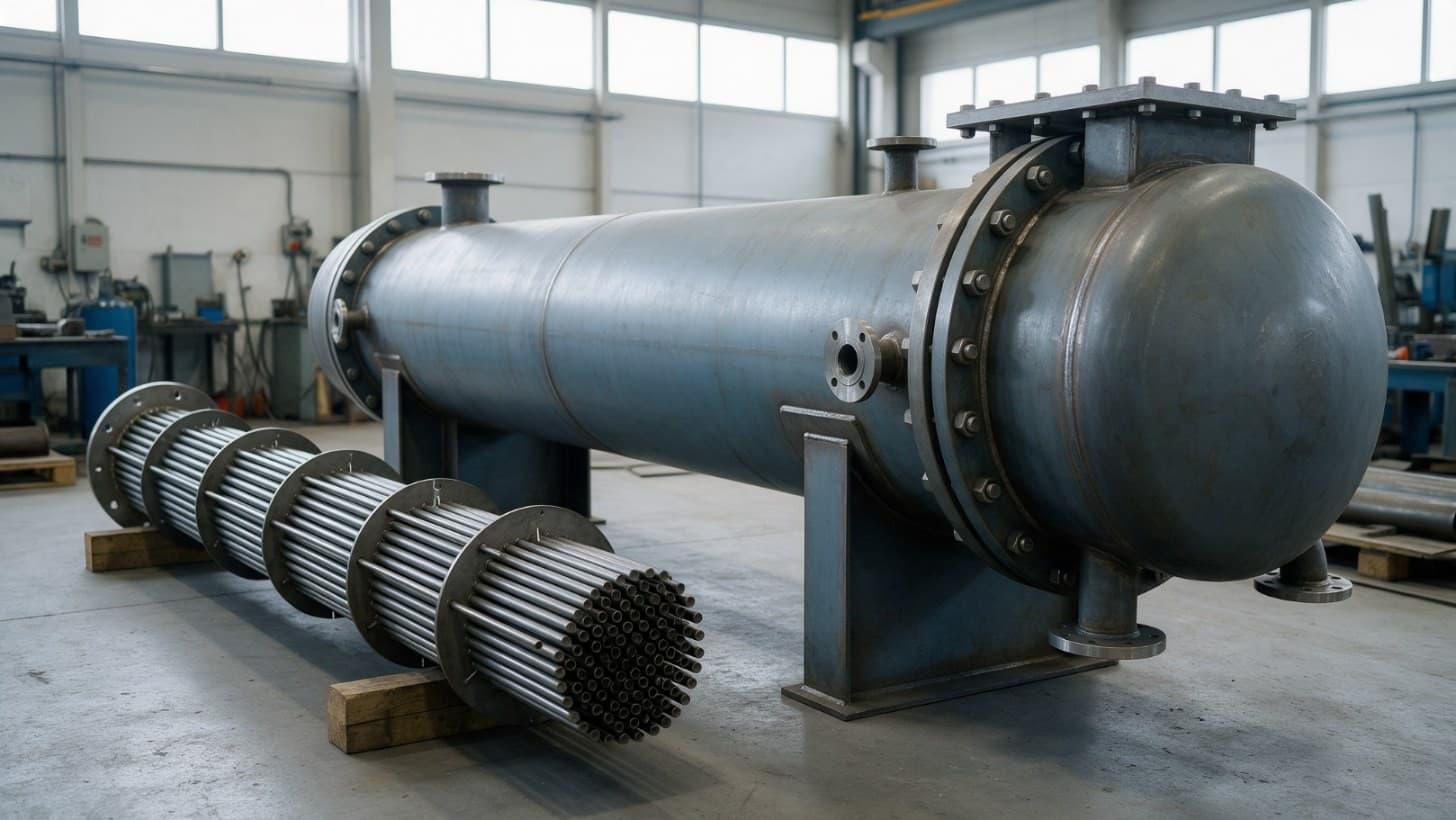
TEMA Heat Exchanger Types: How to Read AES, BEM and AEU
How to decode the three letter TEMA type, what AES, BEM, AEU and other common types mean for cleaning, expansion, leaks and cost, and how to compare bids that differ.
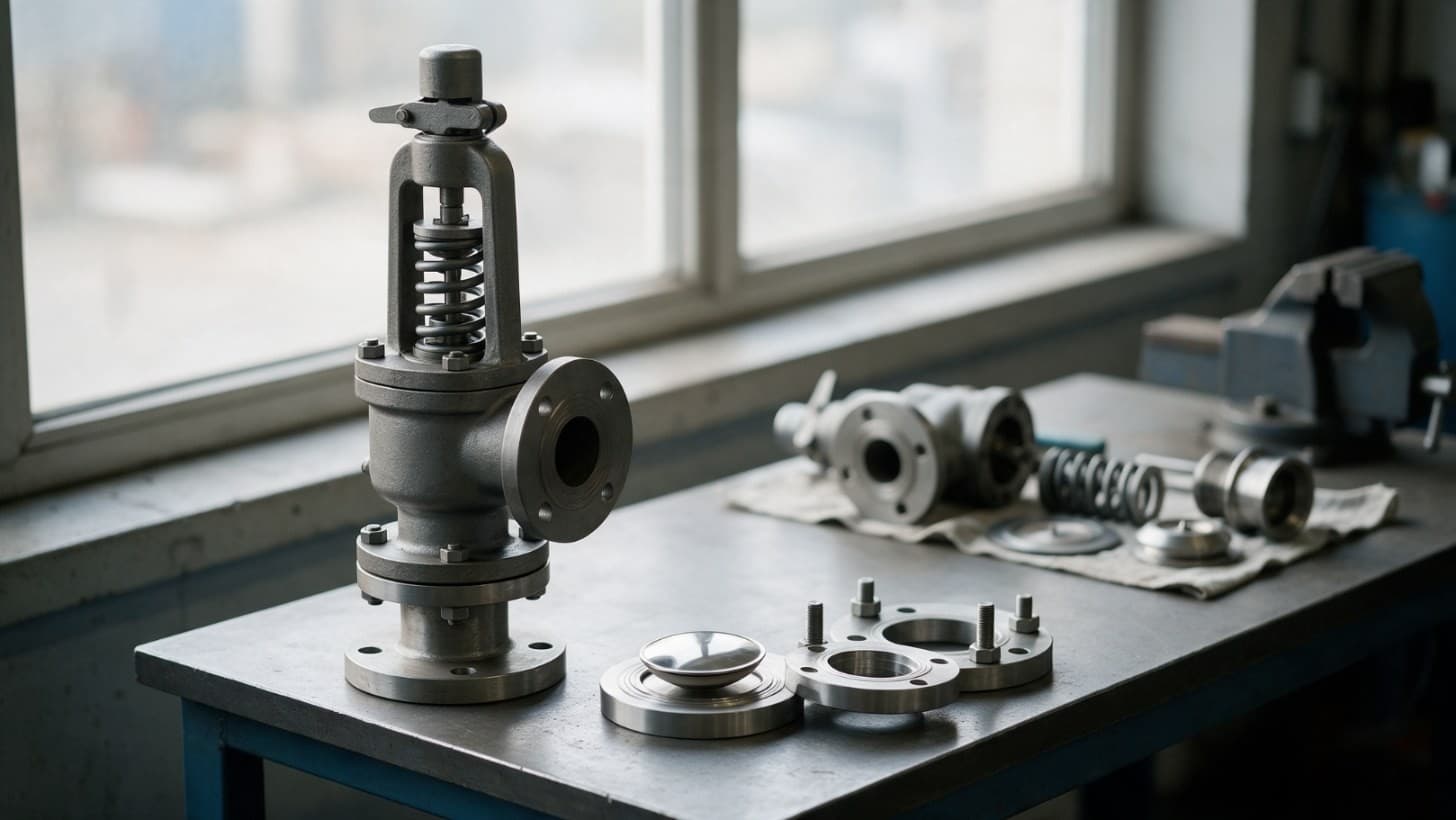
Safety Valve vs Relief Valve vs Bursting Disc: How to Choose
How safety valves, relief valves and bursting discs differ, when to fit a disc under a valve, the pressure terms that matter, GB duties and what to put in the RFQ.