
Full Expensing for Plant and Machinery: Worked Example (UK)
How full expensing, the annual investment allowance, first year allowances and writing down allowances apply to a £500,000 process skid, with the November 2026 rates.
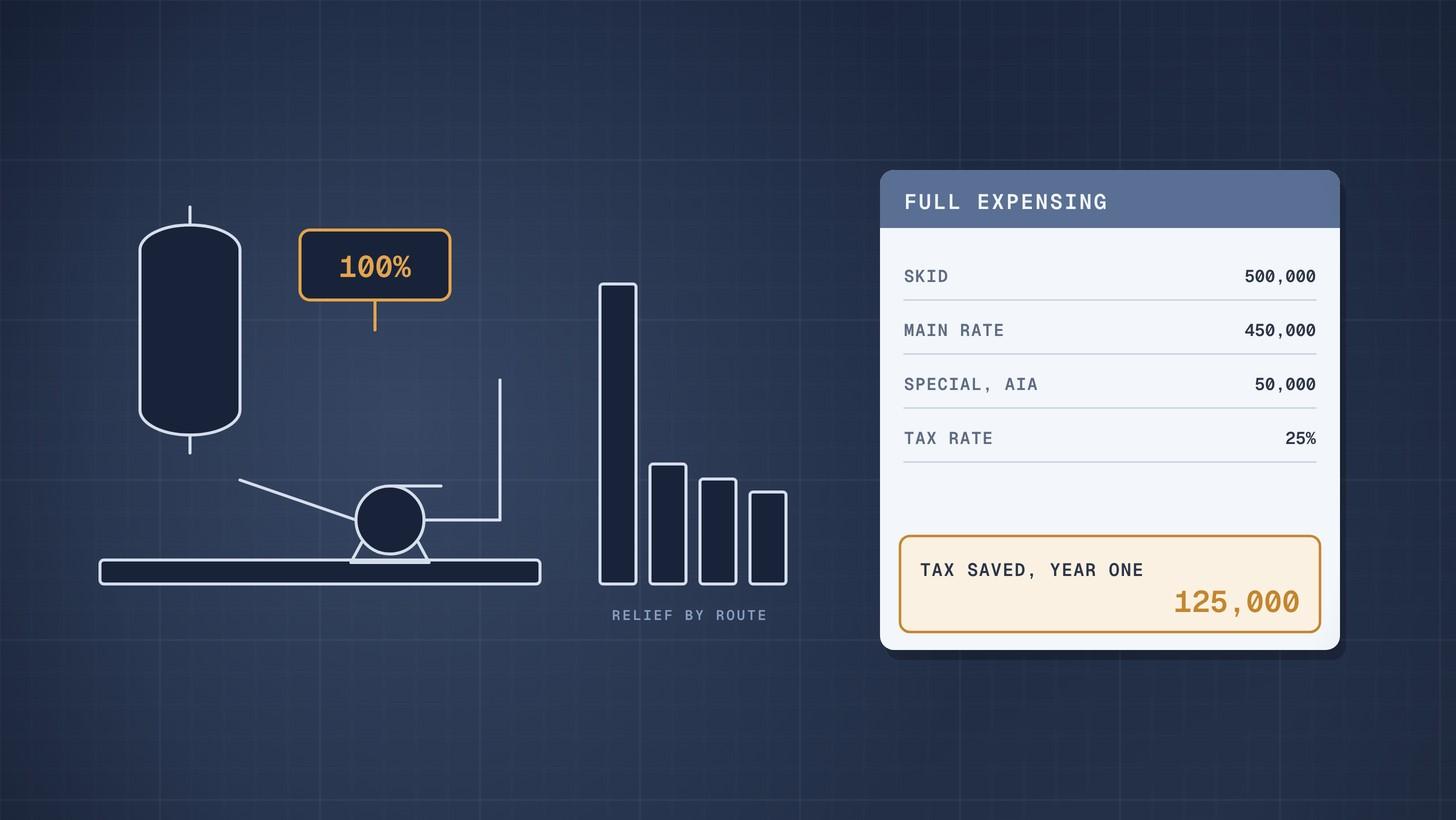
Full expensing lets a UK company deduct 100% of the cost of new, unused main rate plant and machinery from its taxable profits in the year it buys it. In the worked example below, a company paying corporation tax at 25% buys a £500,000 process skid and cuts that year's tax bill by £125,000, so the skid's net cost is £375,000. If the same main rate spending only got writing down allowances, the first year saving would be £15,750.
The rules changed twice in the last year, so the dates below matter. Figures are as published on GOV.UK when we read them in November 2026.
Why this matters now
Full expensing was made permanent in November 2023, removing the 1 April 2026 end date it originally had [1]. Since then the allowances around it have moved:
- From 1 January 2026, a new 40% first year allowance for main rate spending, open to all businesses, not only companies [2].
- From 1 April 2026, the main rate writing down allowance for companies fell from 18% to 14% a year [2].
- In measures published on 29 October 2026, the first year allowance rises to 50% for spending from 1 January 2027, and the main rate writing down allowance falls to 12% from 1 April 2027 [3].
Full expensing and the annual investment allowance were left unchanged [4]. The effect is that the gap between claiming full expensing and relying on writing down allowances has widened, which makes it more important to know which spending qualifies.
Create and manage RFQs in minutes
ChemCapital handles the entire procurement cycle, from structured RFQs and supplier comparisons to formal purchase orders and delivery tracking.
The allowances at a glance
| Allowance | Who can claim | What it gives |
|---|---|---|
| Full expensing | Companies paying corporation tax | 100% of new, unused main rate plant in year one |
| 50% first year allowance, special rate | Companies paying corporation tax | 50% of new, unused special rate plant in year one; the rest goes to the special rate pool |
| Annual investment allowance | All businesses | 100% of qualifying spending up to £1 million a year |
| 40% first year allowance | All businesses, including leasing | 40% of main rate spending; second hand assets and cars excluded |
| Main rate writing down allowance | All businesses | 14% a year on the reducing balance (12% from April 2027, as announced) |
| Special rate writing down allowance | All businesses | 6% a year |
Sources for the table: HMRC guidance on full expensing [5], the November 2025 measure [2] and the October 2026 measure [3].
HMRC's guidance sets the conditions for full expensing: the buyer must be a company within corporation tax, the plant must be new and unused, and cars, assets bought to lease out (other than background plant in a leased building) and assets bought in the period the business stops trading are excluded [5]. GOV.UK adds that you cannot claim full expensing and the 50% allowance on the same spending [6].
Worked example: a £500,000 process skid
A manufacturing company with profits above £250,000 orders a new process skid for £500,000. Its accounting year runs to 31 March 2027. The price, the split and the discount rate are illustrative.
Step 1: the tax rate. For profits above £250,000 the corporation tax main rate is 25%; below £50,000 the small profits rate is 19%, with marginal relief in between [7].
Step 2: classify the spending. Most of a process skid is main rate plant. Some parts may fall in the special rate pool, which your tax adviser will identify. Suppose £450,000 is main rate and £50,000 is special rate.
Step 3: claim.
| Spending | Allowance | Deduction in year one | Tax saved at 25% |
|---|---|---|---|
| £450,000 main rate | Full expensing | £450,000 | £112,500 |
| £50,000 special rate | Annual investment allowance | £50,000 | £12,500 |
| £500,000 | £500,000 | £125,000 |
If the company had already used its annual investment allowance, the £50,000 special rate part would get the 50% first year allowance instead: £25,000 deducted in year one, saving £6,250, with the other £25,000 going into the special rate pool from the following year [5].
Step 4: the net cost. £500,000 minus £125,000 is £375,000 in the year of purchase. That is the figure to use in a payback or net present value calculation, along with the timing of the tax payment.
What the alternatives are worth
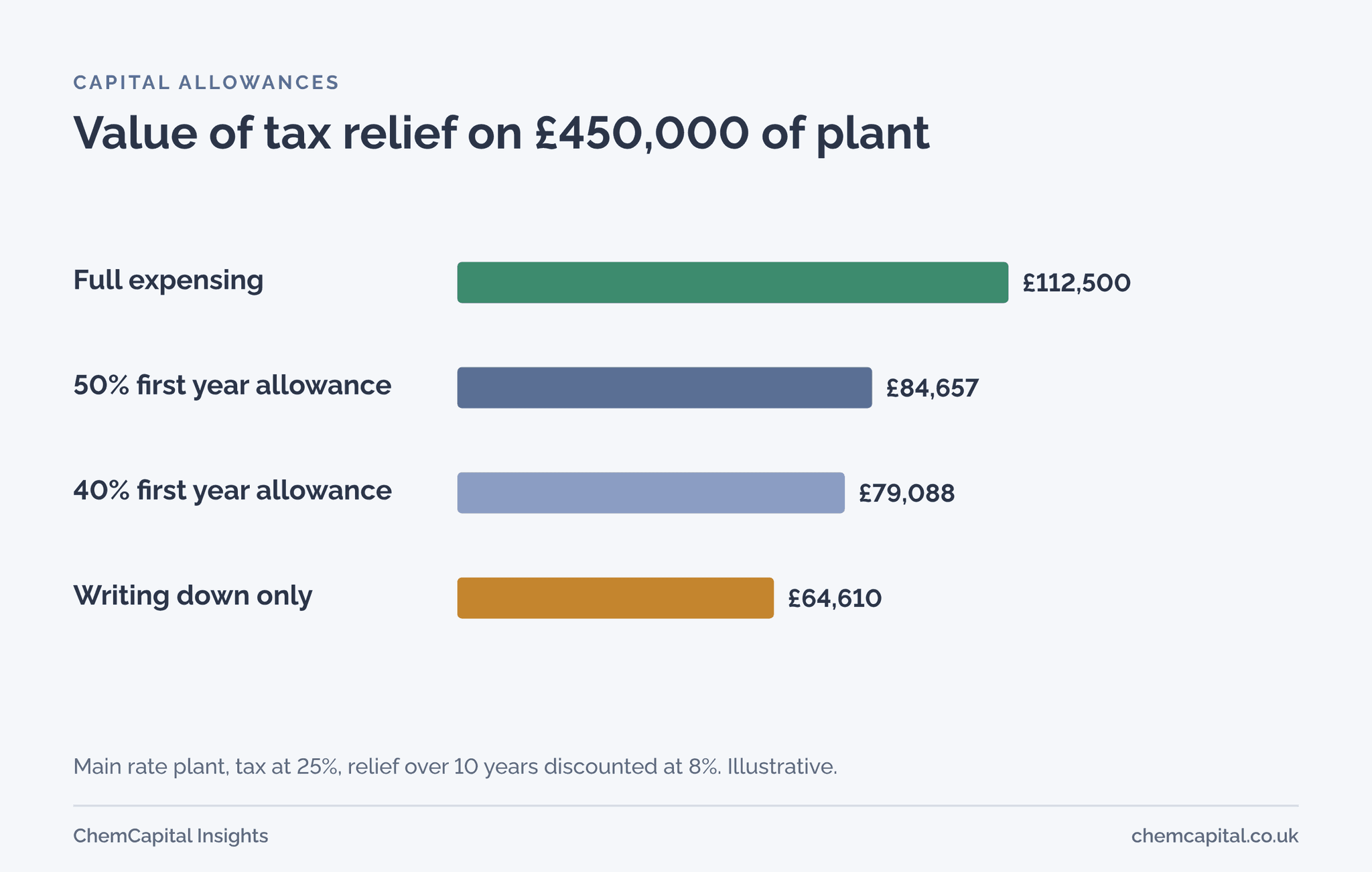
Full expensing is not always available: an unincorporated business cannot use it, nor can a company buying plant to lease out, and a second hand skid does not qualify. Here is the same £450,000 of main rate spending under the other routes, with tax at 25% and future savings discounted at 8% a year:
| Route | Tax saved in year one | Value of the relief over 10 years |
|---|---|---|
| Full expensing | £112,500 | £112,500 |
| 50% first year allowance (from January 2027) | £56,250 | £84,657 |
| 40% first year allowance | £45,000 | £79,088 |
| Writing down allowances only | £15,750 | £64,610 |
The total relief is the same in every case, because writing down allowances eventually give relief for the whole cost. The difference is timing: under writing down allowances alone, about £122,000 of the cost is still unrelieved after ten years. In today's money, full expensing is worth almost £48,000 more than writing down allowances on this skid.
The year one figures for the first year allowances follow HMRC's approach for the special rate allowance, where the balance goes into the pool in the following period [5]; check the treatment for your own accounting period with your adviser.
Putting it into the business case
Suppose the skid cuts operating costs by £120,000 a year before tax (illustrative). After 25% tax that is £90,000 a year.
| Basis | Cost | Yearly saving | Simple payback |
|---|---|---|---|
| Before tax, ignoring allowances | £500,000 | £120,000 | 4.2 years |
| After tax, ignoring allowances | £500,000 | £90,000 | 5.6 years |
| After tax, with full expensing | £375,000 | £90,000 | 4.2 years |
The middle row is the one to avoid: taxing the savings but not giving credit for the allowance makes the project look a year and a half worse than it is. If your business case template works after tax, make sure it includes the capital allowance in the year it is claimed. Our guide to life cycle cost in equipment quotes shows how to add energy and maintenance to the same calculation.
What to keep in the purchase file
Your tax team will need evidence when they make the claim. Ask the supplier for, and keep:
- A confirmation that the equipment is new and unused, on the quotation or the delivery note.
- A price breakdown that separates process equipment from installation, building work and any items your adviser treats as special rate.
- The contract date and the payment schedule, so the date the spending was incurred can be worked out.
- Delivery and commissioning records, showing when the plant was brought into use.
A clear breakdown in the supplier's quote saves arguments later, so ask for it in the RFQ rather than after the order.
What it means for procurement
- Timing. The allowance depends on when the spending is incurred, and the 40% allowance becomes 50% for spending from 1 January 2027 [3]. For a business that cannot use full expensing, an order placed either side of that date can change the first year saving. Ask your tax team how the payment terms affect the date.
- New or used. Full expensing needs new and unused plant [5]. A refurbished skid may be cheaper to buy but slower to relieve, so compare quotes after tax.
- Leasing. Buying through a lease changes who claims. The 40% allowance is open to leasing businesses, full expensing is not [2].
- Disposals. If you later sell an asset you claimed full expensing on, HMRC requires a charge to be added to your taxable profits [5], so include it in end of life plans.
Our guide to capex procurement strategy for manufacturers sets this alongside budgeting and approval. ChemCapital's Project Costing reuses your previous supplier quotations to build capital cost estimates, so the pre tax cost you feed into this calculation is grounded in real prices.
This is general information, not tax advice. Rates and conditions change; confirm the treatment of any purchase with your accountant or tax adviser.
Ready to build capital cost estimates from real supplier quotes? Start a free 14 day ChemCapital trial, with no credit card needed.
Frequently asked questions
What is full expensing for plant and machinery?
It is a UK capital allowance that lets a company paying corporation tax deduct 100% of the cost of new, unused main rate plant and machinery from its taxable profits in the year of purchase. It was made permanent in November 2023. Cars and assets bought to lease out are excluded.
How much tax does full expensing save on a £500,000 machine?
For a company paying the 25% main rate, deducting £500,000 cuts the tax bill by £125,000 in the year of purchase, assuming all of it qualifies for full expensing or the annual investment allowance.
Can unincorporated businesses claim full expensing?
No. Full expensing is for companies within corporation tax. Unincorporated businesses can use the annual investment allowance, up to £1 million a year, and the 40% first year allowance for main rate spending from 1 January 2026, due to rise to 50% from 1 January 2027 as announced in October 2026.
What is the main rate writing down allowance in 2026?
14% a year on the reducing balance, from 1 April 2026 for corporation tax and 6 April 2026 for income tax. In October 2026 the government announced a further cut to 12% from April 2027. The special rate stays at 6%.
Continue reading
Informational only, not procurement or legal advice. Cited names, frameworks, and statistics belong to their respective owners.
Create and manage RFQs in minutes
ChemCapital handles the entire procurement cycle, from structured RFQs and supplier comparisons to formal purchase orders and delivery tracking.
Start for freeRelated articles
Spare Parts Carrying Cost: Worked Example
How to calculate the yearly carrying cost of spare parts, build your own carrying rate and decide which items on a recommended spares list are worth stocking.
Pump Total Cost of Ownership: Worked Example
How to calculate a pump's total cost of ownership with the Hydraulic Institute and Europump life cycle cost method, comparing two bids over 15 years in present value.
Compressed Air Cost per Year: Worked Example
How to calculate the yearly running cost and cost per cubic metre of compressed air from a compressor data sheet, compare fixed and variable speed, and price leaks and pressure.