
Spare Parts Carrying Cost: Worked Example
How to calculate the yearly carrying cost of spare parts, build your own carrying rate and decide which items on a recommended spares list are worth stocking.
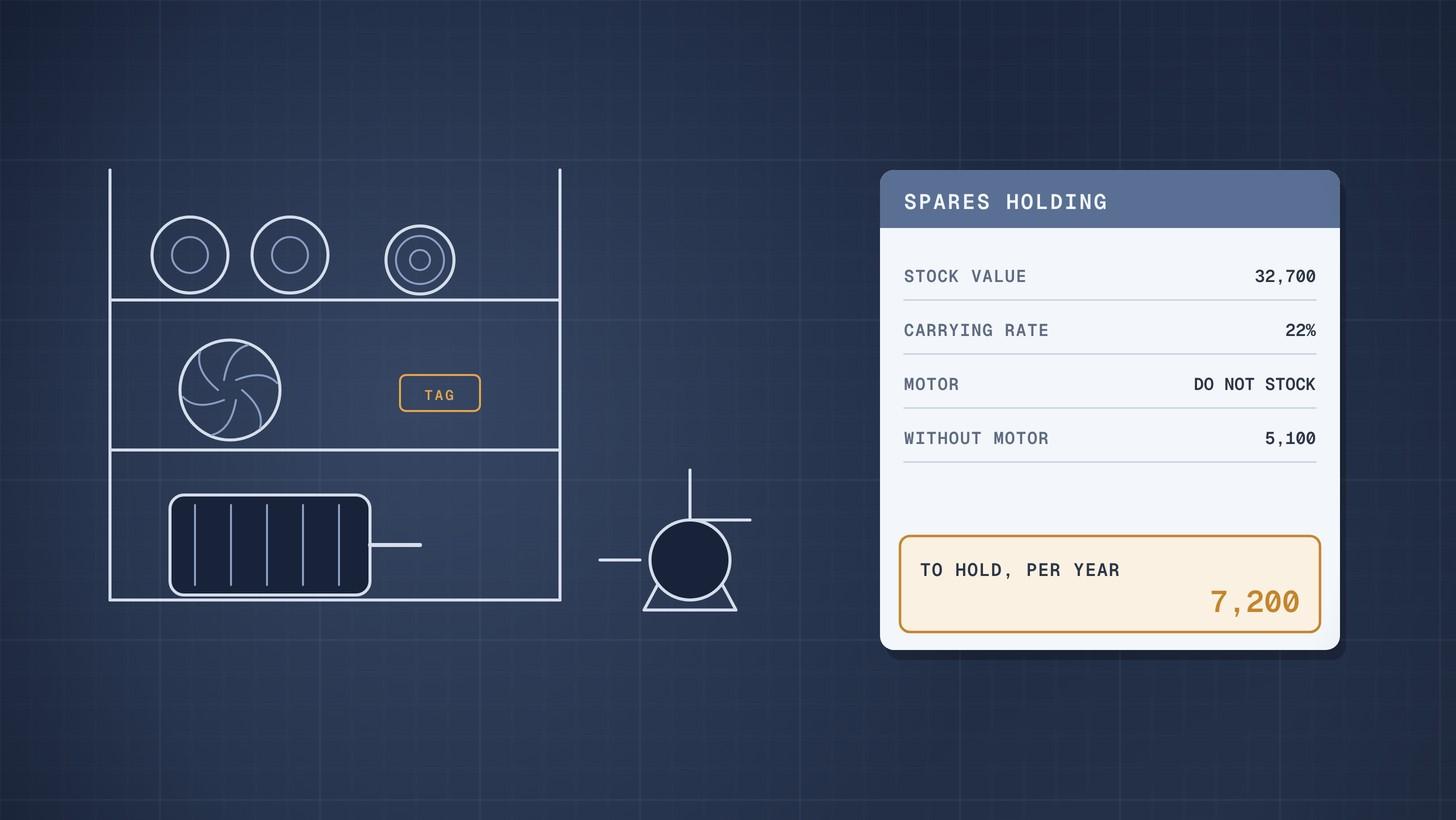
Spare parts carrying cost is what it costs each year to hold a part in stores: the money tied up in it, the space, insurance and admin, and the risk that it is damaged or becomes obsolete. Multiply the stock value by a carrying rate, often taken as 20% to 30% a year. In the worked example below, a £32,700 recommended spares list for a pump costs about £7,200 a year to hold at 22%, and one item on it costs more to keep than it saves.
The decision for each part is a comparison: the yearly carrying cost against the yearly cost of not having it when it fails.
Why this matters now
Supplier recommended spares lists tend to grow, and every item on them is paid for twice: once to buy and every year to keep. At 22% a year, a part held for ten years has cost more than twice its price in carrying cost alone.
The cost of money is also higher than it was. The Bank of England raised Bank Rate to 4% on 5 November 2026 [1], so the capital element of carrying cost, usually the largest, has gone up with it.
Create and manage RFQs in minutes
ChemCapital handles the entire procurement cycle, from structured RFQs and supplier comparisons to formal purchase orders and delivery tracking.
What goes into the carrying rate
A common framework splits carrying cost into four parts. EazyStock describes them as capital cost, storage space, inventory service (insurance, IT, taxes and staff time) and inventory risk (loss, damage, deterioration and obsolescence), and puts the total at often 20% to 30% of inventory value a year [2].
Be careful with that range. A review by Reliable Media found that the widely quoted 25% is an old textbook convention, that a 1979 survey of managers found rates from 12% to 35%, and that it could find no authoritative benchmark specific to maintenance spares [3]. It also notes that capital cost is usually the largest element [3].
So build your own rate. For the example, an illustrative one:
| Element | Rate a year | Basis |
|---|---|---|
| Capital | 9% | Company cost of capital |
| Storage | 3% | Stores space, racking, handling |
| Service | 2% | Insurance, stock checks, admin |
| Risk | 8% | Obsolescence, damage, shelf life |
| Carrying rate | 22% |
Spares for equipment that will be replaced or modified in a few years carry a higher risk element; seals and elastomers with a shelf life do too.
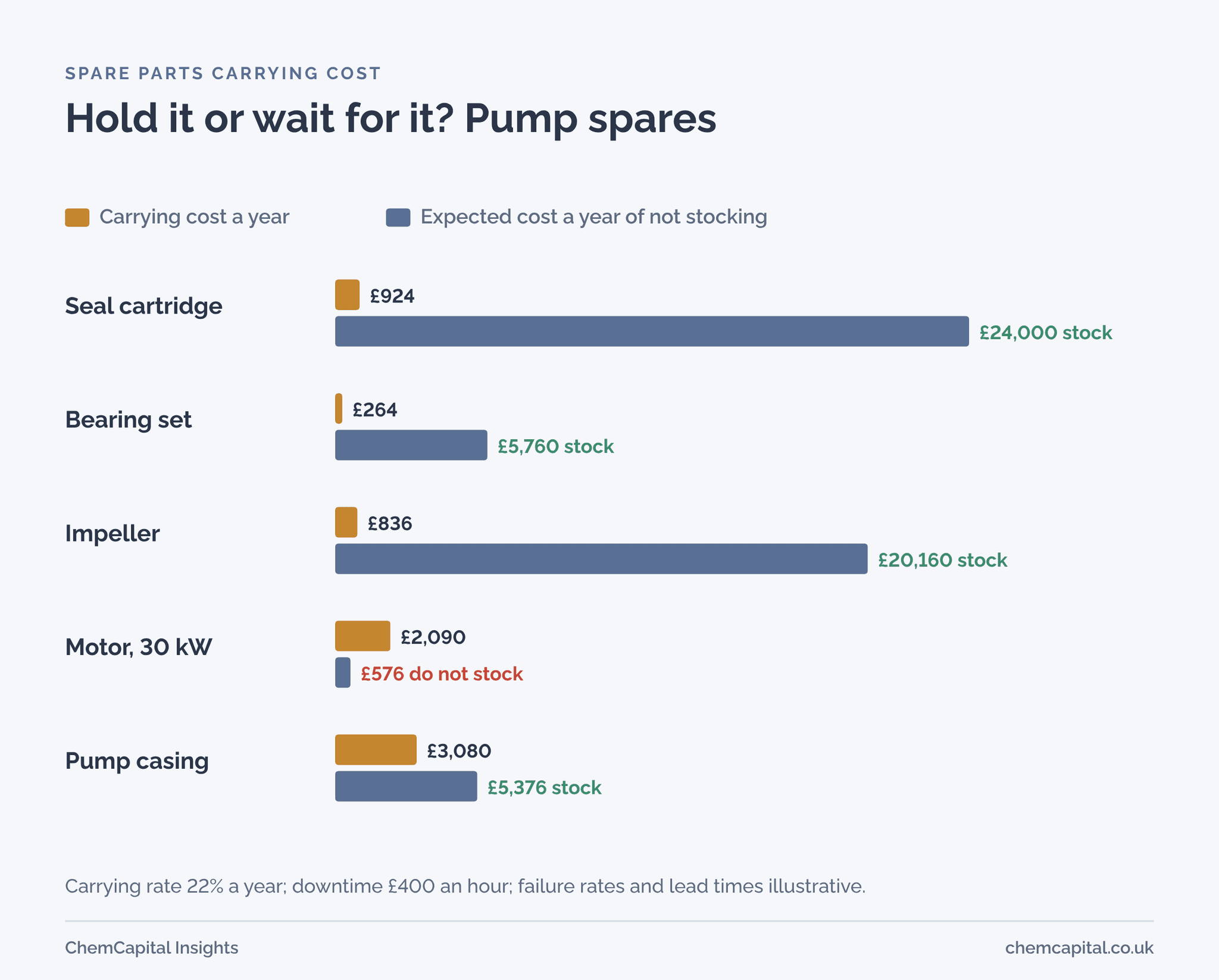
Worked example: a pump's recommended spares
A single pump with no installed standby serves a process line. If it stops, the plant hires a temporary pump and loses some output, costing an illustrative £400 an hour. The supplier's recommended spares list, with failure chances and lead times also illustrative, is below.
Step 1: carrying cost. Value × 22%.
Step 2: cost of not stocking. The approach Operations Engineer describes: multiply the cost of waiting for a part by the probability that it fails, and stock it if that exceeds the cost of holding it [4]. Here, waiting cost is lead time in hours × £400.
| Part | Value | Carrying cost a year | Failures a year | Lead time | Expected cost of not stocking | Decision |
|---|---|---|---|---|---|---|
| Mechanical seal cartridge | £4,200 | £924 | 0.25 | 10 days | £24,000 | Stock |
| Bearing set (two) | £1,200 | £264 | 0.20 | 3 days | £5,760 | Stock |
| Impeller | £3,800 | £836 | 0.05 | 6 weeks | £20,160 | Stock |
| Motor, 30 kW | £9,500 | £2,090 | 0.03 | 2 days | £576 | Do not stock |
| Pump casing | £14,000 | £3,080 | 0.005 | 16 weeks | £5,376 | Stock, or share |
| Total | £32,700 | £7,194 |
Step 3: read the result. The seal, bearings and impeller are easy calls: each saves twenty or more times its carrying cost. The motor is the opposite. It is a standard frame size that a local distributor can supply in two days, so holding it costs nearly four times what it saves. Dropping it cuts the stock to £23,200 and the carrying cost to about £5,100 a year.
The casing is marginal. It rarely fails, but the 16 week lead time makes the consequence large. If a sister site runs the same pump, one shared casing may be the better answer.
Criticality first, arithmetic second
The calculation only works if the consequence figure is right, and that comes from a criticality assessment. Operations Engineer describes assessing each asset for the impact of failure and its likelihood, with detailed methods such as FMECA reserved for the most critical [4]. A Reliabilityweb article on stocking strategy sets stock rules by criticality: for the highest category all spares are held on site, and for the next they must be available within 24 hours [5].
The same article gives a reminder of what happens when this is skipped. At a paper plant, 102 components needed spares but only 60 were stocked; adding the missing ones cost about $200,000, against downtime of more than $10,000 an hour on the line, and a later drive failure came down to a $320 part with a one week lead time [5].
What to ask the equipment supplier
- A priced recommended spares list with lead times, split into commissioning, two year operating and capital spares.
- Which parts are standard and available from distributors, and which are made to order.
- Shelf life and storage conditions for seals, elastomers and electronics.
- Interchangeability with equipment you already run, so you can share stock.
Our guides to the recommended spares list and the SPIR form cover what each document should contain. With ChemCapital's structured RFQs, you can ask every bidder for the same priced spares list, so spares are compared alongside the equipment price.
Ready to buy spares on evidence rather than habit? Start a free 14 day ChemCapital trial, with no credit card needed.
Frequently asked questions
How do you calculate spare parts carrying cost?
Multiply the value of the parts held by a yearly carrying rate made up of capital, storage, service and risk costs. At 22%, a £32,700 spares holding costs about £7,200 a year to keep.
What is a typical inventory carrying cost percentage?
Figures of 20% to 30% of inventory value a year are often quoted, and 25% is a long standing textbook convention. A 1979 survey found rates from 12% to 35%, and there is no authoritative benchmark specific to maintenance spares, so it is better to build your own rate.
How do you decide whether to stock a spare part?
Compare the yearly carrying cost with the expected yearly cost of not having the part: the probability of failure times the cost of waiting for a replacement. Stock it if the expected cost of waiting is higher, starting with the most critical equipment.
Should I stock a spare motor?
Only if the motor is critical and hard to get. A standard frame motor that a distributor can supply in a day or two often costs more to hold than it saves, while a special motor with a long lead time on a critical machine usually justifies a spare.
Informational only, not procurement or legal advice. Cited names, frameworks, and statistics belong to their respective owners.
Create and manage RFQs in minutes
ChemCapital handles the entire procurement cycle, from structured RFQs and supplier comparisons to formal purchase orders and delivery tracking.
Start for freeRelated articles
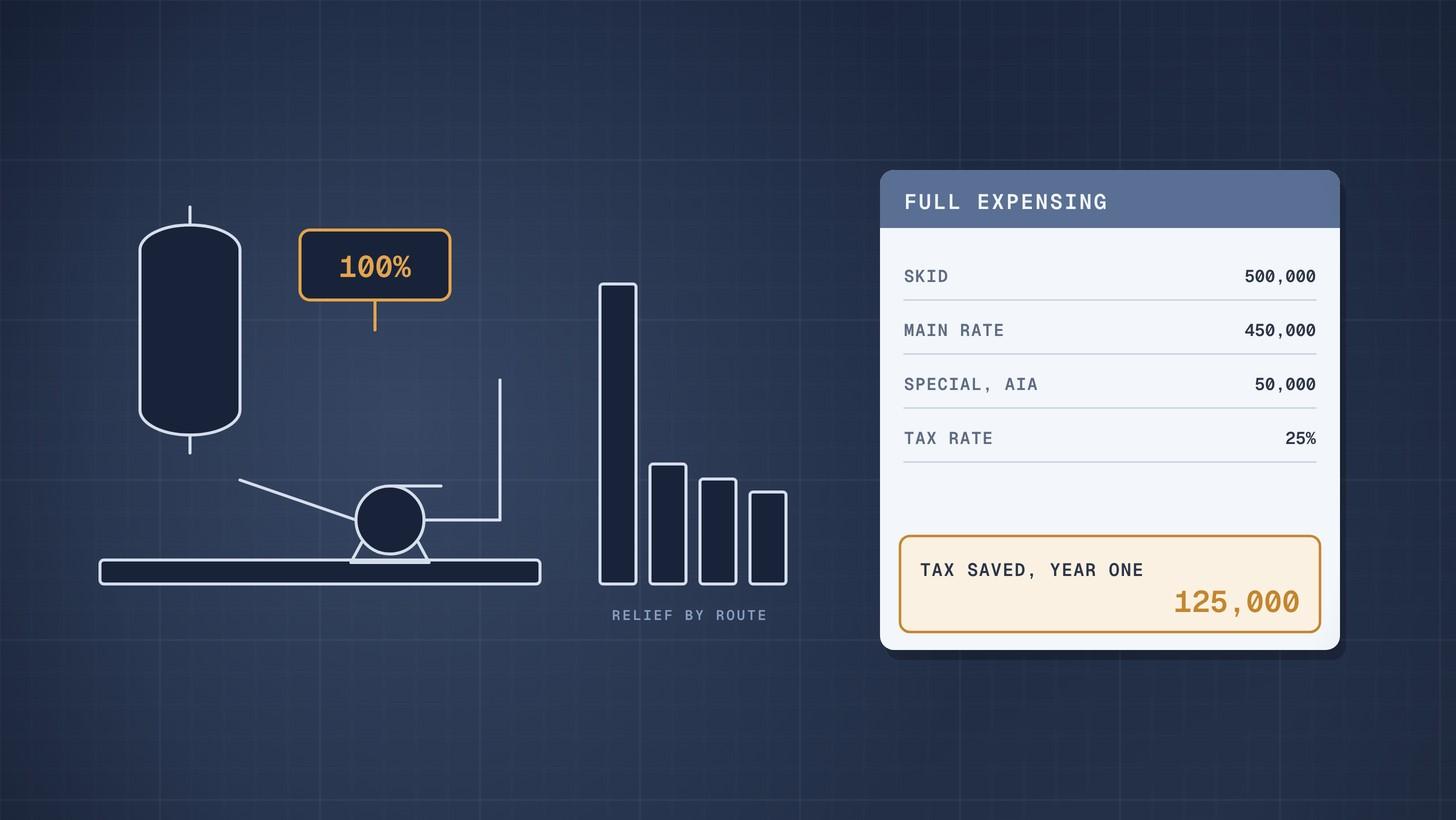
Full Expensing for Plant and Machinery: Worked Example (UK)
How full expensing, the annual investment allowance, first year allowances and writing down allowances apply to a £500,000 process skid, with the November 2026 rates.
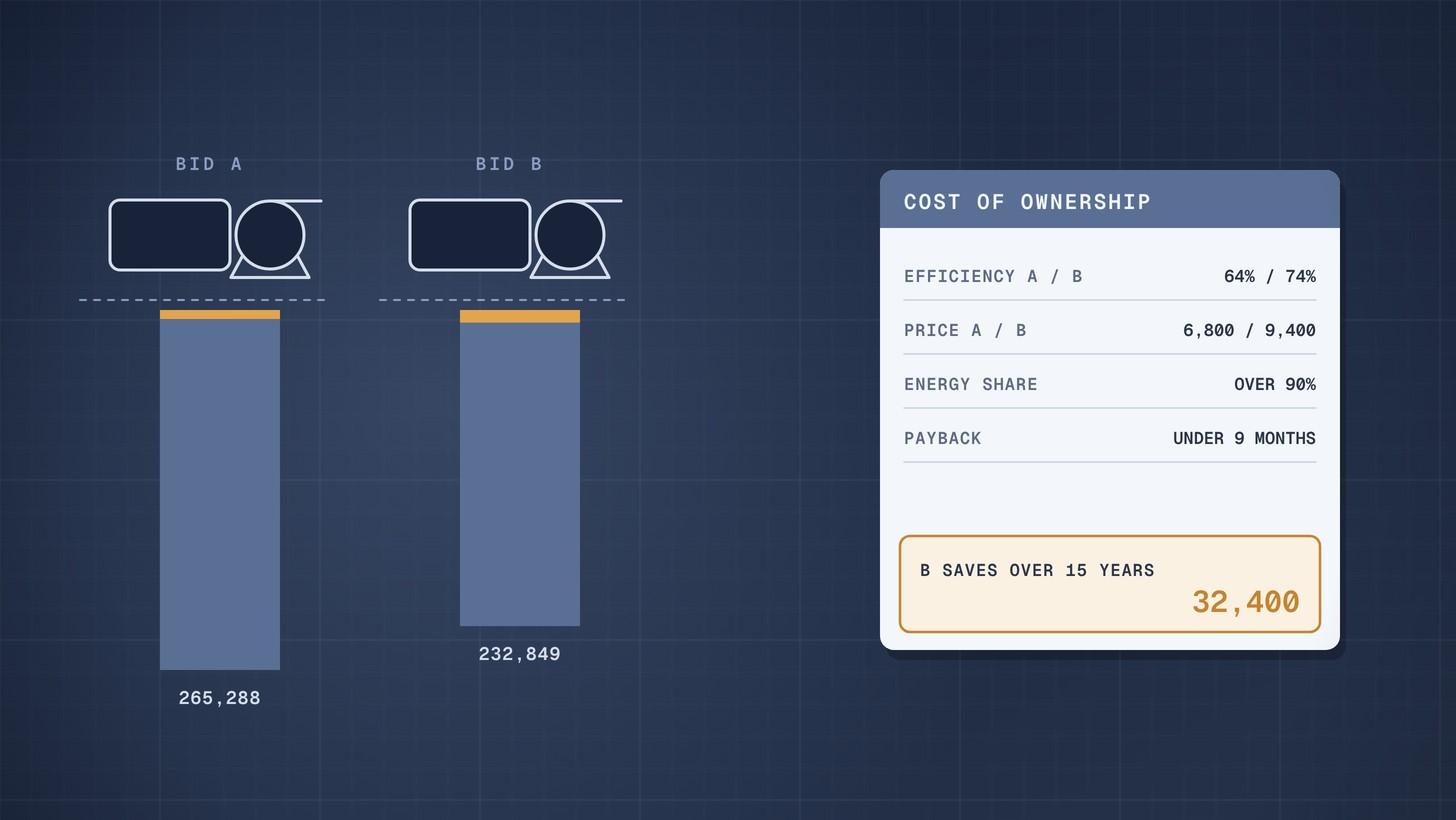
Pump Total Cost of Ownership: Worked Example
How to calculate a pump's total cost of ownership with the Hydraulic Institute and Europump life cycle cost method, comparing two bids over 15 years in present value.
Compressed Air Cost per Year: Worked Example
How to calculate the yearly running cost and cost per cubic metre of compressed air from a compressor data sheet, compare fixed and variable speed, and price leaks and pressure.