
Compressed Air Cost per Year: Worked Example
How to calculate the yearly running cost and cost per cubic metre of compressed air from a compressor data sheet, compare fixed and variable speed, and price leaks and pressure.
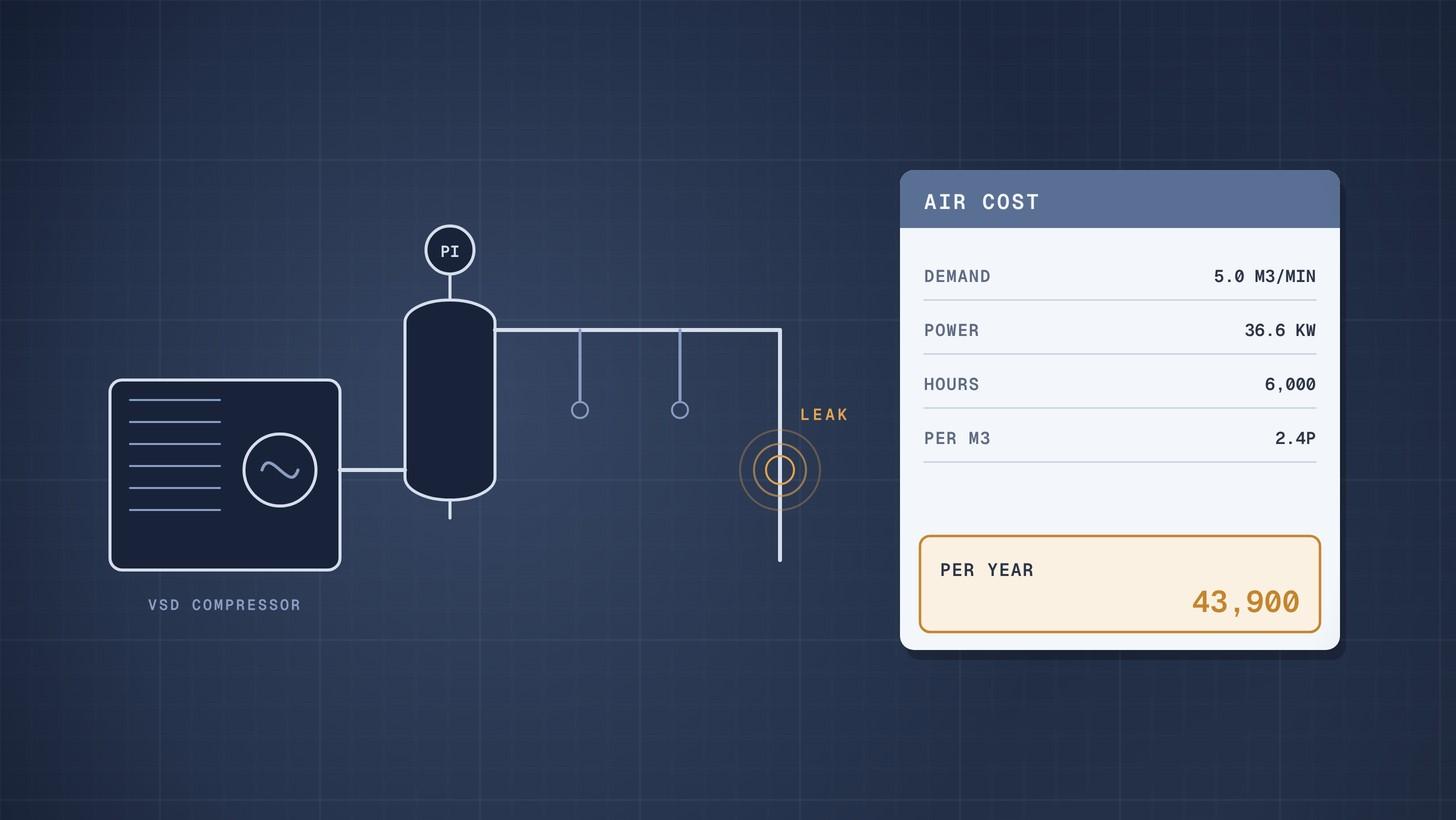
The yearly cost of compressed air is the compressor package's average input power in kW, times running hours, times your electricity price. For a variable speed screw compressor supplying an average of 5.0 m³/min at about 8.6 bar, that is roughly 36.6 kW, or about £43,900 a year over 6,000 hours at an illustrative 20p per kWh: about 2.4p for every cubic metre of free air.
The power figure is the one to get right. It comes from the compressor's data sheet at your actual demand, not from the motor nameplate.
Why this matters now
Compressed air is one of the most expensive utilities on a site. The Carbon Trust estimates it accounts for around 10% of UK industry's electricity use [1]. A US Department of Energy tip sheet notes that the overall efficiency of a typical compressed air system can be as low as 10% to 15% [2], so most of the electricity ends up as heat.
When buying a compressor, the purchase price is the smaller number. A Compressed Air Challenge fact sheet calls electricity by far the largest expense of owning and running a system, and puts yearly maintenance at 10% or more of the initial cost [3]. Comparing compressor quotes on price alone misses most of the money.
Create and manage RFQs in minutes
ChemCapital handles the entire procurement cycle, from structured RFQs and supplier comparisons to formal purchase orders and delivery tracking.
Two ways to work out the power
From the data sheet (best). Compressor makers in many markets publish standard data sheets, often in the format of the US Compressed Air and Gas Institute (CAGI), giving total package input power and specific power at several flows. Specific power is kW per unit of flow. An Atlas Copco data sheet for its GA45 VSD variable speed screw compressor at 125 psig (about 8.6 bar) gives, for example [4]:
| Flow | Package input power | Specific power |
|---|---|---|
| 284 acfm (8.04 m³/min) | 58.0 kW | 20.4 kW per 100 acfm |
| 225 acfm (6.37 m³/min) | 45.8 kW | 20.4 kW per 100 acfm |
| 178 acfm (5.04 m³/min) | 36.8 kW | 20.7 kW per 100 acfm |
| 107 acfm (3.03 m³/min) | 24.1 kW | 22.5 kW per 100 acfm |
| 55 acfm (1.56 m³/min) | 15.0 kW | 27.4 kW per 100 acfm |
One hundred acfm is 2.832 m³/min, so 20.4 kW per 100 acfm is about 7.2 kW per m³/min.
From the motor (estimate). Where no data sheet exists, the Compressed Air Challenge gives annual cost as motor full load brake horsepower × 0.746 × hours × electricity price, divided by about 0.9 for motor efficiency [3]. For a fixed speed machine that loads and unloads, multiply by the share of time loaded plus 0.30 times the share unloaded, because an unloaded rotary screw still draws 20% to 30% of full load power [3].
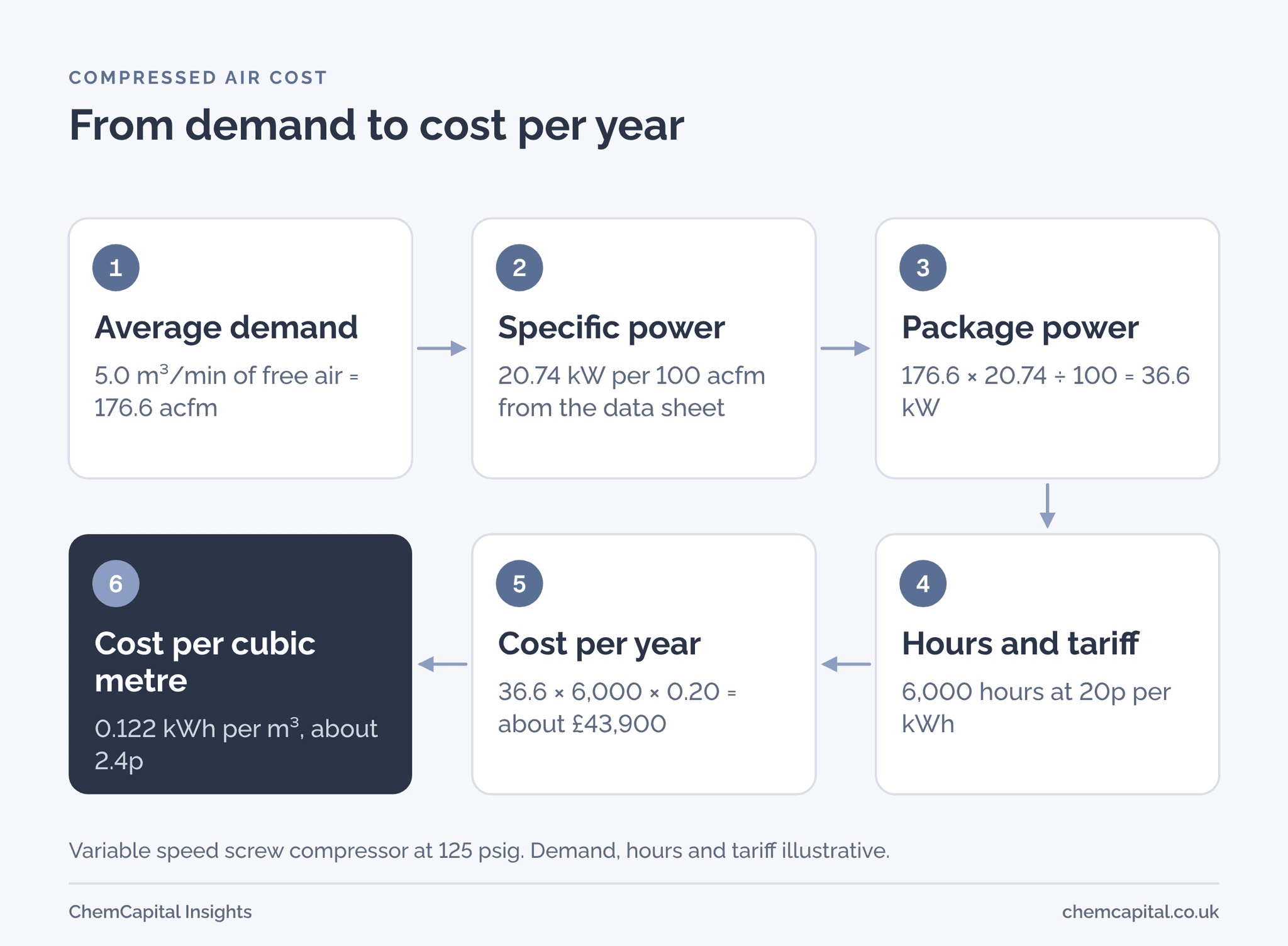
Worked example: a variable speed compressor
A site's average demand is 5.0 m³/min of free air at about 8.6 bar. The compressor is the variable speed model above. Hours, demand and tariff are illustrative.
Step 1: flow in data sheet units. 5.0 ÷ 2.832 × 100 = 176.6 acfm.
Step 2: specific power. Between the 178 acfm and 107 acfm points, interpolating gives about 20.74 kW per 100 acfm [4].
Step 3: package power. 176.6 × 20.74 ÷ 100 = 36.6 kW.
Step 4: yearly cost. 36.6 kW × 6,000 h × £0.20 = £43,900.
Step 5: cost per cubic metre. 36.6 kW ÷ (5.0 × 60) m³/h = 0.122 kWh per m³, or about 2.4p per m³ of free air.
Compare a fixed speed machine. A load and unload compressor with 50 kW full load package power, rated at 7.0 m³/min and loaded 65% of the time, uses about 50 × (0.65 + 0.30 × 0.35) = 37.8 kW on average for 4.55 m³/min [3]. That is 0.138 kWh per m³, about 13% more per cubic metre than the variable speed machine in this example, and about £45,300 a year over the same hours. A variable speed compressor saves for the same reason a pump drive does: it makes only what the system needs. Our guide to VFD energy savings for pumps shows the method.
The two cheapest savings: leaks and pressure
Leaks. Leaks run day and night whether or not production needs the air. The Carbon Trust says a single 3 mm hole can cost a business about £1,000 a year in electricity [1], and a British Compressed Air Society leaflet puts a single 2 mm hole at over £1,249 a year at 12.49p per kWh [5]. Suppose 1.0 m³/min of the 5.0 m³/min demand is leaks, and a leak survey halves it. Demand falls to 4.5 m³/min, power to about 33.7 kW, and the saving is about 2.9 kW, or £3,500 a year.
Pressure. Near 100 psig, every 2 psi of extra pressure costs about 1% more energy [3]. Cutting the set pressure by 0.5 bar (about 7 psi) saves roughly 3.6%, about 1.3 kW or £1,600 a year here. Check the lowest pressure your users really need before buying a compressor sized for a high one.
What to ask in a compressor RFQ
- Your demand profile, not just a peak flow: average, minimum and maximum, by shift if it varies.
- Pressure at the point of use and at the compressor, with the allowance for dryers and filters.
- Data sheet in CAGI format or equivalent, with package input power and specific power at several flows.
- Dryer and filter losses, and their power if they are refrigerated.
- Service cost over five or ten years, so you can build a life cycle cost.
Our guide to life cycle cost in equipment quotes shows how to combine price, energy and maintenance into one figure. ChemCapital's AI quotation comparison puts each compressor bid's capacity, power and service terms side by side, so the bid with the lowest running cost is easy to find.
Ready to compare compressor quotes on running cost as well as price? Start a free 14 day ChemCapital trial, with no credit card needed.
Frequently asked questions
How do you calculate the cost of compressed air per year?
Find the compressor package input power at your average demand from its data sheet, multiply by running hours and by your electricity price. A package drawing 36.6 kW for 6,000 hours at 20p per kWh costs about £43,900 a year.
What is the cost of compressed air per cubic metre?
Divide package power by flow to get kWh per cubic metre, then multiply by your tariff. A good variable speed screw compressor at around 8 bar uses about 0.12 kWh per cubic metre of free air, roughly 2.4p at 20p per kWh, before leaks and pressure drop.
What is specific power for a compressor?
It is the package input power divided by the air delivered, given as kW per 100 acfm or kW per m³/min on standard data sheets. Lower is better, and it changes with flow and pressure, so compare it at your actual operating point.
How much do compressed air leaks cost?
The Carbon Trust estimates a single 3 mm hole can cost about £1,000 a year in electricity, and a British Compressed Air Society leaflet puts a 2 mm hole at over £1,249 a year at 12.49p per kWh. Leaks run whenever the system is pressurised, whether or not production needs air.
Continue reading
Informational only, not procurement or legal advice. Cited names, frameworks, and statistics belong to their respective owners.
Create and manage RFQs in minutes
ChemCapital handles the entire procurement cycle, from structured RFQs and supplier comparisons to formal purchase orders and delivery tracking.
Start for freeRelated articles
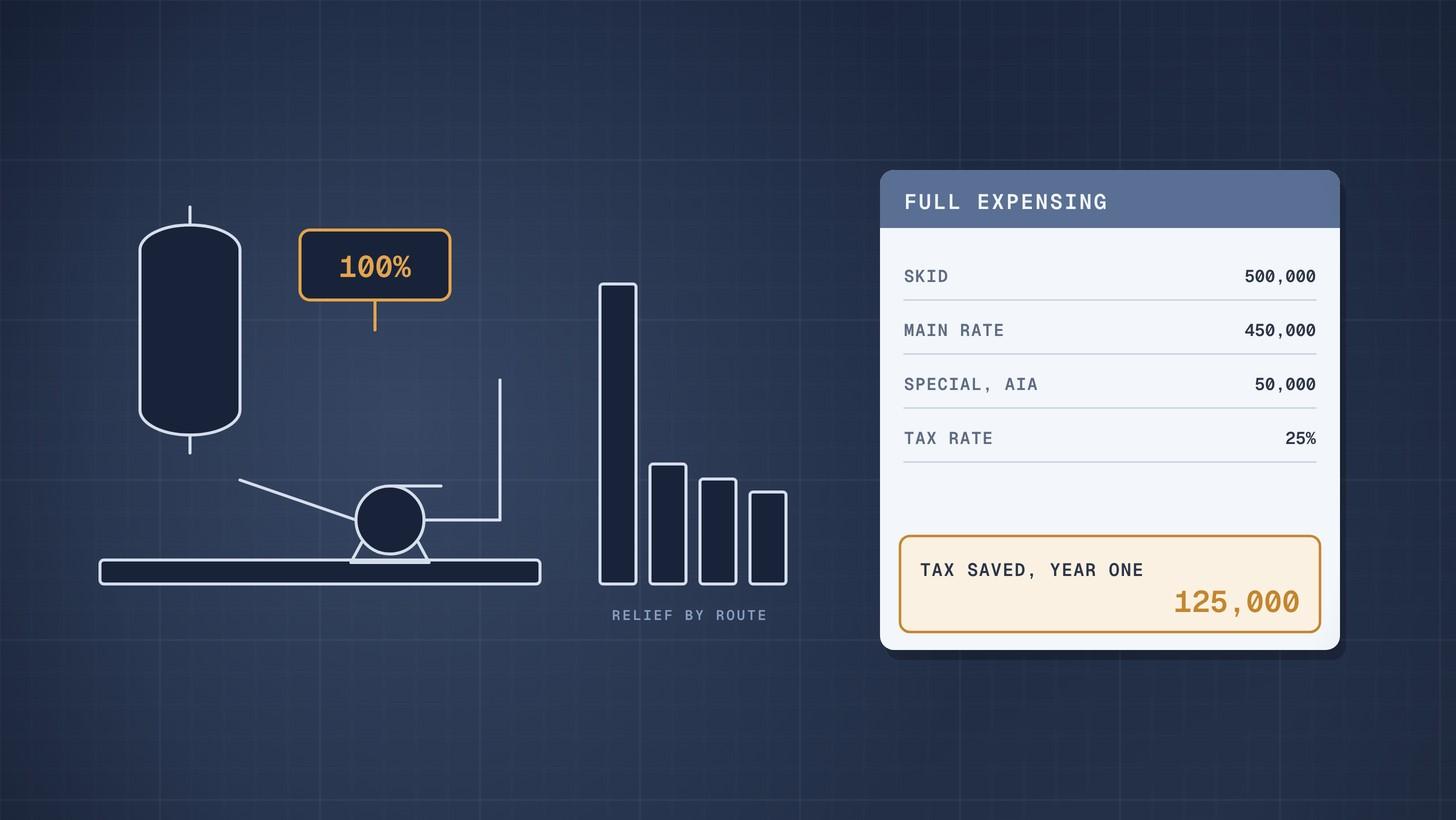
Full Expensing for Plant and Machinery: Worked Example (UK)
How full expensing, the annual investment allowance, first year allowances and writing down allowances apply to a £500,000 process skid, with the November 2026 rates.
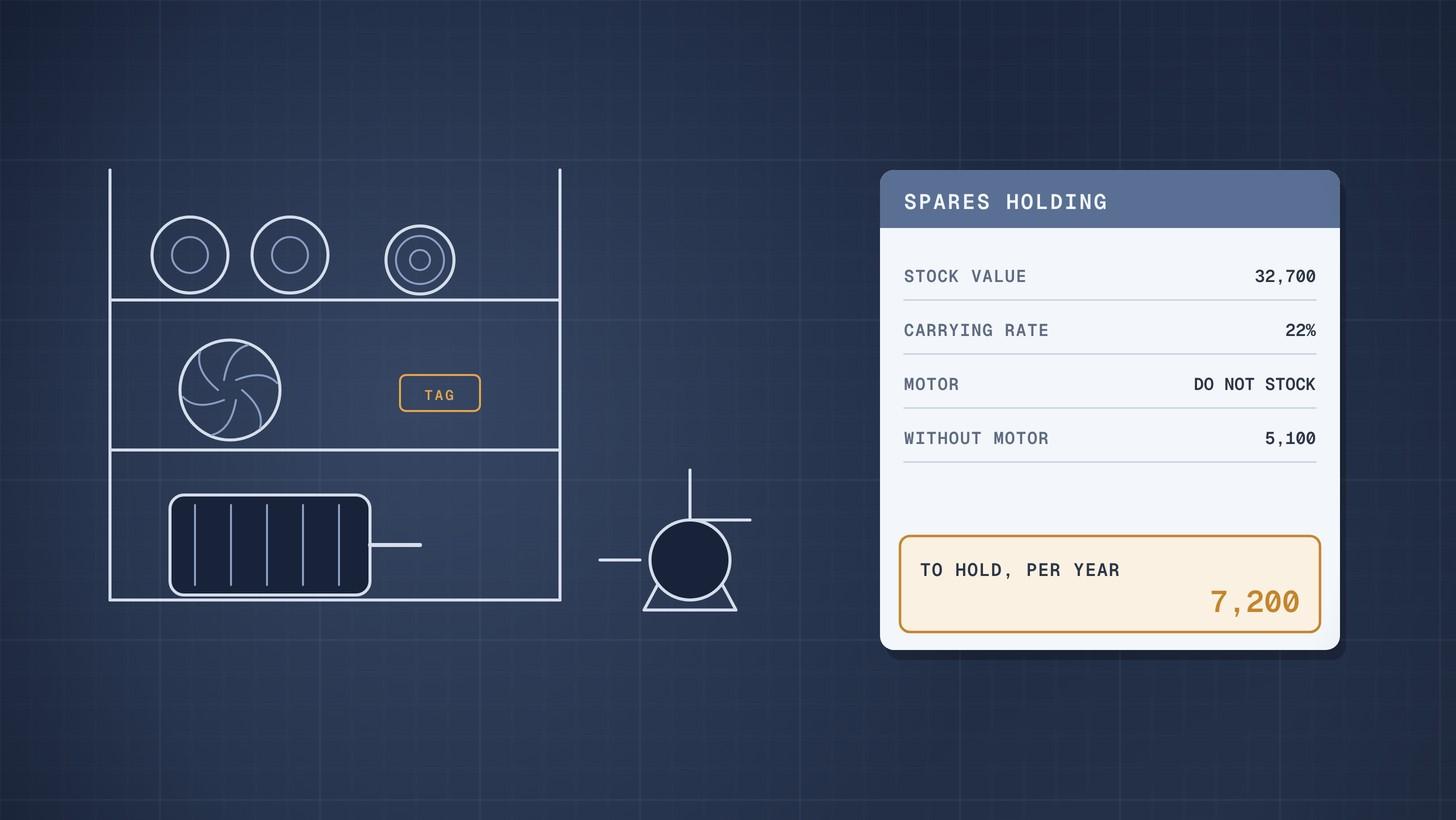
Spare Parts Carrying Cost: Worked Example
How to calculate the yearly carrying cost of spare parts, build your own carrying rate and decide which items on a recommended spares list are worth stocking.
Pump Total Cost of Ownership: Worked Example
How to calculate a pump's total cost of ownership with the Hydraulic Institute and Europump life cycle cost method, comparing two bids over 15 years in present value.