
Design Pressure, MAWP and Operating Pressure in a Vessel RFQ
The difference between operating pressure, design pressure, MAWP and PS, how much margin to add, how relief valves and hydrostatic tests follow from them, and what to put on the vessel datasheet.
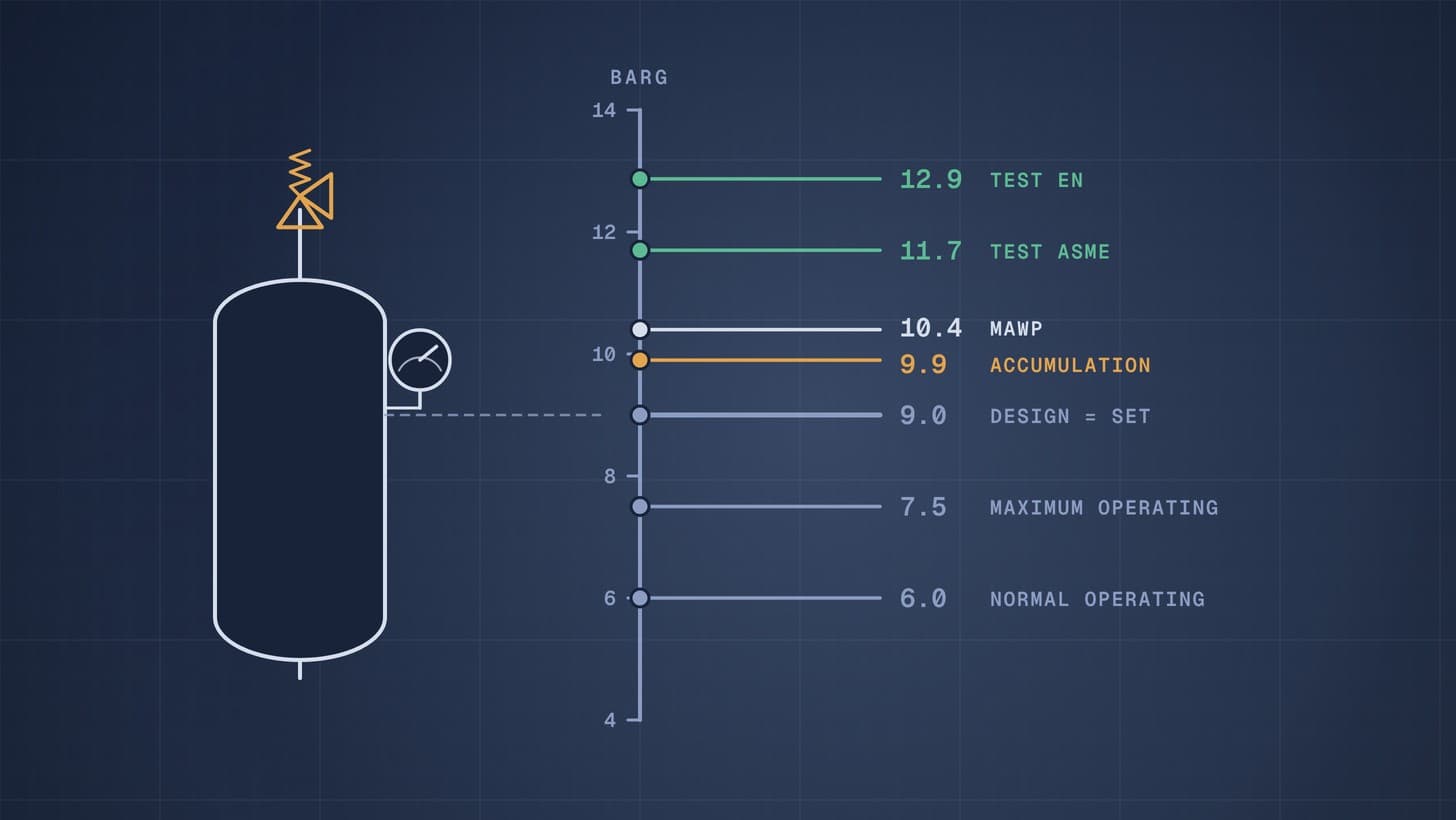
Operating pressure is what the vessel sees in normal running, and maximum operating pressure is the highest it should see in any foreseeable operation. Design pressure is the pressure the engineer uses in the code calculations, set with a margin above the maximum operating pressure. MAWP, the maximum allowable working pressure, is the highest pressure the finished vessel is allowed at the top in its operating position, at design temperature, based on the thicknesses actually used less the corrosion allowance; it is never below the design pressure and often a little above it. In European and UK pressure equipment law the comparable limit is PS, the maximum allowable pressure.
Those numbers then set the rest of the ladder: the relief valve set pressure must not be above the MAWP, the pressure during relief is limited to a small accumulation above it, and the hydrostatic test pressure is a multiple of it.
Why this matters now
A buyer's datasheet is where these pressures first get written down, and small slips are expensive. Leave out vacuum and the vessel may collapse during a steam out. Set design pressure too close to operating and the relief valve will weep. Set it too high and the vessel is thicker, heavier and dearer than it needs to be, and every flange, valve and instrument on it has to match.
The definitions also differ by jurisdiction. Pressure Vessel Engineering, a Canadian design consultancy, notes that in Alberta and Saskatchewan the design pressure must equal the MAWP [1]. A vessel bought from one country for use in another can carry the right number with the wrong meaning.
Join ChemCapital to streamline sourcing and connect with verified partners
Whether you're buying or supplying, ChemCapital gives you the tools to manage the complete procurement cycle in one platform.
Five pressures, one vessel
| Term | What it means | Who sets it |
|---|---|---|
| Normal operating pressure | Pressure in normal running | Process design |
| Maximum operating pressure | Highest pressure in any foreseeable operation, including start up and upsets the controls allow | Process design |
| Design pressure | Pressure used in the code calculations, with a margin above maximum operating | Process and mechanical engineers, on the datasheet |
| MAWP (ASME) or PS (PED and PER) | Highest allowed pressure for the finished vessel; MAWP can be calculated from actual thicknesses, while PS is specified by the manufacturer | The vessel designer, stamped on the nameplate |
| Relief set pressure | Pressure at which the relief device starts to open | Relief system design, not above MAWP |
Pressure Vessel Engineering explains that MAWP is governed by the weakest component, reflects hot and corroded conditions, and is shown on the nameplate as a whole number; the maximum allowable pressure in the new, cold condition is a different figure [1].
How much margin to add
There is no single rule, but the textbooks agree on the order of magnitude. Northwestern University's open process design textbook summarises Turton's guidance as a design pressure of 10%, or a fixed margin of roughly 0.69 to 1.7 bar, above the maximum operating pressure, whichever is greater, and Towler's as overdesign of 5% to 10% [2]. Company standards often set their own figures; use them if you have them.
Two practical checks sit on top of the rule of thumb:
- The relief valve needs room. If the set pressure equals the design pressure and the vessel normally runs close to it, the valve may simmer or leak. Ask the valve supplier what gap it needs between operating and set pressure.
- Every upset counts. Pump shut off head, a blocked outlet, thermal expansion of trapped liquid and the static head of liquid at the bottom of a tall vessel can all exceed normal operating pressure. Design pressure must cover the foreseeable cases the relief system will not.
Design temperature gets a margin too. The same textbook cites Turton's allowance of 25 °C above the maximum operating temperature for vessels between about minus 30 °C and 345 °C, and a Towler figure of 50 °F above the maximum and 25 °F below the minimum, differences of about 28 °C and 14 °C [2]. It gives corrosion allowances generally in the range of 1.5 mm to 5 mm, depending on the service [2].
Why MAWP is usually higher than design pressure
The designer sizes each part for the design pressure, then picks the next stock plate or pipe thickness above the minimum. That extra thickness means the finished vessel can usually take a higher pressure, which the designer can calculate as the MAWP. Ward Vessel and Exchanger, a fabricator, puts it simply: MAWP is always equal to or higher than design pressure [3]. It also notes the owner's choice: stamp the higher MAWP to allow for possible higher pressure service later, or rate the vessel only at design pressure and treat the extra thickness as additional corrosion allowance, which can extend its life [3].
Decide which you want and say so in the RFQ. Otherwise each bidder decides for you, and the nameplates on two otherwise identical vessels may differ.
What follows from the MAWP
Relief devices. Under ASME VIII, a single relief device must be set no higher than the MAWP, and accumulation during relief is limited to 10% above MAWP with one device, 16% with several and 21% in a fire case, according to Emerson's relief valve handbook, which reflects the 2013 code edition [4]. For new equipment under the UK Pressure Equipment (Safety) Regulations 2016, pressure must not permanently exceed PS, and a momentary surge may reach no more than 10% above it [5].
Hydrostatic test. ASME VIII Division 1 tests at 1.3 times the MAWP, adjusted by the ratio of allowable stresses at test and design temperature [6], while the UK regulations apply a floor of 1.43 times PS as a general rule for vessels [5]. Our guide to hydrostatic test pressure works through the codes side by side.
Pressure equipment category. Under the European and UK regimes, PS is one of the inputs that decide the category, which in turn decides how much third party assessment the vessel needs. See PED and PER 2016 categories.
What to put on the datasheet
| Field | What to give | Why it matters |
|---|---|---|
| Normal and maximum operating pressure | Both, in barg, with the case that sets the maximum | Lets bidders check your margin |
| Design pressure, internal | One figure per chamber, in barg | Drives thickness and weight |
| Design pressure, external | Full vacuum, partial vacuum or none | Vacuum needs stiffening or thicker walls |
| Design temperature | Maximum and minimum, per chamber | Sets allowable stress and impact testing |
| MAWP stamping | Stamp at design pressure, or at calculated MAWP | Avoids different nameplates from different bidders |
| Corrosion allowance | In mm, per part | Affects thickness and MAWP |
| Static head | Liquid height and density at maximum level | Bottom of a tall vessel sees more pressure |
| Relief basis | Set pressure and who supplies the device | Ties the vessel to its protection |
| Code and regulations | Code and edition, and the conformity marking needed | Definitions differ between them |
Units are a frequent source of error. Bar gauge and bar absolute differ by about one bar; psi and bar by a factor of about 14.5. Write the unit next to every number. Our pressure vessel datasheet guide covers the other fields.
Practical example
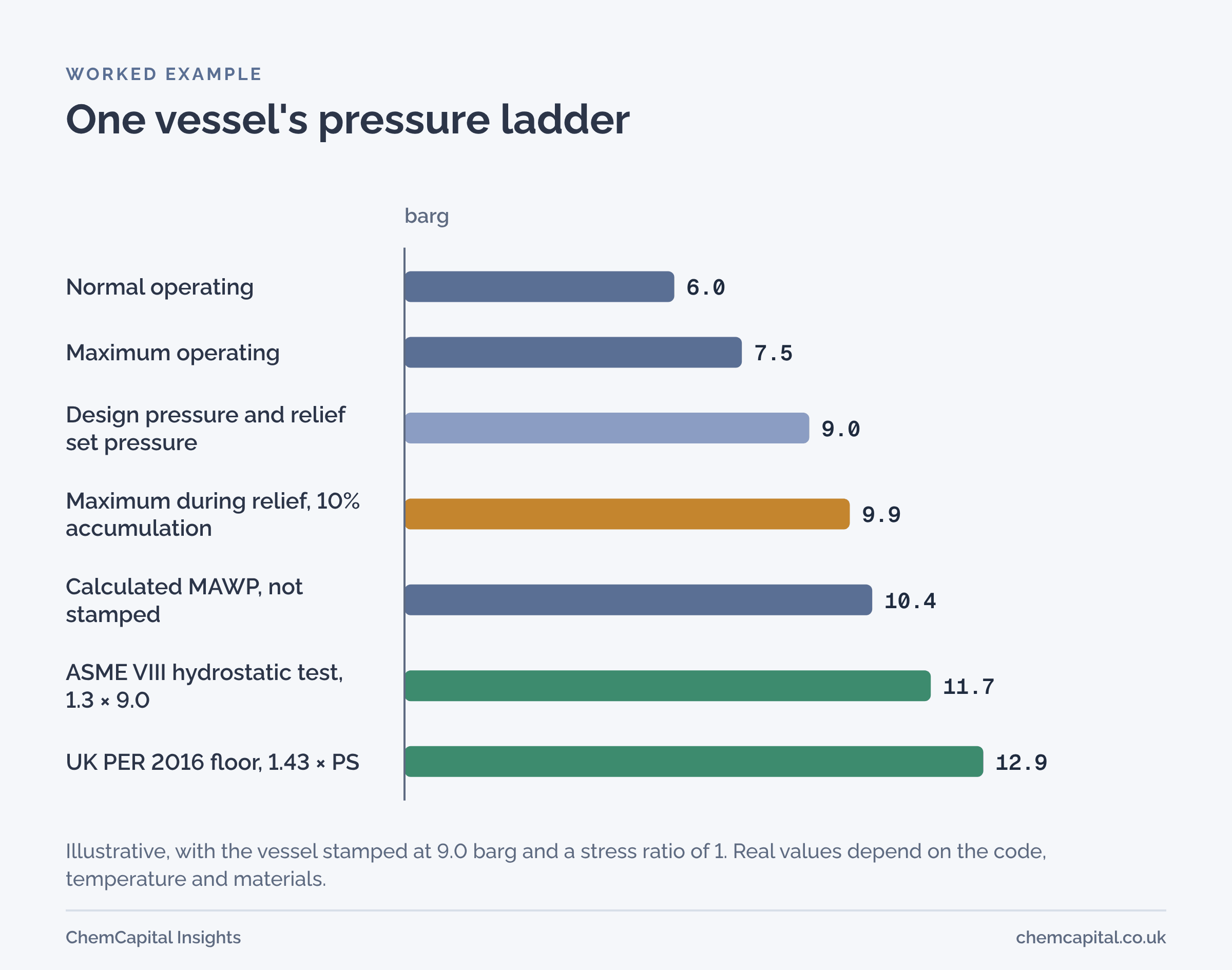
In this illustrative example, a buyer specifies a stainless receiver that normally runs at 6.0 barg, with a maximum operating pressure of 7.5 barg when the feed pump runs against a closed outlet.
Applying the 10% rule gives 8.25 barg; a fixed margin of 0.69 to 1.7 bar gives 8.19 to 9.2 barg. The buyer's own standard uses a fixed margin of 1.5 bar, giving 9.0 barg, which is greater than the 8.25 barg from the 10% rule, so design pressure is set at 9.0 barg, with full vacuum as the external design case because the vessel is steamed out. The relief valve is set at 9.0 barg, which leaves 1.5 bar between maximum operating and set pressure for the valve to stay tight.
The fabricator's calculations, using stock plate, give a calculated MAWP of 10.4 barg. The buyer asks for the vessel to be stamped at 9.0 barg and the extra thickness kept as additional corrosion margin. With one valve and no fire case, the pressure during relief is limited to 9.9 barg, 10% above the stamped MAWP [4]. The ASME hydrostatic test, with a stress ratio of 1, is 11.7 barg [6], but because the vessel is going into service in Great Britain the 1.43 times PS floor of about 12.9 barg applies as a general rule [5].
Had the buyer left the stamping choice open, one bidder might have stamped 10.4 barg and offered a relief valve set there, and the comparison of bids would have mixed two different vessels.
Where ChemCapital fits
ChemCapital sends one structured RFQ with line items and attachments, so the same datasheet, with its pressures, temperatures and stamping choice, reaches every bidder. The AI quotation comparison then extracts price, lead time, materials, certifications and scope from each quote, keeps the source text beside every extracted field, and checks for missing fields and unit mismatches, so a bid quoted in different units is easier to spot before anyone compares prices.
Want every vessel bid built on the same design conditions? Start free with ChemCapital.
Frequently asked questions
What is the difference between design pressure and MAWP?
Design pressure is the pressure the engineer uses in the calculations. MAWP is the maximum pressure the finished vessel is allowed at the top in its operating position, at design temperature, based on the actual thicknesses less corrosion allowance; because plate comes in stock thicknesses, it is usually equal to or higher than the design pressure.
How much higher than operating pressure should design pressure be?
Towler suggests 5% to 10% above the maximum operating pressure; Turton suggests 10% or a fixed margin of roughly 0.69 to 1.7 bar, whichever is greater. Company standards and the relief valve's needs often set the final figure.
Is PS the same as MAWP?
They play similar roles. PS, the maximum allowable pressure, is the term used in the European Pressure Equipment Directive and the UK Pressure Equipment (Safety) Regulations 2016, while MAWP is the ASME term; check how each is defined in the code and regulations that apply to your vessel.
Informational only, not procurement or legal advice. Cited names, frameworks, and statistics belong to their respective owners.
Join ChemCapital to streamline sourcing and connect with verified partners
Whether you're buying or supplying, ChemCapital gives you the tools to manage the complete procurement cycle in one platform.
Get started freeRelated articles
Pressure Vessel and Process Datasheets for Quotations
The difference between a process and a mechanical datasheet for vessels, the fields a fabricator needs to quote, and the omissions that cause requotes.
Mechanical Seal Plans and API 682: A Pump Buyer's Guide
How API 682 classifies pump seals by category, arrangement and type, what the common piping plans such as 11, 23, 52, 53A and 53B do, and what to specify so seal bids can be compared.
Valve Seat Leakage Classes Explained: FCI 70 2, API 598 and ISO 5208
What control valve leakage classes II to VI allow, how API 598 and ISO 5208 rate isolation valves, and how to specify shut off in an RFQ so bidders quote the same tightness.