
Valve Seat Leakage Classes Explained: FCI 70 2, API 598 and ISO 5208
What control valve leakage classes II to VI allow, how API 598 and ISO 5208 rate isolation valves, and how to specify shut off in an RFQ so bidders quote the same tightness.
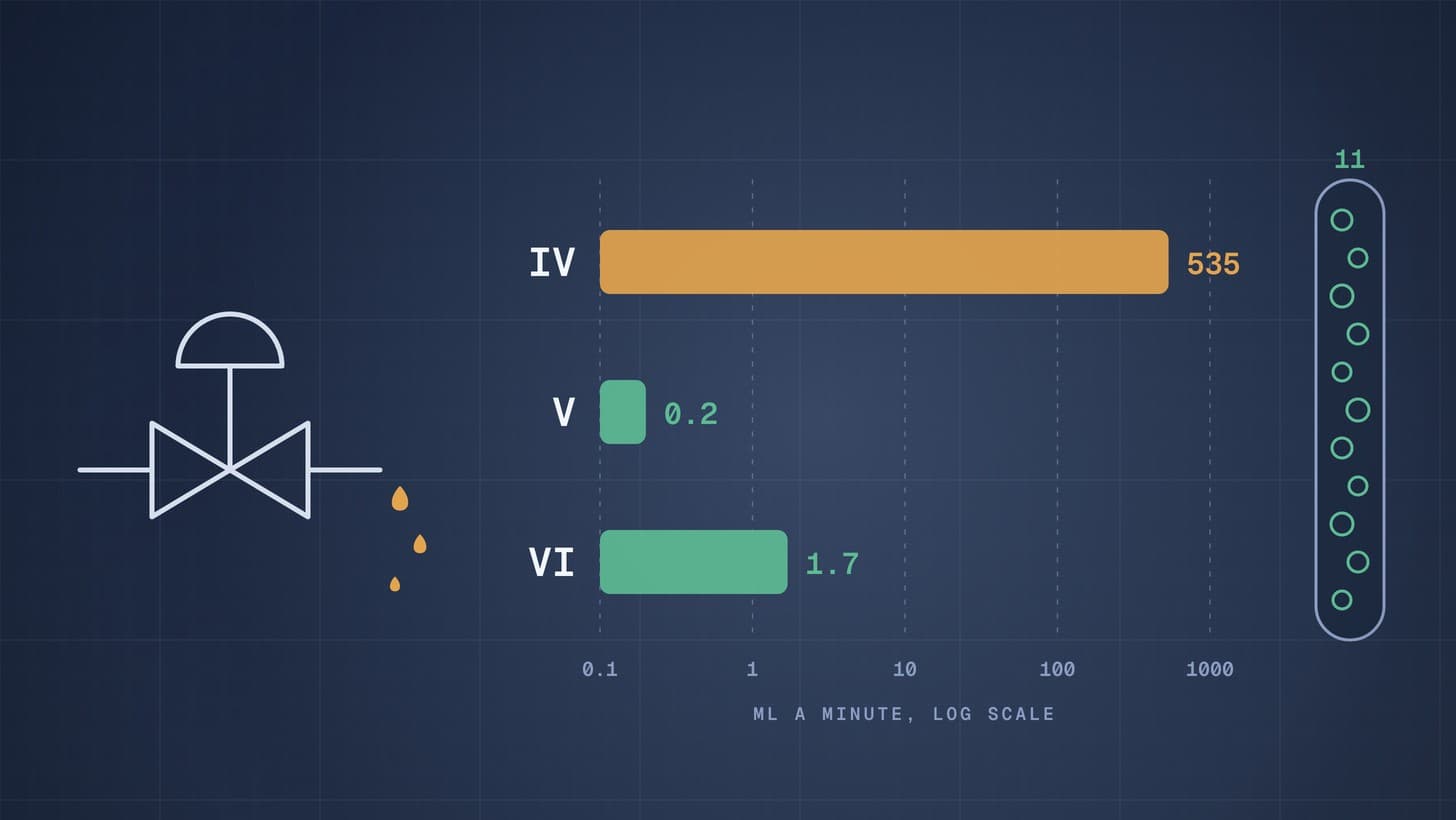
Valve seat leakage classes say how much fluid may pass a closed valve during a factory test. For control valves, the common reference is ANSI/FCI 70 2, with classes II to VI: classes II, III and IV allow 0.5%, 0.1% and 0.01% of the valve's rated capacity; class V sets a very small water leakage per inch of seat diameter per psi of pressure drop; and class VI, the tightest, sets an air leakage in millilitres or bubbles per minute by seat size [1]. Isolation valves are tested to different standards: API 598 allows zero leakage for resilient seated valves and a small allowance for larger metal seated ones, and ISO 5208 grades leakage in rates from A, no visible leakage, to G [2] [3].
For a buyer the point is simple: "tight shut off" or "bubble tight" in an RFQ means different things to different bidders. Specify the class and the test standard.
Why this matters now
Shut off requirements have a direct effect on price and design. A class VI requirement is mainly met by resilient seated control valves, yet it is often applied to metal seated isolation valves too [2], which can force a different valve design or a costlier seat. Under specify and a valve that is meant to isolate a reactor feed lets product through. Over specify and every bidder prices a tighter seat than the duty needs.
Create and manage RFQs in minutes
ChemCapital handles the entire procurement cycle, from structured RFQs and supplier comparisons to formal purchase orders and delivery tracking.
Control valve classes under ANSI/FCI 70 2
| Class | Test fluid | Test pressure | Maximum allowed seat leakage |
|---|---|---|---|
| II | Air or water | 45 to 60 psig, or maximum operating pressure drop if lower | 0.5% of rated capacity |
| III | Air or water | As class II | 0.1% of rated capacity |
| IV | Air or water | As class II | 0.01% of rated capacity |
| V | Water | Maximum operating pressure drop | 0.0005 ml per minute per inch of seat diameter per psi of pressure drop |
| VI | Air or nitrogen | Maximum rated pressure drop or 50 psig, whichever is less | By seat diameter, from 0.15 ml a minute at 1 inch to 6.8 ml at 8 inches |
These figures are from Valmet's summary of the 2013 edition of the standard, which also gives a class V variant tested with air at 50 psig and allowing 4.7 standard ml a minute per inch of seat diameter, and sets the test temperature at 50 °F to 125 °F [1]. The current edition, ANSI/FCI 70 2 2021, still defines six seat leakage classes and the test procedure for each [4]; this article covers classes II to VI, which carry test limits. Check the current edition before relying on the 2013 figures.
Class VI is easiest to picture as bubbles. Valmet's guide takes one bubble as about 0.15 ml and lists 1 bubble a minute at a 1 inch seat, 11 at 4 inches and 45 at 8 inches [1]. Because FCI 70 2 is a low pressure test, closure tests at higher pressure follow other standards such as API 598 or MSS SP 61 [2].
Isolation valves: API 598 and ISO 5208
API 598 covers inspection and testing of gate, globe, check, ball, plug and butterfly valves. It requires zero leakage for resilient, soft seated valves, and allows a defined leakage for metal seated valves above NPS 2 [2]. One summary of the API 598 table lists metal seated allowances that rise with size, from 12 drops or 24 bubbles a minute for mid sized valves to 28 drops or 56 bubbles above NPS 12 [5]; check the edition your specification calls up. The same summary notes 16 drops make a millilitre [5]. API 598 also sets a hydrostatic seat test at 1.1 times the maximum cold working pressure and a shell test at 1.5 times [2].
ISO 5208 grades seat leakage in rates A to G, from no visible leakage (A) through standard industrial leakage (D) to rates for special applications (G), and the right rate depends on the valve type, service and project specification [3]. Rate A is commonly applied to soft seated valves, and rate D to metal seated valves [2]. EN 12266 1 uses a similar lettered scale [2].
Practical example
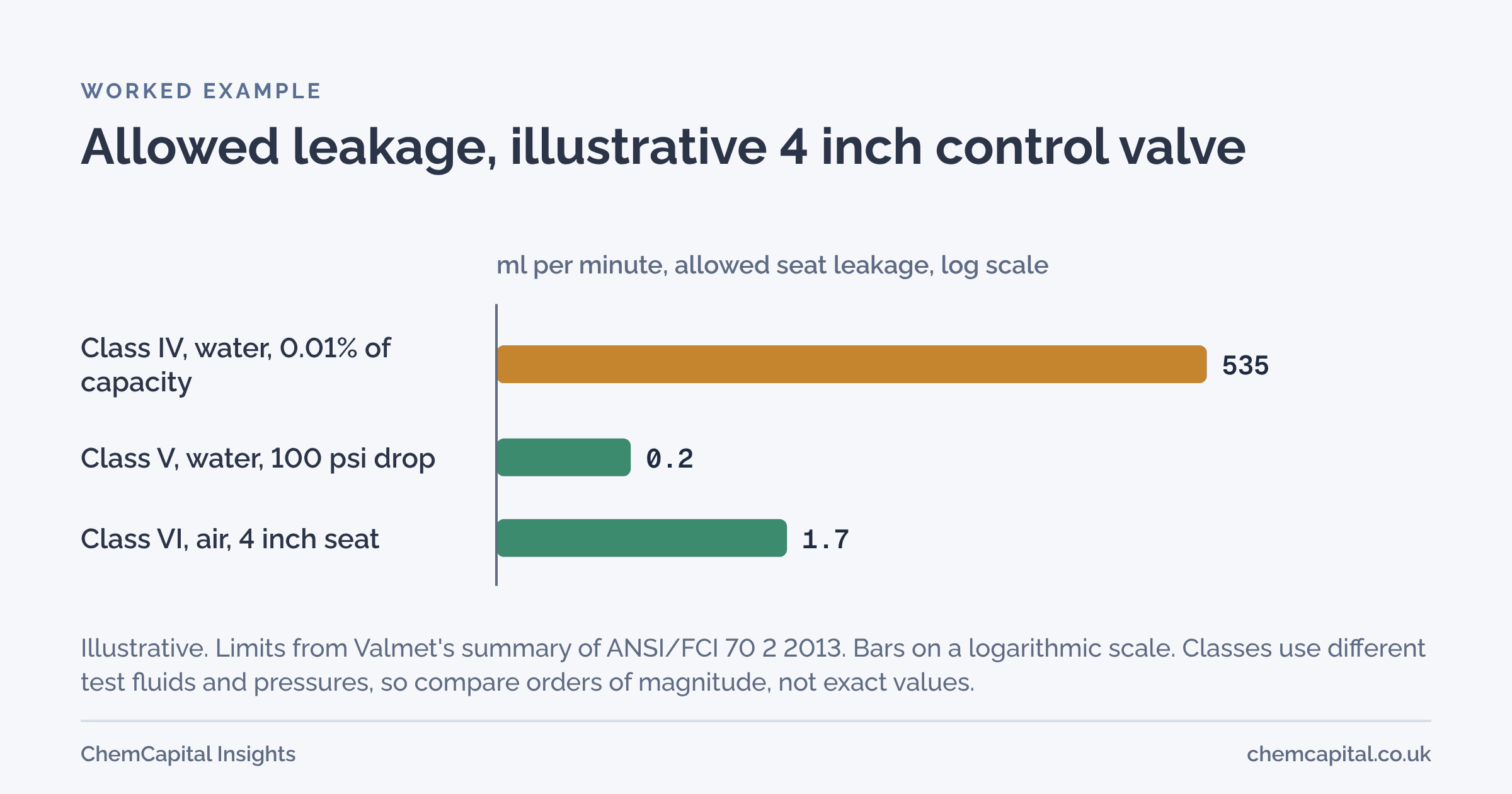
In this illustrative example, a buyer's datasheet asks for a 4 inch control valve with "tight shut off". Three bidders offer three classes: one class IV, one class V and one class VI.
To put them side by side, take a valve with a flow coefficient, Cv, of 200, as explained in our guide to control valve sizing and Cv. At a 50 psi water test, its rated capacity is about 1,414 US gallons a minute, or about 5.35 million ml a minute. Class IV allows 0.01% of that, about 535 ml a minute. Class V, assuming a 4 inch seat at a 100 psi pressure drop, allows 0.0005 × 4 × 100, or 0.2 ml a minute of water. Class VI allows 1.70 ml a minute of air, about 11 bubbles [1].
Class IV allows hundreds of times more leakage than class VI and thousands of times more than class V. Classes V and VI cannot be ranked against each other on these figures, because one is tested with water and the other with air at different pressures. For a valve that only throttles, class IV may be fine. For a valve that must hold back a hazardous feed when closed, it is not. The buyer rewrites the datasheet to ask for class V, tested to FCI 70 2, plus an upstream isolation valve to API 598 for maintenance, and asks all three bidders to requote.
What to put in the RFQ
- For each control valve: the seat leakage class and the standard, for example "ANSI/FCI 70 2 class V", and the maximum shut off pressure drop.
- For each isolation valve: the test standard and rate, for example "API 598" or "ISO 5208 rate A", and the seat type.
- Witnessing: which tests you want to attend, and certificates for every valve.
- Consistency: the same wording on the valve list and every datasheet, so no bidder works from an older version.
Where ChemCapital fits
ChemCapital sends one structured RFQ with line items and attachments, so every bidder gets the same valve list and datasheets. The AI quotation comparison extracts price, lead time, materials, certifications and scope from each quote, keeps the source text beside every extracted field, and checks incoming quotes for missing fields and compliance gaps; a quote that misses a mandatory requirement you set, such as a leakage class, is flagged and left out of the ranking, and people make the final call.
Ready to send valve RFQs that every bidder reads the same way? Start a free 14 day ChemCapital trial, with no credit card needed.
Frequently asked questions
What is ANSI class VI leakage?
It is the tightest seat leakage class for control valves in ANSI/FCI 70 2, tested with air or nitrogen and expressed in millilitres or bubbles per minute by seat diameter. For a 4 inch seat, Valmet's summary of the 2013 edition allows 1.70 ml a minute, or about 11 bubbles.
What is the difference between API 598 and ISO 5208?
Both cover pressure testing of industrial valves, including shell and seat tests. API 598 sets allowable seat leakage by seat type and size, with zero leakage for resilient seated valves, while ISO 5208 grades seat leakage in rates from A, no visible leakage, to G.
Is class IV or class VI better for a control valve?
Neither is better in general. Class IV suits many metal seated control valves where a small leak is acceptable; class VI is mainly for resilient seated valves where tight shut off matters, and specifying it unnecessarily can limit the valve design or raise the price.
Continue reading
Informational only, not procurement or legal advice. Cited names, frameworks, and statistics belong to their respective owners.
Create and manage RFQs in minutes
ChemCapital handles the entire procurement cycle, from structured RFQs and supplier comparisons to formal purchase orders and delivery tracking.
Start for freeRelated articles
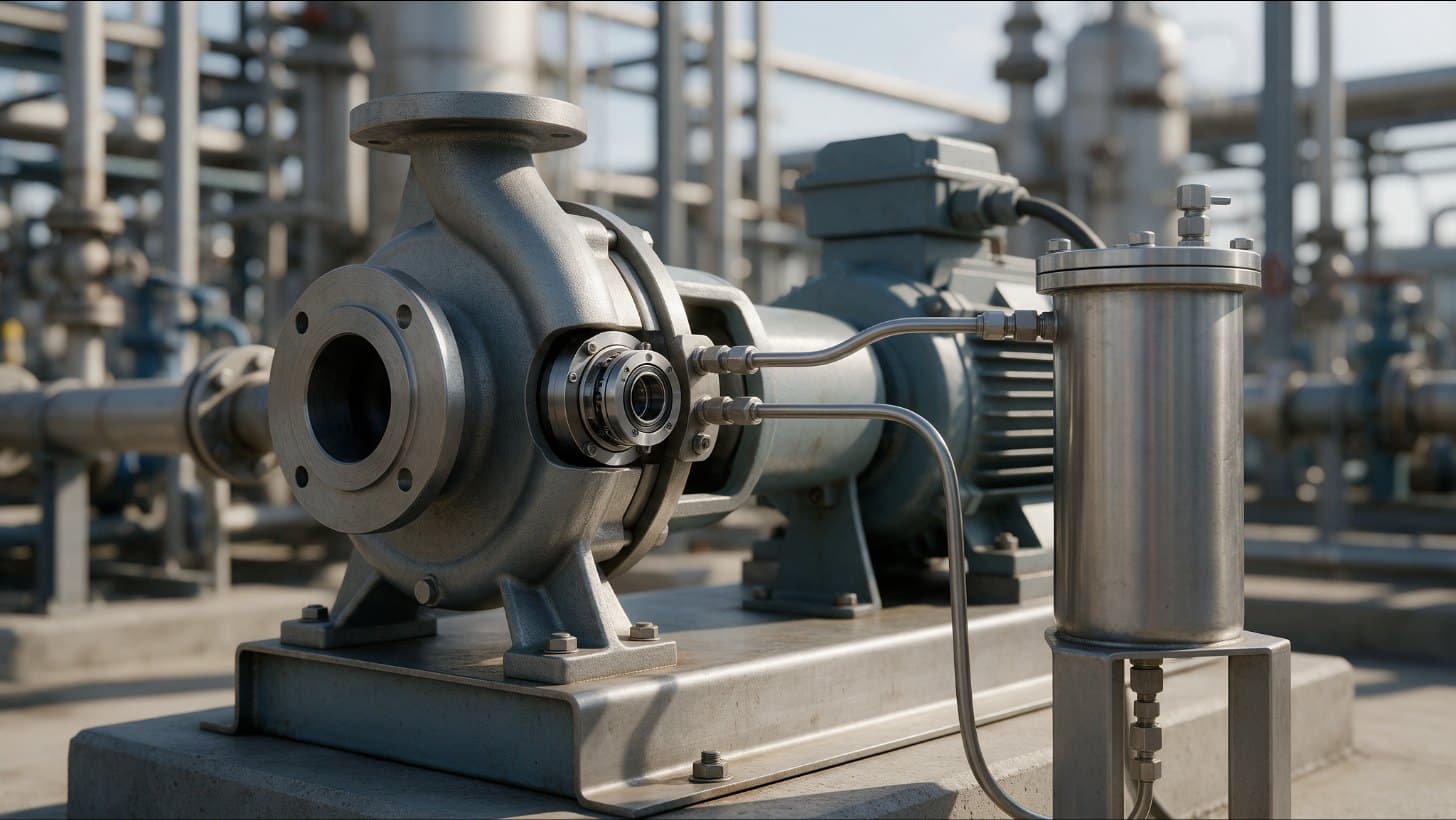
Mechanical Seal Plans and API 682: A Pump Buyer's Guide
How API 682 classifies pump seals by category, arrangement and type, what the common piping plans such as 11, 23, 52, 53A and 53B do, and what to specify so seal bids can be compared.
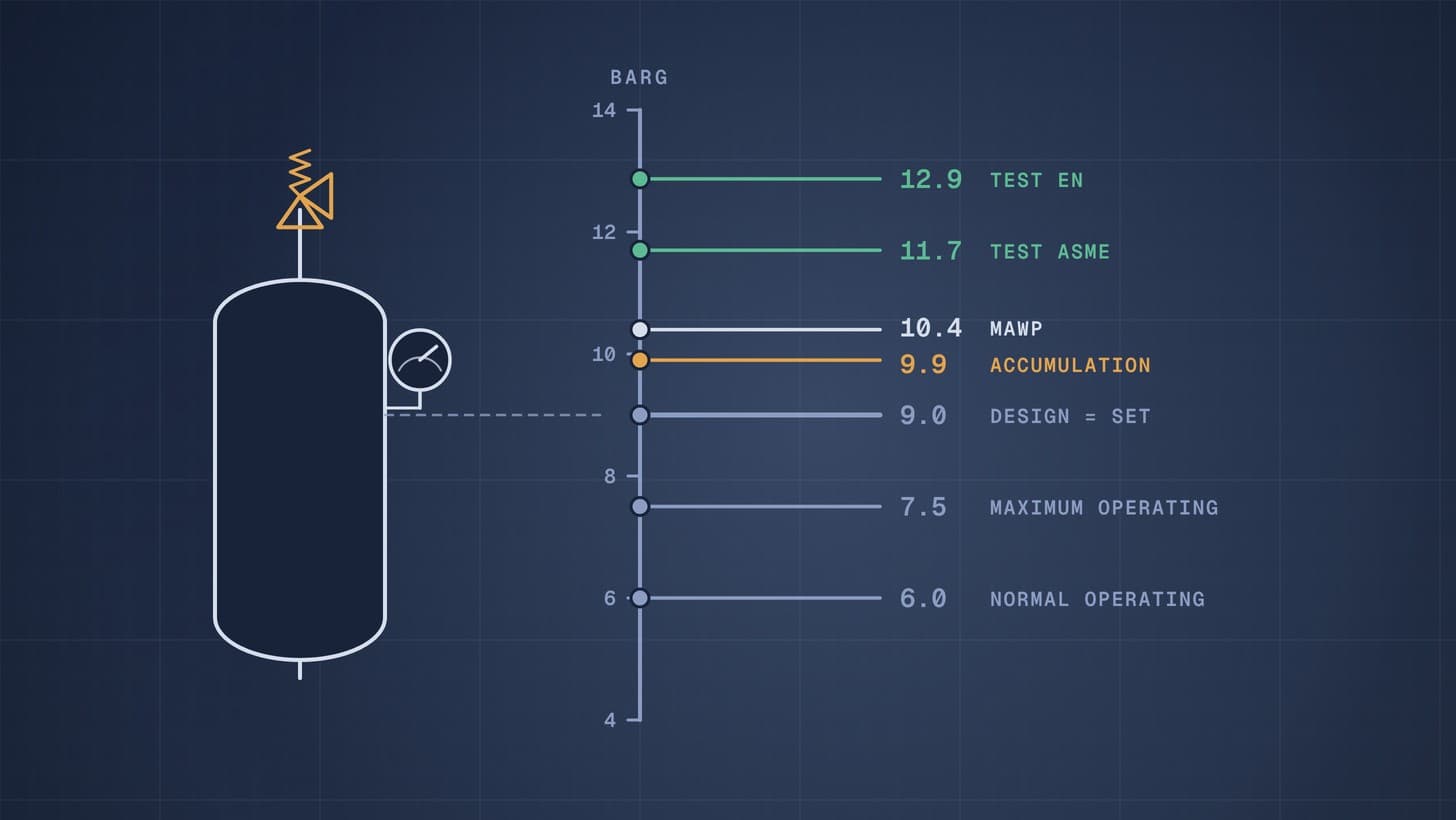
Design Pressure, MAWP and Operating Pressure in a Vessel RFQ
The difference between operating pressure, design pressure, MAWP and PS, how much margin to add, how relief valves and hydrostatic tests follow from them, and what to put on the vessel datasheet.
Pressure Vessel and Process Datasheets for Quotations
The difference between a process and a mechanical datasheet for vessels, the fields a fabricator needs to quote, and the omissions that cause requotes.