
Deviation List for Equipment Bids: How to Write One Buyers Respect
How to write a deviation and clarification list for an engineered equipment bid: classify each item, cite the clause, give the reason and the cost or schedule effect, with a template.
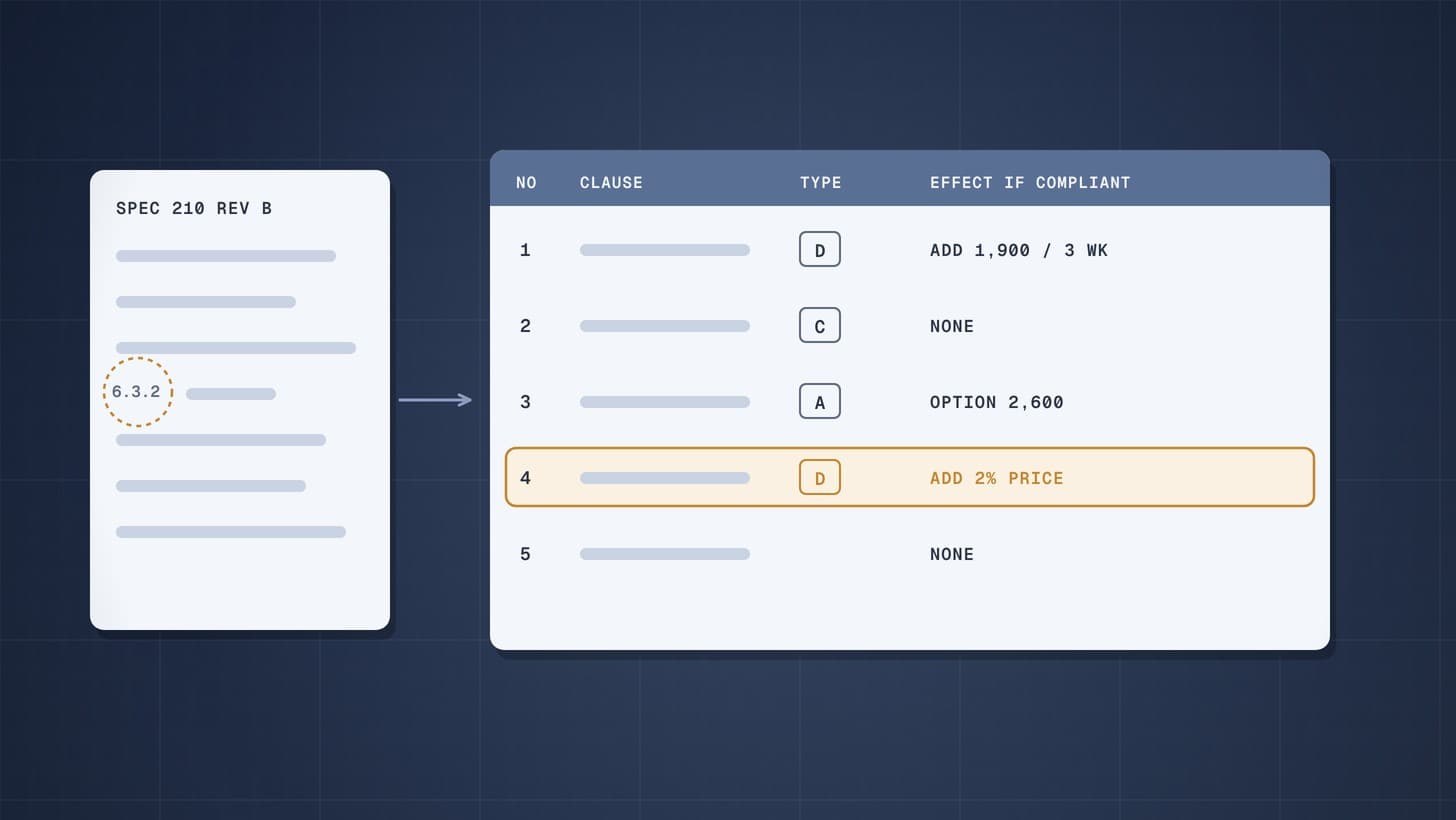
A deviation list is the table in your bid where you state every point on which your offer differs from the buyer's RFQ, each one tied to a document and clause, with your reason and the cost or schedule effect. Done well, it lets the buyer evaluate your bid quickly and fairly. Done badly, with vague blanket exceptions or deviations buried in a covering letter, it makes your bid look risky or gets it set aside.
Free download: deviation and clarification list (Excel). Ready to fill in, free to use, no sign up needed.
The rule of thumb: classify each item as a deviation, a clarification or an alternative, cite the exact clause, say why, and say what it costs. Everything not on the list is accepted as written. Below is how buyers read deviations, how to write them, and a template table.
Why this matters now
Buyers judge deviations against a clear standard. Development bank bidding documents set out a clear test. They distinguish a deviation (a departure from the requirements), a reservation (a limiting condition, or not fully accepting the requirements) and an omission (failing to submit required information). Any of these is material if accepting it would substantially affect the scope, quality or performance of the goods, or substantially limit the buyer's rights or the bidder's obligations. It is also material if correcting it would unfairly affect the other bidders. A conditional bid, or one with reservations, is treated as non responsive [1].
Non material differences are not fatal. Under the same rules, quantifiable non material differences are carried into the financial evaluation and adjusted for comparison, rather than causing rejection [1]. Some buyers load the evaluated price for commercial departures such as a longer delivery, a different warranty, liquidated damages terms or performance guarantees [2].
Public buyers in the UK work to similar logic. Under the Procurement Act 2023, the most advantageous tender is one that satisfies the authority's requirements, and an authority may disregard a tender that breaches a procedural requirement in the tender notice [3]. In US federal buying, the standard instructions ask the offer to state the extent of its agreement with all the terms. Proposals that depart from stated requirements must say why accepting them would be advantageous [4].
The common thread: name every departure, explain it, and price it.
Access real procurement opportunities from global buyers
Join ChemCapital to get discovered by verified procurement teams across pharmaceutical, chemical, and industrial manufacturing.
Deviation, clarification or alternative
| Type | What it is | Example | Buyer's reaction |
|---|---|---|---|
| Deviation | You will not meet a stated requirement | Datasheet asks for 316L impeller; you offer CD4MCu duplex | Assesses impact; may accept, load the price or reject |
| Clarification | You meet the requirement but state how you read it | "Hydrotest per the code; no separate pneumatic test" where the spec is ambiguous | Confirms or corrects your reading |
| Alternative | You offer something different in addition to a compliant base offer | Base offer as specified, plus a priced option with a different seal plan | Evaluates the base; may take the option |
Keep the three apart. A clarification dressed as a deviation makes you look non compliant; a deviation dressed as a clarification looks evasive when the buyer spots it. An alternative should always sit beside a compliant base offer, so the buyer can still evaluate you on the base.
How to write each line
- Cite the exact clause. Document number, revision and clause: "Spec 210 rev B, clause 6.3.2". Never "various" or "see covering letter".
- Quote the requirement briefly. So the evaluator does not have to open the spec.
- State what you offer. Specific and measurable: a material grade, a test, a number.
- Classify it. Deviation, clarification or alternative.
- Give the reason. Technical (better suited to the duty, standard design), commercial (insurance cannot cover it), or supply (material availability). One sentence is enough.
- Give the effect. Price and delivery effect if the buyer insists on compliance. "Compliance possible: add £3,400 and 4 weeks" is the most useful line you can write.
Avoid blanket exceptions. "Our standard terms apply" or "We take exception to all liquidated damages clauses" reads as a reservation on everything [1]. If you need a liability cap, state the clause, the cap you offer and why. Our guide to liquidated damages in equipment contracts explains what buyers can and cannot move on.
One list, one place. Put every deviation in the list, including commercial ones. Deviations hidden in datasheet notes or a covering letter are exactly what technical bid evaluations look for, and finding one there costs trust. Do not count on fixing it later either: in public evaluations, clarification cannot be used to improve a bid [5].
Buyers who compare bids in ChemCapital's AI quotation comparison see each bid's exclusions and deviations side by side, so a clear, complete list makes your bid easy to compare on its merits.
Ask before you deviate
Many deviations should never reach the bid. If a requirement looks wrong, ambiguous or impossible, raise a tender query during the bid period. The buyer can then clarify or amend the RFQ for every bidder, and you may not need a deviation at all. Keep the deviation list for genuine differences you have chosen to offer, not for questions you did not get round to asking.
Before you submit, run a final check:
- Every line has a clause. No line says "general" or "various".
- Every deviation has a price for compliance. If you truly cannot comply, say so plainly.
- Clarifications are not hiding deviations. If the meaning changes the scope, it is a deviation.
- Alternatives sit beside a compliant base. The buyer must be able to evaluate the base offer alone.
- Datasheets match the list. A datasheet value that differs from the RFQ needs its own line, even if it seems obvious.
- The covering letter adds nothing new. Anything that changes the offer belongs in the list.
Template: deviation and clarification list
| No | Document, rev, clause | Requirement | Offered | Type | Reason | Effect if compliance required |
|---|---|---|---|---|---|---|
| 1 | Datasheet P101 rev B, line 34 | Impeller 316L | Impeller duplex CD4MCu | Deviation | Better erosion resistance for 2% solids; standard for this model | 316L possible: add £1,900, 3 weeks |
| 2 | Spec 210 rev B, cl. 8.4 | Hydrotest witnessed | Hydrotest witnessed; 5 working days' notice | Clarification | Notice period not stated in spec | None |
| 3 | Spec 210 rev B, cl. 5.1 | Seal plan 53A | Base: plan 53A. Option: plan 53B | Alternative | Plan 53B suits site without nitrogen | Option: add £2,600 |
| 4 | Terms rev A, cl. 17.2 | LDs 1% per week, max 15% | LDs 0.5% per week, max 10% | Deviation | Aligns with insurance cover | Full terms accepted: add 2% to price |
| 5 | Spec 210 rev B, cl. 11 | Paint system C4 high | As specified | None | Listed for completeness | None |
Want this as a file? Download the deviation and clarification list (Excel).
State in the bid that all requirements not listed are accepted.
Practical example
Illustrative. A pump supplier's first draft of a bid had a covering letter saying "we offer our standard material for this duty and our standard terms apply". The buyer's technical evaluation would have had to guess what that meant.
The revised bid replaced the letter with the five line table above. The buyer accepted the duplex impeller after a technical query, noted the hydrotest notice, took the plan 53B option, and loaded the price by 2% for the liquidated damages deviation, as the supplier had offered. Line 5, listed only for completeness, cost nothing and saved a query about the paint system. The bid stayed in the evaluation, and the buyer knew exactly what it was buying.
If you are the buyer
Ask for a deviation list in a set format and say that anything not listed is deemed accepted. Ask bidders to price compliance for each deviation. Then you can choose between accepting the deviation and paying for compliance, instead of rejecting a good bid over one clause. Score deviations consistently across bidders, and record why each was accepted, loaded or rejected, so the award can be explained afterwards.
Where ChemCapital fits
A clean deviation list is one of the strongest signals of a competent supplier. It shows you read the RFQ, and it makes your bid easy to say yes to. For more on how buyers decide, see how suppliers win industrial contracts.
Ready to win more of the RFQs you answer? List your company on ChemCapital. It is free to start.
Frequently asked questions
What is a deviation list in a bid?
It is a table listing every point where the offer differs from the RFQ, each tied to a document and clause, with what is offered instead, the reason, and the cost or schedule effect if the buyer insists on compliance. Anything not listed is accepted as written.
What is the difference between a deviation and a clarification?
A deviation means you will not meet a stated requirement. A clarification means you will meet it but state how you read an ambiguous point. An alternative is a different offer made alongside a compliant base offer.
What makes a deviation material?
Under common international bidding rules, a deviation is material if accepting it would substantially affect the scope, quality or performance of the goods, or substantially limit the buyer's rights or the bidder's obligations, or if correcting it would unfairly affect other bidders. Material deviations can make a bid non responsive.
Should I list commercial exceptions in the deviation list?
Yes. Put every departure, technical and commercial, in one list with the clause, what you offer and the price of full compliance. Blanket statements such as our standard terms apply read as reservations and can get a bid set aside.
Continue reading
Informational only, not procurement or legal advice. Cited names, frameworks, and statistics belong to their respective owners.
Access real procurement opportunities from global buyers
Join ChemCapital to get discovered by verified procurement teams across pharmaceutical, chemical, and industrial manufacturing.
List your companyRelated articles
How to Ask for Feedback on a Lost Equipment Tender (With Email Template)
How equipment suppliers should ask for a debrief after losing a bid: when to ask, what to ask, what buyers can and cannot share, and how to use the answers. Includes a short email template.
Bid or No Bid? A Scorecard for Engineered Equipment RFQs
A simple bid or no bid scorecard for equipment suppliers: the gates to check first, seven weighted criteria, a worked example and a template you can copy.
Equipment Quotation Template: A Proposal Buyers Can Compare
A ten section quotation template for engineered equipment suppliers: cover letter, scope and battery limits, compliance and deviations, price schedule, delivery, commercial terms, exclusions and documents.