
Liquidated Damages for Late Equipment Delivery: Rates, Caps and a Worked Example
How liquidated damages for late delivery work in equipment contracts: how UK courts treat them, how to set the rate and cap, what the clause must say, and a worked example with Orgalim terms.
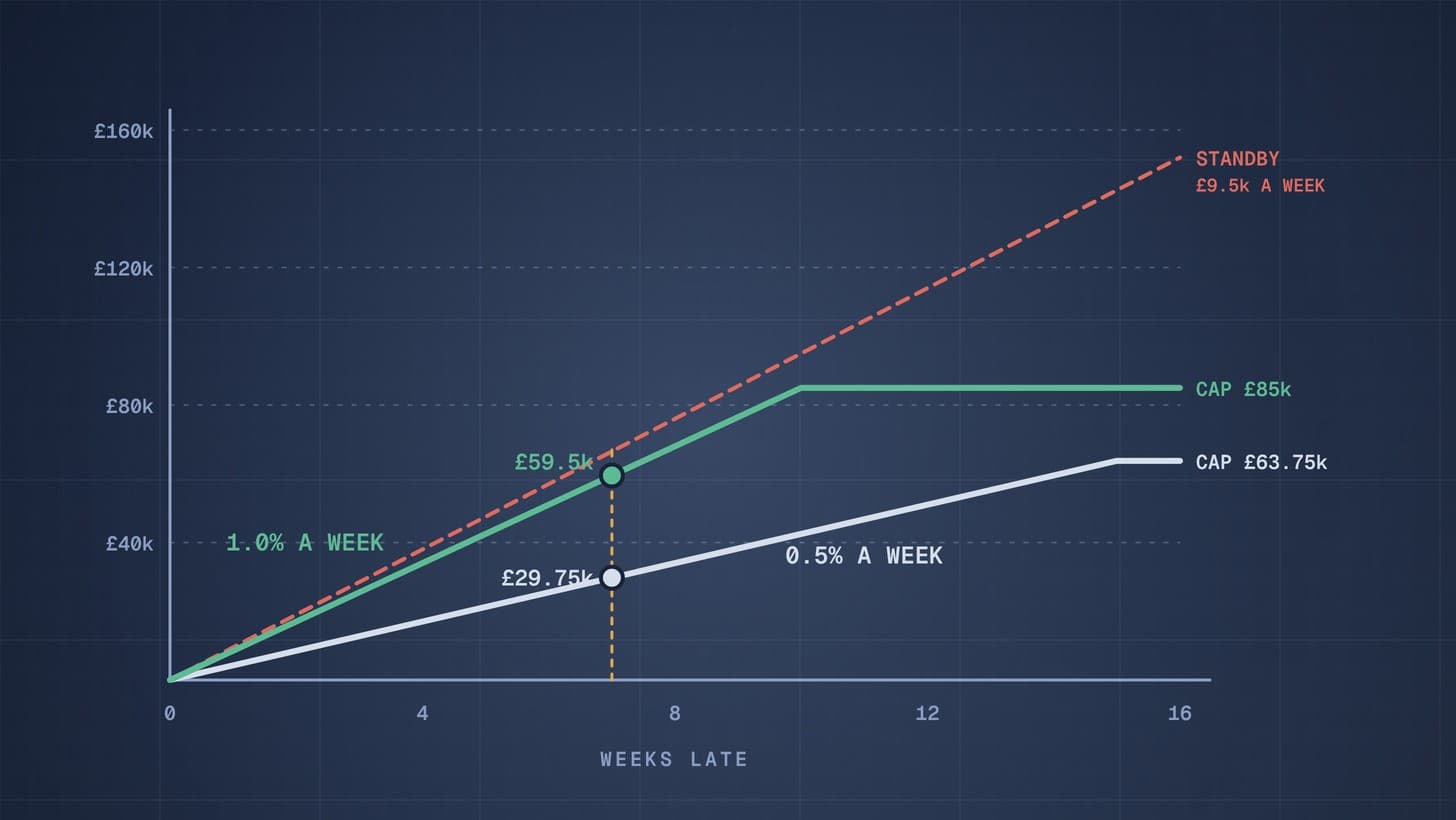
Liquidated damages for late delivery are a sum agreed in the contract that the supplier pays for each period of delay, so the buyer is compensated without having to prove its actual loss. In equipment contracts they are usually a percentage of the contract price for each week of delay, capped at a maximum percentage, and they are often the buyer's only remedy for lateness. Get three things right and the clause works: a rate that reflects a genuine interest in on time delivery, a cap both sides can live with, and a clear date from which delay is measured, with a way to move that date when the buyer causes the delay.
This is general information, not legal advice. Take advice from your own legal team on any specific contract.
Why this matters now
Many equipment suppliers quote on standard terms with a delay clause already built in. Orgalim S 2022, general conditions published by the Brussels based industry association Orgalim and adopted by some suppliers as their standard terms, set liquidated damages at 0.5% of the contract price for each commenced week of delay, capped at 7.5%. They require the buyer to claim in writing within six months of when delivery should have happened, and make liquidated damages and a limited right to terminate the only remedies for delay unless the supplier is guilty of gross negligence [1]. Other suppliers' terms leave interfaces and site preparation with the purchaser [2], so delays on the buyer's side of that line fall on the buyer.
If you accept those terms without reading them, you have accepted that a 15 week delay on a critical item is worth 7.5% of its price to you, whatever it actually costs. Sometimes that is fine. Often it is not.
Join ChemCapital to streamline sourcing and connect with verified partners
Whether you're buying or supplying, ChemCapital gives you the tools to manage the complete procurement cycle in one platform.
How UK courts treat liquidated damages
Three lines of English case law shape how these clauses work.
The penalty test. In Cavendish Square Holding v Makdessi, decided on 4 November 2015, the Supreme Court moved away from asking only whether the sum was a genuine pre estimate of loss. A clause triggered by breach is now an unenforceable penalty only if the detriment it imposes is out of all proportion to the innocent party's legitimate interest in performance; the court asks first what legitimate interest the clause protects, then whether the provision for it is extravagant, exorbitant or unconscionable [3]. That makes commercial liquidated damages clauses harder to attack as penalties, but careful drafting still matters.
Termination. In Triple Point Technology v PTT in 2021, the Supreme Court held unanimously that liquidated damages run up to the date the contract is terminated, with general damages available after that, even where the work is never completed [4]. The same case shows the interaction with liability caps: in that contract the liquidated damages stayed within the cap because of how the clause was worded [4].
The prevention principle. A buyer cannot hold a supplier to a date the buyer itself made impossible. If the buyer's acts cause delay and the contract has no mechanism to extend time for them, time becomes "at large": the supplier must finish within a reasonable time, and the buyer cannot recover liquidated damages against the original date [5]. The Court of Appeal confirmed in North Midland Building v Cyden Homes in 2018 that parties can agree terms that change how this works [5]. For a buyer, the practical lesson is simple: include an extension of time clause, because without one a single late drawing approval can wipe out your liquidated damages.
Setting the rate and the cap
Start from what late delivery would actually cost you, then decide how much of that the supplier can reasonably carry.
| Loss from late delivery | Usually recoverable through equipment liquidated damages? |
|---|---|
| Installation contractor standing by | Yes, a typical basis for the weekly rate |
| Extended project management and site costs | Yes |
| Hire of temporary equipment | Sometimes, if foreseeable and stated |
| Lost production or margin from a late plant start | Rarely in full: no supplier will carry it for one item |
| Knock on delay to other contracts | Rarely; usually excluded as indirect loss |
The weekly rate should relate to the costs you would really incur, which supports the legitimate interest test. The cap limits the supplier's exposure; suppliers price risk, so a higher cap usually means a higher price or fewer bidders. If a delay could stop the whole plant, liquidated damages alone will not protect you. Manage that risk with realistic dates, expediting, factory visits and, for the most critical items, earlier ordering.
What the clause must say
- The trigger date. Delivery under the stated Incoterm, readiness for factory acceptance test, or mechanical completion on site. Be precise; "delivery" means different things in different documents.
- The basis. Percentage of the whole contract price, or only of the delayed part? Suppliers will push for the delayed part.
- The period. Per commenced week, per complete week or per day. Orgalim uses each commenced week [1].
- The cap, and how it sits with the overall limitation of liability.
- Sole remedy or not. If liquidated damages are the only remedy for delay, say what happens when the cap is reached, usually a right to terminate. Orgalim limits the buyer's compensation on termination for delay to 15% of the price of the terminated part [1].
- Extension of time events. Buyer changes, late information or approvals from the buyer, and force majeure, with a notice procedure.
- Claims procedure. Any deadline for claiming, such as Orgalim's six months [1].
- Milestones, if any. Some buyers apply smaller liquidated damages to late drawings or documents. Keep them proportionate, or bidders will price them in.
Our guide to purchase order terms for capital equipment covers how this clause fits with warranty, limitation of liability and the rest.
Practical example
In this illustrative example, a buyer orders a reactor package for £850,000. If it arrives late, the installation contractor stands by at £6,500 a week and the project team's extended costs are about £3,000 a week, a total of £9,500 a week.
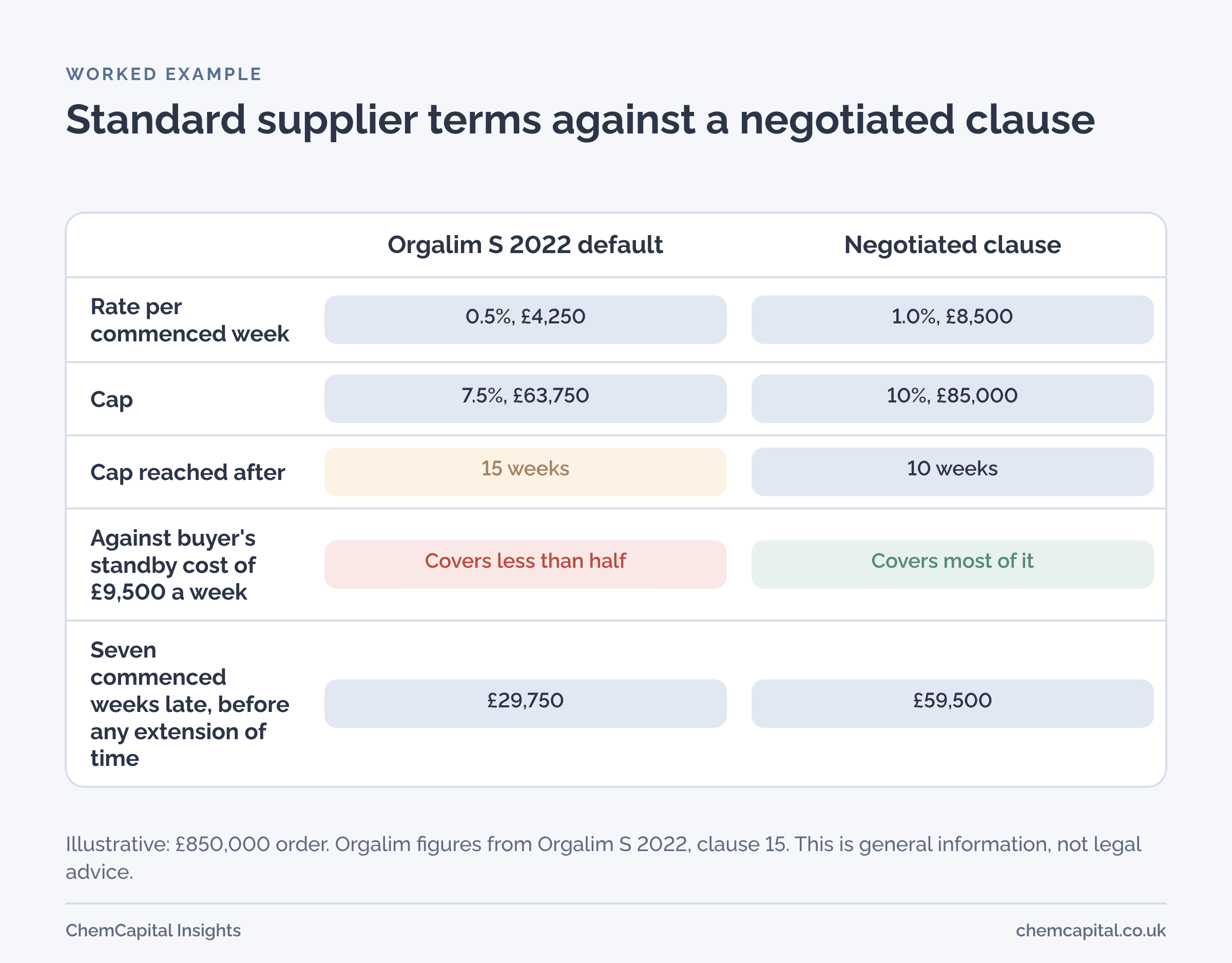
The supplier's quote is on Orgalim S 2022 terms: 0.5% per commenced week, or £4,250 a week, capped at 7.5%, or £63,750, which is reached after 15 weeks [1]. That covers less than half the buyer's weekly standby cost. The buyer negotiates 1.0% per commenced week (£8,500) capped at 10% (£85,000), reached after 10 weeks, plus a clear extension of time procedure for late buyer approvals, with notice and records.
The package arrives six weeks and two days late, which is seven commenced weeks. Under the original terms the buyer would recover £29,750; under the negotiated clause, £59,500. Neither covers the buyer's full cost, and neither is meant to; the negotiated clause comes much closer, and it gives the supplier a stronger reason to put the order at the front of the queue.
The supplier's records then show that the buyer approved the general arrangement drawing ten days late. Under the extension of time procedure the delivery date moves by ten days. The package is now 34 days late, five commenced weeks, so the liquidated damages fall to £42,500 under the negotiated clause. Without any mechanism to extend time for the buyer's own delay, the buyer could have lost them altogether [5].
If you are the supplier
Read the clause against your real lead times, not your sales promise. Ask for the basis to be the delayed part only, for a cap in line with your margin on the order, and for extensions of time when approvals or information from the buyer arrive late. Record every late input when it happens; months later, that record decides who pays.
Where ChemCapital fits
Liquidated damages disputes are usually won or lost on the record of what happened when. ChemCapital lets buyers issue formal purchase orders in the platform and track supplier confirmations; suppliers confirm with their own reference number and dates and can flag exceptions, each order has its own message thread, suppliers post milestone updates, and interactions and decisions are logged with timestamps and the person who made them. See how it works.
Want one written record of every date, approval and change on your equipment orders? Start free with ChemCapital.
Frequently asked questions
What are liquidated damages for late delivery?
They are a sum agreed in the contract that the supplier pays for each period of delay, usually a percentage of the price per week, so the buyer does not have to prove its actual loss. They are normally capped at a maximum percentage of the contract price.
Are liquidated damages enforceable in the UK?
Usually, in commercial contracts. Since Cavendish v Makdessi in 2015, a clause is only an unenforceable penalty if it protects no legitimate interest or imposes a detriment out of all proportion to that interest. This is general information, not legal advice.
What is a typical liquidated damages rate for equipment?
There is no single figure, but standard supplier terms are a useful anchor: Orgalim S 2022, which some equipment makers adopt as standard terms, sets 0.5% of the contract price for each commenced week of delay, capped at 7.5%. Buyers with higher losses negotiate higher rates or caps.
Continue reading
Informational only, not procurement or legal advice. Cited names, frameworks, and statistics belong to their respective owners.
Join ChemCapital to streamline sourcing and connect with verified partners
Whether you're buying or supplying, ChemCapital gives you the tools to manage the complete procurement cycle in one platform.
Get started freeRelated articles
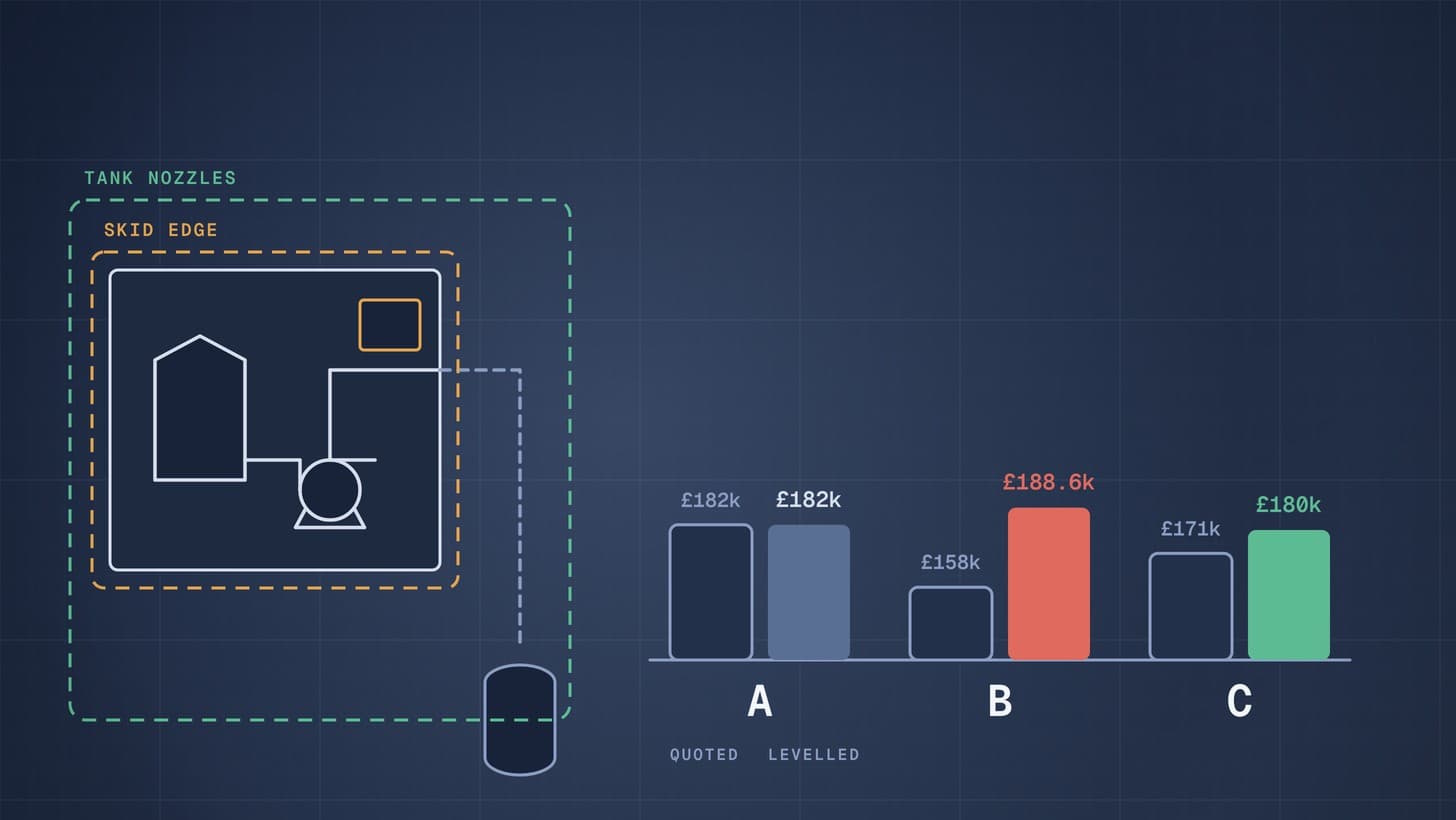
Battery Limits, Terminal Points and Scope of Supply in Equipment Quotes
What battery limits, terminal points and scope of supply mean, how gaps between them make quotes look cheaper than they are, and a terminal point schedule you can put in every RFQ.
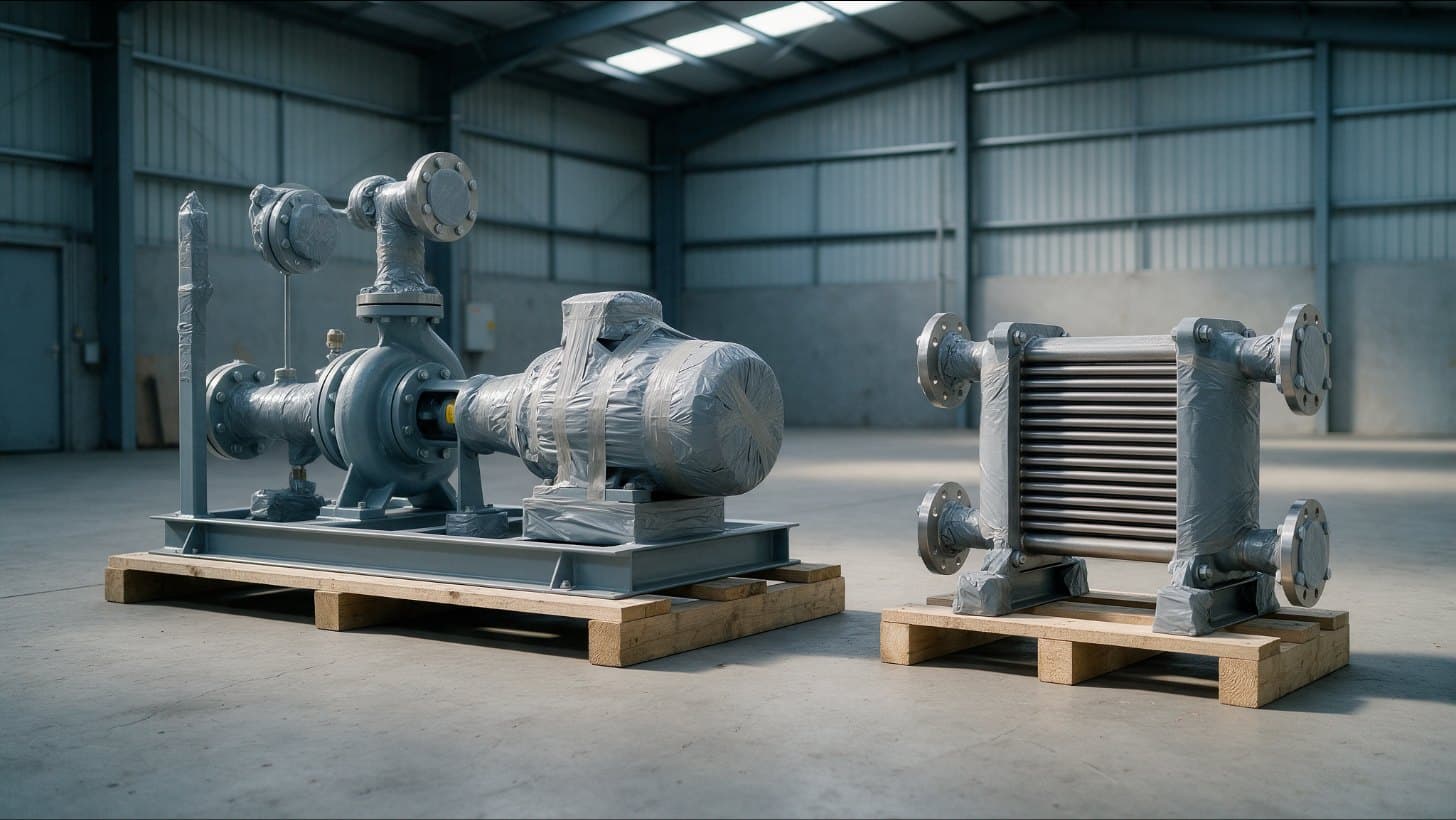
Preservation and Storage of Process Equipment Before Start Up
How to keep pumps, motors, skids and vessels in good condition between delivery and start up: what to put in the order, storage conditions, shaft rotation, insulation checks and a preservation log.
Third Party Inspection for Process Equipment: When to Use It and How to Scope It
What a third party inspector does at your supplier's works, how it differs from a notified body or code inspector, how to pick an accredited agency, and how to scope and price the assignment.