
Dosing Pump vs Metering Pump: Accuracy, Turndown, How to Specify
Dosing pump and metering pump mean the same thing in practice. What counts is accuracy and turndown: API 675 figures, five designs, accessories and an RFQ datasheet.
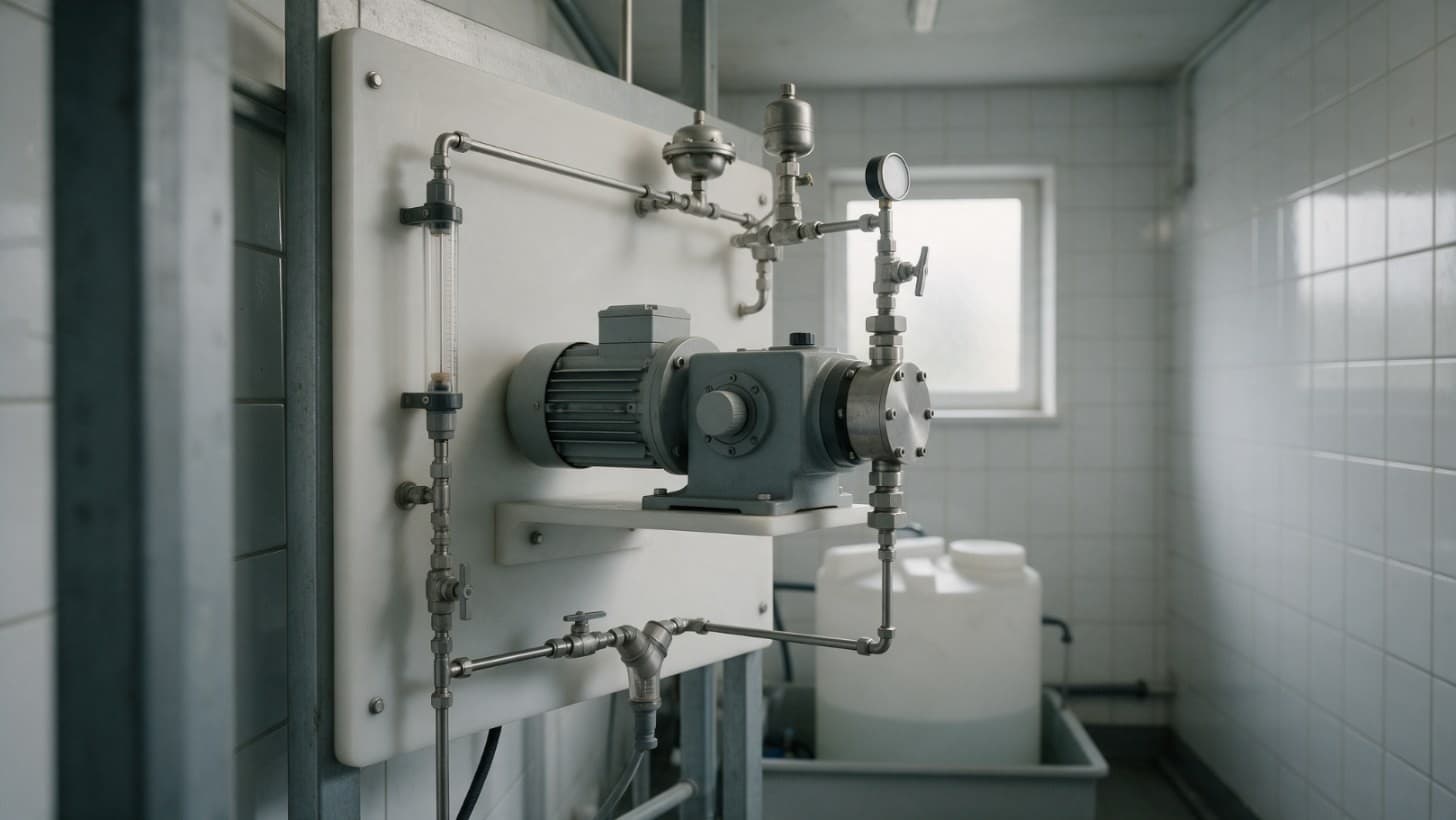
In practice there is no technical difference. The Hydraulic Institute treats metering pump, dosing pump, controlled volume pump and chemical injection pump as names for the same family: pumps giving an accurate, repeatable and adjustable flow, set by stroke length or stroking speed [1]. Makers mix the words too; ProMinent quotes the "dosing precision" of a pump it sells as a metering pump [3].
Where engineers draw a line, it is proven performance: "metering" usually implies a stated accuracy over a defined turndown, and the usual reference is API 675, publicly described as requiring steady state accuracy within ±1% over 10:1 [2, 3]. So specify the numbers, not the label.
Why this matters now
Ask three suppliers for "a dosing pump" and you may get a solenoid pump, a motor driven diaphragm pump on a panel and a hydraulic diaphragm pump built to API 675, each quoting accuracy on a different basis. The bids cannot be ranked until that is fixed.
Errors cost more than wasted chemical. HSE's swimming pool guidance records chlorine gas releases from hypochlorite and acid dosing, mostly when circulation stopped or fell while automatic dosing carried on: the circulation pumps failed or lost prime, were isolated for maintenance, or bypass valves were opened [4]. The same can happen wherever dosing continues into a line that has lost its flow.
Create and manage RFQs in minutes
ChemCapital handles the entire procurement cycle, from structured RFQs and supplier comparisons to formal purchase orders and delivery tracking.
Accuracy, repeatability and turndown: what the figures mean
The Hydraulic Institute names four performance criteria [1]; Wanner's glossary defines them [2].
| Term | What it means | API 675 figure, as publicly described |
|---|---|---|
| Steady state accuracy | Flow variation at an unchanged setting; Wanner gives it as a percentage of mean delivered flow | Within ±1% [2] |
| Repeatability | Same flow again after the setting is moved and reset, as a percentage of rated capacity | ±3% [2] |
| Linearity | How far measured flow strays, at worst, from a straight line of flow against setting, as a percentage of rated capacity | ±3% [2] |
| Turndown ratio | How far below its rating the pump can be set while meeting its stated accuracy | 10:1, the industry norm [2, 3] |
ProMinent rates its API 675 pumps for a 1:10 control range and says 1:5 does not satisfy the standard [3]. These are makers' public summaries, not the standard itself. API 675 is in its third edition [8], so check the current text before specifying.
Watch the bases. Repeatability and linearity are percentages of rated capacity, not of the flow you set [2]: on a 20 l/h pump, ±3% is ±0.6 l/h, or ±30% of a 2 l/h setting. Calibrated at its setting, the pump holds that flow closely; set from the dial alone, it may not.
Steady state accuracy varies too. Wanner uses the mean delivered flow [2], but some public summaries of API 675 put the ±1% on rated flow, which is ±10% at a 10% setting. Ask each bidder which basis its figure uses.
Maker figures for other designs also read ±1% but measure different things: reproducibility for a solenoid pump used as its instructions say [5]; dosing precision within 10% to 100% of stroke volume for a hydraulic diaphragm pump [3]; accuracy, with ±0.5% repeatability, for one peristaltic range whose flow shifts with discharge pressure [6]. A control range such as 1:40,000 [5] says how far the setting moves, not where accuracy holds; Wanner warns that at very high turndown a pump may not pass the API 675 tests [2].
The main designs and where each fits
All but the peristaltic pump are reciprocating: a diaphragm or plunger strokes between a suction and a discharge check valve [1, 7].
| Design | How it moves the liquid | Example published range | Points to check |
|---|---|---|---|
| Solenoid driven diaphragm | An electromagnet pulses the diaphragm | ProMinent gamma/X: 1 ml/h to 45 l/h, 25 to 2 bar [5] | Suction lift with a self degassing head |
| Motor driven, mechanically actuated diaphragm | Motor, worm gear and cam stroke the diaphragm [7] | ProMinent Sigma/2 Basic: 50 to 420 l/h, 16 to 4 bar [7] | Multi layer diaphragm with rupture indicator, relief valve [7]; outside API 675 scope [2] |
| Hydraulically actuated diaphragm | A plunger pushes oil, which flexes the diaphragm | ProMinent HYDRO API: 7 to 1,506 l/h, 100 to 7 bar [3] | Diaphragm monitoring; API 675 if required |
| Packed plunger | A plunger sealed by packing displaces the liquid | Covered by API 675 [8] | Handling of packing leakage |
| Peristaltic | Rollers squeeze a hose along, with no check valves | Watson Marlow Qdos 60: 6 ml/h to 60 l/h (0.1 to 1,000 ml/min), up to 7 bar [6] | Hose compatibility and replacement; flow shift with discharge pressure [6] |
Rick Ray of Milton Roy describes API 675 as covering hydraulically actuated diaphragm and packed plunger pumps [8]; diaphragm pumps with direct mechanical actuation are excluded [2]. A motor driven, mechanically actuated diaphragm pump, like Bid B below, is therefore outside API 675 however accurate. Wanner says its own pumps pass the standard's performance tests but not all its design clauses [2]; if a bid claims API 675, ask whether it means the tests or the whole standard.
Installation: the accessories that make the accuracy real
A reciprocating pump's output pulses, so piping design matters; the Hydraulic Institute points to its guideline ANSI/HI 7.8 [1], and API 675 has annexes on NPSH versus NPIP (net positive inlet pressure) and on pulsation [8]. Our guide to NPSH covers the suction side.
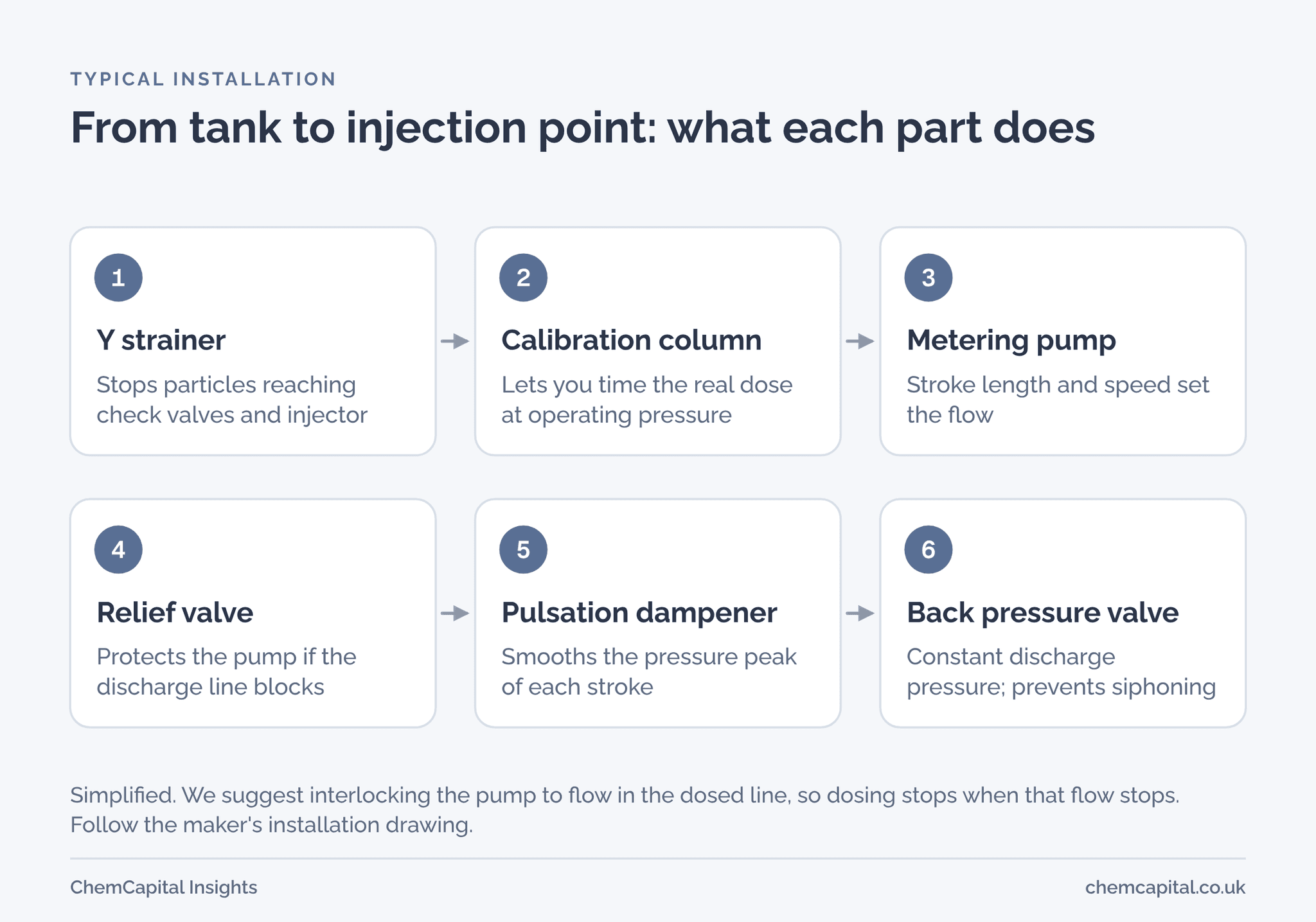
Pulsafeeder explains what each accessory does [9]:
- Calibration column: a graduated cylinder the pump draws from, to time the real dose. Output shifts with system pressure, so check at operating pressure and after any change or service.
- Back pressure valve: holds the discharge at a constant pressure, so each stroke delivers the same volume. It also prevents siphoning, where liquid runs through the pump unaided because the tank stands above the injection point or the suction side is at higher pressure.
- Relief valve: a positive displacement pump keeps building pressure against a blocked discharge until something gives. This valve sends the flow back to suction instead; some pumps have one built in [7].
- Pulsation dampener: soaks up the pressure peak of each stroke, smoothing flow and sparing pipe joints from vibration fatigue.
- Y strainer: stops particles reaching the check valves and injector; Pulsafeeder counts a blocked injector among the commonest causes of overpressure.
A self degassing head suits liquids that give off gas, at a price: on one solenoid model at 7 bar, suction lift falls from 4.0 to 1.8 m water column and capacity from 7.6 to 5.6 l/h [5].
Finally, given HSE's experience [4], we suggest interlocking the pump to a flow signal from the dosed line, so dosing stops when that flow stops.
What to put on the RFQ datasheet
API 675 includes its own data sheets [8]. For any dosing pump, give every bidder:
- liquid, concentration, temperature, viscosity, vapour pressure, solids and any gas it gives off
- minimum, normal and maximum dosing flow
- suction conditions and the back pressure range at the injection point
- the accuracy you need, with its basis: steady state accuracy, repeatability, linearity and turndown
- liquid end, diaphragm, valve and seal materials, for example PVDF, carbon filled PTFE, 1.4571 stainless steel or Hastelloy C [3]
- diaphragm rupture indication and how it is signalled [3, 7]
- control: contacts, a 4 to 20 mA signal or a fieldbus such as PROFIBUS [7], plus alarm outputs
- accessories in scope, and whether API 675 is required
Practical example
An illustrative duty: dose a chemical that gives off gas into a process water line at 2, 10 and 18 l/h (minimum, normal, maximum) against 3 barg. Two bids arrive; assume both state linearity as ±3% of rated capacity, the API 675 limit.
| Item | Bid A: solenoid diaphragm | Bid B: motor driven diaphragm on a panel |
|---|---|---|
| Rated capacity at 3 barg | 20 l/h | 50 l/h |
| Maximum flow as share of rating | 90% | 36% |
| Minimum flow as share of rating | 10% | 4% |
| Turndown needed (rating ÷ minimum flow) | 10:1 | 25:1 |
| Linearity band at 2 l/h | ±0.6 l/h, or ±30% | ±1.5 l/h, or ±75% |
| Accessories | Options: relief valve £210, dampener £320, back pressure valve £180, calibration column £150 | All four included |
| Price (illustrative) | £1,450 + £860 = £2,310 | £3,900 |
Bid B looks complete but is oversized: minimum flow is 4% of its rating, well beyond 10:1, so accuracy there is unproven. Bid A sits at the edge of 10:1 with 10% headroom. Confirm its 20 l/h rating holds with its self degassing head fitted; the head's lower suction lift [5] argues for a flooded suction.
Calibration earns its place at the low end. Set from the dial at 2 l/h and running 30% high, Bid A would add 0.6 l/h: over 4,000 hours a year, 2,400 litres, or £960 at an illustrative £0.40 per litre.
The fair step is to ask Bid B to rebid a smaller head, then compare both on the same accessory scope.
Find suppliers who publish the numbers
Supplier Discovery searches the web for suppliers from a plain text description, pasted RFQ or uploaded specification, extracts their published parameters with source links, and gives each a fit verdict: Strong, Partial, Information Missing or Rejected. Certifications are shown as claimed, not verified; nothing is sent automatically, and you choose which suppliers to attach to your RFQ. Three searches are free without signing up. When bids return, our technical bid evaluation guide covers the next step.
Ready to send one dosing pump datasheet to the right suppliers? Start a free 14 day ChemCapital trial, with no credit card needed.
Frequently asked questions
What is the difference between a dosing pump and a metering pump?
In practice there is none: the Hydraulic Institute lists dosing pump as another name for a metering or controlled volume pump, and makers use both words. Where buyers draw a line, metering usually implies a stated accuracy over a defined turndown, such as the ±1% over 10:1 that API 675 is publicly described as requiring.
How accurate is a metering pump?
API 675 is publicly described as requiring steady state accuracy within ±1%, with repeatability and linearity of ±3% of rated capacity, over a 10:1 turndown. Makers of other designs also quote ±1%, but often as reproducibility or precision rather than steady state accuracy, and with conditions such as following the operating instructions, the stroke range or the discharge pressure. Check the current edition of API 675, and ask each bidder which basis its figure uses.
What is turndown ratio on a dosing pump?
It is the rated capacity divided by the lowest flow at which the pump still meets its stated accuracy, and 10:1 is the usual industry basis. A very wide control range shows how far the setting can be adjusted, so ask over what range the accuracy figure actually holds.
Why does a metering pump need a back pressure valve?
A metering pump only repeats its dose when it works against a constant discharge pressure, and the valve provides one. It also prevents siphoning, where liquid runs through the pump on its own because the tank is higher or the suction side is at higher pressure, which would overdose the process.
Continue reading
Informational only, not procurement or legal advice. Cited names, frameworks, and statistics belong to their respective owners.
Create and manage RFQs in minutes
ChemCapital handles the entire procurement cycle, from structured RFQs and supplier comparisons to formal purchase orders and delivery tracking.
Start for freeRelated articles
Where to Find Pharma and Chemical Plant Projects Before They Go to Tender: the 2027 Pipeline
Twenty pharma and chemical plant projects checked against owner or government announcements, the buying timeline on each, and where to watch for the next ones for free.
TEMA Heat Exchanger Types: How to Read AES, BEM and AEU
How to decode the three letter TEMA type, what AES, BEM, AEU and other common types mean for cleaning, expansion, leaks and cost, and how to compare bids that differ.
Safety Valve vs Relief Valve vs Bursting Disc: How to Choose
How safety valves, relief valves and bursting discs differ, when to fit a disc under a valve, the pressure terms that matter, GB duties and what to put in the RFQ.