
EHEDG vs 3A: Hygienic Design Certification for Food and Pharma
What EHEDG and 3A certification each involve, what the schemes charge, how to check a supplier's certificate, where ASME BPE fits and what to ask for in the RFQ.
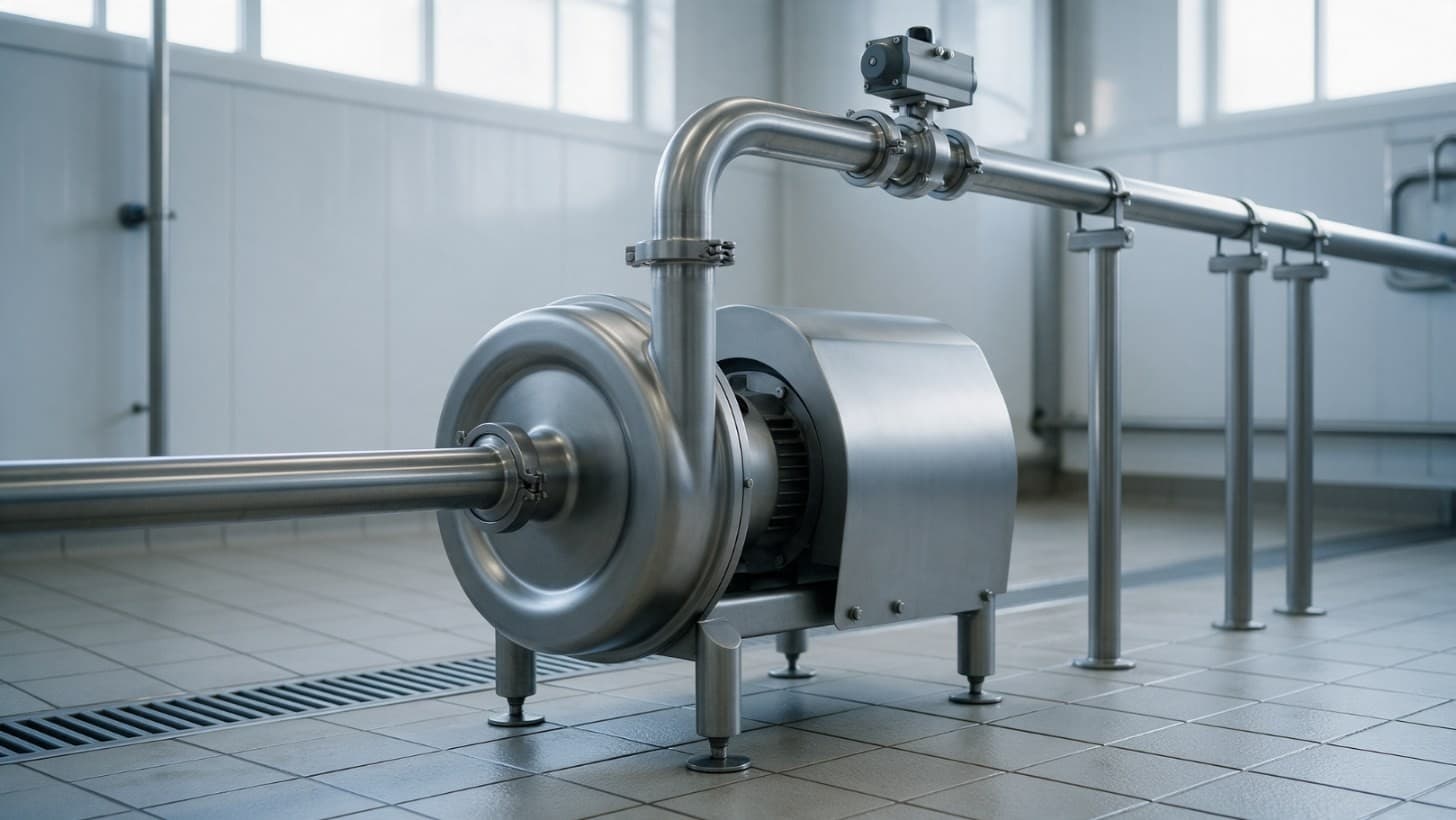
EHEDG and 3A both certify that a piece of food equipment is hygienically designed, but they check it in different ways. EHEDG certification means an authorised evaluator has reviewed the design against EHEDG guidelines and, for most closed equipment, a laboratory has shown in at least three tests that it cleans in place [1]. 3A Symbol authorisation means the equipment conforms to a published 3A Sanitary Standard, confirmed by an independent inspector on site [2]. According to WIKA, an instrument maker whose products carry both marks, EHEDG is mainly recognised in Europe, while 3A has wider recognition among countries and food producers [3].
A certificate on a pump or valve says nothing about the line it sits in [4], and neither scheme is named in the food hygiene regulation that applies in Great Britain [5].
Why this matters now
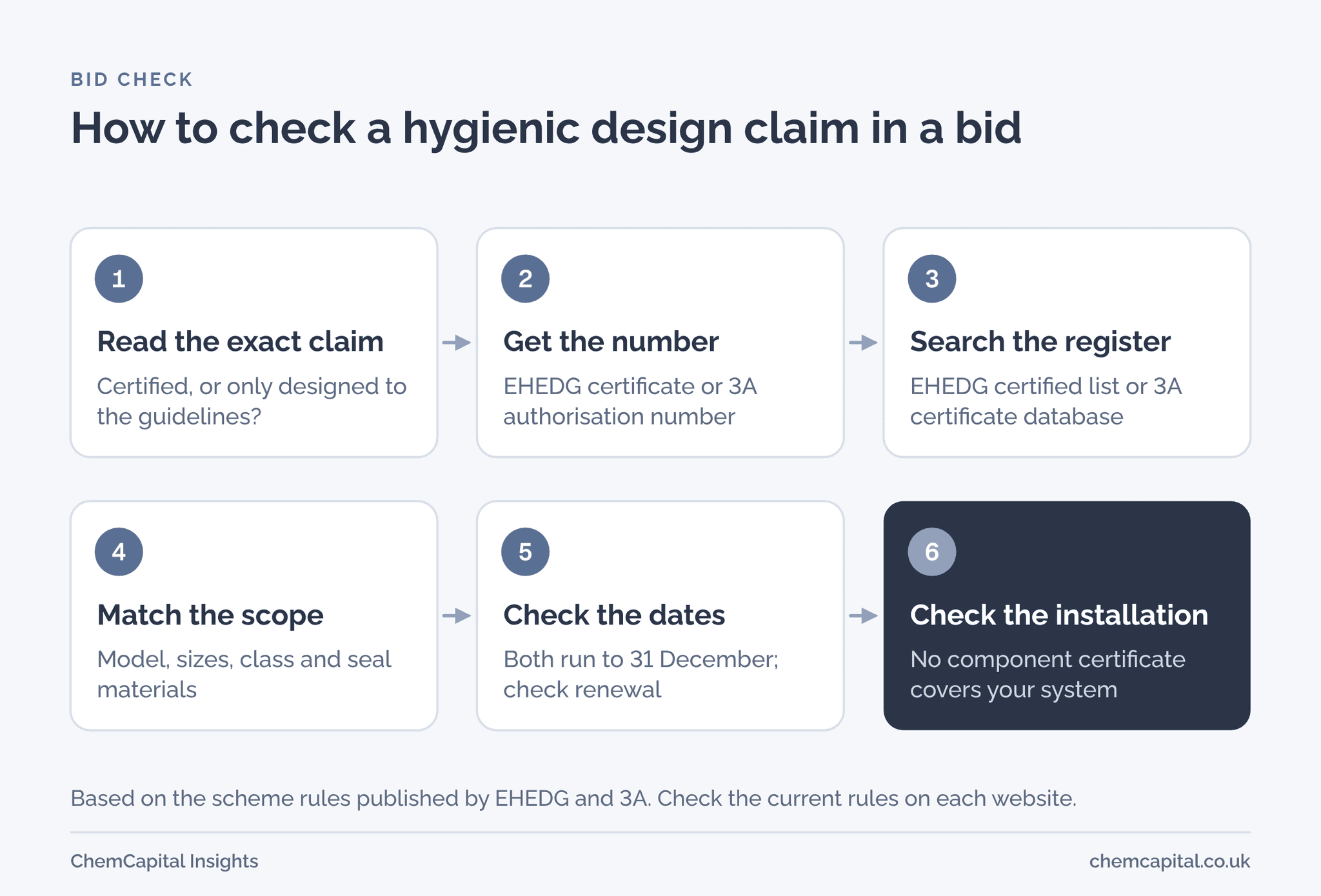
Datasheets for pumps, valves and sensors use the same few words loosely: "EHEDG certified", "designed to EHEDG guidelines", "3A compliant". Only the first kind of claim, backed by a certificate number in a public register, can be checked.
In Great Britain, the UK version of Regulation (EC) No 852/2004 requires food contact equipment to be cleaned effectively, and disinfected where necessary, and to be installed so that it and the area around it can be cleaned properly [5]. It sets the outcome and names no scheme. This is general information, not legal advice. So whether you need EHEDG, 3A or both is a choice you make in the specification, often driven by your customers or export markets. It is worth getting right: WIKA cites expert estimates that cleaning takes up to 30% of time in food and beverage production [3].
Create and manage RFQs in minutes
ChemCapital handles the entire procurement cycle, from structured RFQs and supplier comparisons to formal purchase orders and delivery tracking.
How EHEDG certification works
EHEDG, the European Hygienic Engineering and Design Group, publishes design guidelines and runs a certification scheme. Every item is evaluated by an Authorised Evaluation Officer (AEO), and a second AEO reviews the file before EHEDG accepts it [1]. Most closed equipment must also pass cleaning in place (CIP) tests to EHEDG Doc. 2 at an Authorised Test Laboratory, at least three times [1]. Equipment that fully meets the design criteria can be certified without testing [4], and EHEDG's certification page says files for open and dry cleaned equipment are reviewed by all the AEOs [1]. EHEDG can accept a departure from its guidelines where it is judged technically unavoidable for the equipment to function [1].
The certificate names a type and a class [6]:
- EL Class I: cleaned with liquids in place, without dismantling
- EL Class II: dismantled for wet cleaning
- EL Aseptic Class I and II: closed equipment that is also steam sterilisable and bacteria tight, cleaned in place or after dismantling
- ED Class I and II: dry cleaned only; Class I is closed equipment cleaned without dismantling, Class II is closed or open equipment dismantled for cleaning
Since a decision effective 13 September 2017, direct metal to metal joints other than welds are allowed only in EL Class II and the ED classes [6]. A certificate runs for five years before full renewal, with an annual prolongation by the end of December in which the holder confirms the design has not changed [1, 4]. The certificate itself shows a valid until date of 31 December, so check the copy you are given is current. EHEDG charges €500 for a first issue or renewal, including the first prolongation, then €150 for each later prolongation. EHEDG says the renewal fee is set by the renewing AEO or laboratory, and it does not publish what AEOs and laboratories charge for evaluation and testing [1].
How 3A Symbol authorisation works
3A Sanitary Standards, Inc. is a US not for profit corporation. Its members are the International Dairy Foods Association, the Food Production Solutions Association and the International Association for Food Protection, with representatives of the US Department of Agriculture and the Food and Drug Administration [2]. Its standards began in the 1920s for dairy equipment, and 3A first licensed its Symbol, now a registered mark, in 1956 [2].
A manufacturer buys the 3A Sanitary Standard for its equipment type, then prepares cleaning and installation procedures and a technical file holding the bill of materials, drawings, quality control documents and material certificates [7]. A Certified Conformance Evaluator (CCE), chosen from 3A's list and paid by the manufacturer, inspects the finished equipment at the factory, and any deficiency must be corrected before the Symbol is authorised [2, 7].
The authorisation runs to 31 December, is renewed each year with an attestation, and needs a new inspection every five years [7]. For 2026, 3A lists a US$850 application fee plus US$97.95 for each full month to December, then US$1,175 a year [8].
EHEDG and 3A side by side
| EHEDG certification | 3A Symbol authorisation | |
|---|---|---|
| Who runs it | Membership organisation; working groups write guidelines by consensus [4] | US not for profit; members IDFA, FPSA and IAFP, with USDA and FDA representatives [2] |
| What is checked | Design review against guidelines; CIP test for most closed equipment [1] | Conformance to one 3A Sanitary Standard; on site inspection by a CCE [2, 7] |
| Output | Certificate with type, class, sizes and seal materials tested [1, 6] | Authorisation to display the 3A Symbol [2] |
| Validity | Valid to 31 December, prolonged yearly; full renewal every five years [1] | Valid to 31 December, renewed yearly; new inspection every five years [7] |
| Scheme fees | €500, then €150 a year; AEO and laboratory charges extra [1] | US$850 plus part year licence, then US$1,175 a year (2026) [8] |
| Public register | List of certified equipment on ehedg.org [1] | Certificate database on the 3A website, searchable by number, equipment type or company [2] |
Where ASME BPE fits for pharma
Pharmaceutical buyers also meet ASME BPE, whose scope covers equipment for the bioprocessing, pharmaceutical and personal care industries [9]. It certifies the quality management system of a manufacturer. A certified manufacturer can then mark the metal parts it makes, such as tube, fittings and valves, with the ASME Certification Mark and BPE designator; makers of polymeric static seals hold a separate quality system certificate [9]. It is not a cleanability test of one model. Our guide to diaphragm valves for hygienic service shows how BPE appears in a valve specification.
What a certificate does not cover
EHEDG says its certificates normally cover single components, not whole machines or process lines. For closed equipment only the internal wetted surfaces are assessed; the motor, drive, actuator and frame are not [4]. Nor does an EHEDG certificate confirm that materials meet food contact law: EHEDG says it does not review legal compliance [4]. A certified pump in a line with a dead leg, a pipe that does not drain or a badly placed sensor is still a cleaning problem. The hygiene regulation also requires equipment to be installed so that it can be cleaned [5], and our article on CIP skid design covers the system side.
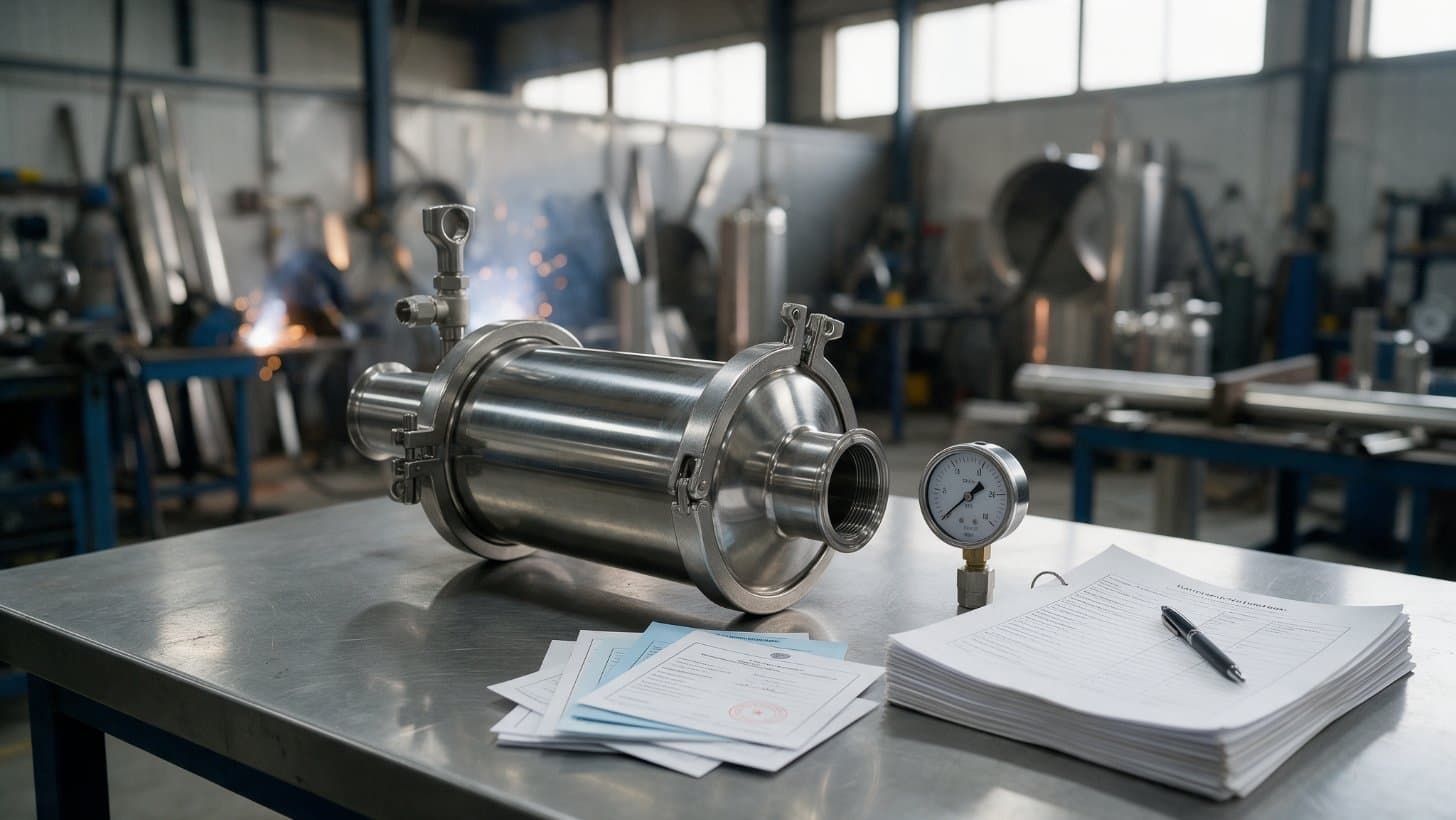
What to write in the RFQ
Ask for evidence, not adjectives:
- the scheme, type and class required, for example EHEDG EL Class I, or 3A Symbol to the named 3A standard
- the certificate or authorisation number for the exact model and size offered
- the seal materials covered, matched to the ones quoted
- the expiry or renewal date, and confirmation it will be valid at delivery
- any deviation from the certified configuration, such as a different seal or connection, stated in the bid
- a declaration that wetted materials and seals comply with food contact materials law in the country of use
- cleaning and installation instructions with the documentation package
Practical example
Take an illustrative order: a CIP cleanable centrifugal pump for a UK dairy plant whose specification requires EHEDG EL Class I. Quotes arrive on 26 October 2026 with 30 week delivery, so the pump lands about 24 May 2027.
| Bid | Price (illustrative) | Claim | Register check | Outcome |
|---|---|---|---|---|
| A | £14,600 | EHEDG EL Class I, issued March 2023 | Listed; EPDM and FKM seals tested | Certificate valid to 31 December 2026; five year renewal due March 2028; compliant |
| B | £12,900 | "Designed to EHEDG guidelines" | No certificate number; model not listed | Not certified; fails the requirement |
| C | £13,800 | EHEDG EL Class I | Listed; EPDM seals only; bid offers FKM | Ask for EPDM; requoted at £13,650 |
Bid B is cheapest, £1,700 or 11.6% below A, but it does not meet a mandatory requirement, so it drops out before price is compared. After the requote, C is £950 below A, about 6.5%, on a like for like certified basis. In October 2026 Bid A's certificate will read 31 December 2026, but the pump arrives in May 2027, so ask for the prolonged EHEDG certificate, and the 2027 3A renewal if your customer also requires 3A, before releasing payment.
Shortlist suppliers who can prove it
Supplier Discovery finds suppliers from a plain text description, a pasted RFQ or an uploaded specification, pulls their published product parameters with source links and gives each a fit verdict. Certifications are shown as claimed, not verified, so check them in the registers as above. When quotes arrive, AI Quotation Comparison flags a bid missing a required certification and keeps it out of the ranking, as with Bid B.
Ready to shortlist hygienic equipment suppliers on evidence? Start a free 14 day ChemCapital trial, with no credit card needed.
Frequently asked questions
What is the difference between EHEDG and 3A?
EHEDG certification combines a design review by authorised evaluators with cleaning in place tests for most closed equipment, and WIKA describes it as mainly recognised in Europe. 3A Symbol authorisation confirms conformance to a published 3A Sanitary Standard through an on site inspection by a Certified Conformance Evaluator, and grew out of US dairy equipment standards.
What does EHEDG EL Class I mean?
EL stands for equipment cleaned with liquids, and Class I means it is cleaned in place without dismantling. EL Aseptic Class I adds steam sterilisability and bacteria tightness for closed equipment.
How do I check an EHEDG or 3A certificate?
Ask for the certificate or authorisation number and look it up: EHEDG lists certified equipment on its website, and the 3A certificate database can be searched by authorisation number, equipment type or company. Then check that the model, sizes, seal materials and dates match the bid. Both schemes date certificates to 31 December, so confirm renewal if delivery falls in the next year.
How much does EHEDG certification cost?
EHEDG's own certificate fee is €500 for a first issue or renewal, including the first annual prolongation, then €150 for each later prolongation. EHEDG does not publish what evaluation officers and test laboratories charge for design review and cleanability testing, and says the renewal fee is set by the renewing AEO or laboratory, so ask for those costs separately.
Continue reading
Informational only, not procurement or legal advice. Cited names, frameworks, and statistics belong to their respective owners.
Create and manage RFQs in minutes
ChemCapital handles the entire procurement cycle, from structured RFQs and supplier comparisons to formal purchase orders and delivery tracking.
Start for freeRelated articles

How to Get on a Pharmaceutical Company's Approved Vendor List (and Stay On It)
What an approved vendor list is, how pharma buyers qualify equipment suppliers, what to have ready, why vendors stall, and how to get invited in the first place.
The Supplier Qualification Questionnaire: How an Equipment Vendor Answers It Without Losing Weeks
What GMP buyers check in a supplier questionnaire, what evidence to attach to each section, and an answer kit that returns 120 questions in five working days.
User Requirement Specification for Process Equipment: URS Template
How to write a user requirement specification that suppliers can quote against: URS vs FS and DS, testable requirements, a URS template and a jacketed vessel example.