
Diaphragm Valves for Hygienic and Pharma Service: What to Specify
How a diaphragm valve works, weir or straight through, EPDM and PTFE steam limits, drain angles, zero static valves and the datasheet to send with your RFQ.
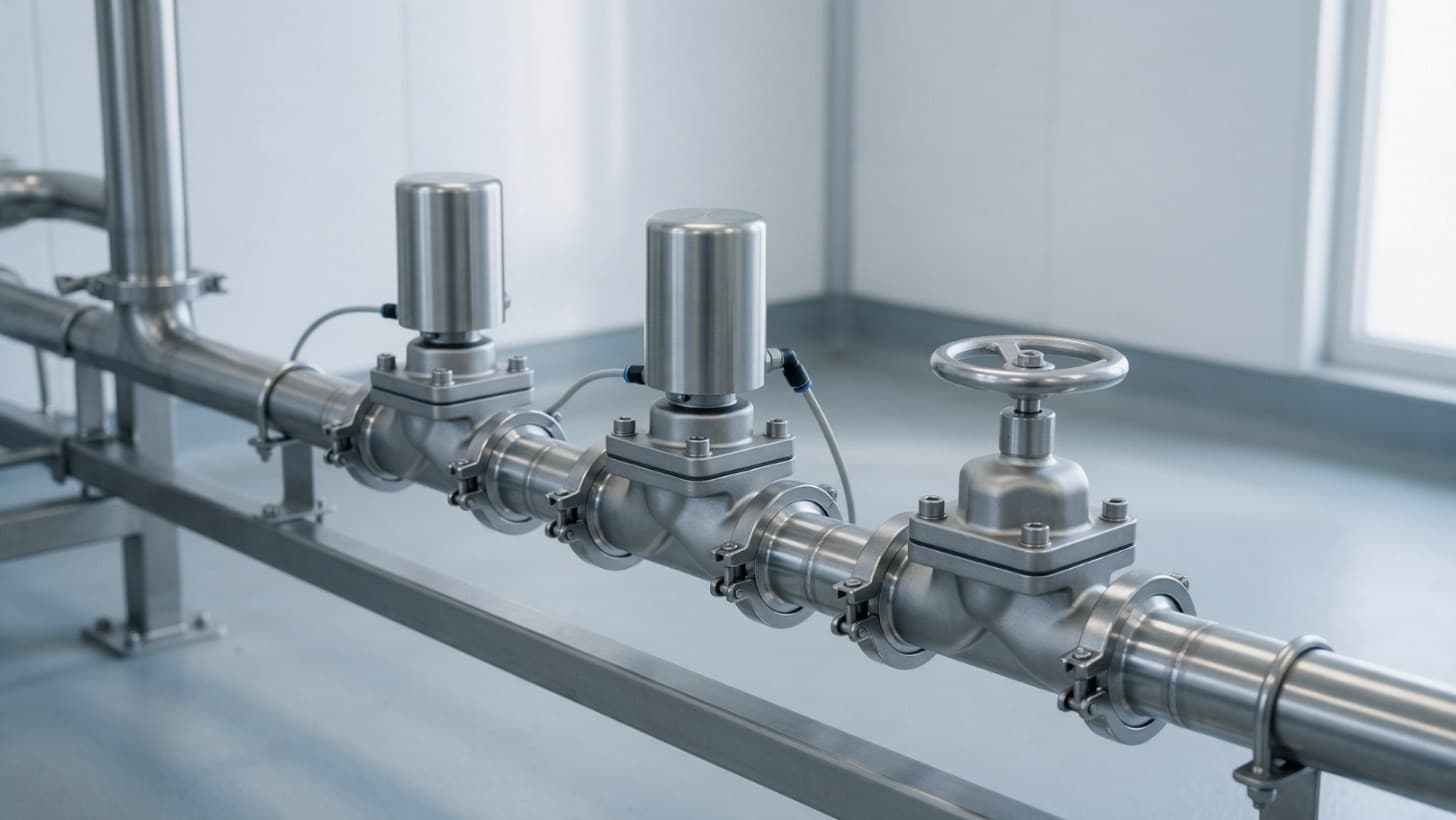
A diaphragm valve closes by pressing a flexible diaphragm down onto a seat, which in hygienic bodies is a raised weir. The diaphragm isolates the stem, compressor and actuator, so no working parts sit in the process fluid [1]. It is widely used on purified water, water for injection (WFI) and bioprocess lines. Specify six things: body type and form, a diaphragm grade that survives your steam cycle, tube standard and drain angle, surface finish, actuation and feedback, and the price of spare diaphragms.
Engineers often call it a Saunders valve, after P.K. Saunders, who invented the original diaphragm valve in 1928; Crane ChemPharma & Energy now makes the Saunders range [1].
Why this matters now
A diaphragm valve is one line on a skid quotation, yet it decides whether a system drains, cleans and passes validation. The FDA inspection guide for high purity water systems says ball valves are not considered sanitary, because water can sit in the centre of a closed ball [2].
ASME BPE, the bioprocessing equipment standard, is now in its 2026 edition, covering materials, design, fabrication, inspection, testing and certification [3]. Name the edition in your specification.
The diaphragm is also a wear part: GEMU says its diaphragms need regular inspection and replacement, with a maximum recommended life of 8 years including storage [4]. Spare prices belong in the bid comparison.
Create and manage RFQs in minutes
ChemCapital handles the entire procurement cycle, from structured RFQs and supplier comparisons to formal purchase orders and delivery tracking.
Weir or straight through
Inside the bonnet, a compressor on the stem pushes the diaphragm down and supports it in every position [1]. In a weir body it closes onto a raised saddle across the bore; hygienic ranges such as Saunders block valves are built around the weir [5].
A straight through body has no weir, giving a full bore. Crane calls its straight through KB type the choice for corrosive slurries and lists only rubber diaphragms for it; its PTFE faced grades appear in the weir tables alone [1]. Specify weir bodies for clean service and straight through for slurries.
Diaphragm materials and steam limits
Hygienic valves mostly use EPDM (ethylene propylene diene rubber), a flexible elastomer, or a PTFE faced diaphragm: a thin PTFE face against the product on an elastomer backing that supplies the flexibility.
| Maker and grade | Construction | Limits and recommended use stated by the maker |
|---|---|---|
| Saunders ER | Peroxide cured EPDM | minus 40 °C to 110 °C; for standard duty [5] |
| Saunders PR | PTFE face, EPDM backing | minus 20 °C to 160 °C; for mild sterilisation cycles [5] |
| Saunders SR | Modified PTFE (TFM) face, EPDM backing | minus 20 °C to 160 °C; for constant steam [5] |
| Saunders EX | TFM face, silicone backing | minus 20 °C to 175 °C; for intermittent and constant steam [5] |
| GEMU 660, EPDM codes 3A and 13 | EPDM | Media minus 10 °C to 100 °C; steam up to 150 °C, 60 minutes per cycle maximum [6] |
| GEMU 660, PTFE/EPDM code 54 | PTFE face, EPDM backing | Media minus 10 °C to 100 °C; steam up to 150 °C, no time limit per cycle [4, 6] |
First, a temperature range does not tell you whether a diaphragm survives your SIP (steam in place) cycle. Crane rates PR and SR to the same range but recommends PR only for mild sterilisation cycles and SR for constant steam [5]. On its 660 datasheet, GEMU limits the EPDM grades offered, codes 3A and 13, to 60 minutes per cycle and warns that longer exposure shortens diaphragm life [6]. GEMU also notes that only some of its diaphragms carry a time limit, so ask for the figure for the exact grade offered [4].
Second, PTFE is not a free upgrade. GEMU says that using one as a steam barrier, or large temperature swings, shortens its life [4]. Crane's instructions for manual valves with PTFE diaphragms say to take the fastenings back to full torque once 24 hours have passed or after the first heat cycle, preferably with the valve open and no hotter than 40 °C [7].
Pressure ratings change too: in Crane's weir valve pressure table, PTFE is rated no higher than rubber and ratings fall at larger sizes, so check the grade and size offered [1].
Drainability, dead legs and block valves
A weir body in a horizontal line drains only when rotated to its drain angle. Each forged Saunders two way body carries a hash mark that should sit at 12 o'clock, within plus or minus 2 degrees. Under rotate it and the weir dams the line; over rotate it and liquid pools at the weir [8].
The angle depends on size and tube standard: for a forged DN25 Saunders body, Crane gives 30° with ASME BPE 1 inch tube, 17° with DIN 29 mm tube and 12° with ISO 33.7 mm tube [8]. So name the tube standard in the RFQ, and install to the figure for the valve supplied. Crane puts the job of making the whole system drain on the system designer and the end user [8].
Dead legs, branches where water stands still, are the second risk. The 1993 FDA guide quotes a limit of six diameters for an unused branch, measured from the centre line of the main pipe and written for loops circulating at 75 to 80 °C, and warns that in cooler loops any unused length can grow biofilm [2]. A 2006 ISPE article noted that modern plants commonly reach a length to diameter ratio (L/D) of two or less, citing ASME BPE [9]. The two rules measure length from different points, so check how the current ASME BPE edition defines L and D.
Zero static and block valves address this. A zero static valve combines a tee and a weir, so a closed valve leaves almost no branch [5]. Block valves are machined from solid bar or billet into tees or clusters of weirs sharing a chamber, replacing welded clusters with less wetted area and minimum dead leg [5]. Use them at points of use and sample points.
Body form, finish and actuation
Hygienic bodies are forged, investment cast or machined from block: GEMU's 660 datasheet lists cast 1.4408 and 1.4435, forged 1.4435 including a version with delta ferrite under 0.5%, and block bodies [6]. Delta ferrite is a second phase in austenitic stainless steel that some owners limit.
It offers ASME BPE internal finishes from SF1, mechanically polished to Ra 0.51 µm maximum, to SF4, electropolished to Ra 0.38 µm maximum, where Ra is the arithmetic mean deviation of the surface profile from its centre line [6]. Our passivation and electropolishing guide explains them. Match the weld spigots, which GEMU offers to ASME BPE, ISO 1127 and DIN 11866, to your tube [6].
Most automated hygienic diaphragm valves use a pneumatic actuator: normally closed, where a spring shuts the valve if air fails; normally open; or double acting, with air driving both ways [5, 6]. Take the fail position from the P&ID, not the catalogue.
For feedback, GEMU's 660 has an optical position indicator as standard [6], and Saunders offers continuous position sensors with outputs such as 24 V DC and DeviceNet [5].
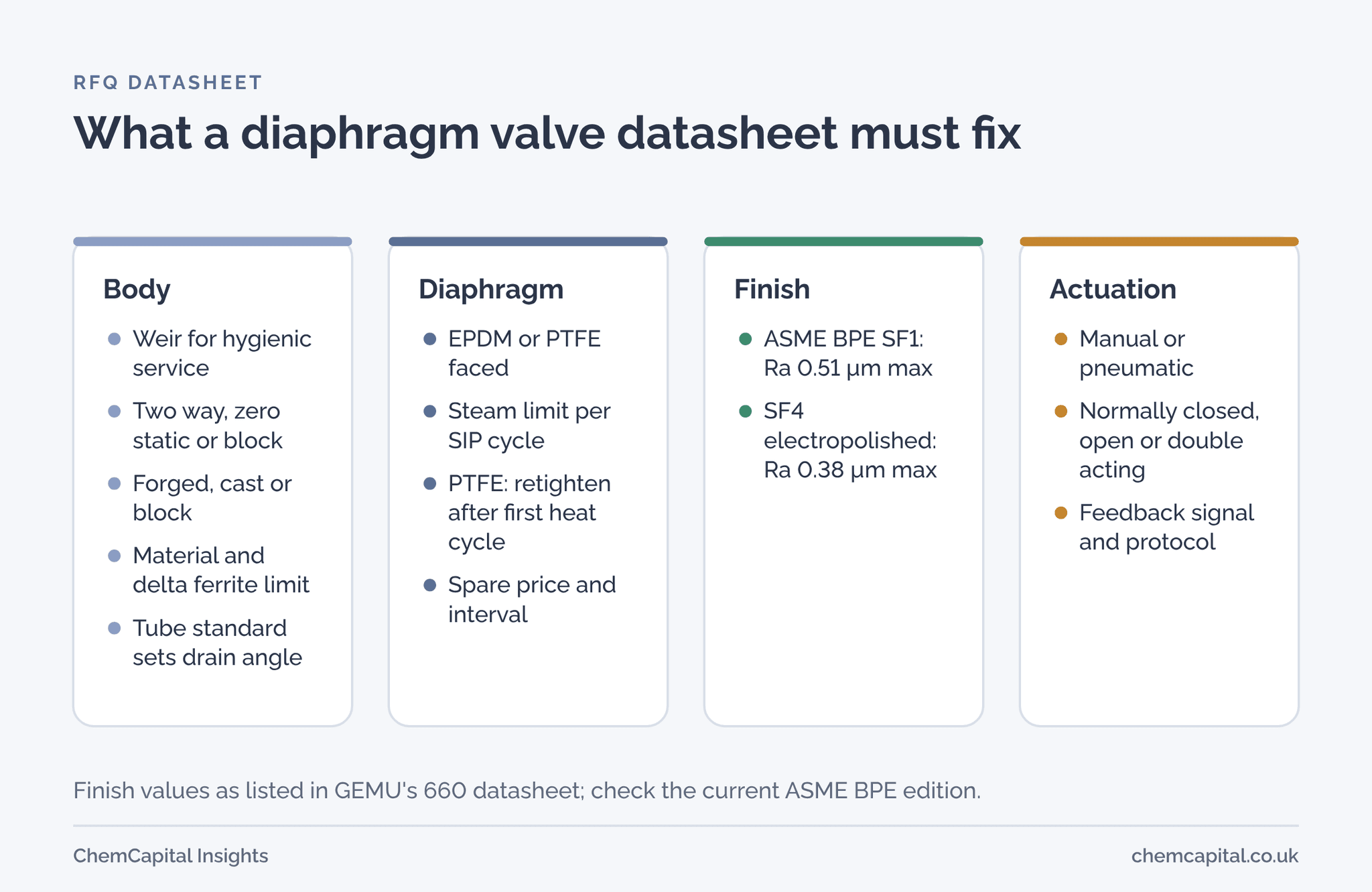
The valve datasheet for your RFQ
Send every bidder:
- service: fluid, design conditions, CIP chemicals, SIP temperature, minutes per cycle and cycles per year
- body: weir or straight through; two way, zero static or block; forged, cast or block; material and any delta ferrite limit
- ends: tube standard, weld spigot or clamp, and drain angle marked on body and drawing
- finish: ASME BPE designation or Ra limit, and whether electropolished
- diaphragm: grade, construction, steam limit per cycle, and compliance documents such as USP Class VI and EN 10204 3.1 traceability
- actuation: manual or pneumatic, fail position, feedback type and protocol
- bonnet: standard or sealed, where a failed diaphragm must not release a hazardous fluid
- spares: spare diaphragm price, recommended interval, retightening step and maximum shelf life
Practical example
An illustrative media preparation skid has 24 DN25 pneumatic weir valves, steamed after every batch with a 90 minute SIP cycle. The owner replaces every diaphragm yearly, an illustrative interval; GEMU says real intervals depend on sterilisation frequency and cycling [4]. Fitting takes 0.75 hours at £65 an hour. All prices are illustrative.
Bid A's datasheet limits its EPDM grade to 60 minutes per sterilisation cycle, as GEMU does for EPDM codes 3A and 13 on its 660 [6]. Other EPDM grades may be rated differently, so check the grade. Asked to comply, Bidder A requotes with PTFE faced diaphragms at £120 more per valve.
| Item | Bid A as offered (EPDM) | Bid A revised (PTFE faced) | Bid B (PTFE faced) |
|---|---|---|---|
| Price per valve | £1,450 | £1,570 | £1,600 |
| 24 valves | £34,800 | £37,680 | £38,400 |
| Spare diaphragm | £55 | £150 | £140 |
| 240 diaphragms over 10 years | £13,200 | £36,000 | £33,600 |
| Fitting labour over 10 years | £11,700 | £11,700 | £11,700 |
| Ten year total | £59,700 | £85,380 | £83,700 |
| Meets the 90 minute SIP cycle | No | Yes | Yes |
Bid A looked £3,600 cheaper on purchase price, but it did not meet the duty. Once compliant, it costs £1,680 more than Bid B over ten years, because its spare diaphragm is dearer. In both compliant bids the diaphragms cost almost as much as the valves. Score spares in your technical bid evaluation.
Find makers who publish the data
Many makers publish drain angles, steam limits and finishes. Supplier Discovery finds suppliers on the web from a plain text description, pasted RFQ or uploaded specification, extracts the parameters each publishes with source links, and gives a fit verdict: Strong, Partial, Information Missing or Rejected. Certifications are shown as claimed, not verified, and nothing is sent automatically. Try three searches without signing up.
Ready to find valve makers whose datasheets answer your RFQ? Start a free 14 day ChemCapital trial, with no credit card needed.
Frequently asked questions
What is a diaphragm valve used for?
It isolates or throttles flow on purified water, WFI and bioprocess lines, and in straight through form on corrosive slurries. The diaphragm keeps the stem, compressor and actuator out of the fluid, so no working parts sit in the product.
What is the difference between a weir and a straight through diaphragm valve?
A weir valve closes the diaphragm onto a raised saddle, drains in a horizontal line when set at its marked drain angle, and is the usual hygienic choice. A straight through valve has a full bore for slurries and solids; Crane lists only rubber diaphragms for its straight through type.
Why is a diaphragm valve called a Saunders valve?
P.K. Saunders invented the original diaphragm valve in 1928, which is why engineers often use the name for any diaphragm valve. The Saunders range is now made by Crane ChemPharma & Energy, and other makers such as GEMU produce hygienic diaphragm valves too.
How often should diaphragm valve diaphragms be replaced?
There is no single interval. GEMU says intervals depend on sterilisation frequency, cycling and maintenance history, and gives a maximum recommended life of 8 years including storage, so agree an interval with the maker and price the spares in the bid.
Continue reading
Informational only, not procurement or legal advice. Cited names, frameworks, and statistics belong to their respective owners.
Create and manage RFQs in minutes
ChemCapital handles the entire procurement cycle, from structured RFQs and supplier comparisons to formal purchase orders and delivery tracking.
Start for freeRelated articles
Where to Find Pharma and Chemical Plant Projects Before They Go to Tender: the 2027 Pipeline
Twenty pharma and chemical plant projects checked against owner or government announcements, the buying timeline on each, and where to watch for the next ones for free.
TEMA Heat Exchanger Types: How to Read AES, BEM and AEU
How to decode the three letter TEMA type, what AES, BEM, AEU and other common types mean for cleaning, expansion, leaks and cost, and how to compare bids that differ.
Safety Valve vs Relief Valve vs Bursting Disc: How to Choose
How safety valves, relief valves and bursting discs differ, when to fit a disc under a valve, the pressure terms that matter, GB duties and what to put in the RFQ.