
Preservation and Storage of Process Equipment Before Start Up
How to keep pumps, motors, skids and vessels in good condition between delivery and start up: what to put in the order, storage conditions, shaft rotation, insulation checks and a preservation log.
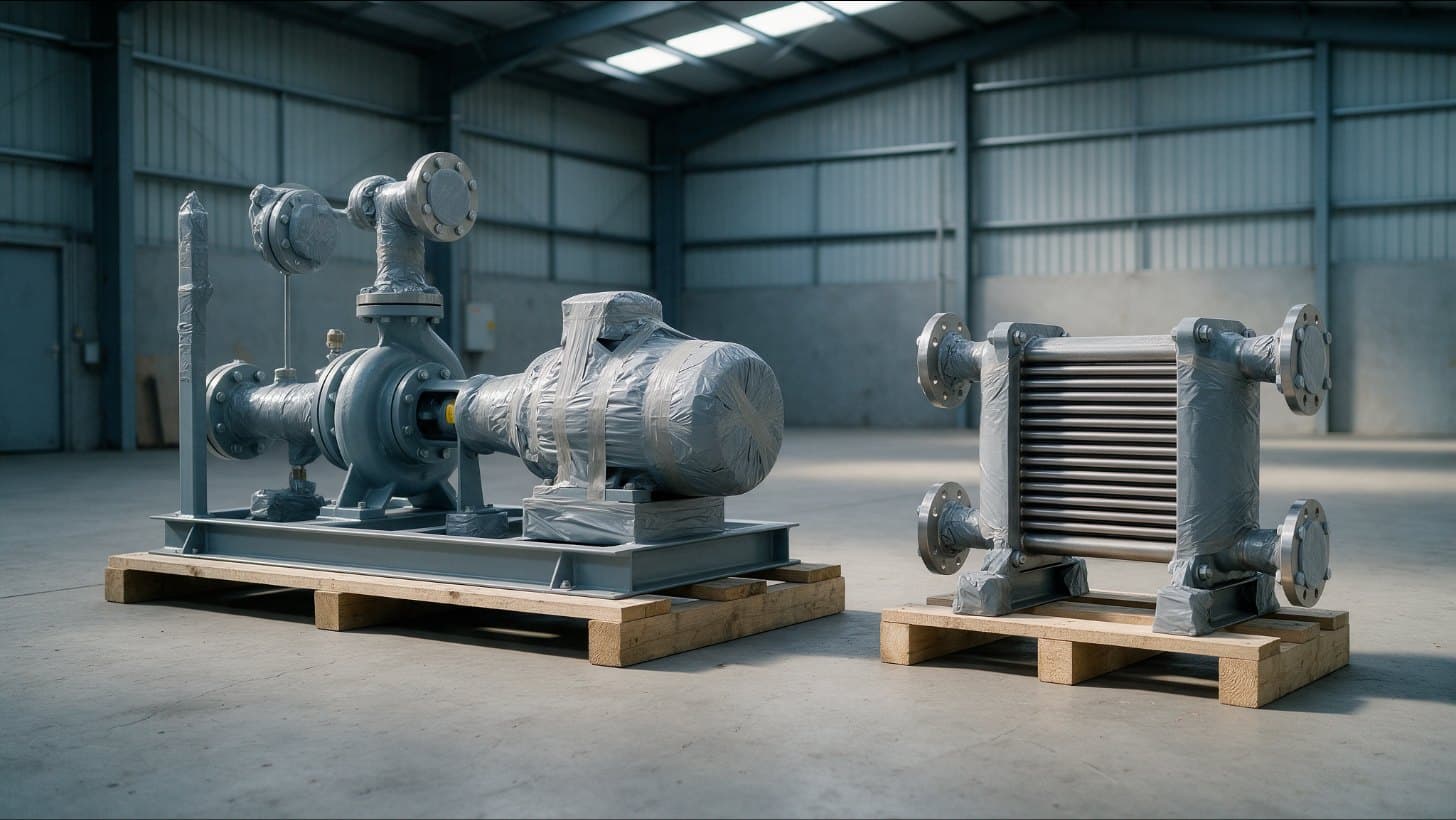
Preserving process equipment means keeping it in the condition it left the factory until the day it starts: dry, clean, uncorroded, with bearings and seals undamaged. In practice that comes down to five things. Put the requirements in the purchase order, store each item in the conditions its maker specifies, seal and protect openings and machined surfaces, carry out the routine checks such as turning shafts and measuring motor insulation, and record every check in a preservation log that goes to the commissioning team.
It matters most when equipment waits: a pump skid delivered on time to a building that is three months late, or spares bought with the main order and kept for years.
Why this matters now
Long lead items are often ordered early to protect the schedule, which means they arrive early too. Manufacturers set the bar for "long term" lower than many buyers expect. Xylem's Bell and Gossett long term storage specification treats storage of more than one month as long term [1]. KSB GIW describes short term storage as up to three months and long term as three to twelve months [2]. DESMI's pump storage manual says that after six years of storage the mechanical seal, ball bearings and bearing grease should be replaced [3].
Damage done in storage can stay hidden until start up, when it is most expensive to fix.
Join ChemCapital to streamline sourcing and connect with verified partners
Whether you're buying or supplying, ChemCapital gives you the tools to manage the complete procurement cycle in one platform.
Put it in the order
Preservation starts with the purchase order, not the warehouse. Ask for:
- Preservation for shipment and for a stated storage period, for example twelve months from delivery, with the method described.
- Written storage and preservation instructions for every item, delivered with the equipment, not with the final data book.
- Protection of openings: flange covers, plugs for threaded holes and sealed vents.
- Motor space heaters wired to an accessible terminal, if your storage could reach the dew point.
- A statement of what storage conditions the warranty assumes, so there is no argument later.
If equipment will wait at the supplier's works instead of your site, agree who is responsible for preservation there and what it costs. Our guide to expediting equipment orders covers how to track these items as delivery approaches.
Storage conditions
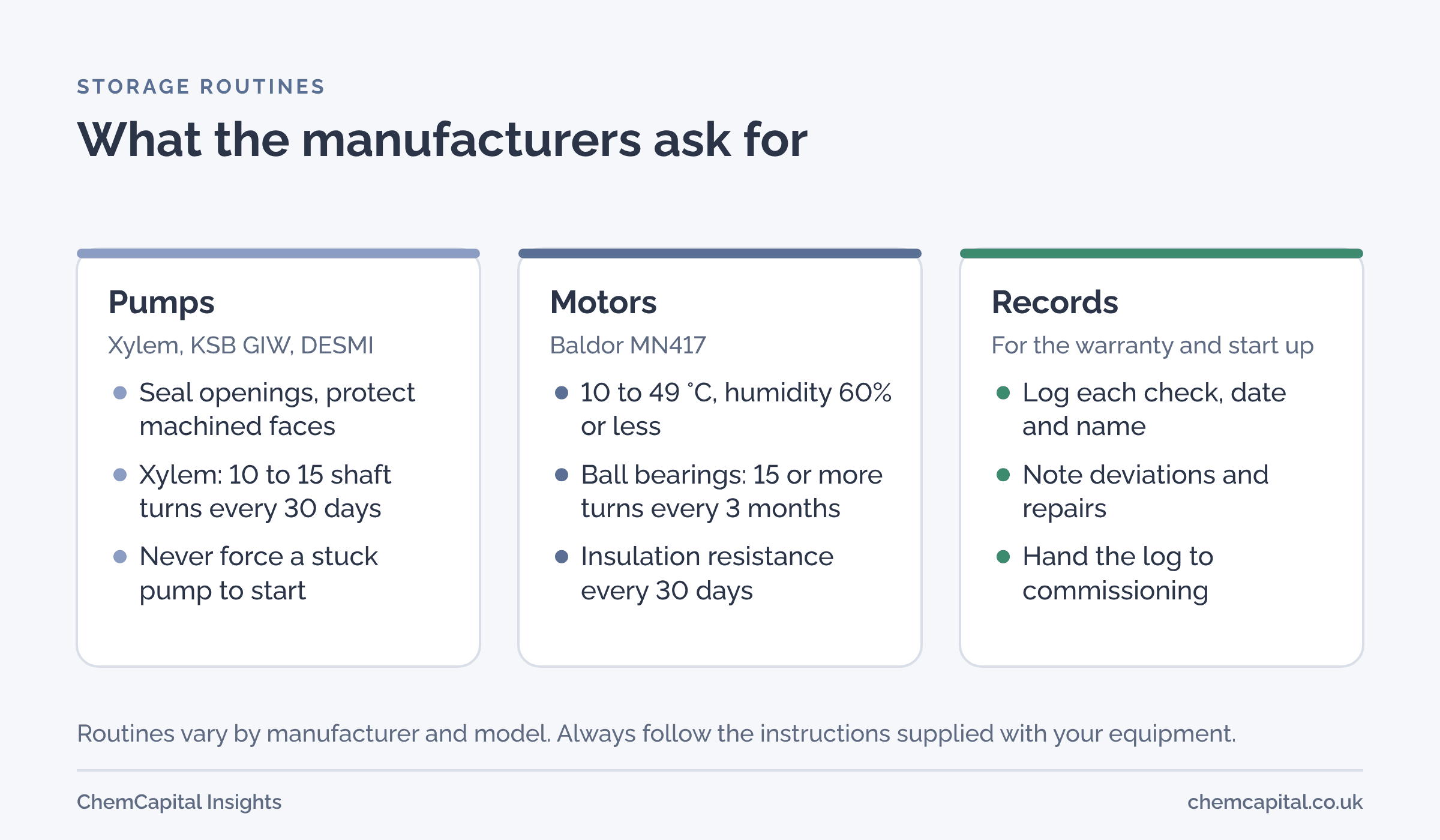
Indoors where possible. DESMI asks for pumps to be stored indoors, in a dry area, on level ground that will not flood and free from vibration, ideally packed in plastic sheeting with silica gel bags [3]. Baldor's long term motor storage procedure specifies a clean, dry, protected warehouse between 10 °C and 49 °C with relative humidity no higher than 60% [4].
Outdoors only with care. KSB GIW says pumps stored outdoors should be raised on blocks or pallets and covered with a vented tarpaulin [2]. Vents matter: a sealed plastic wrap with no desiccant traps condensation.
Seal and protect. Xylem's specification seals housing vents and openings with plastic wrap and waterproof tape, coats unpainted steel and cast iron with a rust inhibiting oil where condensation is expected, and uses a suitable amount of desiccant inside a sealed cover [1]. DESMI recommends spraying anticorrosion oil through the inlet and outlet, and warns that pumps with EPDM rubber seals need oils that will not attack them [3].
The routine checks
Turn the shafts. Turning the shaft prevents standstill damage to bearings and spreads lubricant [3] [4]. Xylem asks for the pump and motor shafts to be turned by hand 10 to 15 times every 30 days, leaving them at a different position each time [1]. Baldor asks for at least 15 revolutions every three months for motors with ball or roller bearings, and 10 to 15 turns monthly for oil lubricated sleeve bearings [4]. Leybold suggests turning some of its ball bearing vacuum pumps by hand every six months and running them at least once a year [5]. The routines differ, which is why the manufacturer's own instruction must sit with each item.
Measure motor insulation. Baldor's procedure has winding insulation resistance measured and recorded every 30 days, with a minimum of 5 megohms or the motor's rated voltage in kilovolts plus one, whichever is greater. Before service, the reading must not be less than half the initial reading taken when storage began; a reading below that indicates moisture, and the motor must be dried before use [4]. Insulation resistance falls as winding temperature rises, so compare readings taken at similar temperatures.
Inspect. Xylem asks for weekly checks of equipment stored outdoors and after storms [1]. KSB GIW recommends checking for corrosion and coating damage and touching up as needed [2].
Never force it. If a shaft will not turn freely, find out why. DESMI states plainly that forced restarting of a stuck pump is not allowed [3].
Keep a preservation log
A simple log, one line per check per item, protects everyone. Record the date, the item tag, what was done, the result and who did it. Note any damage or deviation and what was done about it. A layout that works:
| Date | Tag | Check | Result | Action | Initials |
|---|---|---|---|---|---|
| 4 April | P 101 | Shaft turned by hand | Turns freely | Left at new position | JS |
| 4 April | M 101 | Insulation resistance | 790 megohms | None | JS |
| 4 April | Skid 1 | Desiccant and cover | Desiccant saturated | Bags replaced, cover resealed | JS |
Hand the log to the commissioning team with the equipment; it becomes part of the evidence at the site acceptance test.
Practical example
In this illustrative example, a pump skid with a 400 V motor is delivered in March, but its building is not ready until October, seven months later. The skid is stored in an unheated warehouse.
The site team follows the supplier's instructions: openings sealed, desiccant bags inside the motor terminal box and the skid cover, shafts turned monthly, and motor insulation measured monthly. The first reading in March is 800 megohms. By September, after a damp summer, it has fallen to 300 megohms, which is 37.5% of the initial reading. That is still well above the absolute minimum of 5 megohms, but under the 50% rule in Baldor's procedure the motor must be dried before service [4]. The team energises the motor's space heater for a week, the reading recovers, and the result goes in the log.
Without monthly readings, the motor would have been started damp. With them, the fix cost a week of heater power and a line in a spreadsheet.
Where ChemCapital fits
Preservation requirements only work if they are in the order and everyone can see them. ChemCapital sends one structured RFQ with line items and attachments, so preservation and storage requirements reach every bidder and are priced. After award, purchase orders are issued in the platform, suppliers post milestone updates, each order has its own message thread, and interactions and decisions are logged with timestamps and the person who made them. See how it works.
Want preservation and delivery requirements written into every equipment order? Start free with ChemCapital.
Frequently asked questions
How long can a pump be stored before it needs special preservation?
It depends on the manufacturer. Xylem's Bell and Gossett specification treats storage longer than one month as long term, while KSB GIW describes short term storage as up to three months. Follow the instructions for your equipment and record what was done.
How often should you turn the shaft of stored equipment?
Manufacturers differ: one pump specification asks for 10 to 15 turns every 30 days, and one motor storage procedure asks for at least 15 revolutions every three months for ball and roller bearing motors. The aim is to stop bearings standing in one position and to spread lubricant.
What should be checked on a stored motor before start up?
Insulation resistance. One manufacturer's procedure requires monthly readings during storage and says the reading before service must not fall below half the initial value; a reading below that indicates moisture, and the winding must be dried before use.
Informational only, not procurement or legal advice. Cited names, frameworks, and statistics belong to their respective owners.
Join ChemCapital to streamline sourcing and connect with verified partners
Whether you're buying or supplying, ChemCapital gives you the tools to manage the complete procurement cycle in one platform.
Get started freeRelated articles

Battery Limits, Terminal Points and Scope of Supply in Equipment Quotes
What battery limits, terminal points and scope of supply mean, how gaps between them make quotes look cheaper than they are, and a terminal point schedule you can put in every RFQ.
Liquidated Damages for Late Equipment Delivery: Rates, Caps and a Worked Example
How liquidated damages for late delivery work in equipment contracts: how UK courts treat them, how to set the rate and cap, what the clause must say, and a worked example with Orgalim terms.
Third Party Inspection for Process Equipment: When to Use It and How to Scope It
What a third party inspector does at your supplier's works, how it differs from a notified body or code inspector, how to pick an accredited agency, and how to scope and price the assignment.