
Battery Limits, Terminal Points and Scope of Supply in Equipment Quotes
What battery limits, terminal points and scope of supply mean, how gaps between them make quotes look cheaper than they are, and a terminal point schedule you can put in every RFQ.
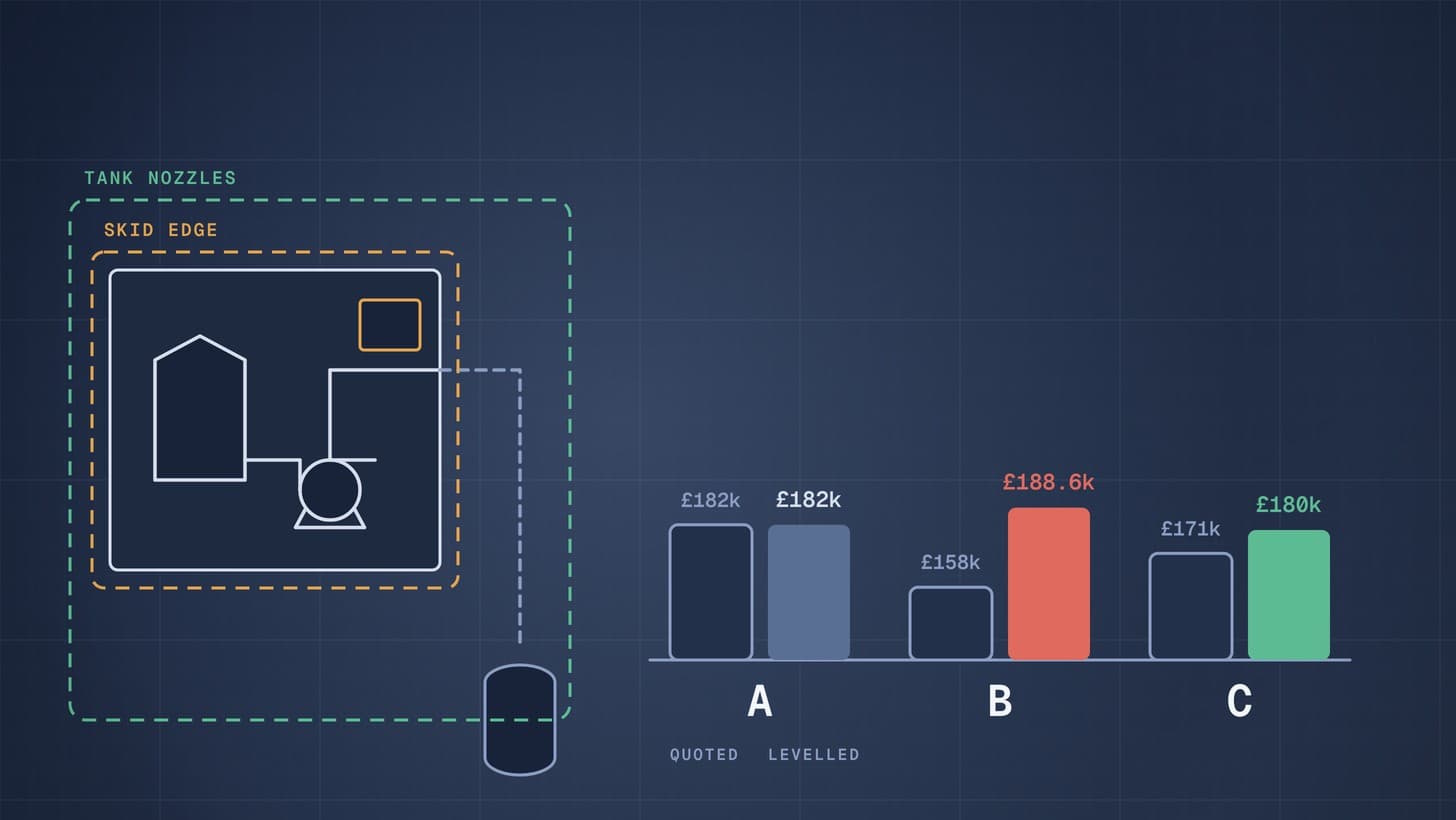
Battery limits, terminal points and scope of supply are three ways of answering one question: where does the supplier's job end and yours begin? A battery limit is the boundary drawn around a plant or unit being engineered and built. A terminal point is the exact physical point on that boundary where the supplier's equipment stops, such as a flange, a cable terminal or a nozzle. The scope of supply is the list of goods, documents and services the supplier has included. If any of the three is vague, quotes cannot be compared, and the gaps turn into change orders after award.
The practical fix is simple: put a terminal point schedule and a scope of supply checklist in every RFQ, ask bidders to confirm or mark exceptions line by line, and price any missing scope before you rank the bids.
Why this matters now
AACE International's cost engineering terminology, revised in February 2026, defines a battery limit as one or more boundaries, real or imaginary, enclosing a plant or unit being engineered or erected, and says the scope inside it must be well defined so everyone understands it [1]. Suppliers' standard terms make the same point from the other side. GEA's standard terms of sale for machines and plants, in their July 2026 edition, define the scope of supply as only the goods, documents and services expressly listed as the contractor's responsibility in its offer; anything not listed falls to the purchaser, who is also responsible for the interface, including its dimensions and compatibility [2].
That is a reasonable position for a supplier to take, and many do. It means that whatever your RFQ does not pin down, you own.
Join ChemCapital to streamline sourcing and connect with verified partners
Whether you're buying or supplying, ChemCapital gives you the tools to manage the complete procurement cycle in one platform.
Three terms, three different jobs
| Term | What it means | Typical example | Where it is written |
|---|---|---|---|
| Battery limits | Boundary around a unit or plant; inside is ISBL, outside is OSBL | A dryer building and its process equipment, excluding the boiler house | Plot plan, battery limit drawing, scope document |
| Terminal points | Exact connection points where supply ends | DN80 PN16 flange on the skid edge; terminals X1 to X40 in the local panel | Terminal point schedule, P&IDs, general arrangement drawings |
| Scope of supply | Positive list of goods, documents and services included | Skid, control panel, first fill of oil, commissioning spares, FAT, data book, 5 days on site | Quote, RFQ scope checklist, purchase order |
For cost estimating, the same split matters. Inside battery limits costs cover procuring and installing the process equipment, while outside battery limits costs cover the supporting facilities the plant needs to run, such as utilities, waste treatment, firefighting, offices and laboratories [3]. AACE notes the term usually refers to the processing area and excludes storage, utilities and auxiliary buildings [1]. A package supplier who says "battery limits" may mean the skid frame; your project engineer may mean the whole building. Agree the words before you agree the price.
Where the gaps usually are
Most scope gaps sit at the same handful of interfaces. Check each one against every bid:
- Process connections. Does supply end at the skid edge flange, or include pipework to your vessels? Who supplies the gaskets, bolts and counter flanges?
- Utilities. Steam, cooling water, compressed air, nitrogen: is there a connection on the skid for each, with its size and rating?
- Electrical. Is the motor control in a panel on the skid, in your motor control centre, or not supplied? Who supplies and terminates the cables between them?
- Instruments and control. Is the control system included? Is the software, and its documentation, in scope? Which signals pass to your plant system, and over what protocol?
- Relief and drains. Where do relief valve outlets, vents and drains end?
- Structure and civil. Holding down bolts, grouting, platforms and ladders.
- Services. Installation supervision, commissioning, training, and how many days of each.
- Documents and testing. Factory acceptance test, certificates, manuals, data book.
- Spares and consumables. Commissioning spares, first fill of lubricants and chemicals, special tools.
Our modular process skids buyer's guide goes deeper on the skid specific items, and the recommended spares list guide covers what spares to ask for.
Delivery is not scope
The Incoterm in a quote decides where delivery happens and when risk passes, along with transport costs and customs formalities. The International Chamber of Commerce is clear that Incoterms rules do not cover every legal or practical issue in a sale, and do not deal with the transfer of title, which is left to national law [4]. They say nothing about whether the control panel is included. A bid "delivered to your site" can still stop at the skid edge. Our guide to Incoterms for process equipment covers delivery terms in detail; keep them separate from scope in both the RFQ and the evaluation.
The terminal point schedule
Attach a schedule like this to the RFQ, one row per connection, and ask every bidder to confirm it or mark exceptions:
| Tag | Service | Size and rating | Connection type | Location | Supplier provides | Buyer provides |
|---|---|---|---|---|---|---|
| N1 | Product inlet | DN80 PN16 | Weld neck flange, raised face | Skid edge, north | Flange and pipework inside skid | Pipework to skid, gasket, bolts |
| N2 | Product outlet | DN80 PN16 | Weld neck flange, raised face | Skid edge, north | As N1 | As N1 |
| U1 | Steam | DN25 PN16 | Flanged | Skid edge, east | Control valve and trap set | Steam supply to flange |
| E1 | Power | 400 V, 3 phase | Isolator terminals | Local panel | Panel, internal wiring | Supply cable and termination |
| C1 | Control signals | Profinet | Panel switch port | Local panel | Panel and software | Network cable to plant system |
Then add a scope of supply checklist with a yes or no column for each item listed in the section above. Bidders who must answer every line cannot leave things out by silence.
Practical example
In this illustrative example, a buyer asks three bidders for a cleaning skid that must connect to two existing tanks about 10 metres away.
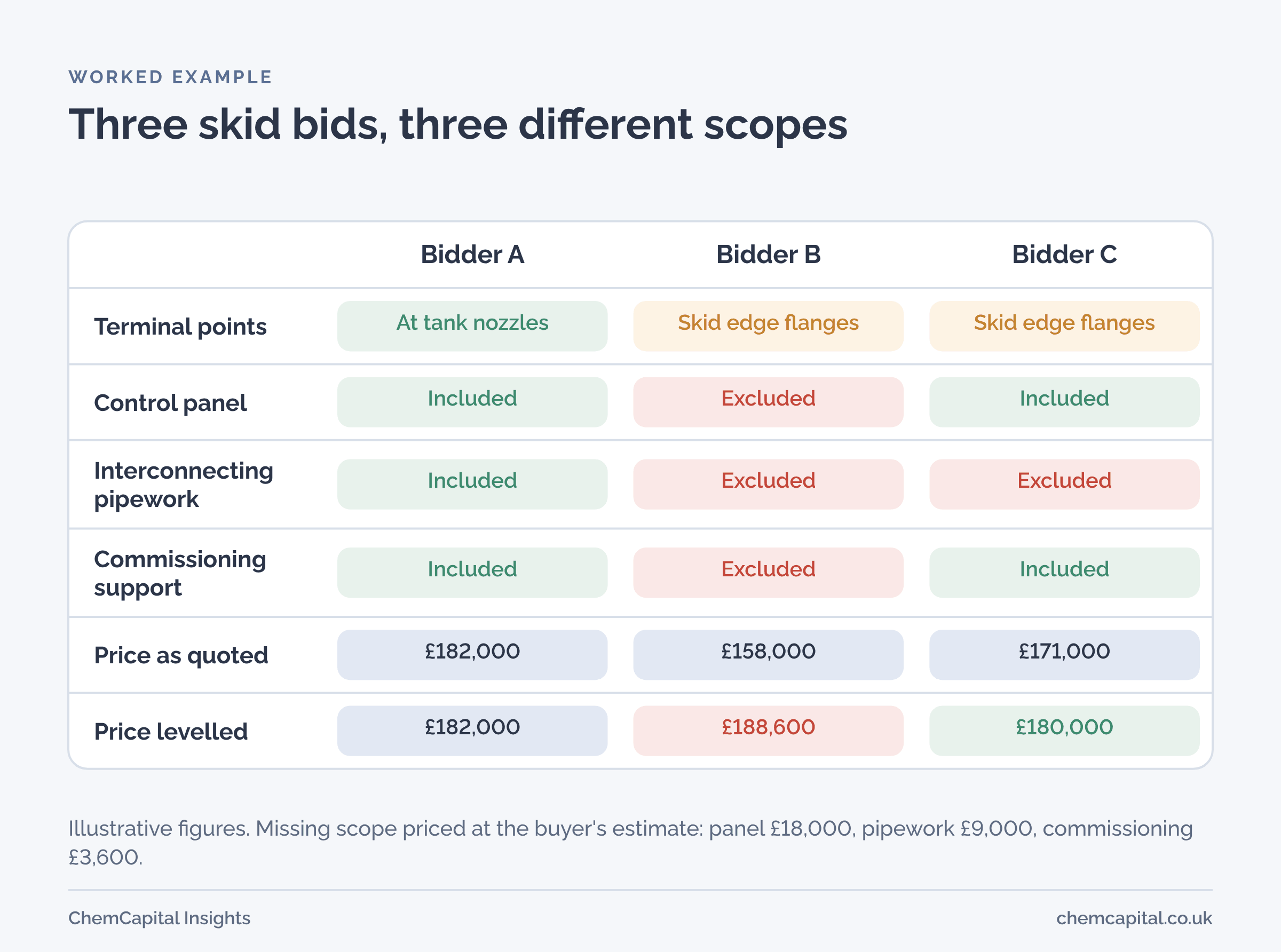
Bidder A quotes £182,000 including the control panel, the interconnecting pipework to the tank nozzles and three days of commissioning. Bidder B quotes £158,000, stopping at the skid edge flanges, with the control panel and commissioning excluded in its clarifications. Bidder C quotes £171,000 with the panel and commissioning included, but stops at the skid edge.
The buyer prices the missing scope at its own estimates: £18,000 for a control panel, £9,000 for the interconnecting pipework and £3,600 for three days of commissioning at £1,200 a day. Levelled, bidder B rises to £188,600 and bidder C to £180,000, while bidder A stays at £182,000. The cheapest quote became the dearest, and the ranking changed from B, C, A to C, A, B.
Two cautions. Use your own realistic costs for missing scope, not punitive ones, or the levelling becomes a way to pick a winner in advance. And where the gap is large, ask the bidder to price it instead; a supplier who builds the panel may do so for less than your estimate. Our guide to commercial bid evaluation explains levelling in more detail.
Raise gaps before signing, not after
Courts tend to hold parties to the documents they signed. In one US case reported by the American Society of Civil Engineers in 2025, an electrical subcontractor on a wastewater pumping station claimed about $83,000 for trench excavation it said was outside its scope; the court found that addenda issued before bidding had put the work in its scope, and that any confusion should have been raised before the subcontract was signed [5]. The lesson works for both sides of an equipment deal: buyers should close gaps in the RFQ, and suppliers should state their exclusions plainly in the quote. This is general information, not legal advice.
If you are the supplier
A clear terminal point list protects you. It stops your quote being compared with a rival's that includes more, and it stops scope creeping in after award. List what is included, what is excluded and what you assume the buyer provides, using the buyer's tags where you have them.
Where ChemCapital fits
ChemCapital sends one structured RFQ with line items and attachments, so your terminal point schedule and scope checklist go to every bidder in the same form. The AI quotation comparison extracts price, lead time, materials, certifications and scope from each quote, with the source text kept beside every extracted field, and checks for missing fields, unit mismatches and scope differences. A quote that fails a mandatory requirement is flagged and left out of the ranking, and people make the final call.
Want every bid on the same scope before you compare prices? Start free with ChemCapital.
Frequently asked questions
What does battery limits mean?
A battery limit is a boundary, real or imaginary, drawn around a plant or unit to show what is inside the scope being engineered and built. Work inside it is called inside battery limits (ISBL) and supporting facilities outside it, such as utilities and storage, outside battery limits (OSBL).
What is a terminal point?
It is the exact physical point where the supplier's scope ends and the buyer's begins, such as a flange on a skid edge, a cable terminal in a panel or a nozzle on a vessel. A terminal point schedule lists each one with its size, rating and who supplies what on each side.
Is the Incoterm the same as the scope of supply?
No. The Incoterm sets where delivery happens and when risk passes, while the scope of supply sets what goods, documents and services are included. A quote can be delivered to your site and still leave out the control panel.
Informational only, not procurement or legal advice. Cited names, frameworks, and statistics belong to their respective owners.
Join ChemCapital to streamline sourcing and connect with verified partners
Whether you're buying or supplying, ChemCapital gives you the tools to manage the complete procurement cycle in one platform.
Get started freeRelated articles
Preservation and Storage of Process Equipment Before Start Up
How to keep pumps, motors, skids and vessels in good condition between delivery and start up: what to put in the order, storage conditions, shaft rotation, insulation checks and a preservation log.
Liquidated Damages for Late Equipment Delivery: Rates, Caps and a Worked Example
How liquidated damages for late delivery work in equipment contracts: how UK courts treat them, how to set the rate and cap, what the clause must say, and a worked example with Orgalim terms.
Third Party Inspection for Process Equipment: When to Use It and How to Scope It
What a third party inspector does at your supplier's works, how it differs from a notified body or code inspector, how to pick an accredited agency, and how to scope and price the assignment.