
Instrument Datasheet for RFQs: What Each Field Means (Free Template)
A field by field guide to the instrument datasheet behind every RFQ line, using a pressure transmitter, with a free template and a worked example of comparing accuracy.
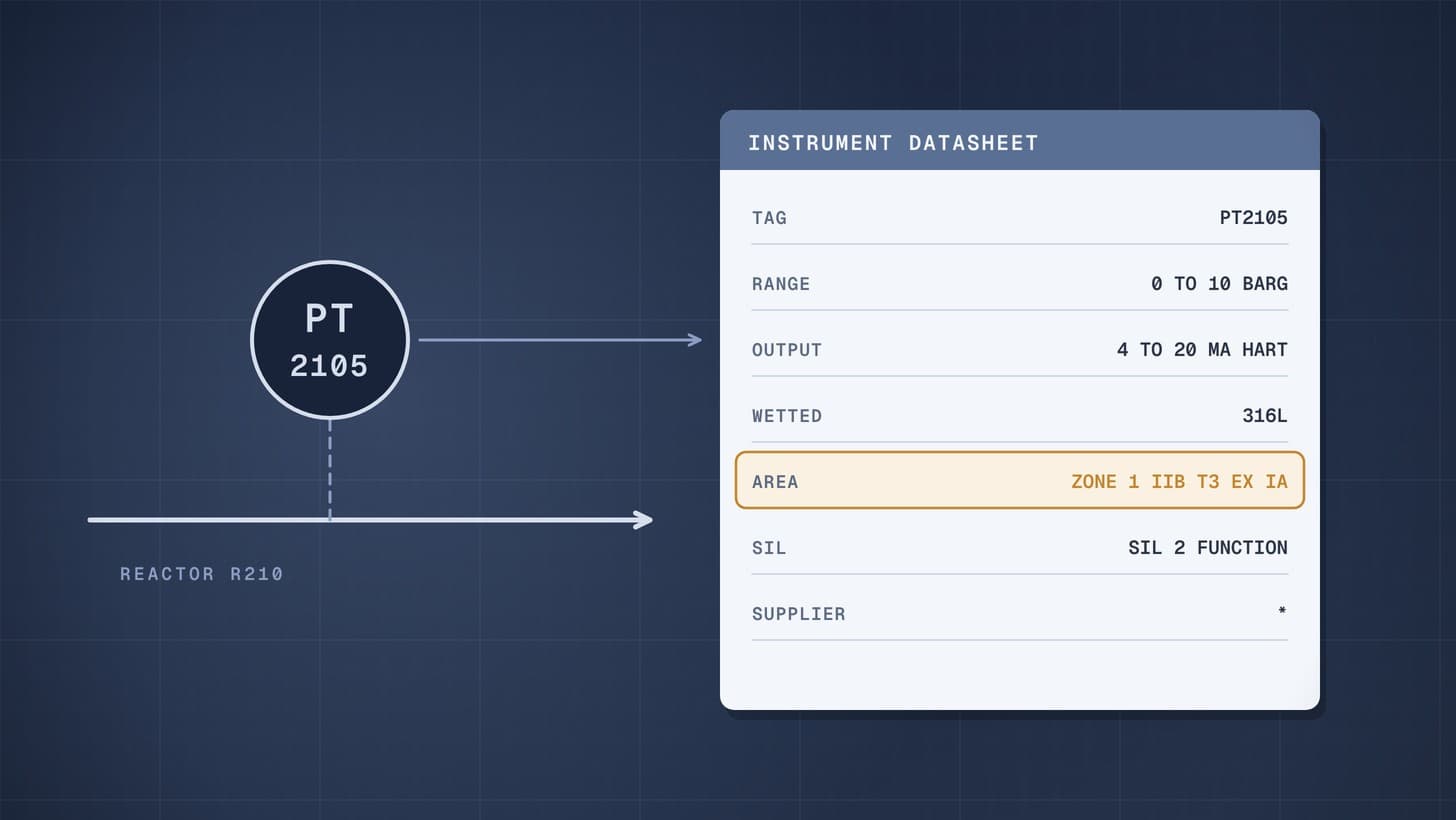
An instrument datasheet is the one page specification that tells a supplier exactly which transmitter, switch or analyser to quote: the process conditions it sees, the range and output you need, the wetted materials, the hazardous area rating, any SIL requirement and the connections. Get those fields right and every supplier prices the same instrument; leave them vague and you get three quotes for three different products.
Free download: pressure transmitter datasheet with bid comparison (Excel). Ready to fill in, free to use, no sign up needed.
This guide walks through a pressure transmitter datasheet field by field, says what each field is for and where buyers go wrong, and gives a template table you can copy into your RFQ.
Why this matters now
Every instrument bubble on a P&ID becomes a line in an RFQ, and a modest skid can carry dozens of them. The data structures behind datasheets have also moved on. IEC 61987 Part 1, which sets a generic structure for describing process measuring equipment so that buyers and makers read the same properties the same way, was reissued as edition 2.0 in October 2024. The new edition adds a separate digital communication heading and aligns its headings with the IEC Common Data Dictionary [1].
The ISA forms most engineers grew up with, ISA TR20.00.01, exist for the same reason: to help write complete specifications, to standardise information for quoting, bid review and purchasing, and to define data fields for electronic exchange [2]. Increasingly a datasheet is structured data rather than a PDF, so it can move from the design tool into the RFQ without retyping. If your instrument list lives in a spreadsheet, see our guide to the line list, valve list and instrument index.
Create and manage RFQs in minutes
ChemCapital handles the entire procurement cycle, from structured RFQs and supplier comparisons to formal purchase orders and delivery tracking.
How a datasheet is organised
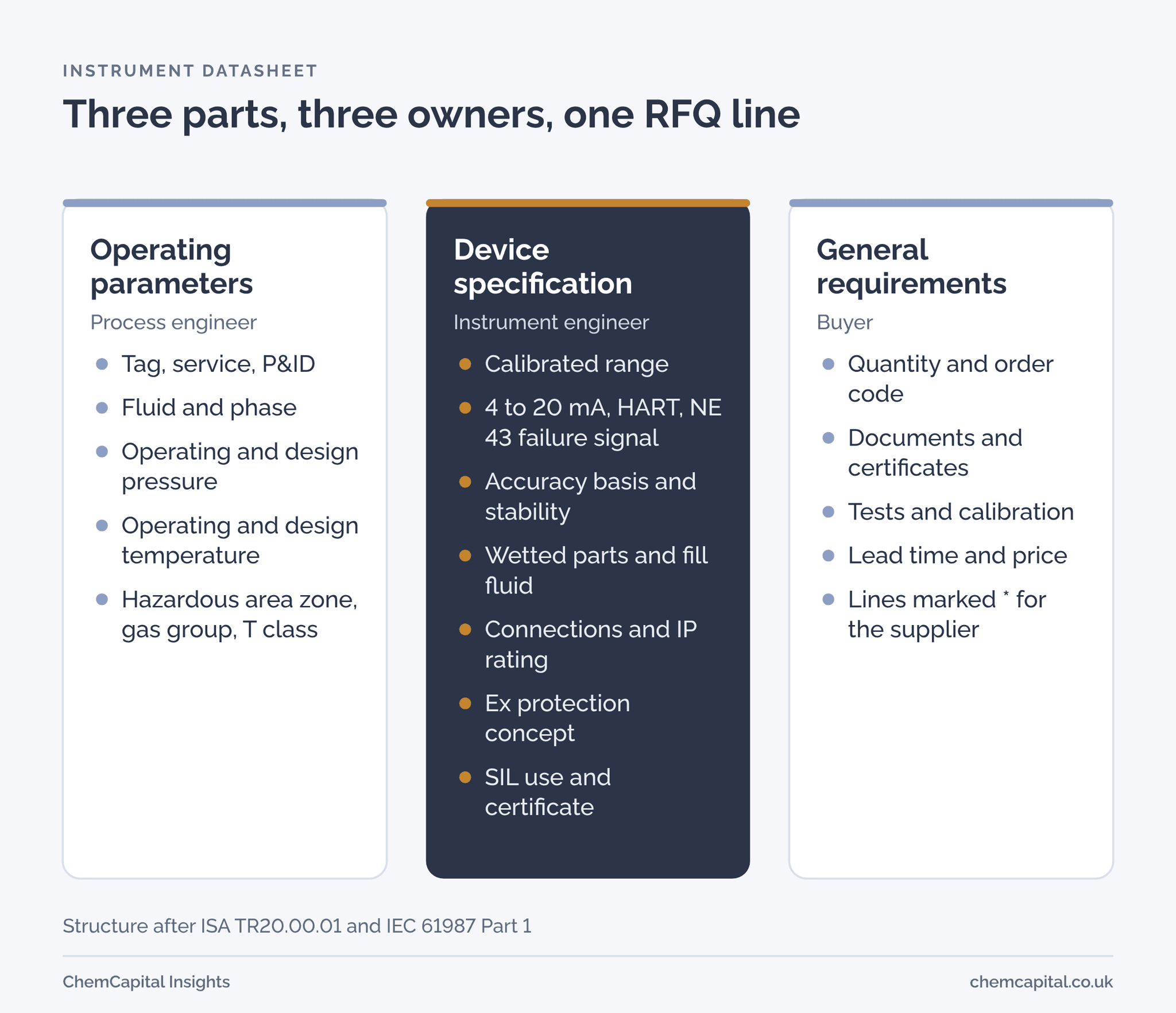
ISA TR20.00.01 splits each form into separate parts for operating parameters, device specifications and general requirements [2]. IEC 61987 Part 1 groups the properties under headings that include application, input, output, digital communication, performance characteristics, operating conditions, mechanical and electrical construction, power supply, and certificates and approvals [1]. The two structures line up well: the process engineer owns the operating parameters, the instrument engineer owns the device specification, and the buyer owns the commercial and document requirements.
The ISA report also describes levels of completeness, from a preliminary inquiry through to a conforming specification agreed by purchaser and supplier. For an inquiry, the specifier can put an asterisk in the revision column against each line the supplier must complete [2]. Use that convention: it tells the supplier which blanks are deliberate.
Field by field: a pressure transmitter
Tag, service and P&ID. Tag PT2105, service, line or equipment number and P&ID reference. This is your traceability; the supplier copies it onto the nameplate.
Process data. Fluid, phase, operating and design pressure, operating and design temperature, and anything unusual: solids, vacuum, pulsation, steam out. The supplier uses these to choose the sensor module, diaphragm and fill fluid.
Calibrated range and output. State the calibrated range, for example 0 to 10 barg, and the output. HART sends digital data over the same 4 to 20 mA wiring, and the FieldComm Group reports more than 40 million HART field instruments installed worldwide [3]. Also state the failure signal. NAMUR NE 43 standardises the signal levels that report a transmitter failure; its 2021 edition added a safety margin for signal detection [4]. One maker's data sheet shows default alarm levels of 21.75 mA or above (high) and 3.75 mA or below (low), with NE 43 levels of 22.5 mA or above and 3.6 mA or below as an option [5]. If your control system expects NE 43, say so.
Accuracy and stability. Ask for reference accuracy as a percentage of calibrated span, and long term stability over a stated period. Makers quote on different bases. One data sheet gives ±0.04% of span, stability of ±0.2% of upper range limit (URL) for 10 years and 50:1 rangeability [5]. A figure in percent of URL looks small but can be large at your span, as the practical example shows.
Wetted materials. Isolating diaphragm, process flange and seals. A common offer is 316L stainless steel or Alloy C276, with PTFE based O rings and a silicone or inert fill [5]. Name what your process needs; do not leave it to "manufacturer's standard".
Process and electrical connections. For example ½ inch NPT female or G ½ A, and M20 cable entries [5]. Mismatched threads are the commonest cause of a site fix.
Hazardous area. Give the zone, gas group and temperature class, not just "ATEX". In Great Britain, DSEAR allows only category 1 equipment in zone 0, category 1 or 2 in zone 1, and category 1, 2 or 3 in zone 2 [6]. The temperature class caps the maximum surface temperature, from 450 °C for T1 to 85 °C for T6 [7]. Say which protection concept you want. An intrinsically safe transmitter carries a marking such as II 1 G Ex ia IIC T4 Ga; a flameproof one, II 1/2 G Ex db IIC T6...T4 Ga/Gb [5]. They need different wiring. Our guide to ATEX and DSEAR equipment covers the zoning.
Enclosure rating. An IP rating such as IP66 or IP67. The first digit 6 means dust tight; a second digit of 7 means protected against temporary immersion, and 8 continuous immersion [8].
SIL. A safety integrity level (SIL) is one of four discrete levels and is a property of a safety function, a loop of sensor, logic solver and final element, not of a single instrument. SIL 2 means a risk reduction of more than 100 up to 1,000 [9]. IEC 61511 is the process sector standard for safety instrumented systems; Part 1 is edition 2.0 of 2016, with Amendment 1 of 2017 [10]. On the datasheet, write "for use in a SIL 2 safety function" and ask for the IEC 61508 certificate or FMEDA report; one maker sells this as an ordering option [5].
Documents and tests. Calibration certificate, material certificates for wetted parts if needed, Ex certificate, SIL documents, and the manual.
ChemCapital's P&ID to RFQ starts from a DEXPI P&ID and turns its instrument tags into RFQ lines, so each line arrives with its tag and service filled in.
Template: pressure transmitter datasheet for an RFQ
Copy this table into your RFQ, one column per tag. Lines marked with an asterisk are for the supplier to complete.
Want this as a file? Download the pressure transmitter datasheet with bid comparison (Excel).
| Section | Field | Your entry (example PT2105) |
|---|---|---|
| General | Tag, service, P&ID | PT2105, reactor R210 pressure, P&ID 210 |
| General | Quantity | 1 |
| Process | Fluid and phase | Solvent vapour, gas |
| Process | Operating and design pressure | 2.5 barg; 6 barg |
| Process | Operating and design temperature | 60 °C; 120 °C |
| Function | Measurement | Gauge pressure |
| Function | Calibrated range | 0 to 10 barg |
| Output | Signal and protocol | 4 to 20 mA with HART |
| Output | Failure signal | To NAMUR NE 43 |
| Performance | Reference accuracy | ±0.1% of calibrated span or better |
| Performance | Long term stability | State % and years * |
| Construction | Diaphragm and wetted parts | 316L stainless steel |
| Construction | Fill fluid | Silicone |
| Construction | Process connection | ½ inch NPT female |
| Construction | Electrical entry | M20 |
| Construction | Enclosure | IP66 minimum |
| Area | Zone, gas group, temperature class | Zone 1, IIB, T3 |
| Area | Protection concept | Ex ia, intrinsically safe |
| Safety | SIL use | For use in a SIL 2 function; IEC 61508 certificate or FMEDA |
| Supplier | Make, model and full order code | * |
| Supplier | URL and turndown at this range | * |
| Supplier | Lead time and price | * |
| Documents | Certificates and manuals | Calibration, Ex, SIL, manual |
To compare the quotes against the same lines, our free quote comparison takes up to three quotes with no account; see AI quotation comparison.
Practical example
Illustrative figures. A skid RFQ covers 14 pressure transmitters, two of them in a SIL 2 trip. For PT2105 the calibrated range is 0 to 10 barg, so the span is 10 bar. Three bids come back.
| Bid | Accuracy as quoted | URL | Error at 10 bar span | Hazardous area |
|---|---|---|---|---|
| A | ±0.075% of calibrated span | 20 bar | 7.5 mbar | Ex ia, as asked |
| B | ±0.1% of URL | 40 bar | 40 mbar (0.4% of span) | Ex ia, as asked |
| C | ±0.065% of calibrated span | 10 bar | 6.5 mbar | Ex db flameproof |
Bid B's 0.1% looks close to Bid A's 0.075%, but because it is a percentage of a 40 bar URL, the error at your range is 40 mbar: more than five times Bid A's 7.5 mbar. Bid C is the most accurate on paper but offers flameproof instead of intrinsic safety. That changes the cabling and the loop design, so treat it as a deviation for the instrument engineer, not a like for like price. Raise both points as technical queries before you level the bids.
If you are the supplier
Return the datasheet completed, line by line, with your full order code. Quote accuracy on the basis asked, and state any line you cannot meet as a deviation. The buyer can then compare like with like, and your bid is easier to accept.
Where ChemCapital fits
A clean datasheet per tag is the difference between three comparable quotes and three different instruments. Put the template in every instrument RFQ, mark the supplier lines, and check the accuracy basis and Ex marking before you compare prices. The same approach works for the other packages; see our centrifugal pump datasheet for RFQs.
Ready to send instrument RFQs that come back on the same basis? Start a free 14 day ChemCapital trial, with no credit card needed.
Frequently asked questions
What is an instrument datasheet?
It is the specification for one instrument tag: process conditions, range, output, accuracy, wetted materials, connections, hazardous area rating, SIL use and documents. It lets every supplier quote the same instrument and becomes the record of what was bought.
Is there a standard instrument datasheet format?
Two are widely used. ISA TR20.00.01 provides specification forms split into operating parameters, device specification and general requirements. IEC 61987 Part 1, reissued as edition 2.0 in October 2024, defines a generic structure for describing measuring equipment, aligned with the IEC Common Data Dictionary.
What should a pressure transmitter datasheet include?
Tag and service, fluid and process conditions, calibrated range, output and failure signal, accuracy and stability, diaphragm and wetted materials, fill fluid, process and electrical connections, enclosure rating, hazardous area zone, gas group and temperature class, protection concept, SIL use and required documents.
Can an instrument be SIL rated?
SIL is a property of a safety function, the loop of sensor, logic solver and final element, not of a single instrument. A transmitter can be certified as suitable for use in a function up to a given SIL, usually backed by an IEC 61508 certificate or an FMEDA report.
Continue reading
Informational only, not procurement or legal advice. Cited names, frameworks, and statistics belong to their respective owners.
Create and manage RFQs in minutes
ChemCapital handles the entire procurement cycle, from structured RFQs and supplier comparisons to formal purchase orders and delivery tracking.
Start for freeRelated articles
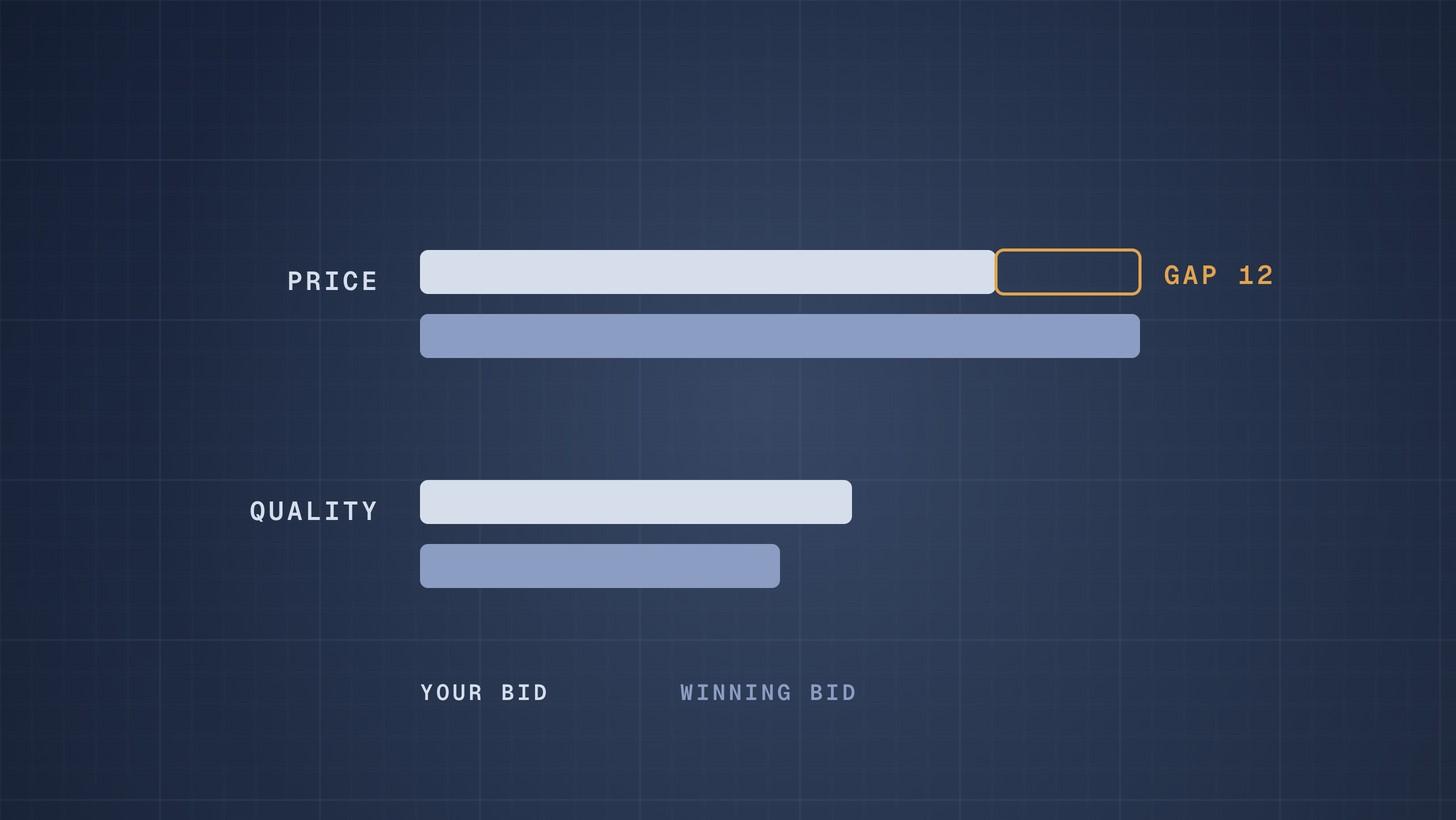
How to Ask for Feedback on a Lost Equipment Tender (With Email Template)
How equipment suppliers should ask for a debrief after losing a bid: when to ask, what to ask, what buyers can and cannot share, and how to use the answers. Includes a short email template.
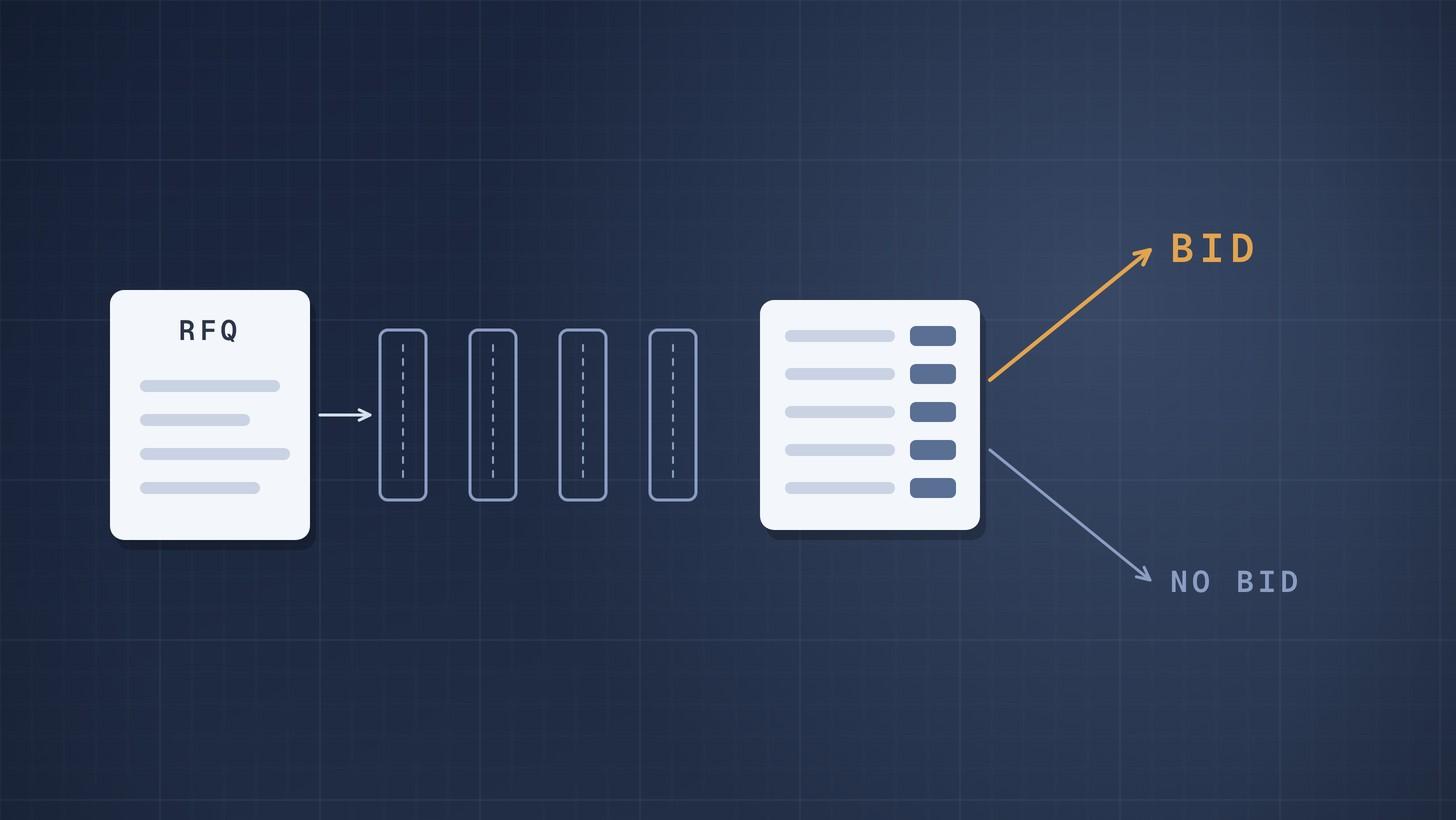
Bid or No Bid? A Scorecard for Engineered Equipment RFQs
A simple bid or no bid scorecard for equipment suppliers: the gates to check first, seven weighted criteria, a worked example and a template you can copy.
Equipment Quotation Template: A Proposal Buyers Can Compare
A ten section quotation template for engineered equipment suppliers: cover letter, scope and battery limits, compliance and deviations, price schedule, delivery, commercial terms, exclusions and documents.