
Industrial Centrifuge Types: Decanter, Disc Stack, Basket and Peeler
Sedimentation or filtering? How decanter, disc stack, tubular bowl, basket, peeler, inverting filter and pusher centrifuges differ, what each suits and what to ask for.
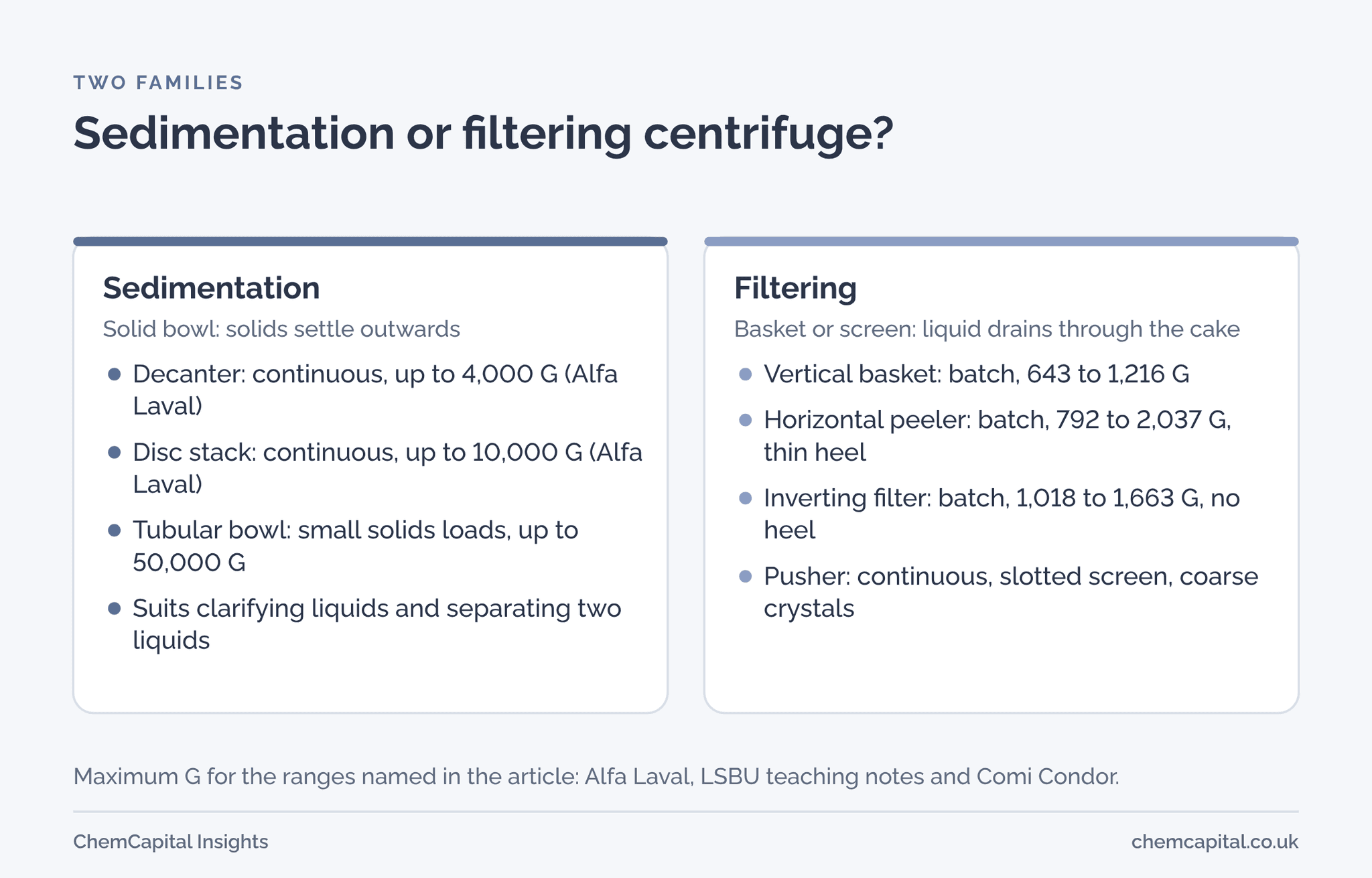
Industrial centrifuges fall into two families. Sedimentation centrifuges spin the feed in a solid walled bowl so denser solids move outwards. The decanter and disc stack run continuously, while the tubular bowl stops to have its solids removed. They serve water, food, energy and biotech duties, including separating two liquids [1, 3, 4]. Filtering centrifuges spin the slurry in a perforated basket or screen, so the liquid drains out through a cake of solids. Vertical basket, peeler and inverting filter machines run in batches on a filter cloth, common for crystals in pharma and fine chemicals; continuous pusher centrifuges use a slotted screen and suit coarser crystals such as salt [2, 5, 6, 7].
The choice usually turns on particle size, solids content, cake washing and dryness, and any need for inerting or containment.
Why this matters now
An RFQ (request for quotation) that describes only the slurry can bring back a decanter from one vendor and a peeler from another, each stating capacity differently. Neither means much until both vendors have the same data and a tested sample. The wrong type leaves a wet cake, a cloudy liquid, or a machine that cannot be cleaned between campaigns.
Create and manage RFQs in minutes
ChemCapital handles the entire procurement cycle, from structured RFQs and supplier comparisons to formal purchase orders and delivery tracking.
Sedimentation centrifuges: decanter, disc stack and tubular bowl
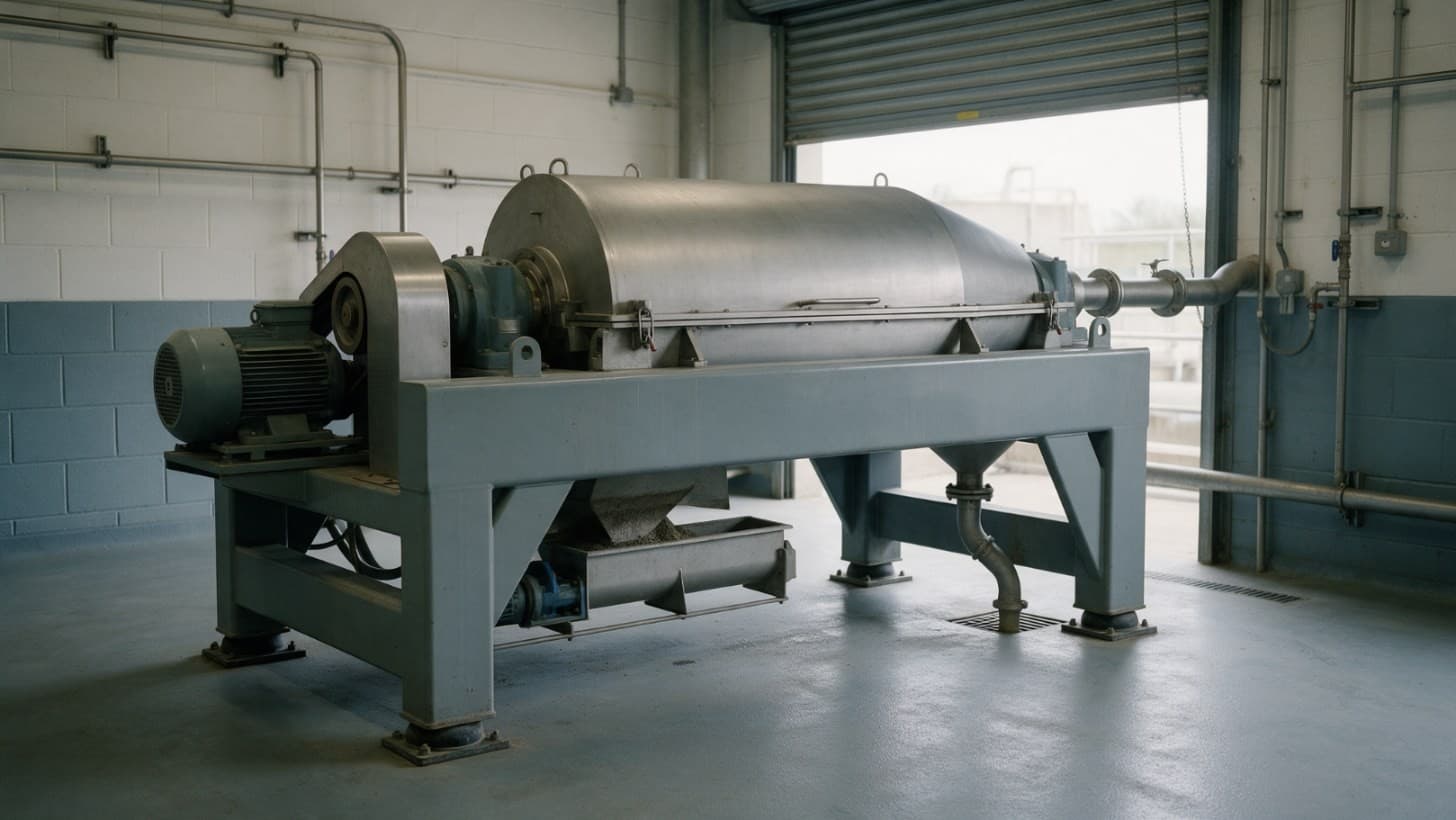
A decanter is a horizontal solid bowl with a screw conveyor, the scroll, turning inside it at a different speed. Solids settle on the bowl wall and the scroll pushes them up a conical section, the beach, and out. The clarified liquid, or centrate, overflows at the other end over plates or tubes that set the liquid depth, or pond [1]. Alfa Laval says its decanters reach up to 4,000 G (4,000 times gravity) and handle 0.1% to more than 65% solids by weight, with particles from 5 mm down to a few microns [1]. Three phase versions also split two liquids [1].
A disc stack separator has a stack of conical discs in its bowl, which increases the effective settling area so each particle crosses only a very thin liquid layer [3, 4]. Alfa Laval quotes up to 10,000 G, with solids removed by hand from a stopped bowl, through ports opening at intervals, or through continuous nozzles, depending on the solids volume [3].
A tubular bowl centrifuge has a long, narrow rotor that runs until full of solids, then stops to be emptied. Teaching notes from London South Bank University (LSBU) give up to 50,000 G for small models holding about 0.1 kg of wet solids, and 16,000 G for large ones holding up to 5 kg [4].
Filtering centrifuges: basket, peeler, inverting filter and pusher
The first three run in batches: feed until the cake reaches a set thickness or weight, wash, spin to the target residual moisture, then discharge [5, 6, 7].
In Comi Condor's bottom discharge vertical basket, a knife cuts the cake into a chute and the heel can be blown off with nitrogen. The range runs from an 800 mm basket at 1,216 G to a 1,850 mm basket at 643 G, for pharmaceutical and fine chemical products needing a large filter area [5].
In Comi Condor's pharma horizontal peeler, the basket slows to discharge speed and a knife peels the cake out. A heel of about 4 to 5 mm stays on the cloth, removed by a nitrogen blow from behind the basket. The maker lists 792 G on its 1,750 mm basket up to 2,037 G on its 500 mm basket [6].
An inverting filter centrifuge turns its cloth inside out to discharge the whole cake, leaving no heel. Comi Condor aims its version at slow filtering, compressible cakes of active pharmaceutical ingredients (APIs) and lists 1,018 to 1,663 G, the higher figure on its pilot unit [7].
A pusher centrifuge filters continuously. Siebtechnik Tema's version serves crystalline bulk products such as sodium chloride and sulphates, preferably with particles over 80 microns [2].
| Type | How it runs | Maximum G, range named | Usually suits | Watch for |
|---|---|---|---|---|
| Decanter | Continuous, scroll discharge | Up to 4,000 (Alfa Laval) [1] | 0.1% to over 65% w/w solids; two or three phases | Pond and scroll speed set per duty |
| Disc stack | Continuous feed | Up to 10,000 (Alfa Laval) [3] | Clarifying or separating liquids [3] | Discharge type must suit solids volume |
| Tubular bowl | Semi continuous | 16,000 to 50,000 (LSBU) [4] | Cell debris, protein | Holds only 0.1 kg to 5 kg of solids |
| Vertical basket | Batch, knife | 643 to 1,216 (Comi Condor) [5] | Crystals, large filter area | Heel on the cloth |
| Horizontal peeler | Batch, knife | 792 to 2,037 (Comi Condor) [6] | API crystals, contained discharge | Heel about 4 to 5 mm (Comi Condor) |
| Inverting filter | Batch, cloth inverts | 1,018 to 1,663 (Comi Condor) [7] | Slow filtering, compressible cakes | No heel |
| Pusher | Continuous, slotted screen | Not stated [2] | Coarse crystals such as salt | Particles preferably over 80 microns |
G force, sigma and how vendors quote capacity
G force, or relative centrifugal force, is angular speed squared times radius, divided by gravity: ω²r ÷ g [4]. You can check a vendor's figure. Comi Condor lists a 500 mm peeler basket at 2,700 rpm [6]: ω = 2π × 2,700 ÷ 60 = 282.7 rad/s, and 282.7² × 0.25 m ÷ 9.81 = 2,037 G, as listed. G is quoted at the wall, so always ask for the diameter and speed too.
G alone does not set capacity. Settling speed rises with the square of particle diameter and with density difference, and falls with viscosity [4]: halve the particle size and it settles four times more slowly. Crowding slows it further; LSBU gives a hindered settling factor of about 0.5 at 3% solids by volume and 0.05 at 20% [4].
For sedimentation machines, the sigma factor combines G, bowl volume and settling distance into one figure for comparing centrifuges and scaling up [4]. A brochure flow in m³/h is usually a hydraulic maximum, not the flow that gives centrate to specification. Filtering centrifuge makers quote basket diameter, filter area, cake volume and maximum load [6]; throughput then depends on a batch cycle time that only tests on your slurry can give.
Solvents, inerting and containment
BS EN 12547:2014 is the safety standard for centrifuges separating liquids and solids; BSI lists it as current and under review [8]. It covers mechanical, ergonomic, thermal, electrical and noise hazards, but BSI notes it does not deal explicitly with flammable or explosive processes, pressure extremes in the housing, microbiological hazards or food hygiene design [8]. Specify those separately, and check the current edition.
For flammable solvents the usual protection is inerting, replacing air with an inert gas such as nitrogen. HSE rates inerting as highly effective at preventing explosions, but only for enclosed plant, and expects continuous monitoring of oxygen and flammable vapour and a slight positive pressure. Nitrogen is also an asphyxiation risk, so entry should be controlled by a permit to work [9]. Ask each bidder for the inerting concept, oxygen analyser, seal design and gas tightness; Comi Condor states 400 mm H2O, about 39 mbar, for its inverting filter machine [7].
For potent APIs, ask how the cake leaves the machine. Comi Condor's pharma peeler offers discharge into a continuous liner or an isolator, and automated cleaning with spray balls [6]. Put these needs in the user requirement specification before anyone quotes.
What to send with the RFQ
- solids content (% w/w), particle size distribution, solid and liquid densities
- viscosity, temperature, solvent and its flammability
- dry solids per day or feed flow, and operating hours
- centrate clarity, cake residual moisture and wash liquid needed
- hazardous area zone, inerting, containment, cleaning and materials
- a representative sample for test work
Ask each vendor for the diameter, speed and G; the sigma factor or a batch cycle breakdown; the basis of any performance guarantee; and whether it can run pilot trials on your sample.
Practical example
Figures are illustrative. A fine chemicals plant must separate 3,000 kg a day of dry crystals from a solvent slurry within 20 operating hours: 150 kg of dry solids an hour. Two vendors tested a sample and bid filtering centrifuges. Both tests gave 15% residual moisture and a wet cake density of 0.9 kg per litre.
| Item | Bid A: vertical basket | Bid B: horizontal peeler |
|---|---|---|
| Basket diameter and speed | 1,250 mm at 1,000 rpm | 1,050 mm at 1,400 rpm |
| G at the basket wall | 699 | 1,150 |
| Usable cake volume | 200 litres | 150 litres |
| Wet cake per batch | 180 kg | 135 kg |
| Dry solids per batch | 153 kg | 114.75 kg |
| Cycle time from the test | 60 minutes | 40 minutes |
| Dry solids per hour | 153 kg | 172 kg |
| Batches for 3,000 kg | 20 | 27 |
| Hours needed a day | 20 | 18 |
Bid A's bigger basket leaves no spare time: 20 batches fill all 20 hours, with nothing left for cleaning or a slow batch. Bid B leaves two hours a day. Before awarding, confirm both cycle times come from the same sample, and how each machine removes its heel at product changes.
Find centrifuge suppliers for your duty
Supplier Discovery finds suppliers on the web from a plain text description, a pasted RFQ or an uploaded specification, and extracts published product parameters with source links. It gives each a fit verdict, shows certifications as claimed, not verified, and sends nothing automatically. Try three searches free without signing up, then score the bids with our guide to technical bid evaluation.
Ready to find centrifuge suppliers that fit your duty? Start a free 14 day ChemCapital trial, with no credit card needed.
Frequently asked questions
What are the main types of industrial centrifuge?
There are two families. Sedimentation centrifuges (decanter, disc stack and tubular bowl) spin the feed in a solid bowl so solids move outwards, while filtering centrifuges spin it in a perforated basket or screen so the liquid drains through a cake: batch vertical basket, peeler and inverting filter machines, common in pharma, and continuous pusher centrifuges for coarse crystals such as salt.
What is the difference between a decanter and a disc stack centrifuge?
A decanter is a horizontal solid bowl with a scroll that removes solids continuously; Alfa Laval quotes up to 4,000 G for its decanters and feeds from 0.1% to more than 65% solids by weight. A disc stack separator uses conical discs to give a thin settling layer, reaches up to 10,000 G in Alfa Laval's range, and is used to clarify liquids or to separate two liquids and a solid.
What G force does an industrial centrifuge run at?
It depends on the type and size: Alfa Laval quotes up to 4,000 G for its decanters and 10,000 G for its disc stacks, while Comi Condor's pharma filtering centrifuges have maximum ratings of 643 to 2,037 G. G, the multiple of gravity, equals the angular speed squared times the radius divided by gravity, so always ask for the diameter and speed behind the figure.
When should you choose a peeler or an inverting filter centrifuge?
Both suit crystalline products, such as APIs, that must be washed, spun to a set moisture and discharged without operator contact. A peeler leaves a thin heel on the cloth, about 4 to 5 mm in Comi Condor's design, while an inverting filter turns the cloth inside out, leaves no heel and is aimed at slow filtering, compressible cakes.
Continue reading
Informational only, not procurement or legal advice. Cited names, frameworks, and statistics belong to their respective owners.
Create and manage RFQs in minutes
ChemCapital handles the entire procurement cycle, from structured RFQs and supplier comparisons to formal purchase orders and delivery tracking.
Start for freeRelated articles
Where to Find Pharma and Chemical Plant Projects Before They Go to Tender: the 2027 Pipeline
Twenty pharma and chemical plant projects checked against owner or government announcements, the buying timeline on each, and where to watch for the next ones for free.
TEMA Heat Exchanger Types: How to Read AES, BEM and AEU
How to decode the three letter TEMA type, what AES, BEM, AEU and other common types mean for cleaning, expansion, leaks and cost, and how to compare bids that differ.
Safety Valve vs Relief Valve vs Bursting Disc: How to Choose
How safety valves, relief valves and bursting discs differ, when to fit a disc under a valve, the pressure terms that matter, GB duties and what to put in the RFQ.