
ISO 12944 Coating Specification for Process Equipment: C1 to CX Explained
How to choose the ISO 12944 corrosivity category and durability range, write the coating line in an RFQ, check dry film thickness to ISO 19840 and settle exclusions.
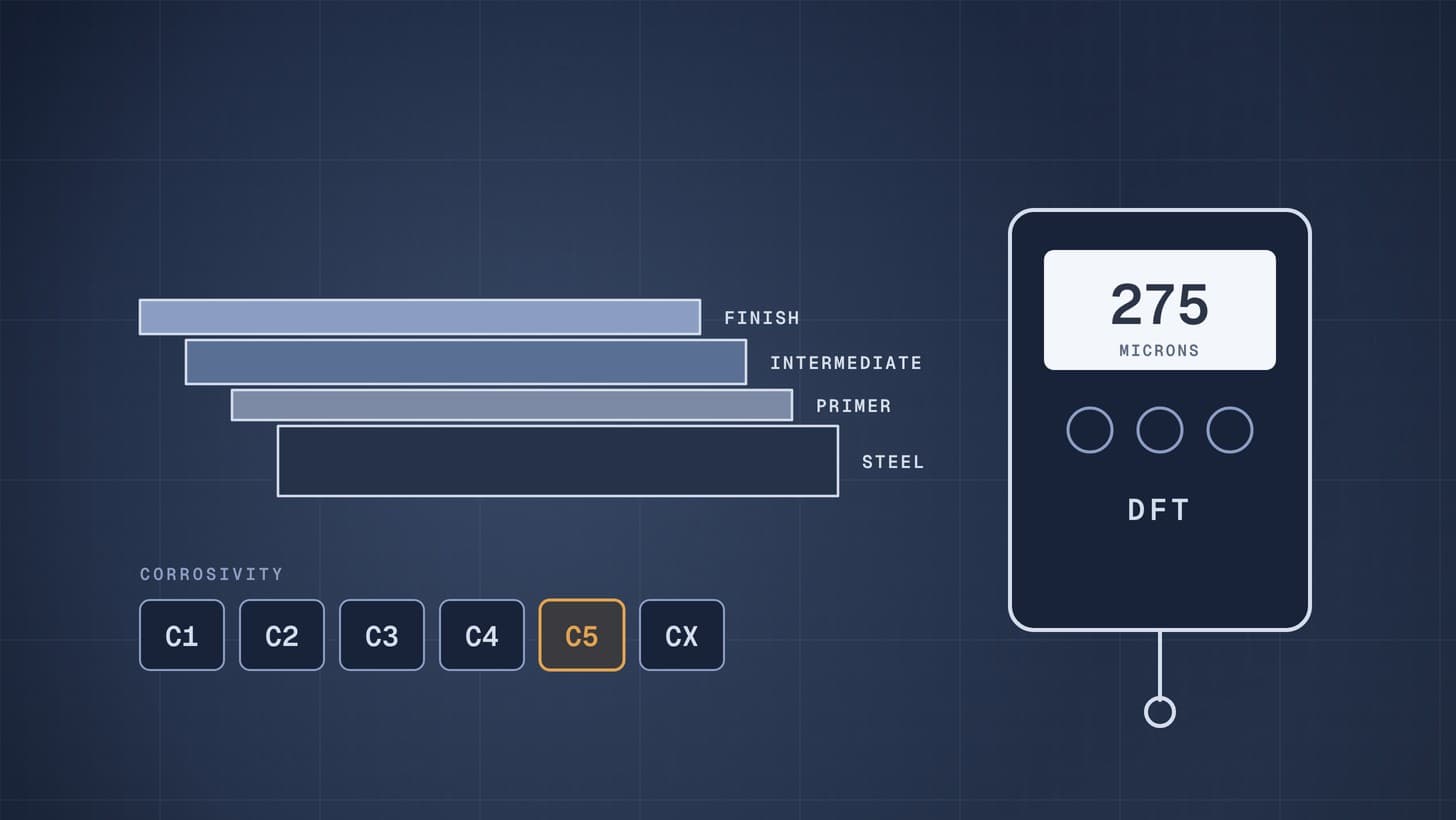
An ISO 12944 coating specification tells the fabricator three things: how corrosive the site is (corrosivity category C1 to CX), how long the paint must last before its first major maintenance (durability L, M, H or VH), and which tested paint system, surface preparation and film thickness will achieve that. Write those into one coating line in your RFQ, add how the film thickness will be checked, and every supplier prices the same paint job.
Leave them out and you get "painted to manufacturer's standard", which can mean anything from one coat of primer to a full three coat system. This guide explains the categories, shows how to write the coating line, how to check dry film thickness at inspection, and the exclusions to settle before award.
Why this matters now
ISO 12944 was revised in 2017 and 2018, and older company specifications may still quote the 1998 categories. The second edition of Part 1 replaced the 1998 edition in November 2017 [1]. The revision replaced the old C5 I (industrial) and C5 M (marine) categories with C5 and a new CX category for extreme industrial and offshore exposure. It added a very high durability range above 25 years, an immersion category for structures with cathodic protection, and minimum film thicknesses for individual coats as well as the whole system [2].
If your specification still asks for "C5 M", a supplier has to guess what you mean. It is a small fix that removes a common source of tender queries.
Create and manage RFQs in minutes
ChemCapital handles the entire procurement cycle, from structured RFQs and supplier comparisons to formal purchase orders and delivery tracking.
The nine parts in one paragraph
ISO 12944 runs to nine parts: general introduction, classification of environments, design, surface preparation, paint systems, laboratory test methods, execution and supervision of paint work, writing specifications, and offshore systems [1]. As a buyer you mostly need Part 2 to pick the category, Part 1 for the durability range, and the paint maker's system guide written to Part 5, which one maker lists against the 2019 edition [3].
Step 1: pick the corrosivity category
The category describes the atmosphere around the equipment, not the equipment itself.
| Category | Corrosivity | Typical exterior | Typical interior |
|---|---|---|---|
| C1 | Very low | Not normally used | Heated, clean buildings |
| C2 | Low | Rural, low pollution | Unheated buildings where condensation may occur |
| C3 | Medium | Urban and industrial, moderate pollution; low salinity coast | Humid production areas, such as food plants |
| C4 | High | Industrial; coastal with moderate salinity | Chemical plants |
| C5 | Very high | Industrial with high humidity and aggressive atmosphere; coastal with high salinity | Almost permanent condensation and high pollution |
| CX | Extreme | Offshore; extreme industrial; subtropical and tropical | Extreme humidity and aggressive atmosphere |
Descriptions from paint makers' ISO 12944 guides [2] [4].
The categories are defined by how fast bare carbon steel corrodes in its first year. For C5 the first year loss is above 80 and up to 200 µm; for CX it is above 200 and up to 700 µm [5].
For equipment buried or under water there are immersion categories: Im1 fresh water, Im2 sea or brackish water, Im3 soil, and Im4 sea or brackish water with cathodic protection [2].
Step 2: pick the durability range
Durability is the expected time to the first major maintenance painting.
| Range | 2017 and 2018 revision | Before the revision |
|---|---|---|
| Low (L) | Up to 7 years | 2 to 5 years |
| Medium (M) | 7 to 15 years | 5 to 15 years |
| High (H) | 15 to 25 years | More than 15 years |
| Very high (VH) | More than 25 years | Not defined |
Sources: paint makers' summaries of the revision [2] [5].
Durability is a planning figure, not a guarantee. Part 1 says so directly [1], and one paint maker says the ranges should by no means be considered a warranty [2]. If you want a guarantee, ask for it separately and expect it to come with conditions.
Step 3: write the coating line
Category and durability together point to a paint system. Each maker publishes systems written to Part 5. For example, one maker's guide gives a C5 high durability system of a zinc rich epoxy primer, an epoxy intermediate and a polyurethane finish at 275 µm in total [2]. Let the supplier propose the system, but make them name it.
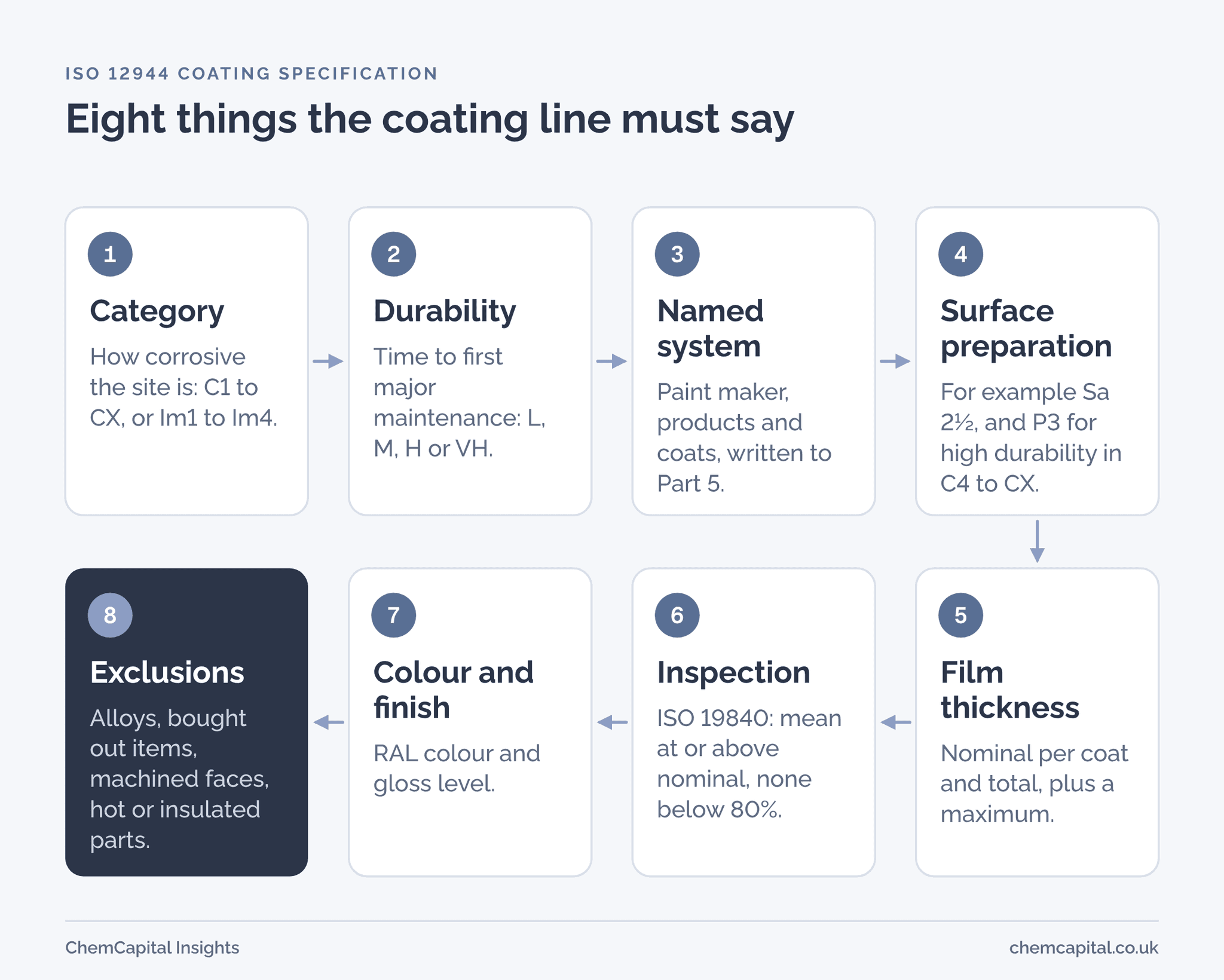
A complete coating line covers:
- Standard and edition. ISO 12944, 2017 and 2018 revision.
- Category and durability. For example C4, durability H.
- System. Paint maker, product names, number of coats.
- Surface preparation. For example Sa 2½ to ISO 8501 Part 1, a near white blast cleaned surface [4]. For high and very high durability in C4 to CX, Part 3 asks for preparation grade P3 to ISO 8501 Part 3: very thorough preparation, leaving no significant visible imperfections [5].
- Film thickness. Nominal dry film thickness (NDFT) per coat and total, and a maximum.
- Inspection. Measurement and acceptance to ISO 19840, with the inspection and test plan stating who witnesses it.
- Colour and finish. For example RAL colour and gloss level.
- Exclusions. What is not painted and what is painted to the maker's standard (see below).
To compare how each bidder answers that line, the free version of ChemCapital's AI quotation comparison takes up to three quotes with no account, so you can line up the system, film thickness and exclusions side by side before you compare prices.
Step 4: check the film thickness
ISO 19840 sets how many readings to take and what passes. For flat areas, one gauge maker's summary gives 5 readings in the first square metre, 10 for 1 to 3 m², 15 for 3 to 10 m², 20 for 10 to 30 m² and 30 for 30 to 100 m² [6]. A batch passes only if [6]:
- the mean is equal to or greater than the NDFT;
- every reading is at least 80% of the NDFT;
- readings between 80% of the NDFT and the NDFT make up less than 20% of the total;
- no reading exceeds the specified maximum.
Agree beforehand how welds, edges and corners will be measured; the standard leaves that to the parties [6]. Put the coating inspection in your inspection and test plan as a witness or review point, depending on how critical the item is.
Exclusions to settle before award
Settle each of these in the RFQ, because each one is a common source of argument at delivery:
- Stainless steel and other alloys. Usually left unpainted; say so, and say what happens to carbon steel attachments welded to them.
- Bought out items. Motors, gearboxes, valves and instruments often arrive in their maker's paint. Decide whether that is acceptable or must match.
- Machined faces and nameplates. Flange faces, shaft ends and nameplates are masked, not painted.
- Insulated and hot surfaces. ISO 12944 deals with steel exposed to atmosphere, water or soil. For surfaces under insulation or running hot, ask the paint maker for a system suited to the temperature.
- Touch up. Who repairs transport and installation damage, with what, and to what standard.
Practical example
Illustrative figures. You are buying a carbon steel skid frame and vessel exterior for a coastal chemical plant. Your engineer classes the site as C5 and asks for durability H.
The coating line reads: "Coating to ISO 12944, category C5, durability H. Paint maker's named Part 5 system, zinc rich epoxy primer, epoxy intermediate, polyurethane finish, NDFT 275 µm total, maximum 550 µm. Surface preparation Sa 2½. Inspection to ISO 19840, witnessed by buyer."
At inspection, the vessel's coated area is 24 m², so 20 readings are taken. 80% of 275 µm is 220 µm.
| Result | Mean | Lowest reading | Readings from 220 to under 275 µm | Verdict |
|---|---|---|---|---|
| Batch 1 | 291 µm | 231 µm | 3 of 20 (15%) | Pass |
| Batch 2 | 284 µm | 226 µm | 5 of 20 (25%) | Fail: more than 20% between 80% and 100% of NDFT |
Batch 2 fails even though its mean is above 275 µm and no single reading is below 220 µm. That rule is easy to miss.
If you are the supplier
Answer the coating line exactly: name the system and the paint maker's reference to Part 5, give NDFT per coat and in total, and list your exclusions. A bid that says "painted to C5" with no system is hard to compare and easy to reject.
Where ChemCapital fits
A clear coating line is one of the cheapest ways to make bids comparable. Pair it with a sound RFQ template for process equipment, and plan preservation and storage for equipment that will sit on site before installation.
Ready to send RFQs where every supplier prices the same paint system? Start a free 14 day ChemCapital trial, with no credit card needed.
Frequently asked questions
What are the ISO 12944 corrosivity categories?
C1 very low, C2 low, C3 medium, C4 high, C5 very high and CX extreme. They describe how corrosive the atmosphere is, based on the first year corrosion of carbon steel. The 2017 and 2018 revision replaced the old C5 I and C5 M with C5 and CX. Immersion categories Im1 to Im4 cover water and soil.
What durability ranges does ISO 12944 use?
Low is up to 7 years, medium 7 to 15 years, high 15 to 25 years and very high more than 25 years, measured to the first major maintenance painting. Durability is a planning figure, not a guarantee.
How do you write a coating specification to ISO 12944?
State the corrosivity category and durability range, the named paint system with its coats, the surface preparation grade, the nominal and maximum dry film thickness, inspection to ISO 19840, colour and finish, and what is excluded from painting.
What is the 80 20 rule for dry film thickness?
Under ISO 19840 the mean must be at or above the nominal dry film thickness, every reading must be at least 80% of nominal, and readings between 80% and 100% of nominal must be fewer than 20% of the total. No reading may exceed the specified maximum.
Continue reading
Informational only, not procurement or legal advice. Cited names, frameworks, and statistics belong to their respective owners.
Create and manage RFQs in minutes
ChemCapital handles the entire procurement cycle, from structured RFQs and supplier comparisons to formal purchase orders and delivery tracking.
Start for freeRelated articles
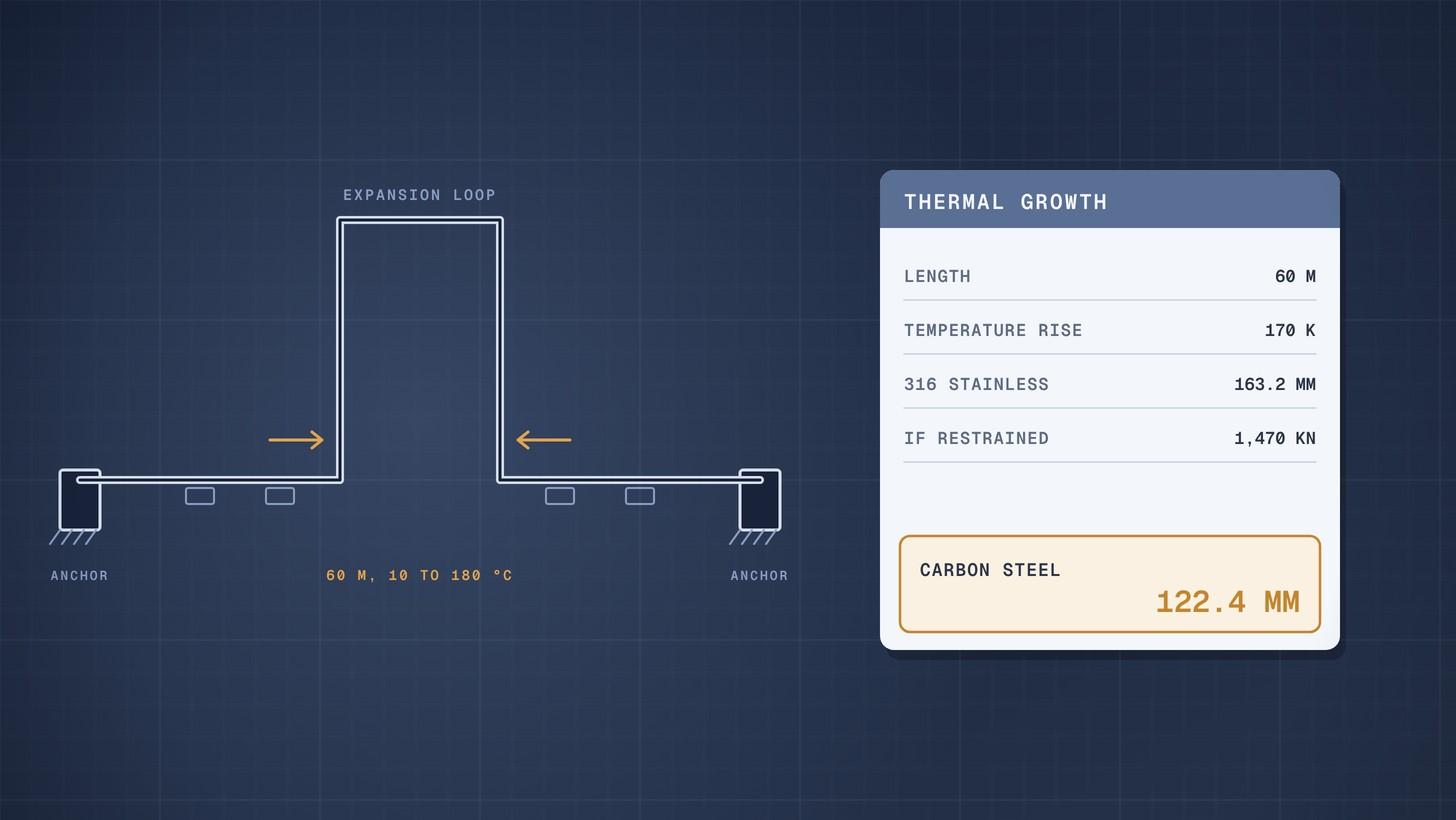
Pipe Thermal Expansion: Worked Example
How to calculate pipe thermal expansion for carbon and stainless steel, what restrained expansion does, and how loops and expansion joints absorb it.
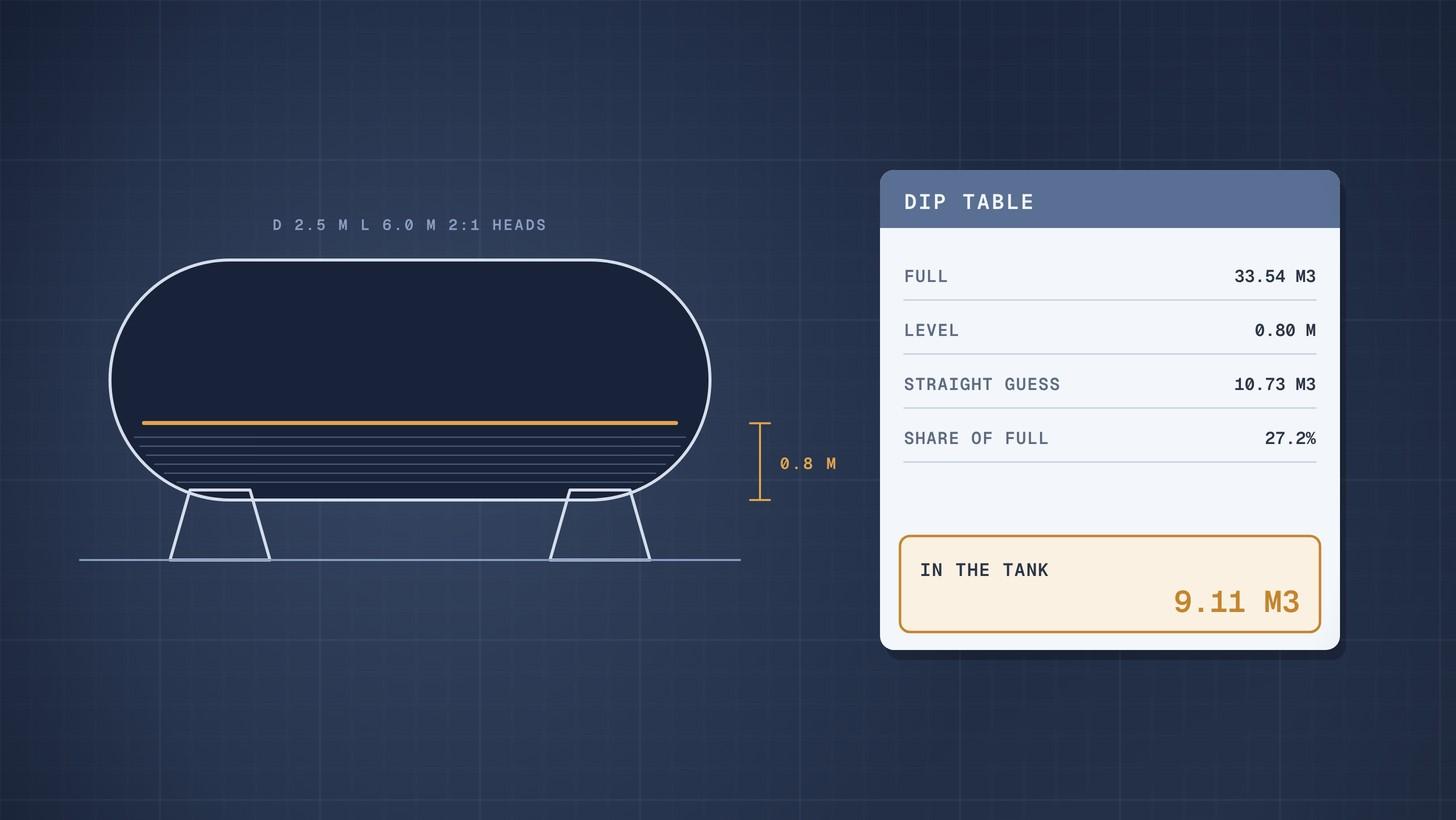
Horizontal Tank Volume When Partly Filled: Worked Example
How to calculate the volume of a partly filled horizontal tank with dished heads, with a worked example and a full dip table you can rebuild in a spreadsheet.
Cooling Water Flow Calculation: Worked Example
How to calculate cooling water flow from heat duty and temperature rise, then size the cooling tower circulation, evaporation and make up water.