
Cooling Water Flow Calculation: Worked Example
How to calculate cooling water flow from heat duty and temperature rise, then size the cooling tower circulation, evaporation and make up water.
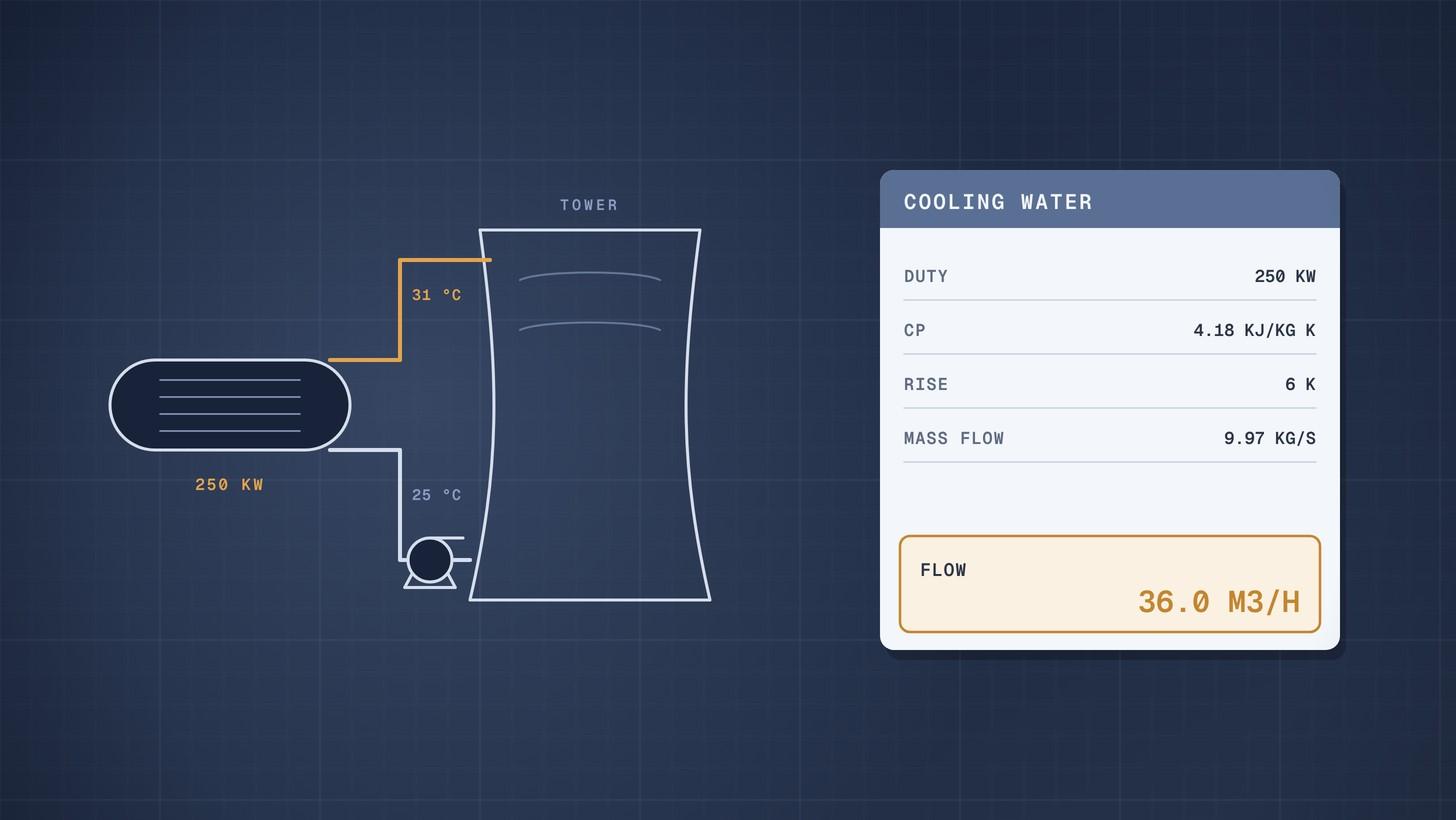
Cooling water flow is the heat to be removed divided by the water's specific heat and its temperature rise: m = Q ÷ (cp × ΔT). In the worked example below, a 250 kW exchanger with cooling water supplied at 25 °C and returned at 31 °C needs about 10 kg/s, or 36 m³/h. Let the water warm by 10 °C instead and the flow falls to under 22 m³/h.
The same equation sizes the cooling tower, where the temperature rise becomes the tower's range and the duty becomes the site's total heat load.
Why this matters
Cooling water flow sets the size of pumps, pipes, exchangers and the tower, and the electricity to circulate it all year. It is also one of the first numbers an exchanger supplier needs, and a common gap in RFQs: a datasheet with the process side filled in and the water side left blank leaves each bidder to guess.
The temperature rise is a design choice, not a given. A small rise means more water and bigger pumps; a large rise means less water but warmer return water, a smaller temperature difference in the exchanger and more risk of scale.
Create and manage RFQs in minutes
ChemCapital handles the entire procurement cycle, from structured RFQs and supplier comparisons to formal purchase orders and delivery tracking.
Step 1: the heat duty
Work out the duty from the process side. For a liquid being cooled, Q = m × cp × ΔT on the process stream.
In the example, 3.5 kg/s of a solvent with a specific heat of 2.2 kJ/kg K is cooled from 80 °C to 47.5 °C (all illustrative):
Q = 3.5 × 2.2 × 32.5 = 250 kW
Step 2: the water flow
Cooling water has a specific heat of about 4.18 kJ/kg K and a density of about 996 kg/m³ at 30 °C [1].
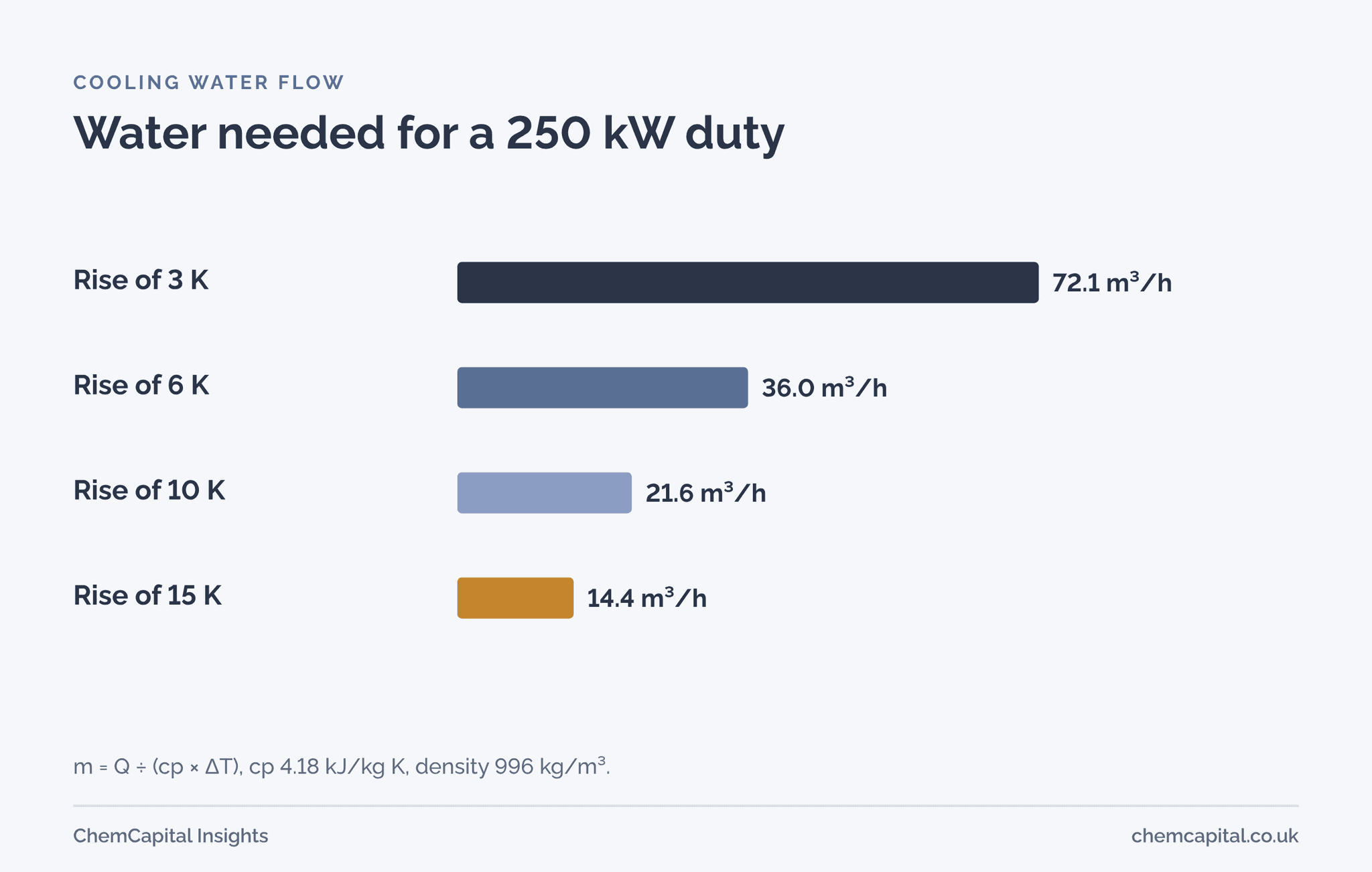
Water from 25 °C to 31 °C (rise of 6 K):
- m = 250 ÷ (4.18 × 6) = 9.97 kg/s
- Volume flow = 9.97 × 3,600 ÷ 996 = 36.0 m³/h
Water from 25 °C to 35 °C (rise of 10 K):
- m = 250 ÷ (4.18 × 10) = 5.98 kg/s
- Volume flow = 21.6 m³/h
The 10 K design needs 40% less water, so a smaller pump and pipe. But the water leaves at 35 °C, closer to the process outlet of 47.5 °C, so the exchanger needs more area for the same duty. And warmer water and walls raise the scaling risk: SWEP notes that calcium carbonate and calcium sulfate become less soluble as temperature rises, so they deposit on warm surfaces [2].
Step 3: the cooling tower
For the tower, add up every user's duty. Two terms describe how the tower performs. The Bureau of Energy Efficiency defines the range as the difference between the water temperature entering and leaving the tower, and the approach as the difference between the cold water temperature and the air's wet bulb temperature [3].
A Marley guide to tower performance adds two practical points: the heat load sets only the range, not the temperatures, and the wet bulb is the only air condition needed to size a tower [4]. A smaller approach needs a bigger tower, and the guide notes that approaches below about 5 °F (2.8 K) are not usually guaranteed [4].
Worked example. A site rejects 2,000 kW to a tower with a 6 K range. The design wet bulb is 20 °C and the approach 5 K, so the tower supplies water at 25 °C and receives it back at 31 °C (illustrative).
- Circulation: 2,000 ÷ (4.18 × 6) = 79.7 kg/s, about 288 m³/h
- Effectiveness: range ÷ (range + approach) = 6 ÷ 11 = 55% [3]
Step 4: evaporation and make up water
The Bureau of Energy Efficiency gives a quick estimate of evaporation: 0.00085 × 1.8 × circulation rate in m³/h × range in °C [3].
- Evaporation: 0.00085 × 1.8 × 288 × 6 = 2.65 m³/h, just under 1% of the flow
Evaporation concentrates the dissolved solids, so some water is bled off as blowdown. Blowdown = evaporation ÷ (cycles of concentration minus 1) [3].
| Cycles of concentration | Blowdown | Make up (evaporation plus blowdown) | Make up over 8,000 h |
|---|---|---|---|
| 4 | 0.88 m³/h | 3.53 m³/h | 28,235 m³ |
| 6 | 0.53 m³/h | 3.18 m³/h | 25,412 m³ |
The US Department of Energy notes that many systems run at two to four cycles while six or more may be possible, and that make up also includes a small drift loss [5]. Raising cycles from four to six saves about 2,800 m³ a year here, but only with water treatment that keeps scale and corrosion under control.
What to put in the RFQ
For an exchanger:
- Duty and the process inlet and outlet temperatures.
- Cooling water supply and maximum return temperature, and whether the flow is fixed or for the supplier to choose.
- Allowable pressure drop on the water side and the fouling allowance.
- Water quality, or at least whether it is tower water, river water or a closed loop.
For a tower: total heat load, range, design wet bulb, approach and the water quality limits. Our guide to the heat exchanger datasheet shows where each value goes, and the comparison of plate and shell and tube exchangers helps decide which type to ask for. With ChemCapital's structured RFQs, every bidder gets the same water side conditions, so the bids are sized on the same basis.
Ready to send exchanger RFQs with nothing left to guess? Start a free 14 day ChemCapital trial, with no credit card needed.
Frequently asked questions
How do you calculate cooling water flow?
Divide the heat duty by the specific heat of water times the temperature rise of the water. For 250 kW and a 6 K rise, 250 divided by (4.18 times 6) gives about 10 kg/s, or 36 m³/h.
What is the range and approach of a cooling tower?
The range is the difference between the hot water entering the tower and the cold water leaving it. The approach is the difference between the cold water temperature and the air's wet bulb temperature. A smaller approach needs a larger tower.
How much water does a cooling tower evaporate?
A common estimate is 0.00085 times 1.8 times the circulation rate in m³/h times the range in °C. For 288 m³/h and a 6 K range that is about 2.65 m³/h, just under 1% of the flow.
What temperature rise should cooling water have?
It is a design choice. A larger rise needs less water and smaller pumps but returns warmer water, reduces the temperature difference in the exchanger and raises the risk of scale. Check the limits your site cooling water system sets.
Continue reading
Informational only, not procurement or legal advice. Cited names, frameworks, and statistics belong to their respective owners.
Create and manage RFQs in minutes
ChemCapital handles the entire procurement cycle, from structured RFQs and supplier comparisons to formal purchase orders and delivery tracking.
Start for freeRelated articles
Pipe Thermal Expansion: Worked Example
How to calculate pipe thermal expansion for carbon and stainless steel, what restrained expansion does, and how loops and expansion joints absorb it.
Horizontal Tank Volume When Partly Filled: Worked Example
How to calculate the volume of a partly filled horizontal tank with dished heads, with a worked example and a full dip table you can rebuild in a spreadsheet.
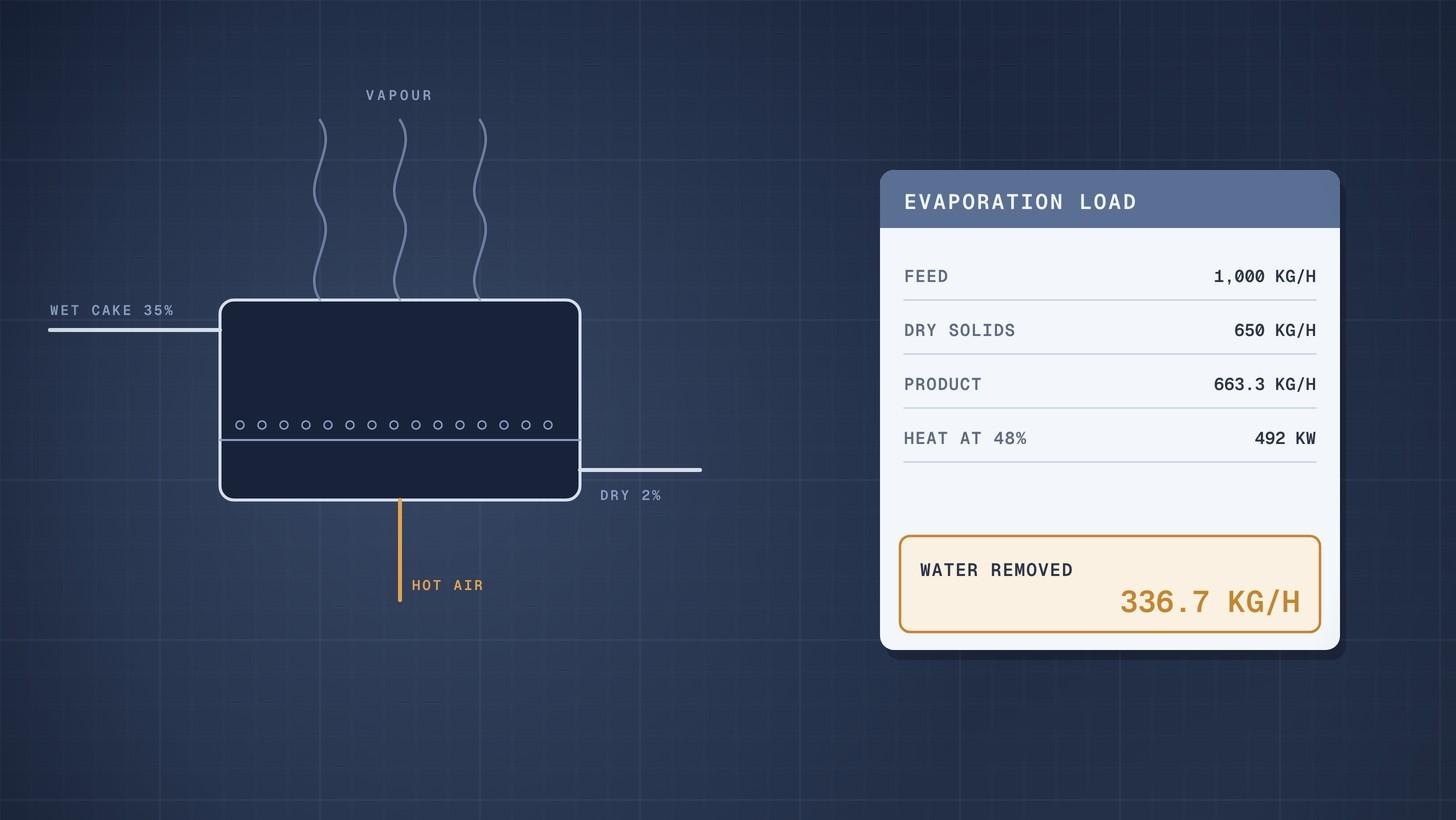
Dryer Evaporation Load: Worked Example
How to calculate a dryer's evaporation load from wet and dry basis moisture, then the minimum and real heat input, with a worked filter cake example.