
Horizontal Tank Volume When Partly Filled: Worked Example
How to calculate the volume of a partly filled horizontal tank with dished heads, with a worked example and a full dip table you can rebuild in a spreadsheet.
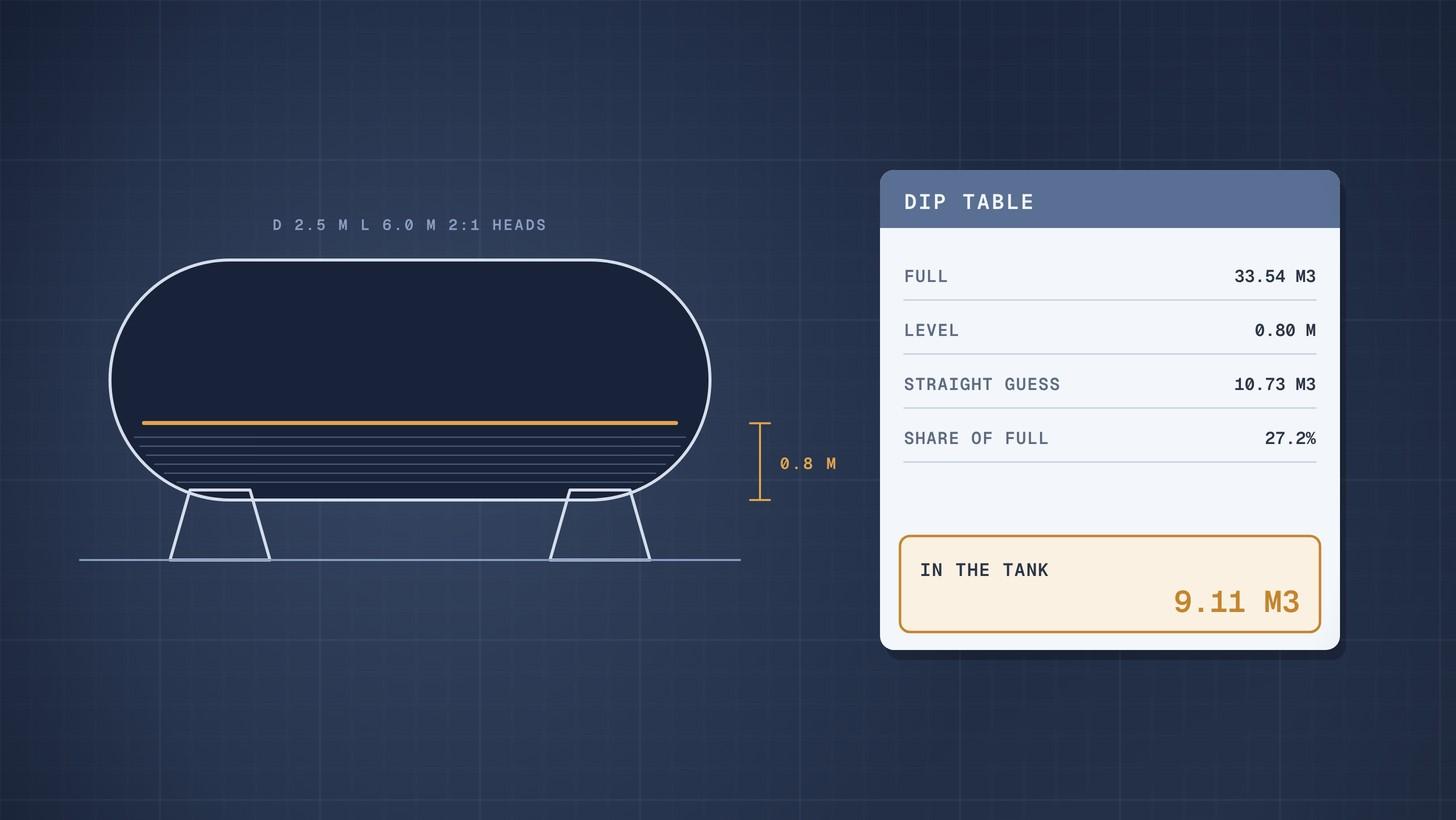
The volume of liquid in a partly filled horizontal tank is the area of the circular segment below the liquid surface times the tank length, plus the liquid in the two heads. In the worked example below, a 2.5 m diameter tank with 2:1 elliptical heads holds 33.54 m³ when full; at a level of 0.8 m it holds 9.11 m³, not the 10.73 m³ a straight proportion would suggest.
Because the tank is round, volume does not rise in step with level. A dip table converts one to the other, and you can build one in a spreadsheet with the formulas below.
Why this matters
Horizontal tanks are everywhere on process sites: day tanks, knock out drums, bullet tanks, buffer vessels. Level gauges and dip readings give a height, but stock, dosing and batch records need a volume. Reading a height as a straight fraction of the full volume overstates the contents in the bottom half and understates it in the top half.
For custody transfer, formal calibration standards apply. API's measurement standard for horizontal cylindrical tanks, Chapter 2.2E, sets out manual calibration methods for tanks up to 4 m in diameter and 30 m long, with corrections for tilt [1]. For everyday inventory and design checks, the geometry below is enough.
Create and manage RFQs in minutes
ChemCapital handles the entire procurement cycle, from structured RFQs and supplier comparisons to formal purchase orders and delivery tracking.
The cylinder: a circular segment
For a cylinder of radius R and length L filled to height h, the liquid volume is [2]:
V = L × [R² × arccos((R minus h) ÷ R) minus (R minus h) × √(2Rh minus h²)]
with the arccos in radians. The same result can be written using the angle θ = 2 × arccos((R minus h) ÷ R): the segment area is ½ × R² × (θ minus sin θ) [3].
The formula works for any level from empty to full. Tables of the same geometry go back a long way: the US National Bureau of Standards published gallonage tables for horizontal tanks with flat ends in 1937 [4].
The heads
Most process tanks have dished heads, which add volume at every level. For a head on a horizontal vessel of inside diameter D, Neutrium gives the liquid volume as [5]:
V head = C × π × D³ ÷ 12 × [3 × (h ÷ D)² minus 2 × (h ÷ D)³]
- C = 1 for a hemispherical head
- C = ½ for a 2:1 elliptical head
This covers the curved part of the head only. The straight flange on each head is part of the cylinder, so measure L between the tangent lines [5].
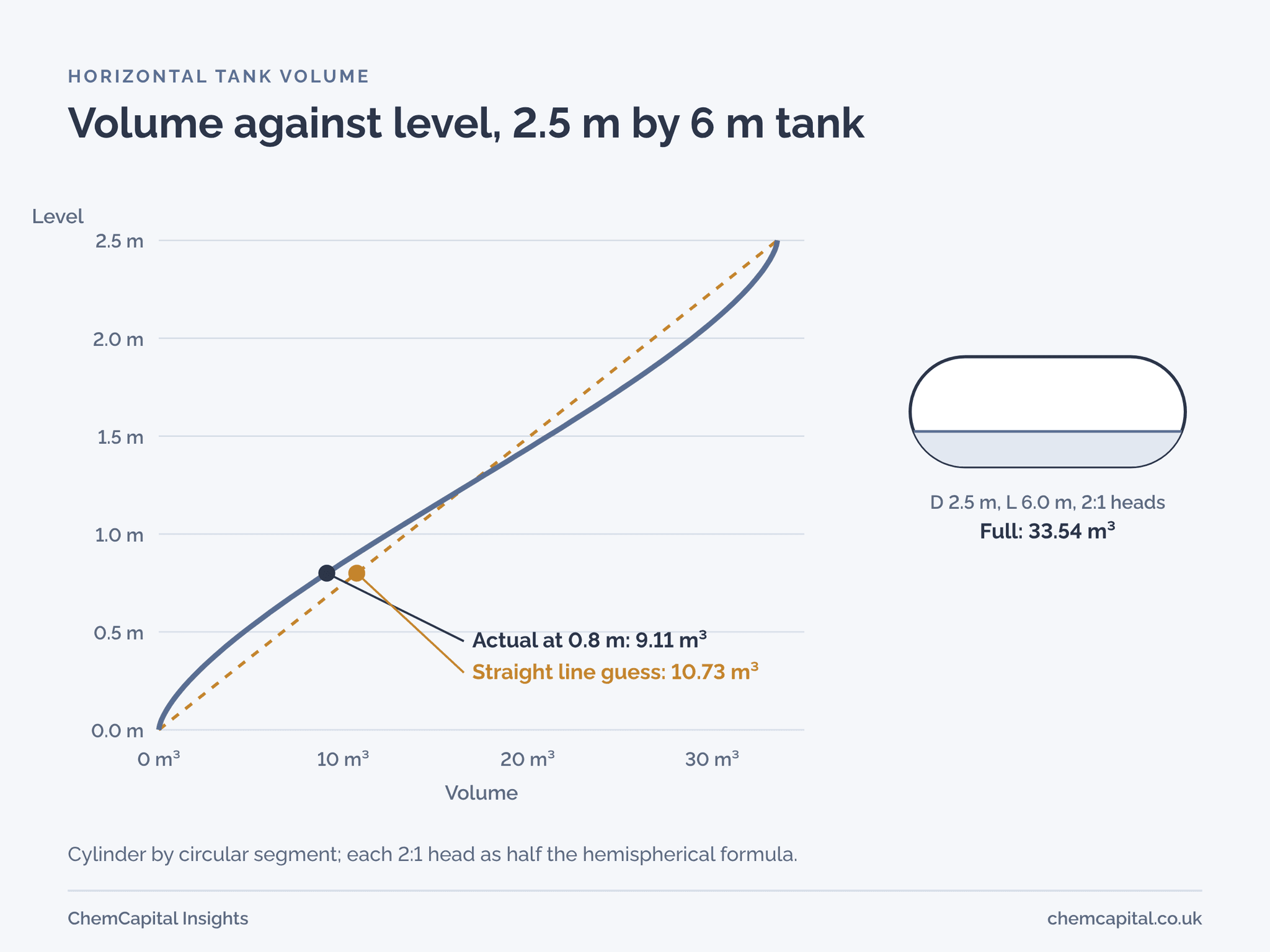
Worked example: a 2.5 m tank at 0.8 m
A horizontal tank has an inside diameter of 2.5 m, a length of 6.0 m between tangent lines and two 2:1 elliptical heads. The level gauge reads 0.8 m. The dimensions are illustrative.
Step 1: full volume.
- Cylinder: π ÷ 4 × 2.5² × 6.0 = 29.45 m³
- Each head: ½ × π × 2.5³ ÷ 12 = 2.045 m³
- Total: 29.45 + 2 × 2.045 = 33.54 m³
Step 2: the cylinder at 0.8 m. R = 1.25 m, so R minus h = 0.45 m.
- arccos(0.45 ÷ 1.25) = arccos(0.36) = 1.2025 rad
- √(2 × 1.25 × 0.8 minus 0.8²) = √1.36 = 1.1662 m
- Segment area = 1.25² × 1.2025 minus 0.45 × 1.1662 = 1.8789 minus 0.5248 = 1.3541 m²
- Cylinder volume = 1.3541 × 6.0 = 8.12 m³
Step 3: the heads at 0.8 m. h ÷ D = 0.32.
- Each head: ½ × π × 15.625 ÷ 12 × (3 × 0.1024 minus 2 × 0.0328) = 0.494 m³
- Two heads: 0.99 m³
Step 4: total. 8.12 + 0.99 = 9.11 m³, or 27.2% of full.
A straight proportion, 0.32 × 33.54, would give 10.73 m³: 1.62 m³ too much, an 18% error on what is actually in the tank.
Dip table
Repeating the calculation at 0.25 m steps gives the table for this tank:
| Level | Volume | Share of full |
|---|---|---|
| 0.00 m | 0.00 m³ | 0% |
| 0.25 m | 1.65 m³ | 4.9% |
| 0.50 m | 4.62 m³ | 13.8% |
| 0.75 m | 8.31 m³ | 24.8% |
| 1.00 m | 12.44 m³ | 37.1% |
| 1.25 m | 16.77 m³ | 50.0% |
| 1.50 m | 21.10 m³ | 62.9% |
| 1.75 m | 25.23 m³ | 75.2% |
| 2.00 m | 28.92 m³ | 86.2% |
| 2.25 m | 31.90 m³ | 95.1% |
| 2.50 m | 33.54 m³ | 100% |
For finer steps, put the two formulas in a spreadsheet with level in one column. Note how the volume per 0.25 m is smallest near the bottom and top and largest across the middle, where the tank is widest.
Things that change the answer
- Tilt. A tank that falls towards one end reads differently at each gauge. Calibration standards correct for measured tilt [1].
- Internals. Heating coils, baffles, nozzles and dip pipes take up volume. Subtract them for an accurate table.
- Other head shapes. Torispherical heads sit between the 2:1 and flat cases; ask the vessel maker for the head volume.
- Datum. Make sure the level is measured from the inside bottom of the shell, not from the nozzle or the outside.
What to ask the vessel supplier
Ask for the calibration or strapping table with the vessel data book, based on as built dimensions, and confirm the level datum used. Our guides to the pressure vessel datasheet and the manufacturer's data book cover where it fits. With ChemCapital's structured RFQs, you can make the table a required deliverable for every bidder.
Ready to buy vessels with the right documents from day one? Start a free 14 day ChemCapital trial, with no credit card needed.
Frequently asked questions
How do you calculate the volume of a partially filled horizontal tank?
Multiply the area of the circular segment below the liquid surface by the tank length, then add the liquid in each head. The segment area is R squared times arccos((R minus h) over R), minus (R minus h) times the square root of (2Rh minus h squared), with the angle in radians.
Why is horizontal tank volume not proportional to level?
The tank is narrowest at the bottom and top and widest in the middle, so each centimetre of level holds less liquid near the ends and more across the middle. In the worked example, a level of 32% of the diameter holds 27.2% of the full volume.
How do you include 2:1 elliptical heads?
For each head, use half of the hemispherical formula: pi times D cubed over 12, times (3 times (h over D) squared minus 2 times (h over D) cubed), times one half. Count the straight flange as part of the cylinder length between tangent lines.
What is a tank dip table?
It is a table that converts a measured liquid level into a volume for a specific tank. It is built from the tank geometry or from a formal calibration, and should be based on as built dimensions.
Continue reading
Informational only, not procurement or legal advice. Cited names, frameworks, and statistics belong to their respective owners.
Create and manage RFQs in minutes
ChemCapital handles the entire procurement cycle, from structured RFQs and supplier comparisons to formal purchase orders and delivery tracking.
Start for freeRelated articles
Pipe Thermal Expansion: Worked Example
How to calculate pipe thermal expansion for carbon and stainless steel, what restrained expansion does, and how loops and expansion joints absorb it.
Cooling Water Flow Calculation: Worked Example
How to calculate cooling water flow from heat duty and temperature rise, then size the cooling tower circulation, evaporation and make up water.
Dryer Evaporation Load: Worked Example
How to calculate a dryer's evaporation load from wet and dry basis moisture, then the minimum and real heat input, with a worked filter cake example.