
Inspection and Test Plan (ITP) Template for Pressure Vessels and Skids
What an inspection and test plan is, who writes and approves it, its columns, a complete ITP for a pressure vessel, a short one for a pump skid, and how it ties to payment.

An inspection and test plan (ITP) is a table, agreed before fabrication starts, that lists every inspection and test in the order it happens. For each one it gives the document that controls it, the acceptance criteria, the record that proves it was done, and the intervention point for each party. The supplier writes it. The buyer and any third party inspector add their own points, and the buyer approves it before work begins [1, 2]. Where an approved or notified body (the organisation that assesses conformity under pressure equipment law) is involved, it sets its own points too.
Below are ITP templates for a welded pressure vessel and a pump skid, and a way to tie both to the purchase order (PO) and its payments.
Why this matters now
An ITP agreed after award is negotiated from a weak position, and late points can be priced as extras. Two buyers' published supplier quality specifications, from Santos (an Australian oil and gas producer) and Air Products (an industrial gases company), show how firmly the timing can be set. Air Products issues its own ITP with the order where inspection is required, for the supplier to build into its plan [2]. Santos asks for ITPs 4 weeks before any work starts, approves them before work begins, and may reject items offered for inspection before approval [1]. Better still, put your own points in the enquiry so bidders price them.
UK law also fixes some points for you. Under the Pressure Equipment (Safety) Regulations 2016, welding procedures and welders for category II, III and IV equipment need approval from a competent third party, and for categories III and IV, NDT (non destructive testing) personnel need approval from a recognised third party organisation. Equipment that must meet the essential safety requirements ends with a final assessment: a final inspection of the equipment and its documents, and a proof test, normally hydrostatic [3]. This is general information, not legal advice.
Create and manage RFQs in minutes
ChemCapital handles the entire procurement cycle, from structured RFQs and supplier comparisons to formal purchase orders and delivery tracking.
What goes in each column
Buyers' specifications ask for much the same columns [1, 2]:
- Number and planned week, to show when notices fall due.
- Activity, listed in the order it happens.
- Location: in house or at a sub supplier.
- Reference document: the procedure or specification, with clause, that controls the activity.
- Acceptance criteria: the code, standard or project specification that sets pass or fail.
- Verifying document: the record that proves it, with the EN 10204 type for certificates.
- Intervention points: one column per party, with space for signatures.
Air Products uses H (hold), W (witness), R (review of records) and S (surveillance) [2]; other buyers add their own codes, so define them in the ITP header. Our guide to hold point vs witness point explains each and how waivers work. In the templates below, P means the vendor performs and records the check. Put notice periods in the ITP header: Air Products asks for at least 10 working days for hold and witness points [2], while Santos asks for 14 days for a hold and 7 for a witness [1]. These are company rules, not code requirements; set your own in the PO.
On a vessel stamped to ASME VIII Division 1, the Authorized Inspector also signs the Manufacturer's Data Report as having inspected it [7], so add that inspector's points.
Pressure vessel ITP template
Illustrative ITP for a welded 316L vessel in category II or above. V is vendor, B buyer, TPI third party inspector, AB approved or notified body.
| No. | Activity | Reference document | Acceptance criteria | Verifying document | V | B | TPI | AB |
|---|---|---|---|---|---|---|---|---|
| 1 | ITP and drawings approved, then pre inspection meeting | PO, data sheet, design code | Approved for construction | Minutes, approved ITP and drawings | P | H | R | R |
| 2 | Welding procedures and welder qualifications | Design code, WPS | Qualified range covers each joint | WPS, procedure records, welder certificates | P | R | R | R |
| 3 | Material receipt and certificates | Material standard, PO | Grade, heat numbers and values as specified | EN 10204 3.1 certificates, traceability record | P | R | R | R |
| 4 | PMI of alloy parts and welds | PMI procedure | Alloy matches specified grade | PMI report | P | R | W | |
| 5 | NDT of welds | Design code, NDT procedures | Method, extent and level per code and PO | NDT reports | P | R | R | R |
| 6 | Dimensional check, nozzle orientation | Approved drawing | Within drawing tolerances | Dimensional report | P | R | W | |
| 7 | Hydrostatic test | Design code, test procedure | Pressure and hold time per code and procedure; no leaks | Test certificate, gauge calibration | P | H | H | H |
| 8 | Pickling and passivation; paint carbon steel supports if specified | Cleaning or paint specification | Surface free of contamination; film thickness as specified | Cleaning or coating report | P | R | S | |
| 9 | Final inspection and nameplate | Drawing, PO | Complete, clean, UKCA or CE marked as required | Final inspection report | P | H | H | H |
| 10 | Data book and inspection release | PO document list | All records accepted; nonconformities closed | Data book with declaration of conformity and instructions, release note | P | H | R | R |
The AB column is illustrative. The body's points depend on the conformity assessment route, for category II module A2, D1 or E1 [8], so confirm them, and whether it attends at all, at the pre inspection meeting.
Notes on the rows that cause most arguments:
- Certificates. Specify the EN 10204 type per item. For main pressure bearing parts of category II to IV equipment, PER 2016 requires a certificate of specific product control [3]. Santos, for example, asks for 3.1 on pressure retaining pipe, fittings, flanges and valve materials, and 2.2 on weld consumables [1]. Our EN 10204 certificate guide shows how to check one.
- PMI. Positive material identification confirms the alloy. A handheld XRF (X ray fluorescence) analyser cannot measure carbon, so it cannot tell 316L from 316; spark OES and laser LIBS analysers can [5]. Name the method if the L grade matters.
- Welding. The procedure is qualified by a test weld whose record supports the WPS (welding procedure specification). The welder who makes that weld is approved by it; other welders are approved by their own test under BS EN ISO 9606 [4].
- NDT. State method, extent and acceptance level per weld group.
- Hydrostatic test. Our hydrostatic test pressure guide explains the pressure. Buyers' specifications can add gauge and water rules: Santos asks for gauges with a full scale range of 1.5 to 3.0 times the test pressure, calibrated by an accredited laboratory within the previous six months, and demineralised water below 20 ppm chlorides for stainless steel [1].
- Data book. Agree its index early; Santos wants the table of contents within 28 days of the order [1].
Pump skid ITP template
A skid adds bought out items, so its ITP is shorter on fabrication and longer on testing.
| No. | Activity | Reference | Verifying document | V | B |
|---|---|---|---|---|---|
| 1 | Pump performance test | ISO 9906, grade in PO | Test curves and report | P | W |
| 2 | Pump casing pressure test | Pump standard, PO | Test certificate | P | R |
| 3 | Skid piping pressure test | Piping code | Test certificate | P | W |
| 4 | Instrument calibration | Data sheets | Calibration certificates | P | R |
| 5 | Factory acceptance test | Approved FAT procedure | Signed FAT record, punch list | P | H |
| 6 | Final inspection and data book | PO document list | Release note | P | H |
ISO 9906:2012 sets acceptance grades 1, 2 and 3 for pump performance tests at test facilities such as the manufacturer's, with grade 1 tightest [6]. ISO lists it as under review, so check the current edition. Santos expects a FAT to cover visual, dimensional, pressure, electrical, software, function and interface checks, with 14 days' notice [1].
How the ITP ties to the order and payments
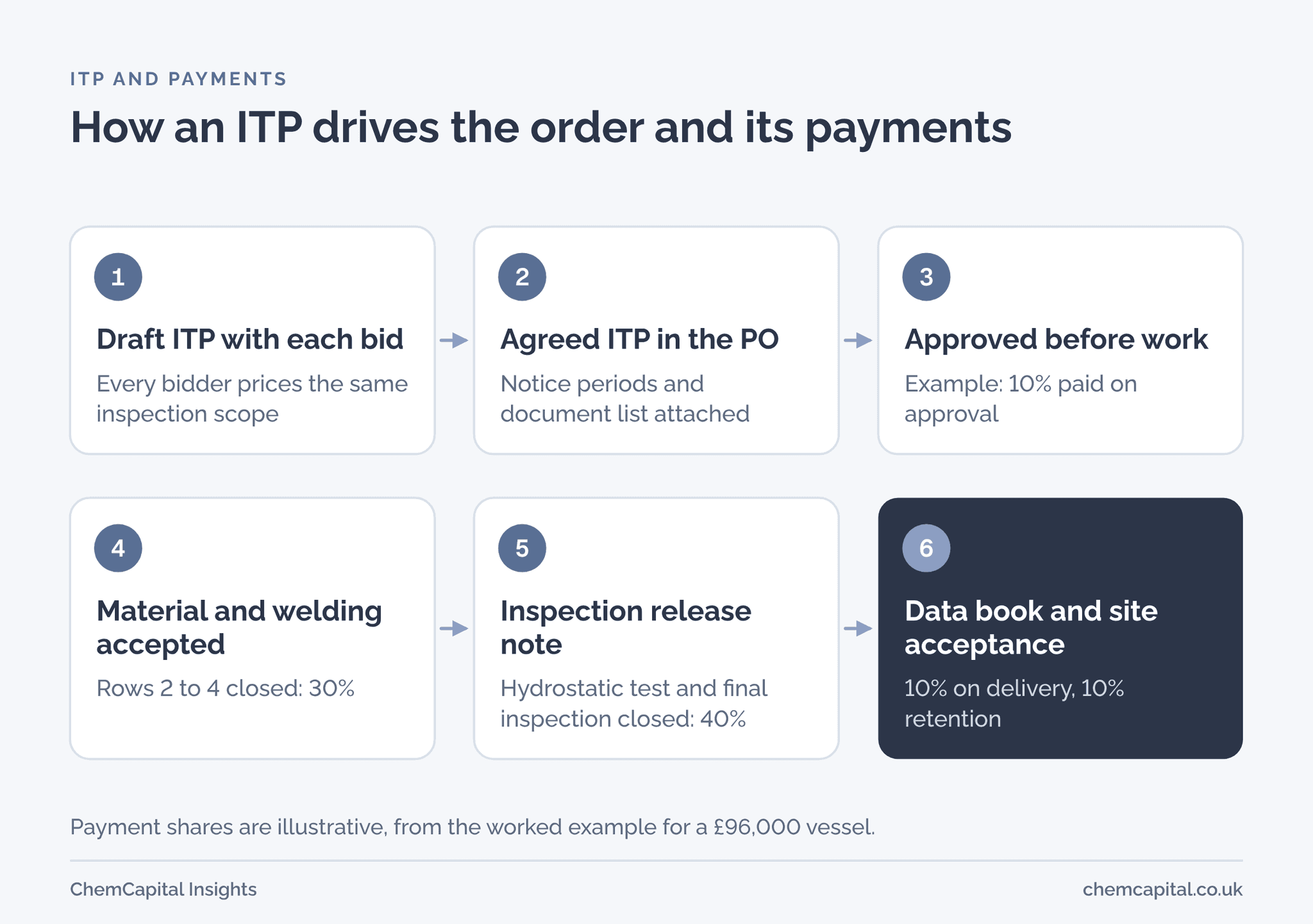
Attach the agreed ITP to the purchase order, with notice periods and the document list, then pay against ITP records, not dates. Air Products allows no shipment until it issues an inspection release note [2]. Santos gives that release only when every ITP activity is accepted and nonconformity reports are closed [1]. Hold back enough at delivery that finishing the data book is worth the supplier's effort.
Practical example
An illustrative 316L vessel is ordered for £96,000. Each payment milestone is tied to ITP rows.
| Milestone | ITP evidence | Share | Amount |
|---|---|---|---|
| Drawings and ITP approved | Row 1 | 10% | £9,600 |
| Material accepted | Rows 2 to 4 | 30% | £28,800 |
| Inspection release note | Rows 5 to 9 closed; release note in row 10 | 40% | £38,400 |
| Delivery with accepted data book | Row 10 data book | 10% | £9,600 |
| Retention, after site acceptance | Site records | 10% | £9,600 |
| Total | 100% | £96,000 |
Only £38,400 is paid before the vessel passes its hydrostatic test and final inspection.
The ITP also sets the inspection budget: three TPI visits, for PMI with material receipt, the dimensional check with the hydrostatic test, and the surface treatment check with final inspection. At an illustrative £850 a day plus £250 travel per visit, that is £3,300, plus two desk days reviewing records at £1,700: £5,000, about 5.2% of the order. Splitting the dimensional check from the hydrostatic test adds a fourth visit and £1,100.
Keep every bidder on the same ITP
ChemCapital sends one structured RFQ to all suppliers at once, so when you attach the draft ITP every bidder prices the same requirements. After award, formal purchase orders are confirmed by suppliers, suppliers post milestone updates, and an audit trail logs every interaction, revision and decision with timestamps.
Ready to send every bidder the same inspection scope? Start a free 14 day ChemCapital trial, with no credit card needed.
Frequently asked questions
What is an inspection and test plan?
An inspection and test plan (ITP) is a table listing every inspection and test on an order in sequence, with the controlling document, acceptance criteria, the record that proves it and the intervention point for each party. The supplier writes it and the buyer approves it before work starts.
Who prepares and approves an ITP?
The supplier prepares it and builds in the buyer's requirements. The buyer, any third party inspector and the approved or notified body add their own hold, witness and review points, and the buyer approves it before fabrication begins, usually before the pre inspection meeting.
What should an ITP for a pressure vessel include?
At least the pre inspection meeting, welding procedure and welder qualifications, material certificates, PMI for alloy parts, NDT, dimensional checks, the hydrostatic test, surface treatment, final inspection and the data book with inspection release. Each line needs a reference document, acceptance criteria and a verifying record.
What do H, W, R and S mean in an ITP?
H is a hold point that cannot be passed without written release, W a witness point that may proceed if nobody attends after due notice, R a review of records and S surveillance, though code sets vary between buyers. Define the codes and the notice periods for H and W points in the ITP header.
Continue reading
Informational only, not procurement or legal advice. Cited names, frameworks, and statistics belong to their respective owners.
Create and manage RFQs in minutes
ChemCapital handles the entire procurement cycle, from structured RFQs and supplier comparisons to formal purchase orders and delivery tracking.
Start for freeRelated articles
Hold Point vs Witness Point: What They Mean in an ITP
A hold point stops work until the buyer releases it in writing; a witness point lets work go on if nobody comes. ITP codes, notice and costs, with an example.
Site Acceptance Test (SAT) Checklist for Process Skids
What a site acceptance test must prove once a skid is installed, how SAT differs from FAT and commissioning, a full SAT checklist and how to handle failed tests.
Recommended Spares List: Commissioning, Operating and Insurance Spares
What a recommended spares list should hold: commissioning, two year operating and insurance spares, criticality, what to ask in the RFQ, and a pump and vessel template.