
Liquid Ring vs Dry Screw Vacuum Pumps for Chemical and Pharma Plants
Liquid ring or dry screw vacuum pump? Vacuum limits, wet gas and slugs, seal water and effluent, solvent recovery, ATEX inside and outside the pump, and a ten year cost example.
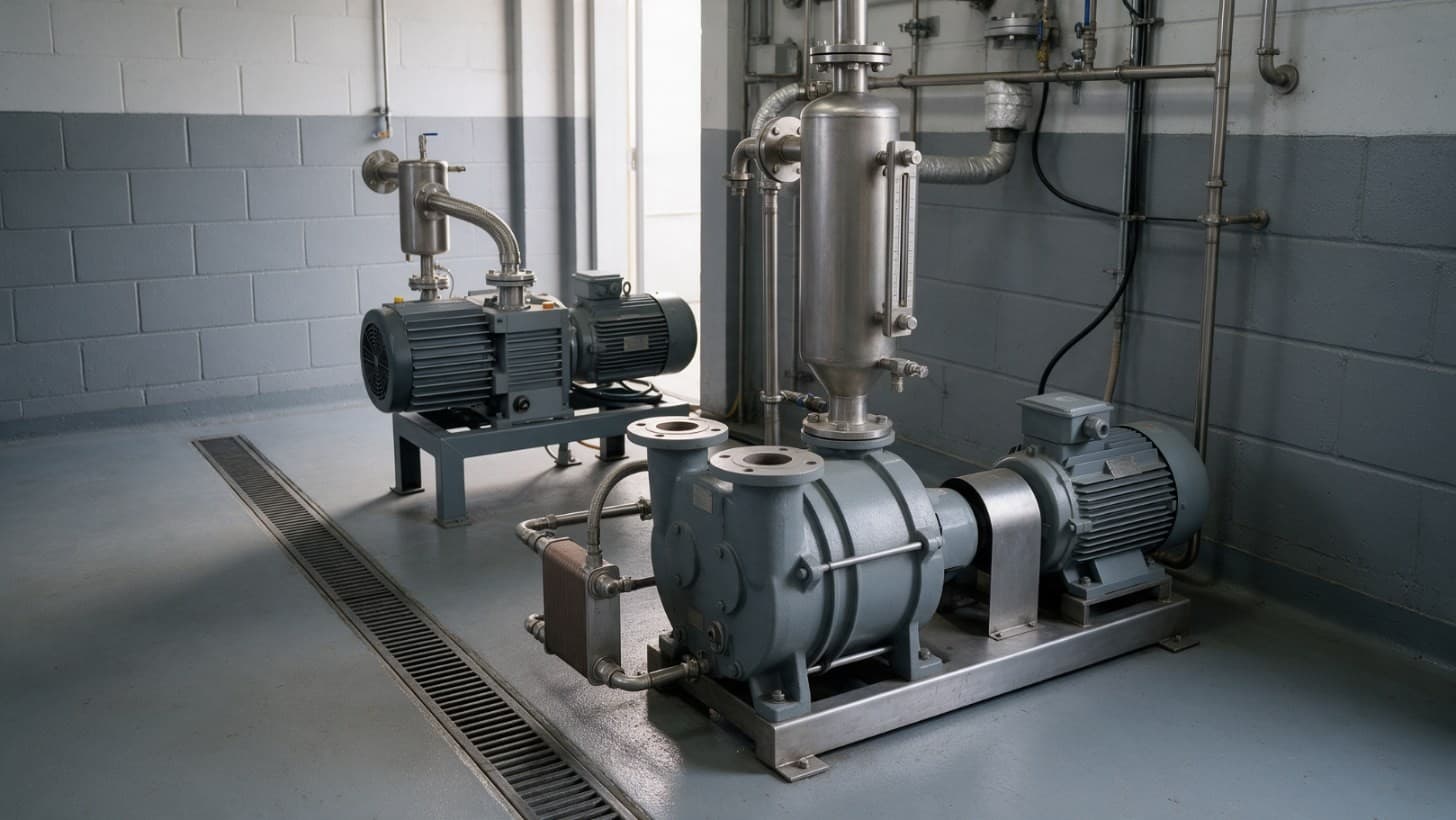
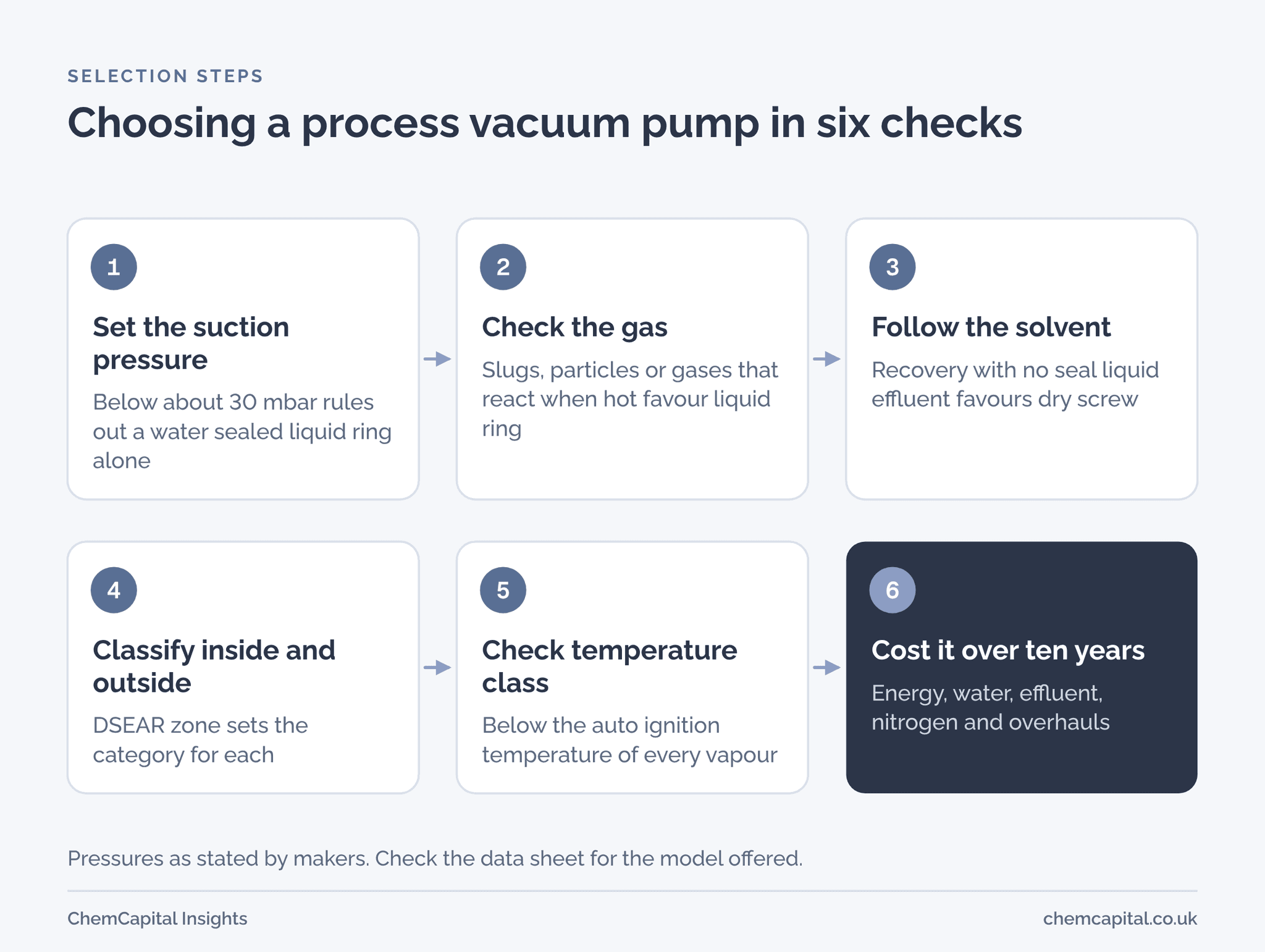
Three questions decide: how deep the vacuum must be, how wet and dirty the gas is, and where the solvent should end up. A liquid ring pump is the forgiving choice for wet, dirty or saturated gas and liquid carryover, but with water at 15 °C as the seal liquid it reaches only about 33 mbar absolute, and vapour that condenses in the pump ends up in that liquid [1, 2]. A dry screw pump reaches around 0.01 mbar, keeps solvent out of any seal liquid and uses less energy, but it costs more to buy and needs a clean, controlled inlet [1, 5].
The cheaper pump to buy is often not the cheaper one to own.
Why this matters now
One enquiry can bring back a liquid ring pump and a dry screw at very different prices, with years of seal water, effluent, energy and overhaul costs behind the gap. A 2025 AIChE primer, written by engineers at a group that makes both types, argues that long service intervals and low lifetime running costs repay the dry screw pump's higher purchase price [1]. Whether it holds depends on your water, effluent and electricity costs.
Create and manage RFQs in minutes
ChemCapital handles the entire procurement cycle, from structured RFQs and supplier comparisons to formal purchase orders and delivery tracking.
How each pump works
Liquid ring
A bladed impeller sits in a round casing about half full of liquid at rest. Turning, it throws the liquid into a ring. With the impeller off centre, the pockets between the blades grow on the suction side, drawing gas in, and shrink on the discharge side, compressing it [2]. The liquid seals the gaps, takes up condensate and removes the heat of compression [2], so the gas stays at nearly constant temperature: Pumps & Systems gives typical discharge temperatures of 45 °F to 150 °F, about 7 °C to 66 °C [4].
The lowest pressure is set by the vapour pressure of the seal liquid, so warmer seal liquid means a poorer vacuum [2, 5]. For deeper vacuum, an ejector (a jet pump with no moving parts) is often combined with it [1].
Dry screw
Two screw rotors turn in opposite directions without touching, and no operating liquid enters the compression chamber [1]. The heat of compression stays in the gas (adiabatic compression), so discharge temperatures can reach 450 °F, about 232 °C [4]. It is run deliberately hot, with its temperature held tightly, so vapours pass through without condensing or polymerising [1, 5].
| Point | Liquid ring | Dry screw |
|---|---|---|
| Lowest pressure, as makers state | About 33 mbar with 15 °C water [2]; 30 mbar(a) [3] | Around 0.01 mbar [1, 7] |
| Discharge temperature | About 7 °C to 66 °C [4] | Up to about 232 °C [4] |
| Wet gas, carryover, particles | Tolerant [1, 2, 6] | Sensitive; fit a knock out pot upstream [1, 5] |
| Gases that react when hot | Cool running lowers the risk [5] | Not suitable [5] |
| Solvent and effluent | Condensate can contaminate the seal liquid, which then needs treatment [5] | No seal liquid; vapour leaves dry |
| Energy | Less efficient [1] | More efficient [1, 5] |
| Purchase price | Lower | Higher [1] |
Seal liquid, effluent and solvent recovery
Water is the usual seal liquid, but a liquid ring pump can run on a solvent, oil or other process compatible liquid [1, 4, 6]. Atlas Copco describes three ways to handle it [3]:
- Once through: seal liquid passes through once and, after the gas is separated, goes to drain. It uses the most water.
- Partial recirculation: a separator returns some seal liquid, mixed with fresh make up to hold the temperature. Typical water saving is 50% against once through.
- Total recovery: a closed loop with a heat exchanger between separator and pump, used where seal liquid is scarce or contamination is a concern. Typical saving is up to 95%.
Either way, condensed vapour ends up in the seal liquid. With water as the seal, a solvent stripping duty makes contaminated water that must be treated before disposal [5], and in a closed loop condensate builds up and must be drawn off. Sealing with the process solvent avoids mixing two liquids, but its vapour pressure then sets the vacuum, and the pump holds solvent that is often flammable.
A dry screw pump has no seal liquid to contaminate, which is why Edwards calls its EDS range effluent free [7]. Solvent can be condensed after the discharge, or captured by a condenser upstream of either type [1]. The price is care at the inlet and at shutdown: a knock out pot (a small vessel where liquid drops out) or cyclone to stop droplets and slugs of liquid [1] and, Busch advises, a rinse with a cleaning fluid when the batch ends, followed by nitrogen to keep the idle pump free of corrosion and deposits [5].
ATEX: zones inside and outside the pump
ATEX is the common name for the European rules on equipment, and on workplaces, where an explosive atmosphere can form. In Great Britain, the Dangerous Substances and Explosive Atmospheres Regulations 2002 (DSEAR) grade such places into zones by how likely an explosive atmosphere is. For gases, vapours and mists, Schedule 3 then requires category 1 equipment in Zone 0, category 1 or 2 in Zone 1, and category 1, 2 or 3 in Zone 2, with categories defined by the Equipment and Protective Systems Regulations 2016 [9].
A vacuum pump needs two ratings: inside, where the process gas flows, and outside, in the plant area. Leybold rates its DRYVAC DV 300 dry screw pump category 2 inside and category 3 outside [8]. Inside, gas is compressed back to atmospheric pressure, above the minimum pressure at which it can ignite, so the user must keep the mixture out of its explosive range, for example by inert gas dilution, or define a zone there [8].
Each certified pump also carries a temperature class, a cap on its maximum surface temperature, such as T3 (200 °C) or T4 (135 °C) [8], which must be below the auto ignition temperature of every vapour pumped. That check matters most for a hot running dry screw; a liquid ring pump's cool, wet compression makes unwanted reactions or ignition inside the pump much less likely [5]. Both types are sold in ATEX versions [6, 7]. This is general information, not legal advice.
What the vendor needs in the RFQ
Give every bidder the same data in the RFQ (request for quotation):
- suction pressure at the vessel and its range, plus losses in any condenser or line between
- gas load: air leakage and other gases that do not condense, in kg/h, with composition
- vapour load: each solvent and water vapour in kg/h, and the gas inlet temperature [4]
- liquid carryover, slugs, particles, and anything that polymerises or reacts when hot [1]
- where the discharge goes (condenser, scrubber or vent) and its back pressure [4]
- inside and outside zones, gas group and temperature class from the site's explosion protection document [8]
- utilities: cooling water temperature, nitrogen, seal liquid, and the effluent route and cost
- duty cycle, materials, and spares to price
Ask for absorbed power at the duty point, then score bids as our technical bid evaluation guide describes.
Practical example
Take an illustrative duty: 250 m³/h at 80 mbar(a) for solvent stripping, 6,000 hours a year, electricity at £0.25/kWh and water plus effluent disposal at £4.00/m³. Bids A and B offer the same water sealed ATEX liquid ring pump with partial recirculation and with total recovery; Bid C is an ATEX dry screw pump. Once through, the liquid ring pump would use 0.8 m³/h of seal water; Atlas Copco's 50% and 95% savings [3] give 0.4 and 0.04 m³/h. The dry screw's 6.5 kW is plausible: Edwards' EDS 300, with a peak speed above 280 m³/h, draws 4.5 kW at ultimate pressure and 8.2 kW at peak load [7].
| Item (illustrative) | A: liquid ring, partial recirculation | B: liquid ring, total recovery | C: dry screw |
|---|---|---|---|
| Price installed | £30,000 | £38,000 | £55,000 |
| Absorbed power | 9.0 kW | 9.0 kW | 6.5 kW |
| Energy a year | £13,500 | £13,500 | £9,750 |
| Seal water to drain a year | 2,400 m³, £9,600 | 240 m³, £960 | None |
| Nitrogen, 0.6 m³/h at £0.20/m³ | None | None | £720 |
| Maintenance a year | £1,500 | £2,000 | £3,000 |
| Running cost a year | £24,600 | £16,460 | £13,470 |
| Ten year total, undiscounted | £276,000 | £202,600 | £189,700 |
Bid C costs £25,000 more than Bid A but saves £11,130 a year, paying back in about 2.2 years. Against Bid B the gap shrinks to £12,900 over ten years, under 7%, before the cost of drawing solvent laden liquid from the loop; cooling water is left out for all three. So the process decides: if the step later needs 20 mbar, only Bid C reaches it without adding an ejector or other stage ahead of the liquid ring; if the gas carries slugs or particles, Bid B is more forgiving.
Find vacuum pump suppliers that fit the duty
Supplier Discovery searches the web for suppliers from a plain text description, pasted RFQ or uploaded spec, and extracts the parameters they publish, with source links. A deterministic engine gives each a fit verdict: Strong, Partial, Information Missing or Rejected. Certifications are shown as claimed, not verified, so ask for the ATEX certificate, or the UK equivalent for UKCA marked equipment. Nothing is sent automatically; three searches are free without signing up.
Ready to find vacuum pump suppliers for your duty? Start a free 14 day ChemCapital trial, with no credit card needed.
Frequently asked questions
What vacuum can a liquid ring pump achieve?
The limit is the vapour pressure of the seal liquid: Leybold gives about 33 mbar absolute with water at 15 °C, and Atlas Copco's range goes down to 30 mbar(a). Warmer seal liquid gives a poorer vacuum, and for deeper vacuum an ejector is often combined with the liquid ring pump.
Is a dry screw vacuum pump better than a liquid ring pump?
Not always. A dry screw pump reaches around 0.01 mbar, uses less energy and makes no contaminated seal liquid, so condensed solvent is not mixed with seal water; a liquid ring pump is cheaper to buy and more tolerant of wet gas, carryover, particles and gases that react when hot.
How much water does a liquid ring vacuum pump use?
It depends on the pump size and how the seal liquid is handled. Atlas Copco quotes typical water savings of 50% with partial recirculation and up to 95% with a closed loop total recovery system, both against once through operation.
Can a dry screw vacuum pump be used in an ATEX zone?
Yes, makers sell ATEX certified versions, rated separately for the inside and the outside of the pump; Leybold, for example, rates its DRYVAC DV 300 category 2 inside and category 3 outside. Under DSEAR, Zone 0 needs category 1 equipment, Zone 1 category 1 or 2, and Zone 2 category 1, 2 or 3. This is general information, not legal advice.
Continue reading
Informational only, not procurement or legal advice. Cited names, frameworks, and statistics belong to their respective owners.
Create and manage RFQs in minutes
ChemCapital handles the entire procurement cycle, from structured RFQs and supplier comparisons to formal purchase orders and delivery tracking.
Start for freeRelated articles
Where to Find Pharma and Chemical Plant Projects Before They Go to Tender: the 2027 Pipeline
Twenty pharma and chemical plant projects checked against owner or government announcements, the buying timeline on each, and where to watch for the next ones for free.
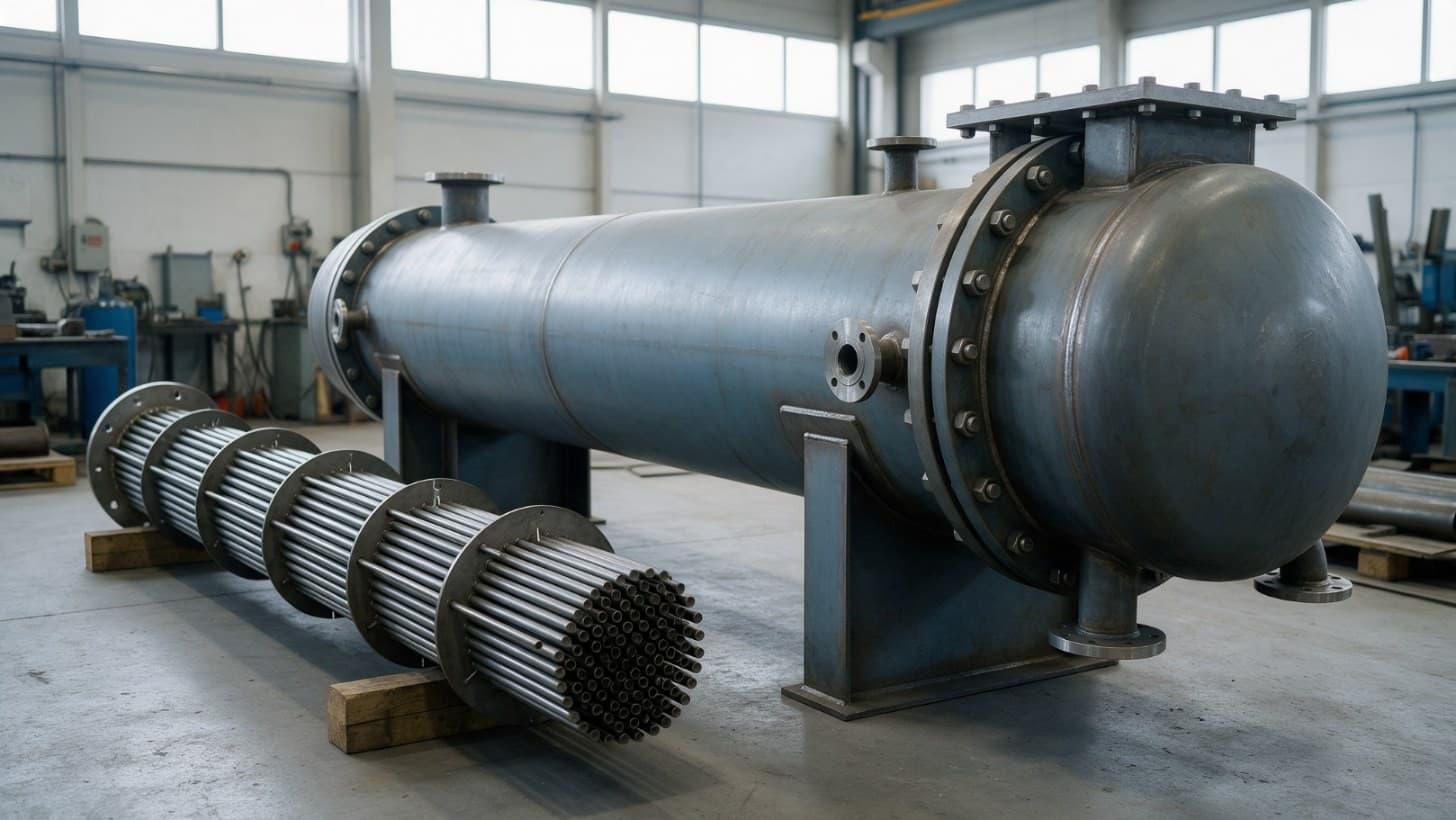
TEMA Heat Exchanger Types: How to Read AES, BEM and AEU
How to decode the three letter TEMA type, what AES, BEM, AEU and other common types mean for cleaning, expansion, leaks and cost, and how to compare bids that differ.
Safety Valve vs Relief Valve vs Bursting Disc: How to Choose
How safety valves, relief valves and bursting discs differ, when to fit a disc under a valve, the pressure terms that matter, GB duties and what to put in the RFQ.