
Magnetic Drive vs Mechanically Sealed Pumps for Chemical Service
Mag drive or sealed pump for a hazardous chemical? How each contains the liquid, where each fails (solids, dry running, decoupling, seal support), efficiency, monitoring, and what to put in the RFQ.
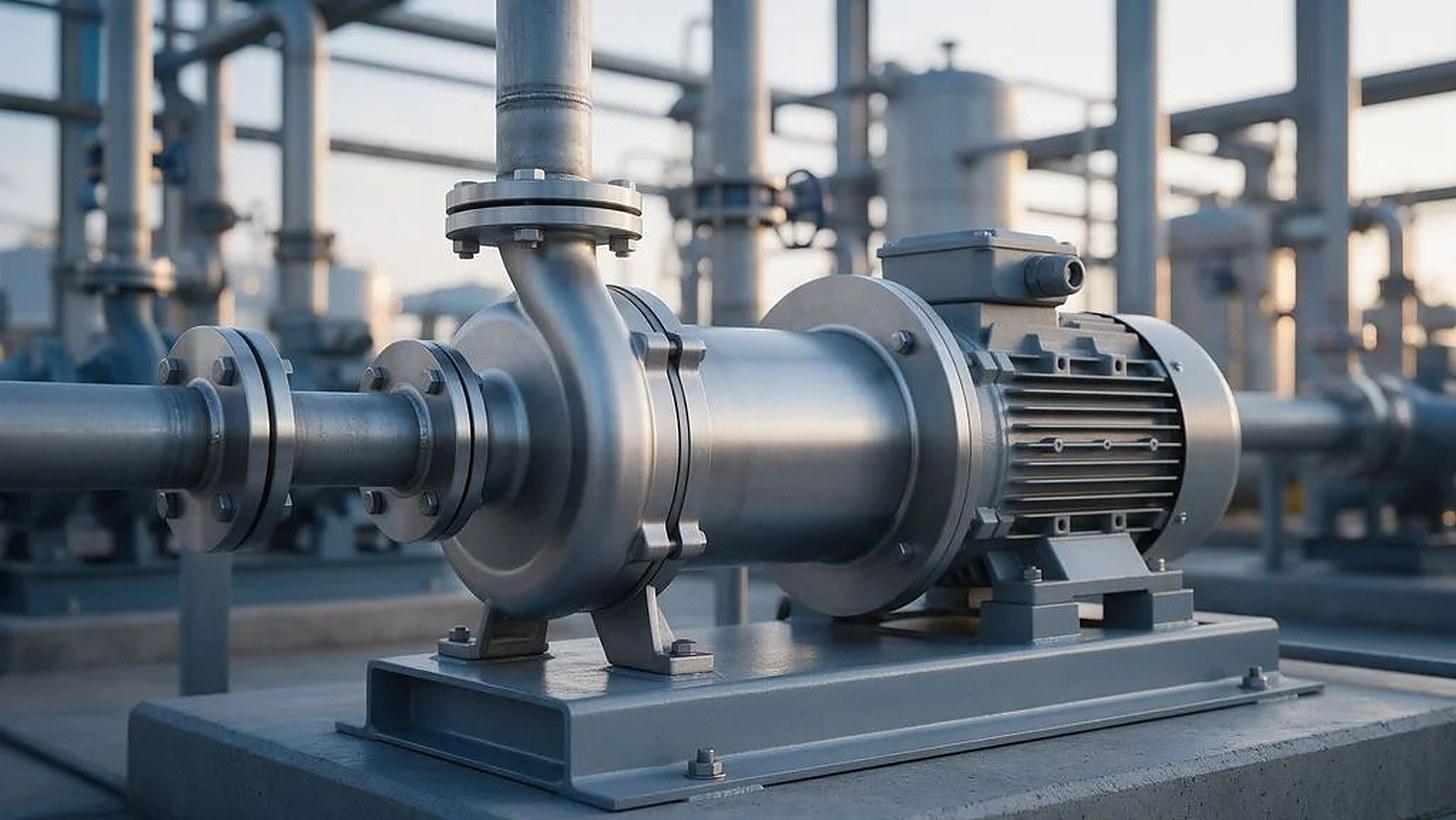
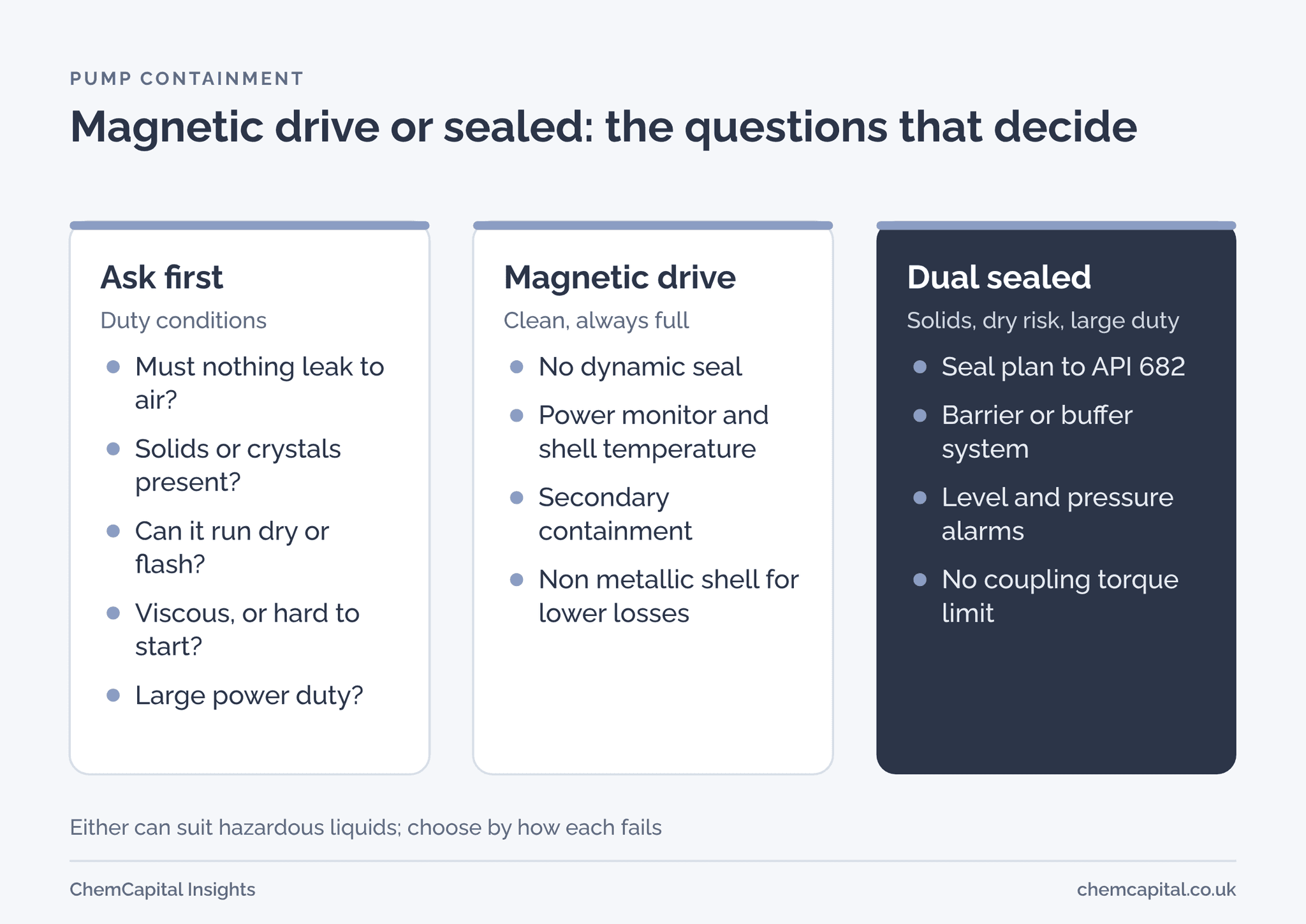
Choose a magnetic drive pump when the liquid is toxic, flammable, expensive or simply must not leak, it is clean, and the pump will always run full of liquid. Choose a mechanically sealed pump, often with a dual seal and a support system, when the liquid carries solids, may run dry, is very viscous, or when the duty is large and efficiency matters most. Either can work for hazardous chemicals; the choice comes down to how each one fails and what that failure costs you.
How each design contains the liquid
A conventional centrifugal pump has a shaft passing from the motor into the liquid, and a mechanical seal where it passes through the casing. The seal is a pair of faces running together with a thin film of liquid between them, so it always leaks a tiny amount. For hazardous liquids, buyers add a second seal and a support system, such as a pressurised barrier fluid, to stop any of that leakage reaching the atmosphere [1].
A magnetic drive pump has no shaft through the casing. The motor turns an outer ring of magnets, which drives an inner ring attached to the impeller through a stationary containment shell [2]. The shell is part of the pressure boundary; there is no dynamic seal to leak. The inner rotor runs on bearings lubricated by the pumped liquid itself [2]. Canned motor pumps, the other sealless type, put the motor rotor inside the liquid behind a thin stator liner [2].
For refinery and petrochemical service, sealless pumps have their own standard, API 685, whose third edition was published in July 2022 and covers both magnetic drive and canned motor pumps [3]. Sealed pumps for the same service follow API 610, with seals to API 682.
Create and manage RFQs in minutes
ChemCapital handles the entire procurement cycle, from structured RFQs and supplier comparisons to formal purchase orders and delivery tracking.
Side by side
| Factor | Magnetic drive pump | Mechanically sealed pump |
|---|---|---|
| Leak path to atmosphere | None in normal operation; the containment shell is static | Seal faces always pass a small amount; dual seals and support systems contain it |
| Solids | Poor: particles damage the product lubricated bearings | Good with the right seal and flush plan |
| Running dry | Damaging: loses bearing lubrication and shell cooling | Damaging to seal faces, but support systems can protect them |
| Viscosity and start up torque | Limited by coupling torque; can decouple | Not limited by a coupling |
| Efficiency | Lower with metallic shells because of eddy current losses | Higher; seal losses are small |
| Ancillaries | Monitoring instruments | Seal support system for dual seals: tank, pressure, level alarms |
| Maintenance | Fewer routine checks; bearing wear to monitor | Seal replacement; barrier fluid checks |
Where magnetic drive pumps struggle
Solids. Particles get into the product lubricated bearings and can damage them, even seize the shaft. Sundyne's David Clark advises flushing process piping before start up, because weld slag alone can cause bearing failure [2].
Running dry. Without liquid, the bearings lose lubrication and the containment shell loses its cooling. Hard bearing materials give some tolerance, but should not be relied on for extended dry running [2]. Clark also notes that liquids with low viscosity or low specific heat are challenging for the standard silicon carbide bearing pair, and recommends alternative bearing materials for them [4].
Decoupling. The magnetic coupling transmits only so much torque. If the load exceeds it, for example at start up or with a viscous liquid, the magnets slip and the pump stops pumping while the motor keeps running. Prolonged operation decoupled can permanently demagnetise the magnets, and magnets also lose strength above their temperature limit [5].
Eddy current losses. A metallic containment shell sits in a moving magnetic field and heats up through eddy currents, which costs power and heats the liquid. Losses rise with the square of speed and of drive radius [5]. World Pumps notes that losses above 20 kW are not uncommon on large metallic shell drives [6]. Non metallic shells, in ceramics or fibre reinforced composites, cut these losses but cost more [6].
Protecting a magnetic drive pump
The failure modes above are well known, and so are the protections. Clark lists motor power monitoring to detect low load and dry running, containment shell temperature sensors, leak detection, low level or low flow monitoring, and ultrasonic vapour detection able to pick up gas bubbles of less than 1% by volume [2]. Secondary containment, a second shell or a housing with a leakage restriction device, captures liquid if the primary shell fails [2]. API 685's third edition clarified definitions of secondary control and containment and added instrumentation and control considerations [3].
Specify these in the RFQ. A magnetic drive pump without a power monitor on a duty that can run dry is a leak waiting for the first empty tank.
Where sealed pumps struggle
A mechanical seal's weakness is that it relies on a liquid film and a controlled environment. Chesterton says inadequate or incorrect support systems are the second highest cause of seal failures, and that controlling the environment around a seal is the single best way to extend its life [1]. Dual seals for hazardous duties need a support system: a Plan 53 system, for example, keeps barrier fluid at about 2 bar above seal chamber pressure, with a regulator, safety valve and level monitoring [1]. That is more equipment to buy, check and maintain, and some barrier fluid passes into the product [1]. Our guide to mechanical seal plans under API 682 explains the options.
In exchange, a sealed pump tolerates solids with the right seal and flush, is not limited by coupling torque, and avoids the eddy current loss.
Commissioning and operating tips
Most early failures of sealless pumps happen in the first hours, so the start up matters as much as the specification:
- Flush the piping first. Weld slag and debris left in new pipework are a classic cause of bearing damage [2].
- Prime and vent fully. Gas trapped in the pump starves the bearings and the shell of liquid. Monitoring that confirms correct priming and venting, such as the ultrasonic devices Sundyne describes, helps here [4].
- Set the trips before the first start. Power monitor low load trips and shell temperature alarms should be live from day one, not added after the first incident.
- Respect minimum flow. Running against a closed valve heats the liquid in the shell quickly.
For sealed pumps the equivalent discipline is commissioning the seal support system properly: filling and pressurising the barrier tank, checking alarms and recording the starting level so that later losses can be spotted.
How to choose
- Can the liquid be allowed to leak at all? If even small emissions are unacceptable, both options remain, but a magnetic drive removes the dynamic leak path.
- Is it clean? Solids or crystals push you towards a sealed pump with a suitable flush.
- Can it run dry or vaporise? Empty tanks, intermittent duty and liquids near boiling favour a sealed pump, or a magnetic drive with strong monitoring.
- Is it viscous, or is the start up load high? Check coupling torque margin with the supplier.
- How large is the duty? At higher powers, metallic shell losses matter; ask for losses in kW and consider a non metallic shell.
- What does your site maintain well? Seal support systems need attention; instruments on a sealless pump need someone to act on their alarms.
Practical example
Illustrative figures. A plant compares two pumps for a 15 kW toxic solvent duty running 8,000 hours a year, with electricity at £0.20 per kWh.
| Item | Magnetic drive, metallic shell | Dual sealed pump, Plan 53 |
|---|---|---|
| Extra power for eddy current loss, assumed 1.5 kW | 12,000 kWh, £2,400 a year | None |
| Seal replacement, assumed £4,000 every 3 years | None | About £1,333 a year |
| Support system checks and barrier fluid, assumed | None | £800 a year |
| Indicative running cost difference | £2,400 a year | About £2,133 a year |
On these assumptions the two are close, so the decision rests on risk: whether the duty can run dry, whether the solvent carries particles, and how much one seal leak would cost in emissions, clean up or downtime. Ask suppliers for actual shell losses and seal life data rather than relying on assumptions; a non metallic shell would remove most of the magnetic drive's extra power.
What to put in the RFQ
State the liquid, solids content, viscosity, vapour pressure and whether the pump can run dry. For magnetic drive pumps, ask for the containment shell material and losses, coupling torque margin at start up, bearing materials, and the monitoring and secondary containment offered. For sealed pumps, state the seal arrangement and plan or ask the supplier to propose one. Our centrifugal pump datasheet guide shows the fields to fill in.
Where ChemCapital fits
Offers for the same duty can come back as one magnetic drive and two sealed designs. ChemCapital's AI quotation comparison sets containment, monitoring, power and maintenance items side by side, so you compare risk and cost, not just price.
Ready to compare pump offers on more than price? Start a free 14 day ChemCapital trial, with no credit card needed.
Frequently asked questions
Is a magnetic drive pump better than a mechanical seal pump?
For clean, hazardous liquids that must not leak and where the pump always runs full, often yes. For liquids with solids, duties that can run dry, viscous liquids or large powers, a sealed pump with the right seal and support system is often the better choice.
Can a magnetic drive pump run dry?
Not safely for long. The pumped liquid lubricates the bearings and cools the containment shell, so dry running damages them. Power monitors, temperature sensors and level or flow switches protect against it.
What is decoupling in a mag drive pump?
When the load torque exceeds what the magnetic coupling can transmit, the magnets slip and the impeller stops while the motor runs. Prolonged decoupling can permanently demagnetise the magnets.
Which standard covers sealless pumps?
API 685 covers sealless centrifugal pumps, both magnetic drive and canned motor, for petroleum, petrochemical and gas industry service. The third edition was published in July 2022.
Continue reading
Informational only, not procurement or legal advice. Cited names, frameworks, and statistics belong to their respective owners.
Create and manage RFQs in minutes
ChemCapital handles the entire procurement cycle, from structured RFQs and supplier comparisons to formal purchase orders and delivery tracking.
Start for freeRelated articles
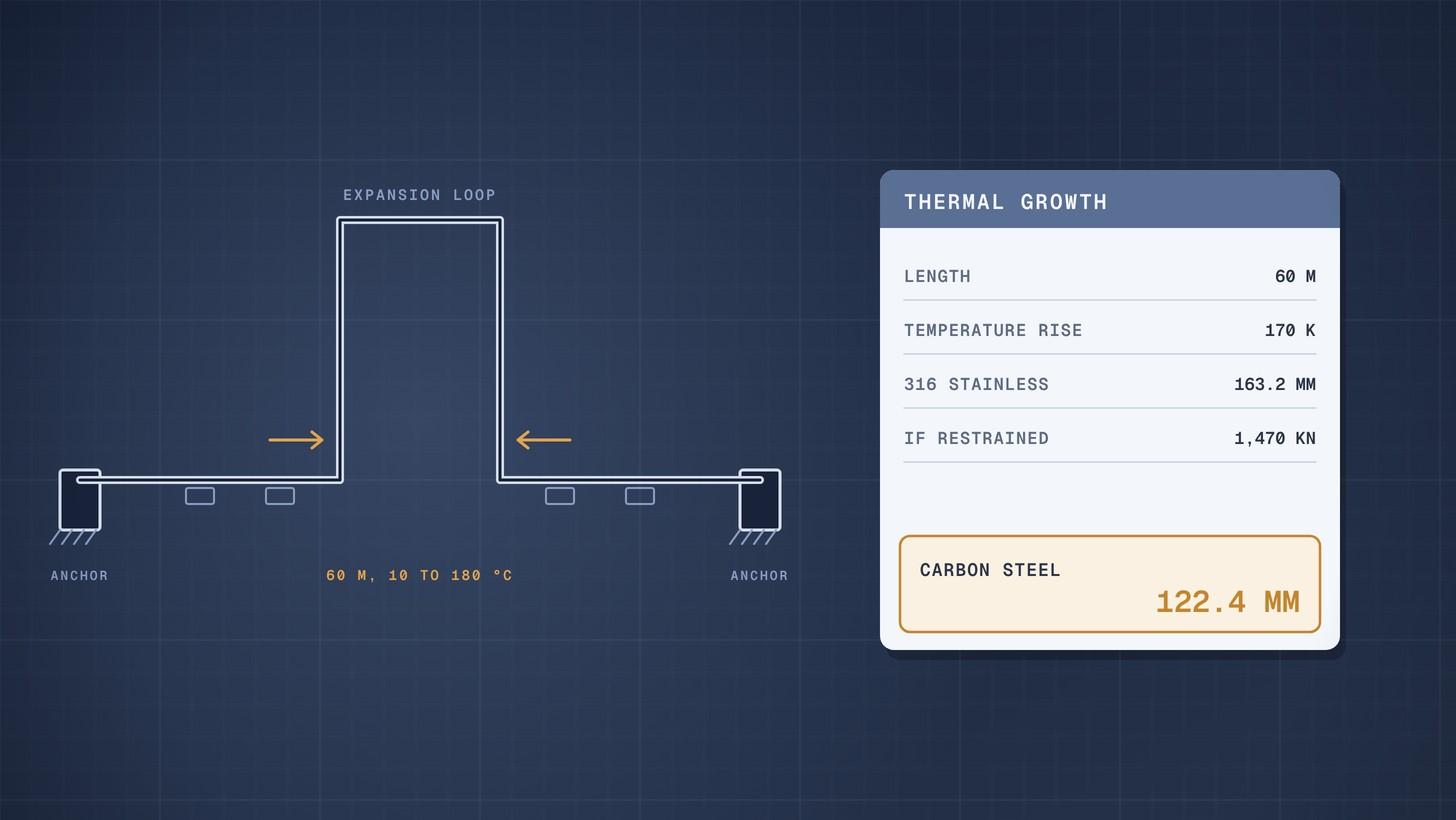
Pipe Thermal Expansion: Worked Example
How to calculate pipe thermal expansion for carbon and stainless steel, what restrained expansion does, and how loops and expansion joints absorb it.
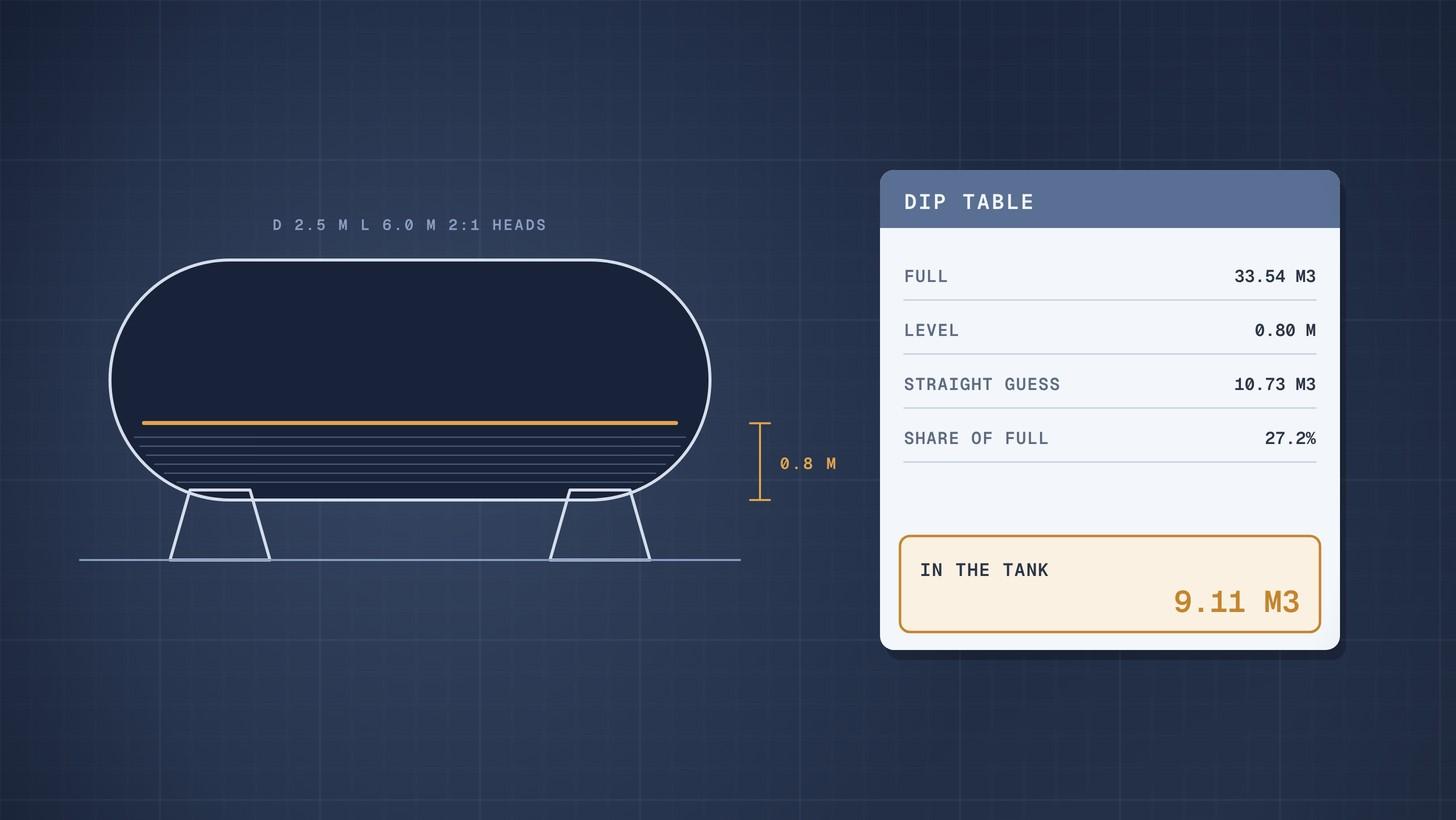
Horizontal Tank Volume When Partly Filled: Worked Example
How to calculate the volume of a partly filled horizontal tank with dished heads, with a worked example and a full dip table you can rebuild in a spreadsheet.
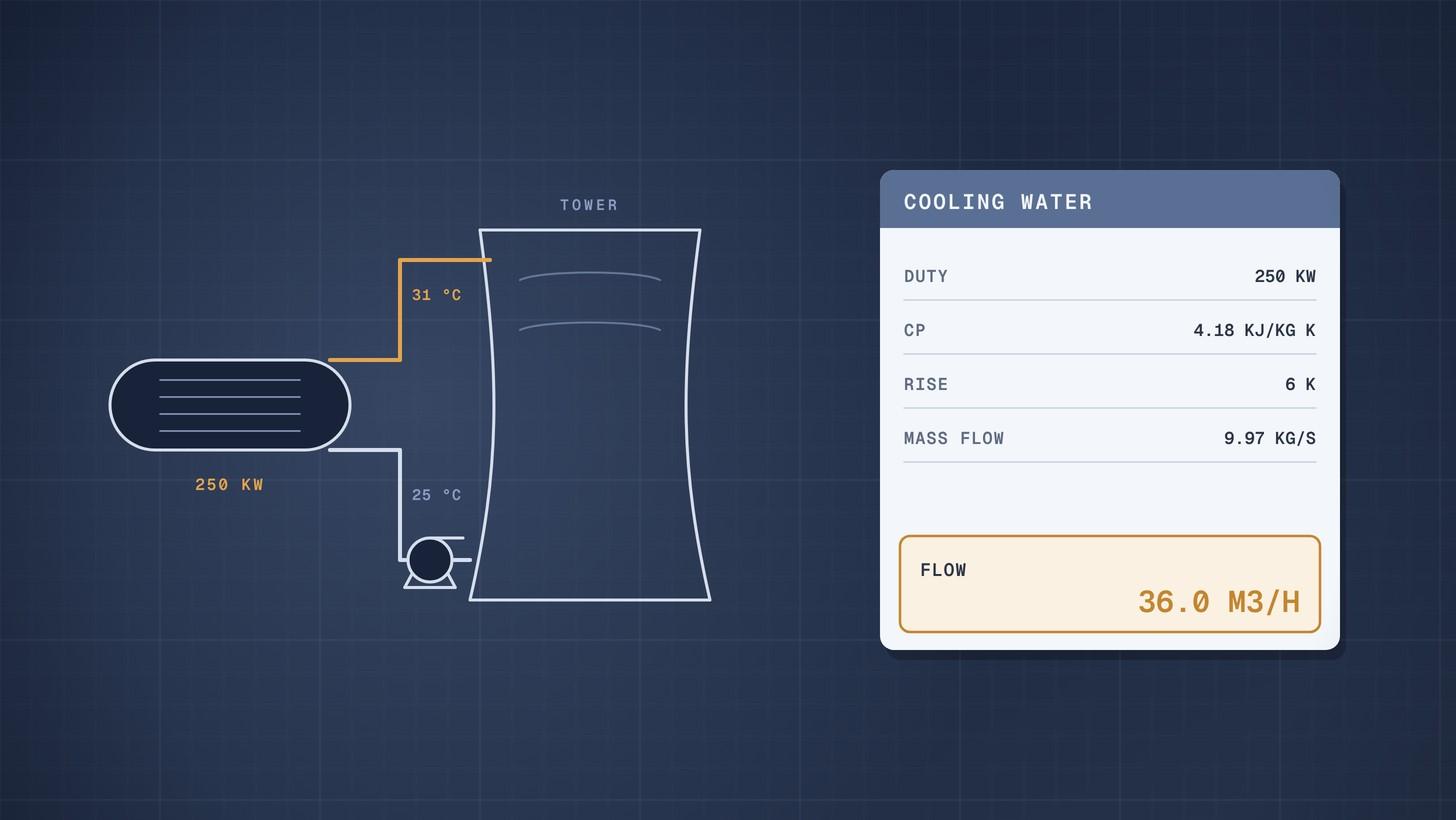
Cooling Water Flow Calculation: Worked Example
How to calculate cooling water flow from heat duty and temperature rise, then size the cooling tower circulation, evaporation and make up water.