
Passivation vs Electropolishing: Surface Finish for Hygienic Equipment
What passivation and electropolishing each do to stainless steel, how Ra and ASME BPE finishes are specified, how to test them and what to write on the purchase order.
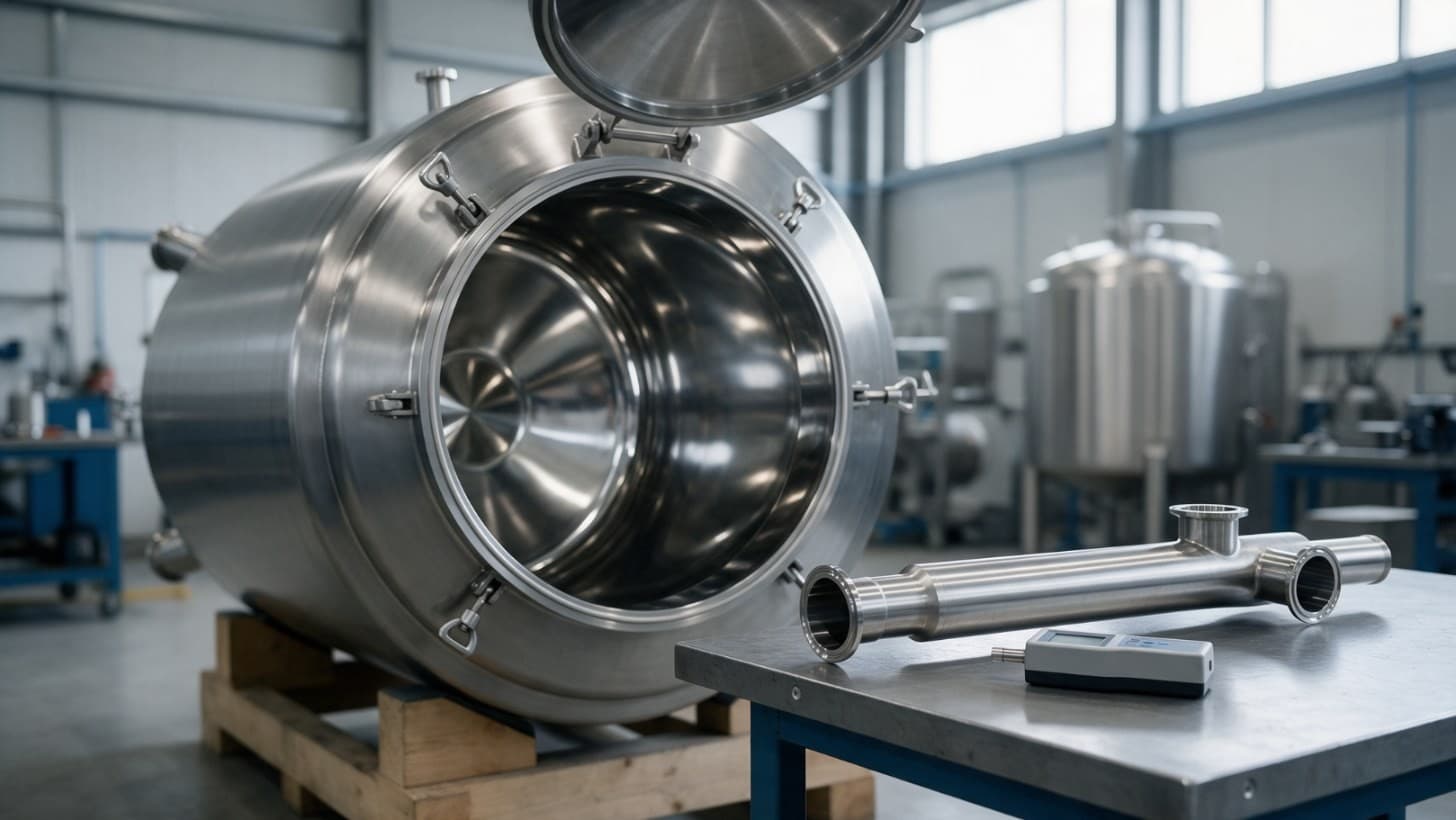
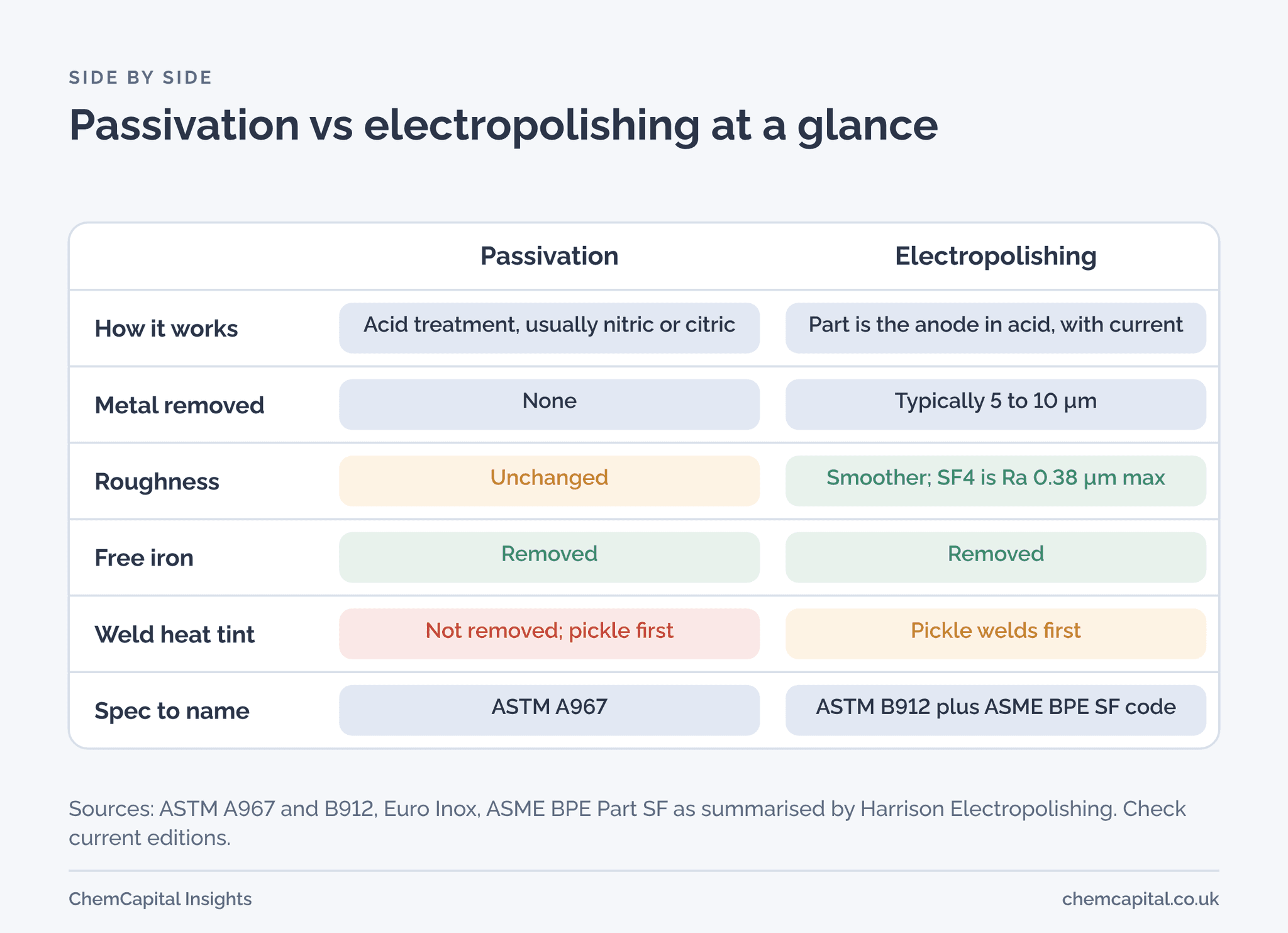
Passivation and electropolishing both leave stainless steel with a clean, chromium rich passive film, but only electropolishing changes the surface you can measure. Passivation is a chemical treatment, usually in nitric or citric acid, that clears free iron and other contamination while taking no metal off [1, 2]. Electropolishing is an electrochemical process that takes a thin layer off the surface, usually 5 to 10 µm, leaving it smoother, brighter and passivated at the same time [3, 4].
So the choice follows the finish you need. For hygienic food equipment the long established benchmark is an average roughness (Ra) below 0.8 µm, which cold rolled or ground stainless steel can meet without electropolishing [5]. Where a pharmaceutical or bioprocess owner wants an electropolished surface, ASME BPE gives designations SF4 to SF6, and SF4 is the tightest at Ra 0.38 µm maximum [6].
Why this matters now
Surface finish is one of the hardest lines to compare across hygienic equipment bids. One fabricator writes "polished and passivated", another writes "SF4", a third writes "Ra 0.8, pickled". They are not the same scope, cost or lead time.
The reference documents have also moved. ASTM issued new editions of A967, for chemical passivation, in 2025 and B912, for passivation by electropolishing, in 2026, so an old datasheet may cite superseded editions [2, 4].
For medicines, EU GMP says product contact parts must not be "reactive, additive or absorptive" to a degree that affects product quality, and that equipment must be designed for thorough cleaning [7]. In Great Britain, check the MHRA's current GMP guidance too. Material, design and surface treatment together are how a fabricator meets that duty in steel; the purchase order is how you make it checkable. This is general information, not legal advice.
Join ChemCapital to streamline sourcing and connect with verified partners
Whether you're buying or supplying, ChemCapital gives you the tools to manage the complete procurement cycle in one platform.
What each process does to the steel
Given oxygen, clean stainless steel grows its own thin, protective, chromium rich oxide film [1]. Fabrication spoils it in two ways. Carbon steel tools and handling gear leave iron on the surface, and welding leaves heat tint, a coloured oxide that draws chromium out of the metal just beneath it [1].
Passivation
ASTM A967 offers nitric acid baths, citric acid baths and an electrochemical route for passivation [2]. Because it takes no metal off, passivation leaves roughness and dimensions as they were [1].
Two limits matter. First, passivation does not remove weld heat tint. The chromium depleted layer has to come off first, usually by pickling in a mixture of nitric and hydrofluoric acids, which does dissolve a thin layer of metal [1]. These acids are hazardous, and Euro Inox recommends specialist firms for spray pickling [1]. Second, A967 leaves it to the purchaser to pick the treatment and the acceptance tests for each application [2].
Electropolishing
In electropolishing the part becomes the anode in an acid bath, usually a blend of sulphuric and phosphoric acids, and a current is passed [3]. Iron and nickel go into solution faster than chromium, so the surface left behind is enriched in chromium [3]. ASTM's summary of B912 says a correctly run electropolish passivates the surface as it goes, clears free iron and also takes off heat tint and scale [4]. Even so, Euro Inox treats electropolishing as a step for clean metal and pickles welds carrying heat oxides first, so check each bid includes that [3].
It is not a cure for a poor base surface. Scratches, pores or inclusions in the parent metal can still mar the finished part, which is why parts are often ground and polished first and why ASME BPE defines SF4 to SF6 as mechanically polished and then electropolished finishes [3, 6]. Edges and corners carry more current and lose more metal unless shields or extra cathodes even it out [3]. Euro Inox steers buyers away from stabilised grades such as 1.4541 and 1.4571 for electropolished equipment, so check the grade first [3].
How surface finish is specified
Ra, the average roughness, is the arithmetic mean of how far the surface profile strays above and below its centre line over a measured length. FORCE Technology cites ISO 4287 for the definition; check the current ISO surface texture standard [5]. Ra is quoted in micrometres (µm) or microinches (µin); 1 µm is about 39.4 µin.
| Designation | Process | Ra max, µm | Ra max, µin |
|---|---|---|---|
| ASME BPE SF0 | No requirement | Set by owner | Set by owner |
| ASME BPE SF1 | Mechanically polished | 0.51 | 20 |
| ASME BPE SF2 | Mechanically polished | 0.64 | 25 |
| ASME BPE SF3 | Mechanically polished | 0.76 | 30 |
| ASME BPE SF4 | Mechanically polished, then electropolished | 0.38 | 15 |
| ASME BPE SF5 | Mechanically polished, then electropolished | 0.51 | 20 |
| ASME BPE SF6 | Mechanically polished, then electropolished | 0.64 | 25 |
| Hygienic food benchmark | Not tied to a process | Below 0.8 | 31.5 (converted) |
ASME BPE values follow Harrison Electropolishing's summary of Part SF [6]; EHEDG and the US 3A organisation support the food benchmark [5]. Check both in the edition your specification names.
Three points prevent arguments. ASME BPE sets each Ra figure as a ceiling for any single reading, so averaging a set of readings to pass is not allowed [6]. Harrison takes its readings with a contact profilometer to ASME B46.1; state on the order where readings are taken and how many [6]. And Ra is only part of the story: FORCE Technology warns that boiling a surface down to one number oversimplifies it, and Euro Inox goes further, saying an Ra reading tells you little about how well an electropolished surface will clean [3, 5]. For food plant, EHEDG's GL 18, revised in 2014, covers pickling, passivation and electropolishing of product contact surfaces [8].
Choosing, testing and writing it on the order
A reasonable starting point, to confirm against your user requirements:
- Food, drink and general hygienic duty: Ra below 0.8 µm, weld heat tint removed by pickling, then passivated to ASTM A967.
- Pharmaceutical and bioprocess product contact surfaces: an ASME BPE designation such as SF4, welds pickled before electropolishing, then electropolishing and passivation to ASTM B912.
- Surfaces that never touch product: passivation alone is usually enough.
Testing should be named, not implied. A967 and B912 each list qualitative tests, from water immersion and salt spray to copper sulphate and ferroxyl checks for free iron, and Euro Inox notes the ferroxyl test also picks up iron oxide [1, 2, 4]. Add a profilometer survey for Ra and a visual check for electropolishing defects. Treat finish as a scored line in your technical bid evaluation and decide which readings you will witness at the factory acceptance test.
Ask each bidder whether electropolishing is done in house or subcontracted. It needs strong acids, ventilation and approved acid disposal, and Euro Inox says it belongs with experienced, properly equipped firms [3].
Wording you can adapt for a datasheet or purchase order:
Product contact surfaces: 316L, mechanically polished and electropolished to ASME BPE SF4 (Ra 0.38 µm maximum), edition [state]. Weld heat tint removed by pickling before electropolishing. Electropolishing and passivation to ASTM B912, current edition, verified by [named test]. Ra by contact profilometer at [locations], every reading at or below the limit, report in the data book. Other surfaces: weld heat tint removed by pickling, then passivated to ASTM A967, current edition, [treatment], verified by [named test].
This is general information, not legal advice.
Practical example
The figures below are illustrative. A buyer asks for quotes on a 2,000 litre jacketed 316L vessel whose specification calls for ASME BPE SF4 on product contact surfaces. Three bids come back.
| Bid | Finish as quoted | Headline price | Added to reach SF4 | Normalised price | Lead time |
|---|---|---|---|---|---|
| A | Polished and passivated, no Ra stated | £84,000 | Electropolishing £9,800; Ra survey and report £1,200 | £95,000 | 18 weeks (quoted 16) |
| B | SF4, electropolished to ASTM B912, Ra report | £96,500 | Nothing | £96,500 | 18 weeks |
| C | Ra 0.8 µm, pickled and passivated | £88,000 | Finer polish and electropolishing £11,200; Ra survey and report £1,200 | £100,400 | 19 weeks (quoted 16) |
This assumes Bid A's polish is fine enough to electropolish straight to SF4; ask the bidder to confirm its Ra.
On headline price, Bid A is £12,500 below Bid B. Once each bid is brought to the same finish, Bid A is still lowest at £95,000, but only £1,500 below Bid B, and Bid C moves from second place to last, £5,400 above Bid A. Bids A and C each gain two to three weeks for the extra electropolishing step.
At that margin the decision turns on risk, not price. Bid B owns the finish and has priced the Ra report; Bid A is pricing a step it had not planned. If you set SF4 as a mandatory requirement, our AI Quotation Comparison flags quotes with that gap and leaves them out of the ranking, which is where Bids A and C sit until they are brought up to it.
Finding suppliers who can actually do it
The harder part is finding firms that genuinely work to SF4 and ASTM B912. Supplier Discovery takes a plain description such as "electropolishing of 316L process vessels to ASME BPE SF4, UK or EU", searches the web and extracts the capabilities suppliers publish, with source links and a fit verdict for each. Certifications are shown as claimed, not verified, so still ask for procedures and a sample Ra report.
Ready to put a clear finish specification in front of the right suppliers? Start free with ChemCapital.
Frequently asked questions
Is electropolishing better than passivation?
Not automatically. Electropolishing takes a thin layer of metal off, smooths the surface and passivates it in one step, while passivation clears free iron but leaves roughness unchanged, so the right choice depends on the finish your specification requires and the extra cost and time you can accept.
Does electropolishing also passivate stainless steel?
Yes. ASTM's own summary of B912 says that, run properly, electropolishing passivates the steel and clears free iron, so B912 is the specification to cite for an electropolished part.
What Ra is ASME BPE SF4?
SF4 is a mechanically polished and then electropolished finish with Ra 0.38 µm (15 µin) maximum. No single reading may exceed it, so confirm the value in the edition your specification names.
Does passivation remove weld heat tint?
No. Heat tint and the chromium depleted layer beneath it are normally removed by pickling, and passivation should follow pickling, not replace it. ASTM B912 says electropolishing also removes heat tint, but Euro Inox still puts pickling of welds ahead of electropolishing.
Continue reading
Informational only, not procurement or legal advice. Cited names, frameworks, and statistics belong to their respective owners.
Join ChemCapital to streamline sourcing and connect with verified partners
Whether you're buying or supplying, ChemCapital gives you the tools to manage the complete procurement cycle in one platform.
Get started freeRelated articles
Where to Find Pharma and Chemical Plant Projects Before They Go to Tender: the 2027 Pipeline
Twenty pharma and chemical plant projects checked against owner or government announcements, the buying timeline on each, and where to watch for the next ones for free.
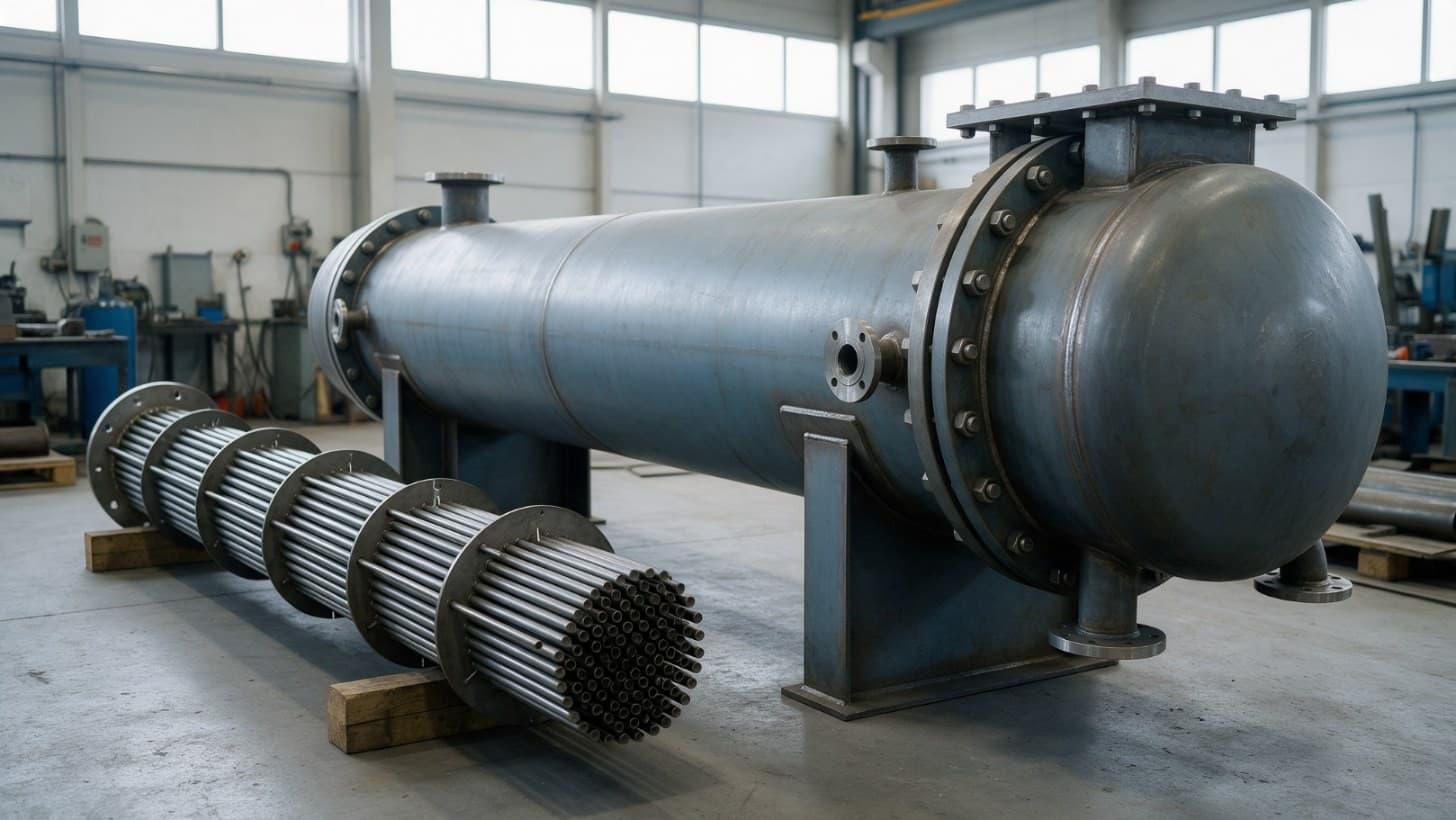
TEMA Heat Exchanger Types: How to Read AES, BEM and AEU
How to decode the three letter TEMA type, what AES, BEM, AEU and other common types mean for cleaning, expansion, leaks and cost, and how to compare bids that differ.
Safety Valve vs Relief Valve vs Bursting Disc: How to Choose
How safety valves, relief valves and bursting discs differ, when to fit a disc under a valve, the pressure terms that matter, GB duties and what to put in the RFQ.