
PFAS Restriction and PTFE Seals, Gaskets and Linings: Where It Stands
Where the EU universal PFAS restriction stands as of November 2026, what RAC and SEAC said about fluoropolymers and sealing, the UK position, and what to ask suppliers now.
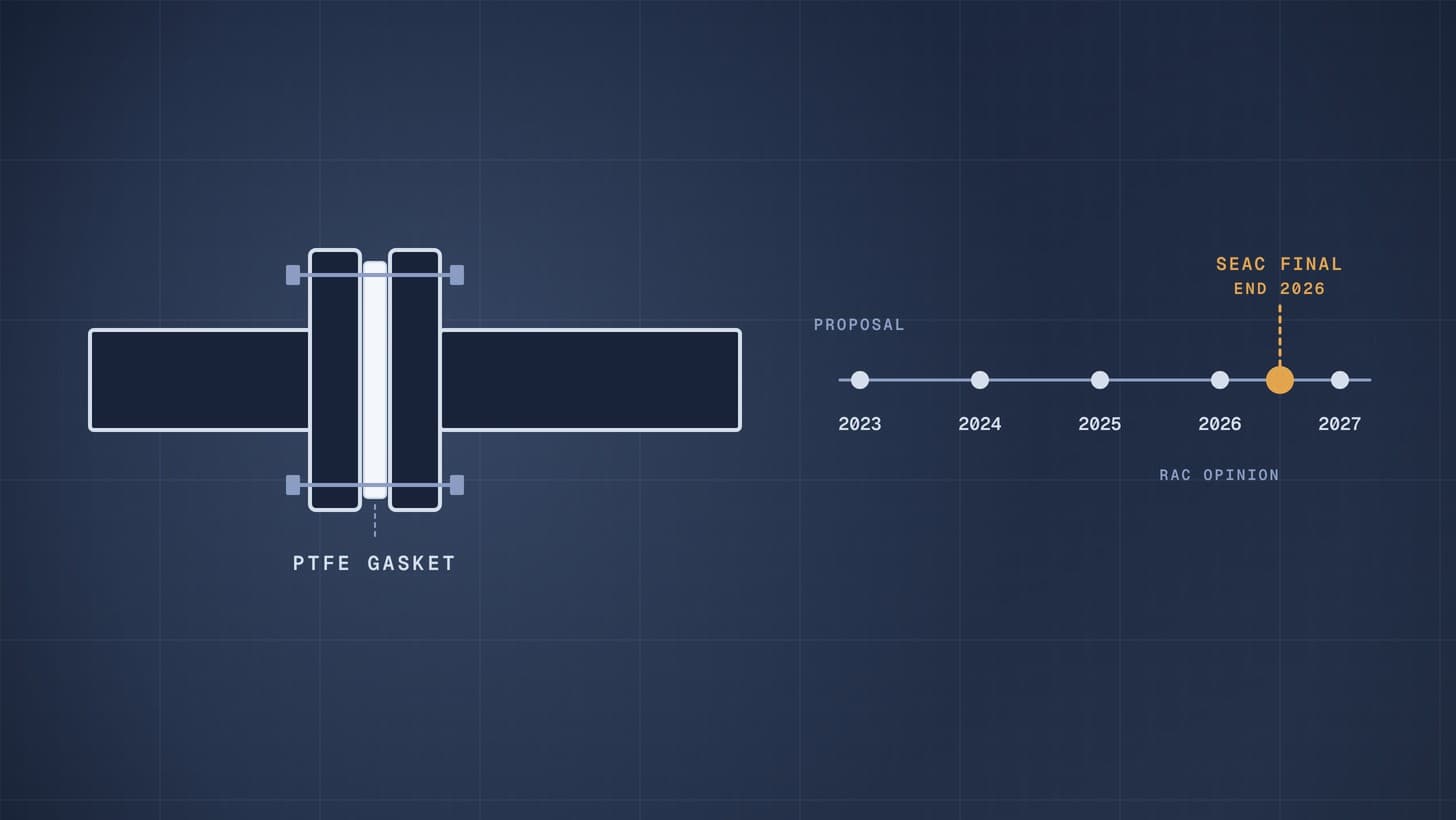
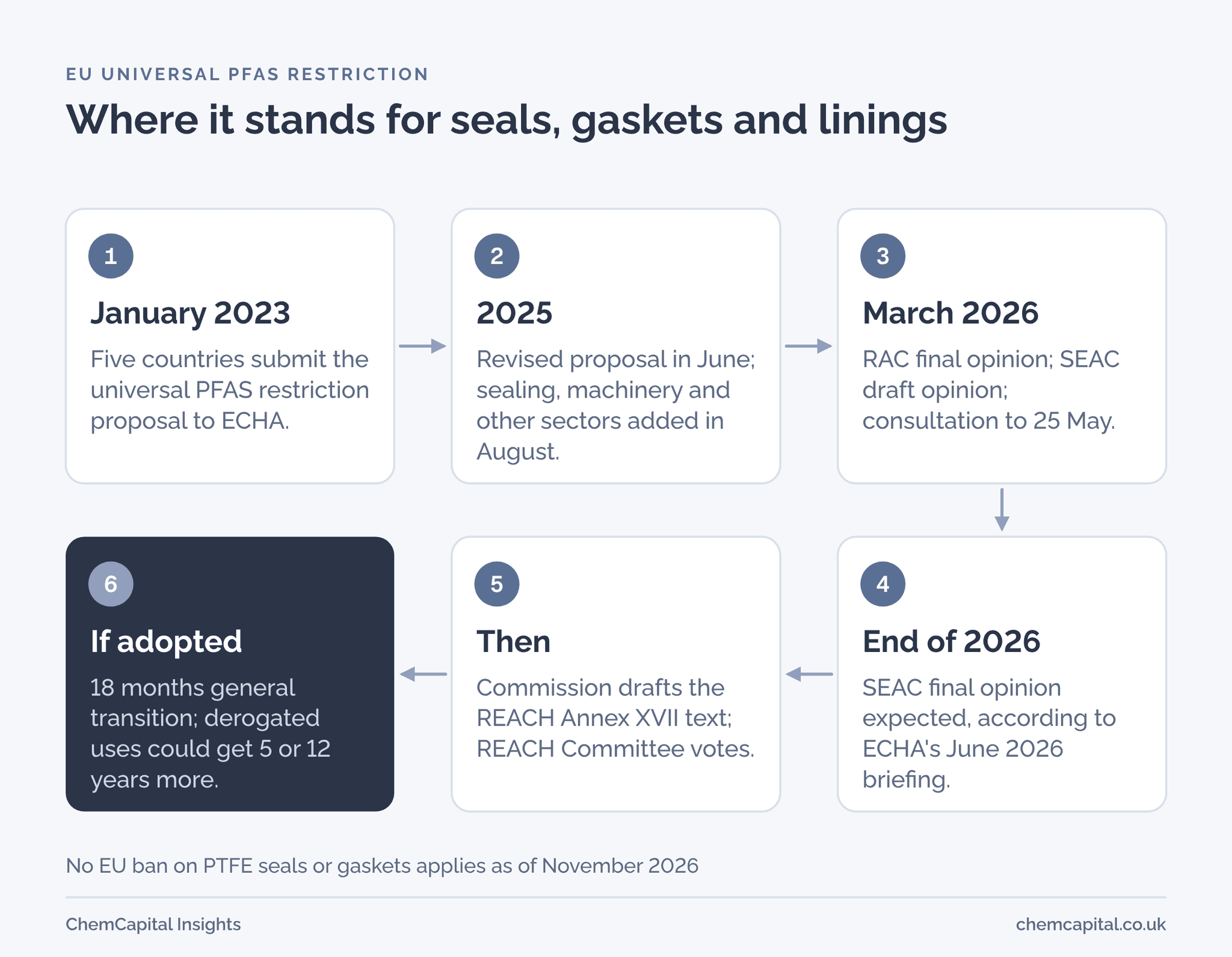
As of November 2026 there is no EU ban on PTFE seals, gaskets or fluoropolymer lined equipment. The universal PFAS restriction proposed under REACH is still with ECHA's committees: the Risk Assessment Committee adopted its final opinion on 2 March 2026, the socio economic committee published a draft opinion for consultation that closed on 25 May 2026, and its final opinion is expected by the end of 2026. Only then does the European Commission draft the legal text for Member States to vote on.
So nothing changes on your purchase orders yet. What has changed is the direction of travel: fluoropolymers are inside the proposed scope, and sealing is one of the sectors the committees have not yet assessed in depth. This guide sets out exactly where the restriction stands, what it could mean for seals, gaskets and linings, and what to ask your suppliers now.
Why this matters now
Fluoropolymers are everywhere in process plant. PTFE packings and gaskets seal valves in the chemical industry [1], and the sealing industry relies heavily on fluoropolymers such as PTFE, FEP and PFA [2]. Add PTFE lined pipe and valves, PFA lined vessels, envelope gaskets, valve seats and diaphragms, and the fluoropolymer part count on a chemical plant adds up quickly.
Equipment bought today will run for decades and will need spares throughout. If a restriction is adopted in 2027, as one law firm anticipates [3], the transition periods discussed run from 18 months to over 13 years from entry into force. That sits well inside the life of a reactor or a lined pipe system. Planning starts at the RFQ, not when a supplier announces a material change.
Create and manage RFQs in minutes
ChemCapital handles the entire procurement cycle, from structured RFQs and supplier comparisons to formal purchase orders and delivery tracking.
Where the restriction stands
The proposal was submitted to ECHA by five countries in January 2023 and would restrict the manufacture, use and placing on the market of PFAS as a group [3].
| Date | Step |
|---|---|
| 13 January 2023 | Restriction proposal submitted to ECHA [4] |
| 22 March to 25 September 2023 | First public consultation [4] |
| June 2025 | Revised proposal published [3] |
| August 2025 | Update adds eight sectors, including sealing and machinery [5] |
| 2 March 2026 | RAC final opinion [4] |
| 10 March 2026 | SEAC draft opinion agreed [4] |
| 26 March to 25 May 2026 | Consultation on SEAC's draft opinion; 3,511 comments received [6] |
| By end of 2026 | SEAC final opinion expected [6] |
| After that | Commission drafts the restriction for discussion and vote in the REACH Committee [6] |
As of November 2026, the latest published position we found, ECHA's June 2026 briefing, is that SEAC aims to adopt its final opinion by the end of 2026 [6]. Until the Commission publishes a draft amendment to REACH Annex XVII, there is no legal text, no confirmed scope and no confirmed derogation for any use.
This is general information, not legal advice; check the current text before you rely on it.
What the committees said about fluoropolymers and sealing
Fluoropolymers stay in scope. RAC includes fluoropolymers in the broad scope. It accepts that evidence of their mobility, bioaccumulation and toxicity is limited, but points to life cycle concerns such as emissions of non polymeric PFAS during production and at end of life. SEAC also rejected industry requests to exclude fluoropolymers [3].
RAC wants a broad ban with very few exceptions. It supports a full EU wide restriction with very limited derogations, accepts an 18 month general transition period, and recommends that any derogation come with risk management such as site specific PFAS management plans and emissions reporting [3] [4].
SEAC is more open to time limited derogations. Its draft opinion supports a broad restriction with time limited, use specific derogations where the socio economic case is made. It generally accepts the proposed derogation periods of 5 or 12 years after the ban takes effect, though it calls the exact durations somewhat arbitrary [3]. SEAC also considers the proposed site specific management plans for fluoropolymer users potentially costly and hard to enforce [3].
Sealing, machinery and broader industrial uses were not assessed in depth. These are among the eight sectors added in 2025. Neither committee assessed them in depth. SEAC says it cannot conclude whether the proposed derogations for them are justified. It recommends evaluating them as soon as possible and, meanwhile, applying a time limited derogation to all uses in these sectors [3]. One regulatory option under consideration includes a 12 year derogation for sealing applications [2].
In plain terms: the most likely outcome for industrial seals and gaskets, based on the committees' drafts, is a transition period rather than an overnight ban. But the length and conditions are not settled, and RAC is pushing for fewer exceptions.
How the transition periods would add up
If the restriction is adopted, the clock starts at entry into force. The dossier submitters proposed [3]:
| Use | Transition | Total from entry into force |
|---|---|---|
| General, no derogation | 18 months | 1.5 years |
| Derogation, 5 years | 18 months plus 5 years | 6.5 years |
| Derogation, 12 years | 18 months plus 12 years | 13.5 years |
Whether a given seal, gasket or lining falls in any of these rows depends on the final text. Do not plan on a derogation until it is in the regulation.
What is still unknown
Be clear with your engineers and management about what nobody can tell you yet:
- The final scope. The committees' opinions advise; the Commission writes the text and Member States vote on it [6].
- Whether sealing gets a derogation, and for how long. SEAC could not conclude on the sealing sector and suggests a time limited derogation while it is assessed [3].
- Conditions on continued use. RAC wants derogations tied to measures such as site management plans and emissions reporting; SEAC doubts the plans are practical [3] [4]. If they survive, users as well as makers could carry obligations.
- The UK timetable. Alignment by December 2028 is an indicative action, not a decision [4].
Anyone who tells you today that PTFE gaskets will be banned on a given date, or that they are safe for good, is ahead of the sources.
The UK position
Great Britain is outside EU REACH. As of early 2026, UK REACH PFAS restrictions covered only PFOA and its salts and perfluorinated silane [5]. The government published a PFAS Plan on 3 February 2026 [7], and it includes an indicative action to align UK REACH with the EU by December 2028 [4]. Under the Windsor Framework, Northern Ireland remains under EU REACH, so an adopted EU restriction would likely apply there [4].
For UK plants buying from EU makers, the EU decision still matters. A supplier that reformulates for its main market may stop making the PTFE version you use, whatever the UK rules say.
Where fluoropolymers sit in your equipment
Build a simple inventory before you talk to suppliers. Typical places to look:
| Equipment | Fluoropolymer parts |
|---|---|
| Valves | PTFE seats and seals, PTFE packing, PTFE or PFA linings, PTFE diaphragms in diaphragm valves |
| Piping | PTFE, PFA or FEP lined pipe and fittings, PTFE envelope gaskets |
| Pumps | PTFE or PFA lined casings, fluoroelastomer O rings in mechanical seals |
| Vessels and columns | PFA or PTFE linings, PTFE gaskets on manways and nozzles |
| Instruments | PTFE diaphragm seals, PFA lined flow meters |
| Hygienic equipment | PTFE gaskets and diaphragms chosen for cleanability |
Lined and diaphragm items deserve special attention because the fluoropolymer is doing the corrosion or hygiene job, not just sealing. See our guide to diaphragm valves for hygienic service.
Alternatives exist for some duties and not others. The sealing industry argues that for critical applications, testing and approving alternatives can take 5 to 25 years [1]. Treat any claim of a drop in replacement with care: it changes the chemical resistance, temperature limit or cleanability, and needs your engineers' approval.
What to ask seal, gasket and lined equipment suppliers
Add these questions to RFQs and to your annual supplier reviews. They are fair, specific and answerable today.
| Question | Why it matters |
|---|---|
| Which parts in your offer contain PFAS, including fluoropolymers and fluoroelastomers? | Builds your inventory part by part |
| Do you have a qualified non PFAS alternative for each part? On what duties is it proven? | Shows the real options and their limits |
| Will you give advance notice of any material change or product withdrawal? | Lets you plan and requalify; see supplier change notification |
| How long will you supply spares in the current material? | Protects operating plant |
| Are you taking part in the EU process or tracking it? | Shows whether they will see changes coming |
| Can you offer a last time buy if a material is withdrawn? | Gives you a fallback for critical spares |
ChemCapital's AI Supplier Discovery can help you find additional makers of sealing and lined products, including those offering alternative materials, so a single withdrawal does not leave you without a source.
Spares and the installed base
The restriction is about placing on the market and use, so spares matter as much as new equipment. Start with your recommended spares list for critical lined and sealed equipment, and mark every fluoropolymer item on it. For those items, find out from the supplier how long the current material will be offered, whether an alternative is qualified for your duty, and what a last time buy would cost if one became necessary. Do not stockpile on rumour; do know your options.
Writing it into the RFQ and purchase order
Two short clauses cover most of the risk today. Adapt them with your legal team:
- Declaration. "The supplier shall list every part in the offer that contains PFAS, including fluoropolymers and fluoroelastomers, with the material and its function."
- Change notice. "The supplier shall give at least 12 months' written notice before withdrawing or changing the material of any listed part, and shall offer a last time buy where a part is withdrawn."
They cost little to agree at tender stage and are hard to win later. They also feed the wider supplier risk picture; see our guide to vendor risk management in pharma supply chains.
Practical example
Illustrative. A UK fine chemicals site reviews one production building before ordering a new PTFE lined reactor feed system.
The inventory finds 140 PTFE lined valves, about 900 PTFE envelope gaskets, 60 PTFE diaphragm valves and PFA lined pipe on two acid lines. For the new order, the RFQ asks each bidder the six questions above. Two bidders confirm PTFE supply for at least 10 years and commit to 12 months' notice of any change. One offers a graphite gasket alternative proven on the site's solvent duties, but not on the acid lines.
The buyer awards on the lined design, takes the graphite gasket option where engineering approves it, writes the notice commitment into the purchase order, and lists the acid line linings as a risk to review when the Commission publishes its draft. Nothing is replaced early; nothing is left to chance.
If you are the supplier
Expect these questions. Answer them part by part, say plainly what is proven and what is not, and commit to change notification. Buyers will remember who told them early. If you make lined or sealed equipment, start testing alternatives on your most common duties now and share the results with customers. The long qualification times the sealing industry describes apply to your customers' approvals as well as yours.
Where ChemCapital fits
The PFAS restriction is a slow moving risk with long lead times. Know where fluoropolymers sit in your plant, ask suppliers the right questions, and keep more than one source for critical parts.
Ready to build supplier resilience into every RFQ? Start a free 14 day ChemCapital trial, with no credit card needed.
Frequently asked questions
Is PTFE banned in the EU?
No. As of November 2026 there is no EU ban on PTFE. The universal PFAS restriction under REACH, which includes fluoropolymers in its proposed scope, is still at the committee stage, with SEAC's final opinion expected by the end of 2026 and a Commission proposal to follow.
Will PTFE gaskets and seals be banned?
Not decided. Sealing is one of the sectors the committees have not assessed in depth. SEAC's draft opinion recommends a time limited derogation for all uses in those sectors while they are evaluated, and one option includes a 12 year derogation for sealing. The final scope depends on the Commission's legal text.
When will the EU PFAS restriction apply?
Only after the Commission drafts it and Member States vote in the REACH Committee. One law firm anticipates adoption in 2027. The proposal includes an 18 month general transition, and derogated uses could have 5 or 12 years more.
Does the EU PFAS restriction apply in the UK?
Not in Great Britain, which has its own UK REACH. The UK published a PFAS Plan in February 2026 with an indicative action to align with the EU by December 2028. Northern Ireland remains under EU REACH.
What should buyers ask seal and gasket suppliers about PFAS?
Which parts contain PFAS, what qualified alternatives exist and on which duties, whether they will give advance notice of material changes, how long they will supply spares in the current material, and whether they can offer a last time buy.
Continue reading
Informational only, not procurement or legal advice. Cited names, frameworks, and statistics belong to their respective owners.
Create and manage RFQs in minutes
ChemCapital handles the entire procurement cycle, from structured RFQs and supplier comparisons to formal purchase orders and delivery tracking.
Start for freeRelated articles
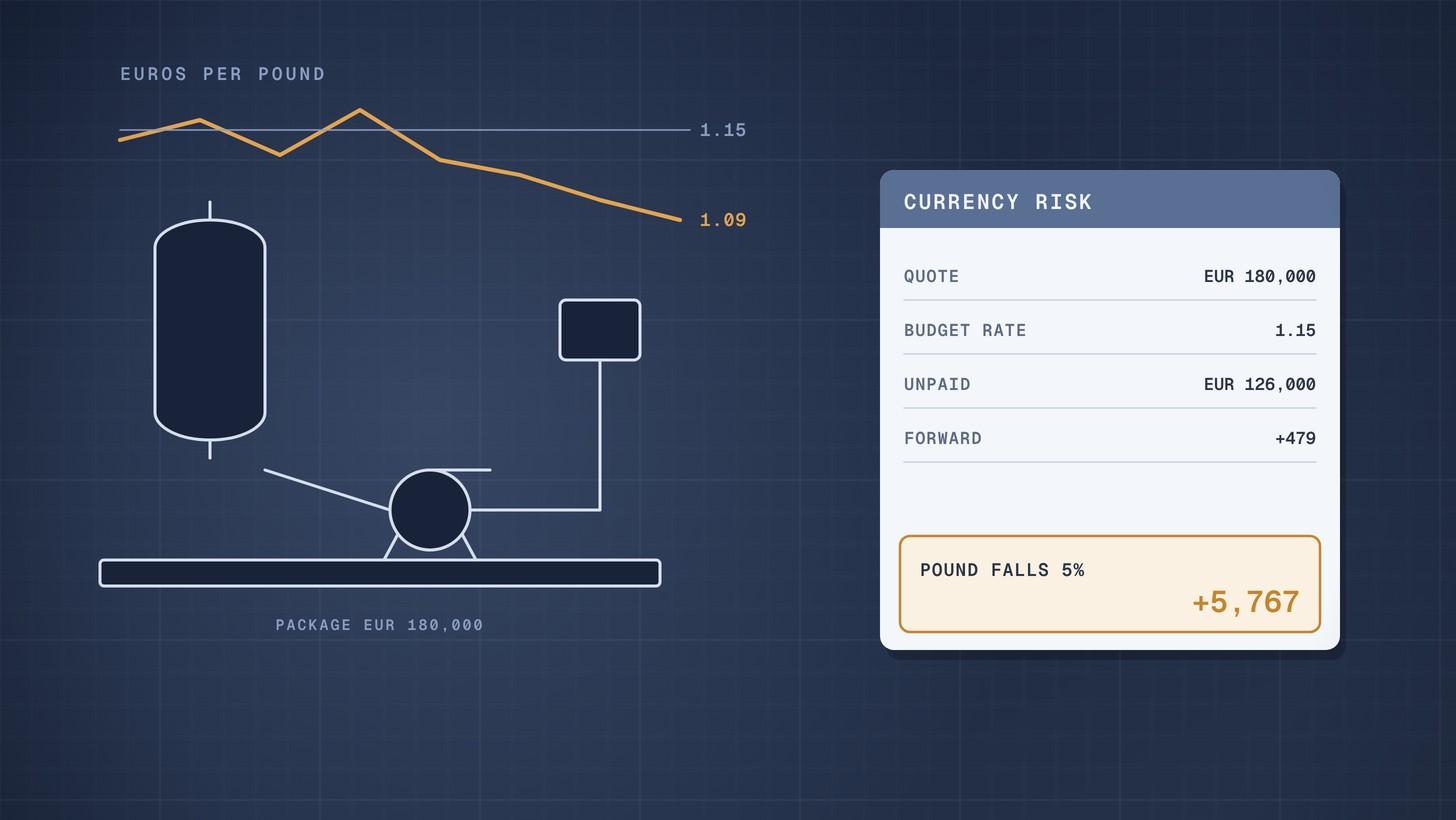
Exchange Rate Risk on Equipment Quotes: Worked Example
How exchange rate risk builds up on a euro or dollar equipment quote between order and final payment, what a 5% move costs, and how forwards and currency clauses limit it.
US Tariffs on Imported Process Equipment in 2026: What UK Suppliers Pay Now
The US tariff position for process equipment as of November 2026: Section 232 metals tariffs and UK rates, the Section 301 tariff that replaced Section 122, the new industrial machinery action, and how to protect a quotation.
How to Check a Supplier's Financial Health Before You Award an Equipment Order
The UK checks that tell you whether an equipment supplier will still be trading when your order is half built: Companies House, charges, Gazette notices and credit reports, plus how to protect advance payments.