
Price Adjustment, Escalation and Currency Clauses in Equipment Quotes
Why long lead equipment quotes carry escalation and alloy surcharge clauses, how the standard index formula works, what to agree, and how to compare a fixed and an adjustable bid.
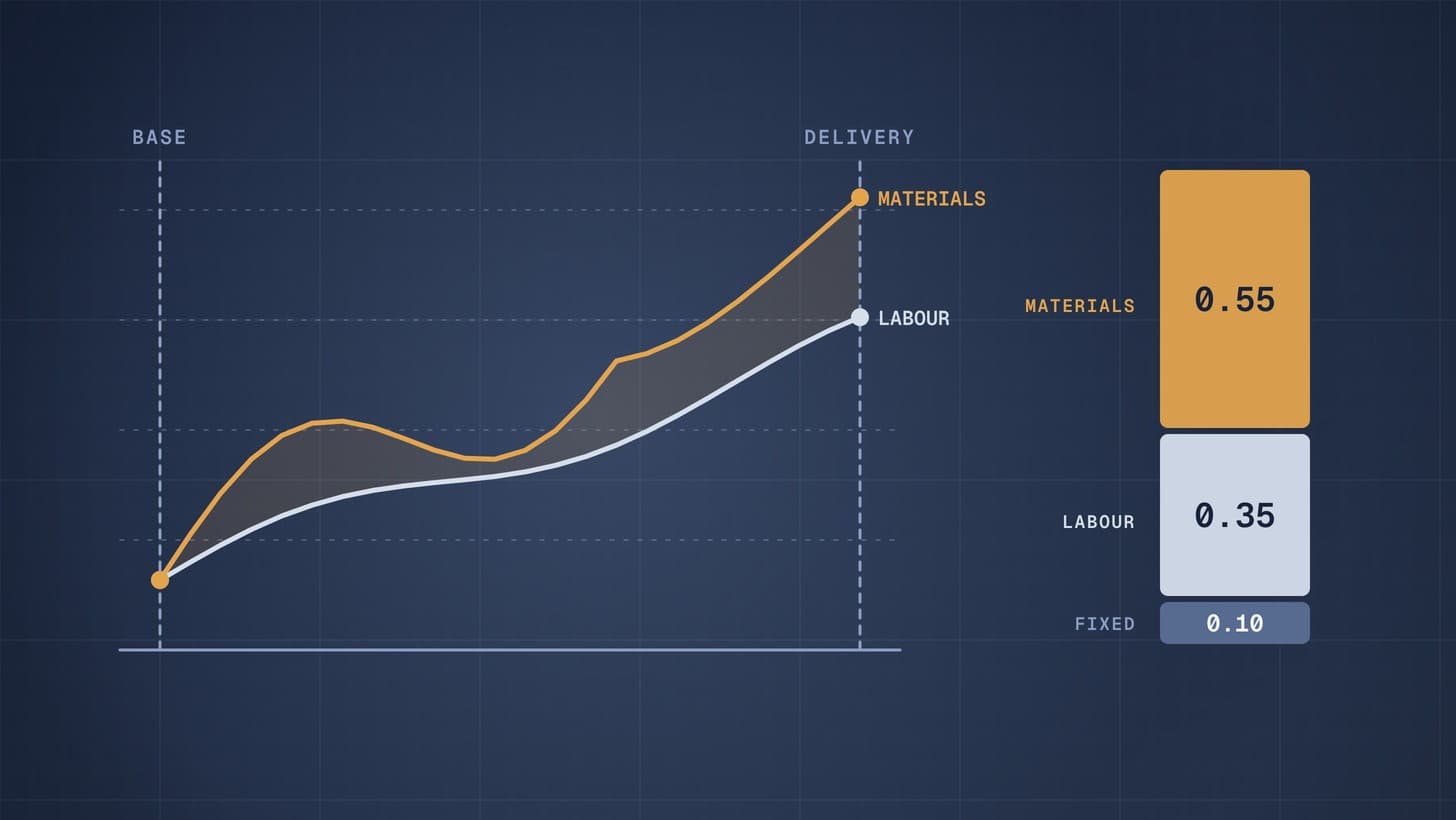
A price adjustment clause, also called an escalation clause, lets the price of equipment move with published cost indices between a base date and delivery, instead of the supplier adding a contingency to a fixed price. The usual formula keeps a fixed share of the price unchanged and links the rest to labour and material indices: adjusted price = base price × (fixed share + labour share × labour index now ÷ labour index at base + materials share × materials index now ÷ materials index at base). Alloy surcharges do the same job for stainless steel and nickel alloys, and currency clauses deal with exchange rates.
This is general information, not legal advice.
Why this matters now
Two changes make these clauses worth a closer look. First, the reference data is moving behind log ins: Outokumpu, a major stainless steel producer, says its European monthly alloy surcharges will from 1 January 2027 be available only to registered customers through its own portal [1]. A clause that says "plus the mill's alloy surcharge" needs to name which published figure applies and how you will see it.
Second, buyers remember how fixed prices broke in 2021 and 2022. Ireland's public works contracts, for example, had allowed no recovery outside their fixed price periods except for hyperinflation; interim measures from 7 January 2022 shortened the fixed period to 24 months and linked materials and fuel to official indices, with inflation thresholds [2]. Many equipment suppliers now ask for a clause rather than carry the risk.
Join ChemCapital to streamline sourcing and connect with verified partners
Whether you're buying or supplying, ChemCapital gives you the tools to manage the complete procurement cycle in one platform.
Why long lead equipment carries these clauses
An item with a lead time of a year or more is priced long before its steel, castings and motors are bought. The supplier can carry that risk by adding contingency, which the buyer pays whether or not costs rise, or share it through an index clause, which costs the buyer more only if costs actually rise. Neither is wrong; the choice should be deliberate.
Metal costs show why. Alloy surcharges are one of three parts of a stainless steel price, alongside the base price and extras, and are usually published month by month [1]. In July 2022, for example, Outokumpu's surcharge for grade 316 flat products was €4,613 a tonne, €128 lower than a month earlier, as nickel and molybdenum prices fell [3]. Our guide to long lead items covers which equipment usually falls into this group.
The standard index formula
The structure is the same in most formulas. A fixed share covers profit, overheads and costs already committed. The remaining shares, which add up to one with it, are linked to indices for labour, materials and sometimes fuel or energy.
South Africa's general conditions of contract for construction works, for example, use a fixed proportion of 0.10 unless the contract states otherwise, with the rest split between labour, plant, materials and fuel indices measured against a stated base month [4]. In the UK, BEAMA, the trade body for electrical infrastructure, has run a contract price adjustment service since 1969 and publishes standard clauses and formulae for electrical machinery and mechanical plant [5]. The Office for National Statistics publishes monthly producer price indices for materials and fuels bought by manufacturers and for factory gate prices [6], which are common choices for the materials part.
What to agree in the clause
| Element | What to agree | Watch out for |
|---|---|---|
| Base date | The month the base indices are taken from, usually the bid date | Using the order date, which adds the evaluation period to the supplier's account |
| Indices | Named series, publisher and a replacement if one stops | "Relevant indices" without names |
| Weights | Fixed, labour and materials shares that add up to one | A fixed share of zero, so the whole price floats |
| Adjustment period | Index at a stated month, or an average over manufacture | Indices taken after a late delivery; freeze them at the contract date if the supplier is late |
| Direction | Up and down | Clauses that only ever increase the price |
| Thresholds and caps | A band with no adjustment, and a maximum | No cap on an item whose metal content is volatile |
| Alloy surcharge | Which published surcharge, which month, applied to what weight of metal | Surcharge on the whole price, not just the alloy content |
| Currency | Price currency and how any conversion is fixed | Supplier's costs in one currency, price in another, with no rule |
On currency, the simplest answer is often to buy in the supplier's currency and fix the cost yourself with your bank, so the comparison between bids stays clean. Whichever route you take, write the rule down.
Practical example
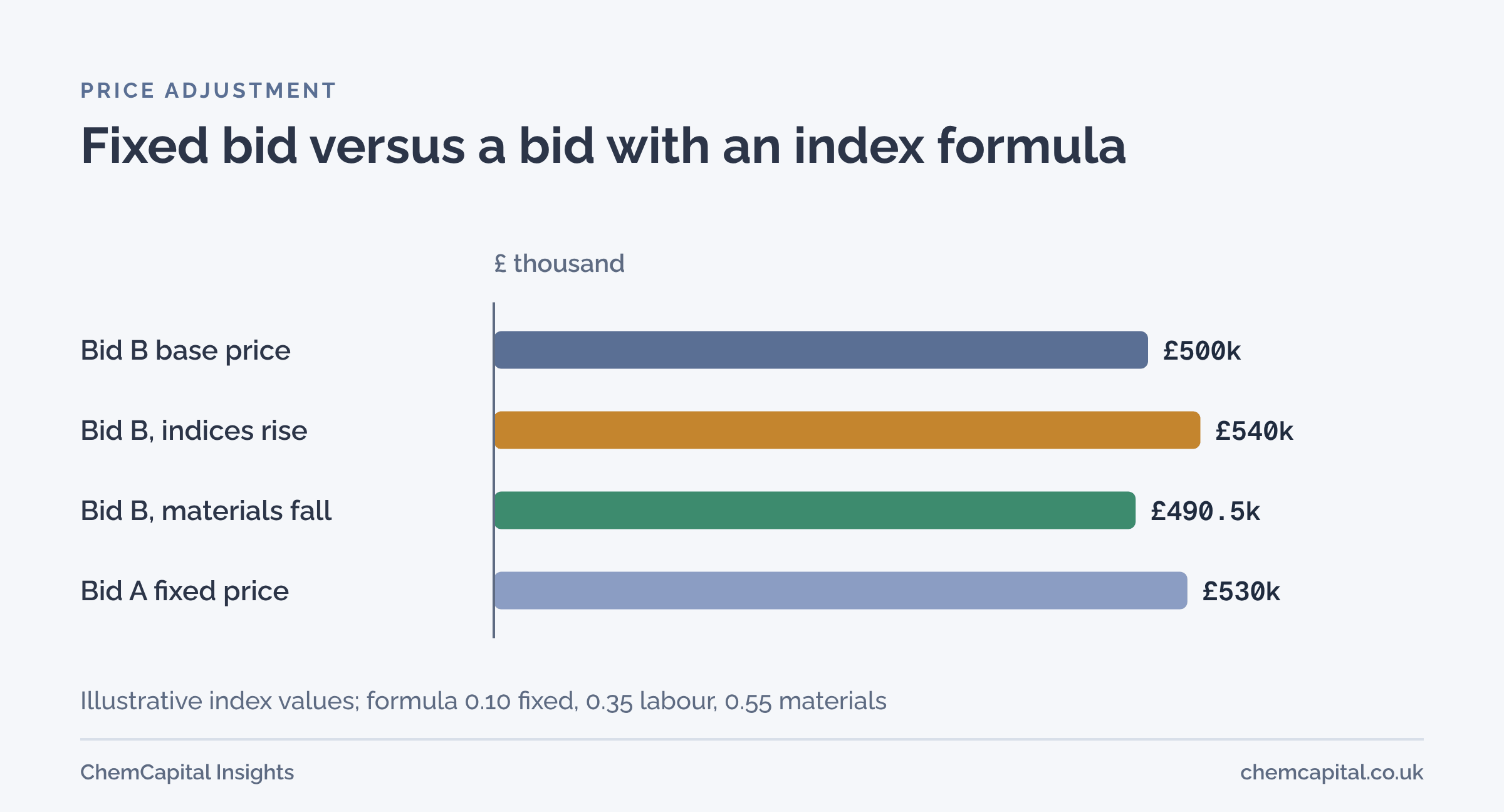
In this illustrative example, two bids arrive for the same package. Bid A is a fixed price of £530,000. Bid B is £500,000 with a formula: 0.10 fixed, 0.35 linked to a labour index and 0.55 linked to a materials index.
If indices rise. The labour index goes from 100 to 104 and the materials index from 100 to 112. The factor is 0.10 + 0.35 × 1.04 + 0.55 × 1.12 = 0.10 + 0.364 + 0.616 = 1.080, so Bid B becomes £540,000, £10,000 more than Bid A.
If materials fall. Labour still rises to 104, but materials fall to 94. The factor is 0.10 + 0.364 + 0.517 = 0.981, so Bid B becomes £490,500, £39,500 less than Bid A.
Break even. Bid B equals Bid A when the factor is 1.06. With labour at 104, that happens when the materials index reaches about 108.4, a rise of 8.4%. The buyer can now ask a sharper question: do we expect materials to rise more than about 8% before delivery, and how much risk are we willing to carry? That is a better basis for a decision than the headline prices. For time adjustments in your own estimates, see CEPCI and cost escalation.
Where ChemCapital fits
ChemCapital's Project Costing shows what each estimate rests on. Past quotes are kept in a library and can be repriced through a deterministic normalisation that adjusts for exchange rates and cost indices such as the CEPCI, among other factors, with every adjustment shown, and a dashboard separates firm quotes from repriced estimates and indicative values. That makes it clear which lines of a budget depend on an index forecast and which are fixed.
Ready to see which parts of your budget depend on index movements? Start free with ChemCapital.
Frequently asked questions
What is a price adjustment clause in an equipment contract?
It lets the contract price move with named published cost indices between a base date and delivery, instead of the supplier building a contingency into a fixed price. It usually keeps a fixed share of the price unadjusted and links the rest to labour and material indices. This is general information, not legal advice.
What is an alloy surcharge?
It is a separate part of the price of stainless steel and nickel alloys that passes changes in alloy costs along the supply chain. Producers usually calculate it from average alloy costs over a fixed period before delivery and publish it month by month.
How do I compare a fixed price bid with one that has an escalation clause?
Run the escalation formula with the same index forecast you use for your budget, and with a high and a low case, then compare the results with the fixed price. Ask the supplier with the formula for a fixed price alternative too.
Informational only, not procurement or legal advice. Cited names, frameworks, and statistics belong to their respective owners.
Join ChemCapital to streamline sourcing and connect with verified partners
Whether you're buying or supplying, ChemCapital gives you the tools to manage the complete procurement cycle in one platform.
Get started freeRelated articles
Cost Risk Analysis: P50, P80 and P90 Estimates with a Worked Example
What P50, P80 and P90 mean, how range estimating and Monte Carlo simulation produce them, a worked three item example, and how owners choose a funding level.
Equipment Cost Estimating: How to Get Budget Prices for Exchangers, Vessels and Pumps
Five ways to get budget prices before firm quotes, how accurate each can be by estimate class, what drives the price of each equipment type, and a worked example.
The Six Tenths Rule: Scaling Equipment Costs, with Worked Examples
How to scale a known equipment price to a new capacity with the six tenths rule, better exponents by equipment type, and how to bring an old quote up to date.