
The Six Tenths Rule: Scaling Equipment Costs, with Worked Examples
How to scale a known equipment price to a new capacity with the six tenths rule, better exponents by equipment type, and how to bring an old quote up to date.
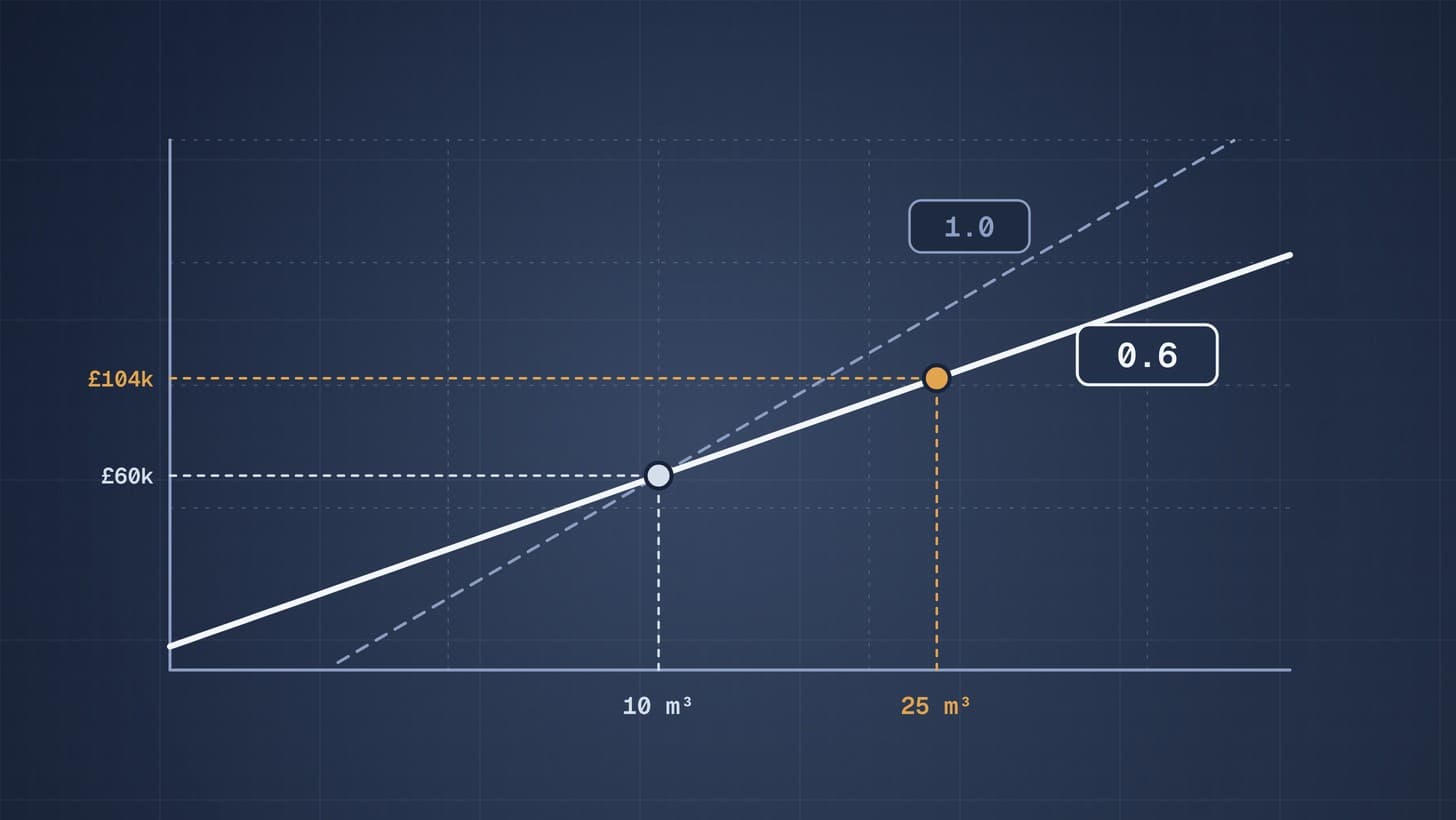
The six tenths rule estimates what equipment will cost at a new capacity from a known cost at another capacity. The formula is: new cost = known cost × (new capacity ÷ known capacity) raised to the power 0.6. Doubling capacity therefore raises the cost by about 52%, not 100%, because larger equipment needs less material for each unit of capacity. Use a better exponent for the equipment type where one is published, stay within about a tenfold change in size, and bring an old price up to date with a cost index.
It is a quick, early stage tool. It is not a substitute for a quote.
Why this matters now
Most early estimates start from a price someone paid for similar equipment a few years ago, which needs adjusting for both size and time. The time part has started moving again: Chemical Engineering reports that the 2025 annual average of its plant cost index rose 1.6% above 2024, reversing two years of decreases [1]. Our article on CEPCI and cost escalation covers the index itself; this one covers the size part, and how to combine the two.
Join ChemCapital to streamline sourcing and connect with verified partners
Whether you're buying or supplying, ChemCapital gives you the tools to manage the complete procurement cycle in one platform.
Where the 0.6 comes from
Think of a vessel. Its capacity grows with volume, but much of its cost follows the steel in its walls, which grows with surface area. Area grows roughly as volume to the power two thirds, about 0.67, so cost rises more slowly than capacity. Real equipment adds fixed costs such as nozzles, instruments and design hours, which pull the exponent lower still.
An AusIMM study calls the 0.6 exponent an aggregate indicator of economy of scale, and found that some cost drivers, such as flow rate and volume, follow it closely while others, such as surface area and pressure, need their own exponents [2].
Better exponents by equipment type
Where you can, use an exponent for the specific equipment. An open chemical engineering textbook gives these examples, each valid over a stated range [3].
| Equipment | Capacity measure | Range | Exponent |
|---|---|---|---|
| Shell and tube heat exchanger, stainless steel | Area, m² | 1.9 to 1,860 | 0.60 |
| Centrifugal pump, stainless steel | Power, hp | 1 to 70 | 0.67 |
| Multistage air compressor | Power, kW | 1 to 1,500 | 0.85 |
| Crystalliser | Volume, m³ | 0.2 to 3.8 | 0.47 |
| Horizontal carbon steel tank | Volume, m³ | 0.5 to 74 | 0.30 |
Course notes based on Peters and Timmerhaus put the true range of exponents from below 0.3 to above 1 [4]. A tank that costs little more as it grows and a compressor that costs almost proportionally more are both normal. Picking 0.6 for everything is where most errors start.
Rules for using it well
- Like for like. Same equipment type, same material, similar pressure and temperature [4].
- Stay within about tenfold. The same notes warn against stretching the capacity range beyond ten times [4]; the US Department of Energy's scaling guidance warns of large errors outside each exponent's range [5].
- Watch for steps. Prices can jump at certain sizes, and items sold in fixed sizes do not scale smoothly; the same guidance treats combustion turbines as a fixed cost for that reason [5].
- Your answer is no better than your starting price. The scaled estimate is at best as accurate as the reference cost [5].
- Scale first, then index. Correct for size, then multiply by today's index divided by the index when the price was quoted [4].
- Know when to stop. The EPA's cost manual treats escalation over more than five years as generally inappropriate and advises getting new quotes instead [6].
Practical example: scaling a vessel price
In this illustrative example, a 10 m³ stainless steel vessel was quoted at £60,000. You need a budget figure for a 25 m³ vessel of the same design, and the cost index has risen from 700 to 800 since the quote.
Step 1: scale for size. The capacity ratio is 25 ÷ 10 = 2.5. With the six tenths rule, 2.5 to the power 0.6 is 1.733, so the scaled cost is £60,000 × 1.733 = about £104,000.
Step 2: update for time. The index ratio is 800 ÷ 700 = 1.143, so the estimate becomes £104,000 × 1.143 = about £118,800.
Step 3: test the exponent. If this vessel behaved like the horizontal carbon steel tank in the table, with an exponent of 0.3, the size factor would be 1.316, giving about £79,000 before indexing and about £90,300 after.
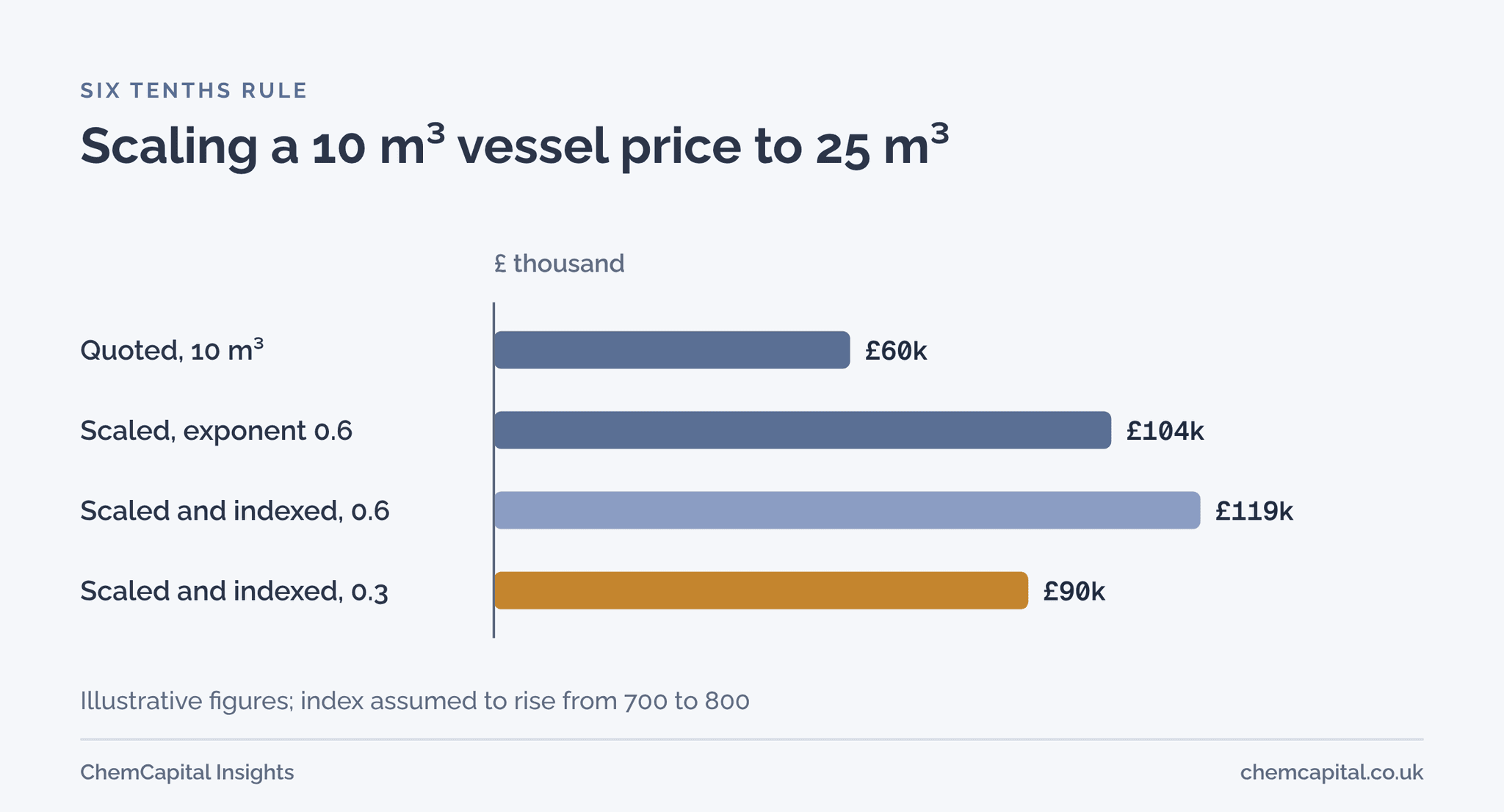
The gap between £90,000 and £119,000 is the honest uncertainty in this method. Report a range, say which exponent you used, and replace the figure with a budgetary quote when the item matters. For whole plant estimates built on equipment costs, see the Lang factor method.
When not to use it
- For items sold in standard sizes, such as motors and catalogue pumps, where the next size up is a fixed step.
- Across a change of material, pressure rating or design code.
- For small packaged units, where controls, testing and documents form most of the price.
- When the reference price is old, from a different country, or for a different scope.
Where ChemCapital fits
ChemCapital's Project Costing starts from real prices rather than rules of thumb. Past supplier quotations are extracted into a library you can reuse, and old quotes can be repriced through a deterministic normalisation that adjusts for exchange rates, cost indices such as the CEPCI, geography and Incoterms, with every adjustment shown so you can trace each figure back to the original quote.
Ready to start your next estimate from prices you have already paid? Start free with ChemCapital.
Frequently asked questions
What is the six tenths rule?
It is a shortcut for estimating the cost of equipment at a new size: new cost equals known cost times the capacity ratio raised to the power 0.6. Doubling capacity raises cost by about 52%, because larger equipment needs proportionally less material per unit of capacity.
When should I not use the six tenths rule?
Avoid it beyond about a tenfold change in size, across different materials or pressure ratings, for items sold in fixed sizes, and for small packages where fixed costs such as controls dominate. Use a published exponent for the equipment type where one exists.
How do I combine the six tenths rule with a cost index?
Scale the old price for size first, then multiply by the ratio of today's index to the index when the price was quoted. Indices lose accuracy over long periods, so after about five years a new quote is usually the better answer.
Informational only, not procurement or legal advice. Cited names, frameworks, and statistics belong to their respective owners.
Join ChemCapital to streamline sourcing and connect with verified partners
Whether you're buying or supplying, ChemCapital gives you the tools to manage the complete procurement cycle in one platform.
Get started freeRelated articles

CEPCI: How to Escalate an Old Equipment Quote to Today's Prices
How to bring an old equipment quote up to date with the CEPCI: the index ratio, the six tenths rule, currency for UK buyers and the pitfalls to check first.
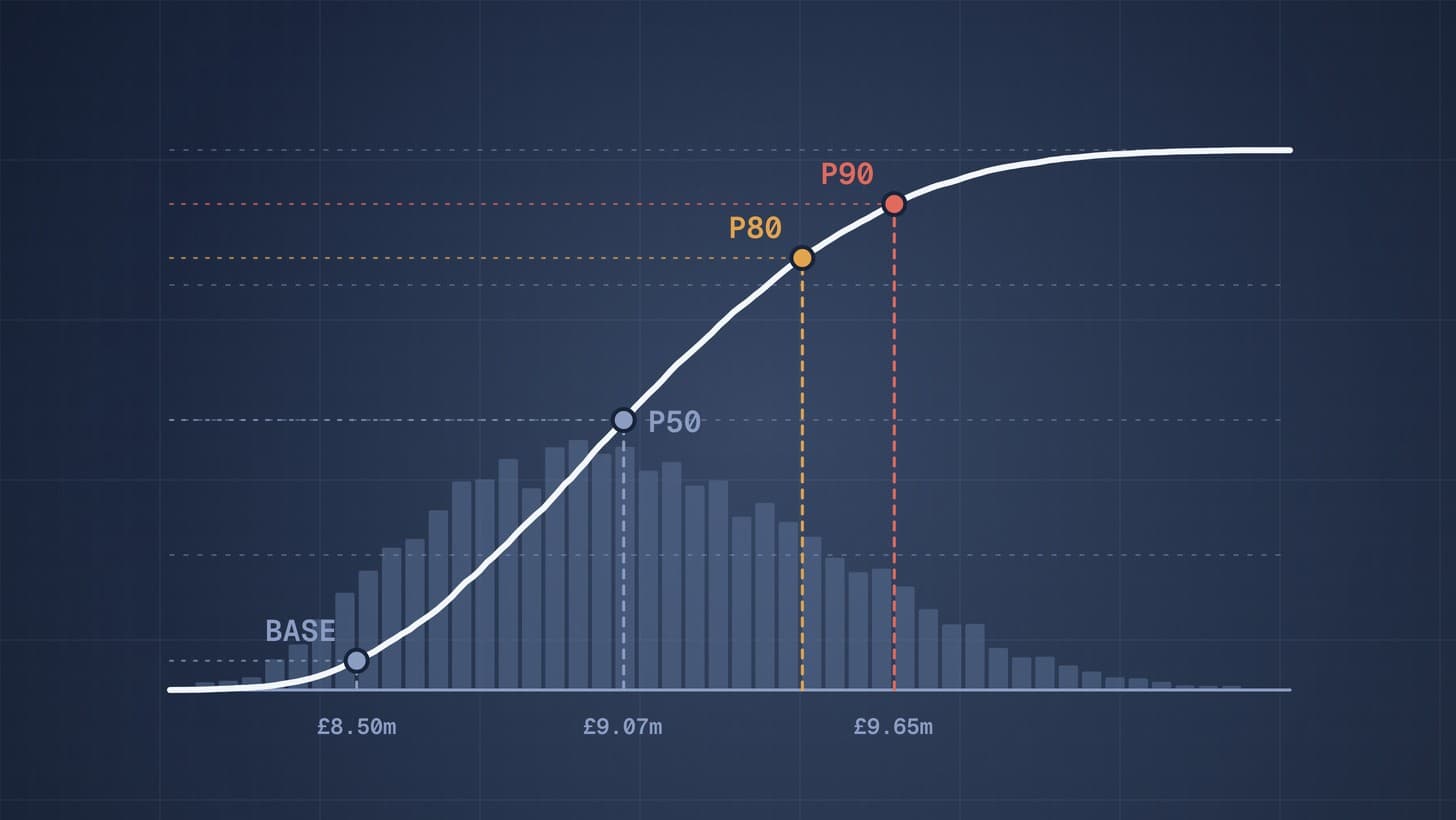
Cost Risk Analysis: P50, P80 and P90 Estimates with a Worked Example
What P50, P80 and P90 mean, how range estimating and Monte Carlo simulation produce them, a worked three item example, and how owners choose a funding level.
Equipment Cost Estimating: How to Get Budget Prices for Exchangers, Vessels and Pumps
Five ways to get budget prices before firm quotes, how accurate each can be by estimate class, what drives the price of each equipment type, and a worked example.