
RABS vs Isolators: Choosing a Barrier System Under EU GMP Annex 1
How restricted access barrier systems and isolators differ on background grade, decontamination, gloves, changeover and cost under the 2022 EU GMP Annex 1, and what to ask suppliers before you choose.
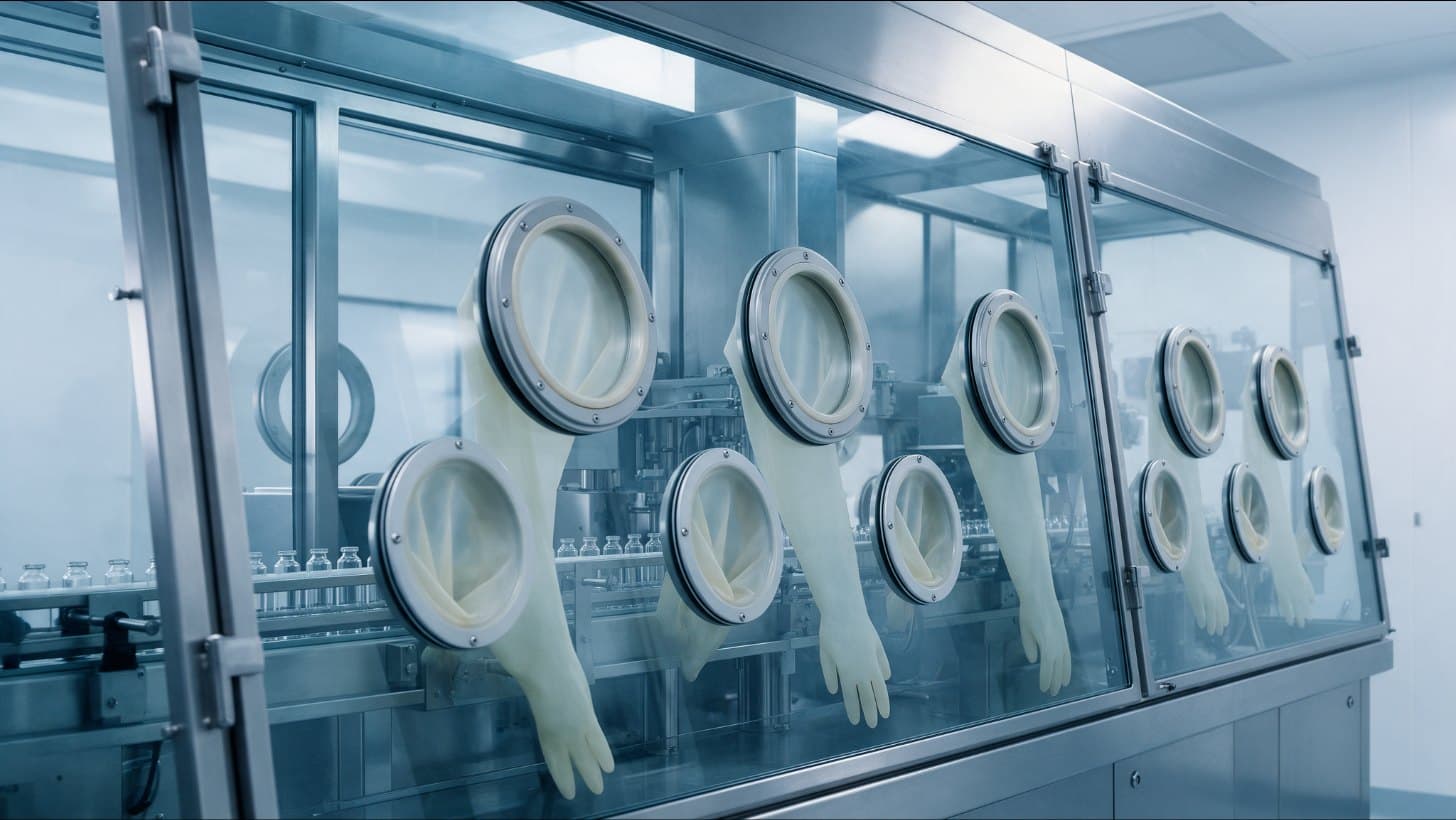
A RABS (restricted access barrier system) and an isolator both create a grade A zone for aseptic processing, separated from operators by rigid walls and glove ports. The difference is how completely. An isolator is an enclosure separated from the room around it, decontaminated by an automated, validated cycle that uses a sporicidal agent in gas or vapour form, and EU GMP Annex 1 allows it to sit in a grade C room, or a grade D room if it is a closed isolator. A RABS relies on routine application of a sporicidal agent and needs a grade B room around it [1]; that disinfection is usually manual [2].
The trade off follows from that. Isolators cost more to buy and take longer to change over, but reduce the cleanroom, gowning and monitoring burden around them. RABS cost less and change over faster, but keep a grade B suite and the people working in it [2] [3]. The right choice depends on your products, your changeovers and your building, and Annex 1 expects it to be justified.
Why this matters now
The revised EU GMP Annex 1 applied from 25 August 2023 [1]. It names RABS and isolators among the appropriate technologies for protecting sterile products and says they are "beneficial in assuring required conditions" [1]. For isolators, it expects the background grade to be based on risk assessment and justified in the site's contamination control strategy [1].
The market has moved. A 2013 article from Vetter counted about 2,200 commercial aseptic lines in conventional cleanrooms worldwide, over 430 isolator lines and about 250 RABS [4]. An August 2026 review of sterile fill finish says adoption "has clearly bent toward isolators", while noting that both technologies remain acceptable if the choice is justified [2]. Anyone buying a new filling line, or upgrading a legacy one, now has to choose deliberately, and the choice shapes the building, the staffing and the supplier shortlist.
Create and manage RFQs in minutes
ChemCapital handles the entire procurement cycle, from structured RFQs and supplier comparisons to formal purchase orders and delivery tracking.
What a RABS is
The industry definition came from ISPE in 2005, written with input from the US FDA. It describes a RABS as a system, not just hardware: a rigid wall enclosure that physically separates aseptic operations from operators; unidirectional airflow giving ISO 5 in the critical zone; access only through glove ports, half suits or automation; sterile gloves at installation; sterilisation in place preferred for product pathways; and high level sporicidal disinfection of non product contact surfaces before each batch [5]. Doors are meant to stay closed. The definition allows rare open door interventions, but treats each one as a significant event, with interlocked doors, recorded alarms, disinfection, line clearance and documentation [5]. One contract filler goes further: if filling is interrupted by an open door intervention, the line is cleaned and cleared and the batch is discarded [4].
RABS come in several forms, and suppliers use the terms loosely, so define them in your specification:
| Type | Air supply | Air return | Notes |
|---|---|---|---|
| Passive open RABS | From the room's ceiling HEPA filters | Overflows into the room | Cheapest and highest risk; not for highly active substances; well suited to retrofits [6] [7] |
| Active open RABS | Integrated fan and HEPA filter unit | Overflows into the room | Better pressure control between grade A and grade B [6] [7] |
| Closed RABS | Integrated | Recirculated inside the barrier | Doors locked during operation; with suitable filtration, can handle highly active substances [6] |
For passive RABS, one guide value for the pressure difference to the grade B room is 10 Pa, confirmed by smoke studies [6].
What an isolator is
Annex 1 distinguishes two kinds. An open isolator must give grade A conditions with first air protection in the critical zone; a closed isolator must give grade A conditions with adequate protection [1]. In practice, open isolators pass materials in and out through small openings, often called mouse holes, protected by continuous overpressure, while closed isolators transfer everything through validated systems such as material locks with hydrogen peroxide surface decontamination. Sterility test isolators and cell and gene therapy process isolators are typical closed designs [6].
The defining feature is decontamination. Annex 1 expects an isolator's bio decontamination to be automated, validated and controlled, and to include a sporicidal agent in a suitable form, such as gas or vapour [1]. Vaporised hydrogen peroxide is the most common choice [2]. The cycle takes time: one manufacturer of isolators puts current processes at roughly one to four hours, depending on chamber size, load and technology, with aeration down to a residual peroxide level, commonly 1 part per million, often taking most of it [8]. Cycles have shortened a lot. Syntegon says cycles took about ten hours in the early 1990s and six by the late 1990s, and says customers of its current system report under an hour on fully loaded commercial lines [9].
Side by side
| RABS | Isolator | |
|---|---|---|
| Grade A design | Unidirectional airflow and first air protection | First air protection (open isolator) or adequate protection (closed isolator) |
| Minimum background | Grade B | Grade C for open isolators, grade D for closed, based on risk assessment |
| Decontamination | Routine application of a sporicidal agent | Automated and validated, sporicidal agent in gas or vapour form |
| Gloves | Sterile when installed; sterilised or bio decontaminated before each campaign | Integrity tested at least at the start and end of each batch or campaign, plus a visual check with each use |
| Changeover | Shorter | Longer |
| Capital cost | Lower | Higher |
| Running cost | Grade B area, gowning and monitoring | Lower background costs, plus decontamination time and hydrogen peroxide |
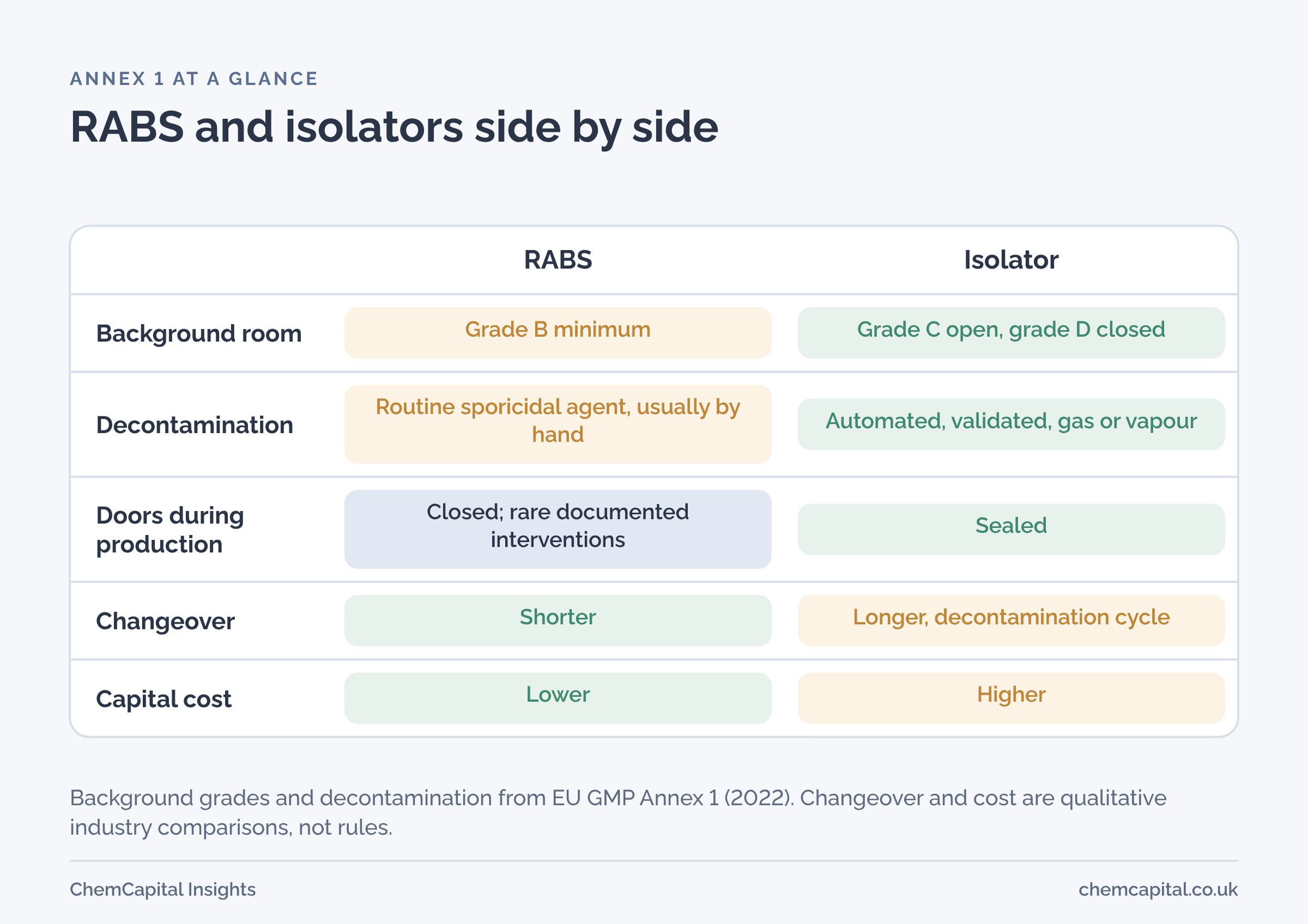
The design, background, decontamination and glove rows come from Annex 1 and the ISPE definition [1] [2] [5]. The changeover and cost rows are industry comparisons, not rules [2] [4] [3]. One older comparison put qualification at six to nine months for cleanrooms, RABS and isolators alike [3], so do not assume either choice is faster to qualify.
How to choose
Start with the product. Highly potent or cytotoxic products push you towards a closed RABS or an isolator; a passive RABS is not suitable for highly active substances [6]. Isolators have long suited mono lines running one product continuously, such as potent or cytotoxic drugs [4].
Count your changeovers. Each isolator changeover means a decontamination cycle, and isolator changeovers are longer [2]. A line with many products and short campaigns spends a noticeable amount of line time decontaminating, which is why RABS are often presented as the more flexible option [4].
Look at the building. An isolator's lower background grade can reduce heating, ventilation and air conditioning load and facility footprint over the life of the plant [2]. For a legacy line in an existing grade B suite, a passive RABS is often the practical retrofit [7].
Count the people. People are the main source of contamination in conventional aseptic processing [5]; one PDA Letter article puts the release from a gowned operator at up to 10,000 colony forming units an hour [7]. A RABS keeps operators gowning into grade B, and training staff to handle door openings correctly often takes months [6].
Write it down. Whatever you choose, Annex 1 expects the choice to be justified in your contamination control strategy [2], and for an isolator, the background grade too [1].
What to ask suppliers
- Decontamination cycle time, honestly measured. Ask for the time with a worst case load in a representative pattern, at your room's temperature and humidity, from clock start to end of aeration, and the residual peroxide level it ends at. Absorbent items such as tubing and wrapped packs lengthen aeration, and a fast reduction at a few easy locations is not a robust basis for comparison [8].
- Glove ports and reach. The number and position of glove ports, proved by mock up studies during design so operators can reach every intervention point [4]; the glove testing method and equipment; and how glove change frequency will be defined, which Annex 1 leaves to your contamination control strategy [1].
- Airflow evidence. Smoke studies covering interventions and, for a RABS, door openings [1] [6].
- Doors, alarms and interlocks. How door openings are prevented, alarmed and recorded [5].
- Transfer systems. Rapid transfer ports, material locks and how each is decontaminated [7] [6].
- Qualification and testing. What the supplier will demonstrate at the factory acceptance test, and which documents it provides for installation, operational and performance qualification. Our factory acceptance test checklist is a starting point.
- Scope at the edges. Whether the hydrogen peroxide generator, glove testing unit, transfer ports, environmental monitoring connections and room works are in or out of the price.
Practical example
In this illustrative example, a contract manufacturer is buying a new vial filling line. It expects around 60 campaigns a year across many products, and two of its clients' products are highly potent.
The flexibility argument favours a RABS: 60 isolator decontamination cycles at two to three hours each would take 120 to 180 hours of line time a year, within the one to four hour range one manufacturer gives for current cycles [8]. The potent products point the other way, because a passive RABS is not suitable for highly active substances [6]. The team narrows the choice to a closed RABS in a grade B suite or an open isolator in a grade C room, and asks three suppliers to quote both against the same user requirement specification.
The bids come back with decontamination cycle times of 45 minutes, 2 hours and 3.5 hours for the isolator option. On inspection, the 45 minute figure is for an empty chamber, and the 3.5 hour figure is for a worst case load. The buyer asks all three to restate the cycle on the same worst case load and room conditions, as above. Two quotes also leave the glove testing unit out of scope, and one excludes the hydrogen peroxide generator. Once scope and cycle times are on the same basis, the isolator from the second supplier wins on total cost over ten years, because the lower grade C background, with lighter gowning, air handling and monitoring, offsets its higher price.
Where ChemCapital fits
Barrier systems are complex, high value packages where scope gaps and unlike for like claims hide easily. ChemCapital sends one structured RFQ with line items and attachments, so every supplier quotes against the same user requirement specification. The AI quotation comparison extracts price, lead time, materials, certifications and scope from each quote, keeps the source text beside every extracted field, and checks for missing fields, unit mismatches and scope differences, such as a glove testing unit included in one bid and missing from another. You can weight the scoring across commercial, technical, delivery, compliance and risk, and people make the final call. See how ChemCapital supports pharmaceutical manufacturing.
Ready to compare barrier system bids on the same scope? Start a free 14 day ChemCapital trial, with no credit card needed.
Frequently asked questions
What background grade does an isolator need under Annex 1?
The 2022 EU GMP Annex 1 says the background for open isolators should generally be at least grade C, and for closed isolators at least grade D, with the decision based on risk assessment and justified in the contamination control strategy. RABS used for aseptic processing need at least a grade B background.
What is the difference between open and closed RABS?
In an open RABS, air from the grade A zone overflows into the surrounding room, and doors may be opened for rare, documented interventions. A closed RABS recirculates its air and keeps its doors locked during operation; with suitable filtration on the air return, it can also handle highly active products.
Is an isolator always better than a RABS?
No. An isolator separates the process from people and the room more completely and needs a lower background grade, but it costs more to buy and changes over more slowly because of its decontamination cycle. A RABS is cheaper and more flexible but keeps a grade B room around it. Annex 1 expects the choice to be justified in the contamination control strategy.
Continue reading
Informational only, not procurement or legal advice. Cited names, frameworks, and statistics belong to their respective owners.
Create and manage RFQs in minutes
ChemCapital handles the entire procurement cycle, from structured RFQs and supplier comparisons to formal purchase orders and delivery tracking.
Start for freeRelated articles
Category Strategy for Engineered Process Equipment: A Step by Step Method
How to build a category strategy for pumps, heat exchangers, vessels, valves and skids: spend and pipeline data, market analysis, Kraljic positioning, sourcing routes and a one page template.
Pharmaceutical Water Systems: Buying Purified Water, WFI and Pure Steam Generation
Which water grade each use needs, how multiple effect distillation, vapour compression and membrane WFI compare on cost and risk, and what Annex 1 expects of the loop.
Procurement in the Chemical Industry: Categories, Risks and Capital Equipment
How chemical companies spend, from formula priced feedstocks to spares and capital equipment, where the savings and risks lie in each category, and what leading procurement teams do differently.