
Category Strategy for Engineered Process Equipment: A Step by Step Method
How to build a category strategy for pumps, heat exchangers, vessels, valves and skids: spend and pipeline data, market analysis, Kraljic positioning, sourcing routes and a one page template.
A category strategy for engineered process equipment is a written plan, usually for three to five years, that groups similar equipment bought across sites and projects (pumps, heat exchangers, pressure vessels, valves, packaged skids), sets what the organisation needs from each supply market, and decides how to buy it: a fresh competitive tender for every project, a framework agreement with a few qualified makers, or a long term alliance. It is built from four inputs: spend history, the project pipeline, a supply market analysis and the engineering standards your plants already run on.
The method below follows the standard category management cycle, adapted for equipment that is engineered to a duty, bought in lumps when projects happen and then lived with for twenty years. It ends with a one page template you can copy.
Why this matters now
On capital projects, most of the money leaves the building. Boston Consulting Group's study of engineered products found external spending can reach 80 percent or more of a project's total budget, and reported that companies using its capital procurement model can save as much as 15 percent of a project's net present value [1]. At one global resources company it described, 40 percent of projects had no dedicated procurement manager [1]. Buying project by project, with no view across projects, leaves that value on the table.
Industry is also moving towards shared specifications. IOGP's JIP33 programme now holds 58 standardised procurement specifications, aims to cover about 80 percent of procurement scope, and since January 2026 all IOGP members can take part in maintaining the specifications [2]. In the UK public sector, the Cabinet Office's Sourcing Playbook, updated in September 2026, expects a market health and capability assessment for every sourcing project and calls a should cost model good practice for all procurements [3]. Private buyers are not bound by it, but the thinking travels well.
Create and manage RFQs in minutes
ChemCapital handles the entire procurement cycle, from structured RFQs and supplier comparisons to formal purchase orders and delivery tracking.
How engineered equipment differs from other categories
Category management grew up in indirect spend: stationery, IT, travel. The cycle still works for equipment, but several features change the answers.
| Feature | Typical indirect category | Engineered process equipment | What it means for the strategy |
|---|---|---|---|
| Demand | Steady, predictable | Lumpy, driven by projects and shutdowns | Plan from the capital pipeline, not last year's spend |
| Specification | Catalogue items | Designed to a duty, codes and site standards | Standard datasheets matter as much as price |
| Lead time | Days to weeks | Often months; longer for large or alloy items | Strategy must protect schedule, not only cost |
| Cost over life | Purchase price dominates | Energy, maintenance and spares often dominate | Evaluate on life cycle cost |
| Installed base | Replaced often | Runs for decades | Every new make adds spares and training |
| Compliance | Light | Pressure, hazardous area and quality documents | Supplier capability is part of the category |
Two of these deserve emphasis. First, the installed base: every pump make you add means more spare parts, more seal designs and more training for maintenance teams, for as long as the pump runs. Second, life cycle cost: for equipment that runs continuously, the purchase price can be the smaller number, which is why one mining company in BCG's study standardised the total cost of ownership models used by all its sites [1]. Our guide to life cycle cost when comparing equipment quotes shows how to put numbers on it.
Step 1: Define the category and its boundaries
CIPS describes the cycle as starting with defining categories: naming them, deciding what procurement will manage within each, and setting up a team across the functions involved [4]. For equipment, draw boundaries around supply markets, not budget codes. A useful test is whether the same group of makers could bid for everything inside the boundary.
A typical split for a chemical or pharmaceutical manufacturer looks like this:
- Rotating equipment: centrifugal pumps, positive displacement pumps, agitators, compressors and fans.
- Heat transfer: shell and tube and plate heat exchangers, coolers and condensers.
- Vessels and columns: pressure vessels, storage tanks, reactors, columns.
- Packaged equipment: skids such as CIP units, dosing systems, purified water plant and vacuum packages.
- Valves and actuation: manual, control, safety and hygienic valves.
- Instrumentation and analysers.
Then split further where the market splits. A glass lined reactor and a carbon steel buffer tank are both vessels, but the number of capable makers, the lead times and the risks are entirely different, so they deserve different strategies.
Step 2: Analyse spend and demand
Pull three years of purchase orders and project cost reports, and classify each line by subcategory, supplier, site and project. Then add the two things indirect categories rarely need:
- The forward pipeline. List the projects in the capital plan with their equipment content and likely order dates. For lumpy categories, next year's demand often bears no resemblance to last year's.
- The installed base. Count the makes and models already running, by site, from the asset register. Variety is a cost: it drives spare parts holdings and maintenance effort.
The output is a short fact base: total spend per subcategory, top suppliers and their share, number of makes installed, forecast demand by year and the projects that drive it.
Step 3: Analyse the supply market
CIPS frames this stage as researching business needs and the supply market, including competitive and economic analysis [4]. For engineered equipment, answer six questions per subcategory:
- How many qualified makers can supply to your codes and standards? Count those you would actually accept, not every name on a directory.
- How concentrated is the market? A few makers with full order books means you compete for their attention, not the other way round.
- What are the lead times, and are they moving? Ask suppliers directly during market engagement.
- What drives their costs? Alloy content links prices to nickel and stainless surcharges; see our guide to stainless steel and nickel prices in equipment quotes.
- Where is it made, and what are the risks? Geography, sanctions, single factories and logistics for oversized loads.
- What regulation applies? Pressure equipment marking, hazardous area certification and pharmaceutical documentation all narrow the field.
Kraljic listed similar measures of supply market complexity: scarcity, the pace of technological change, entry barriers, logistics and monopoly or oligopoly conditions [5]. If your list of qualified makers is short, widening it is a strategy in itself; our guide on how to find process equipment suppliers covers the search and the checks.
Step 4: Position each subcategory
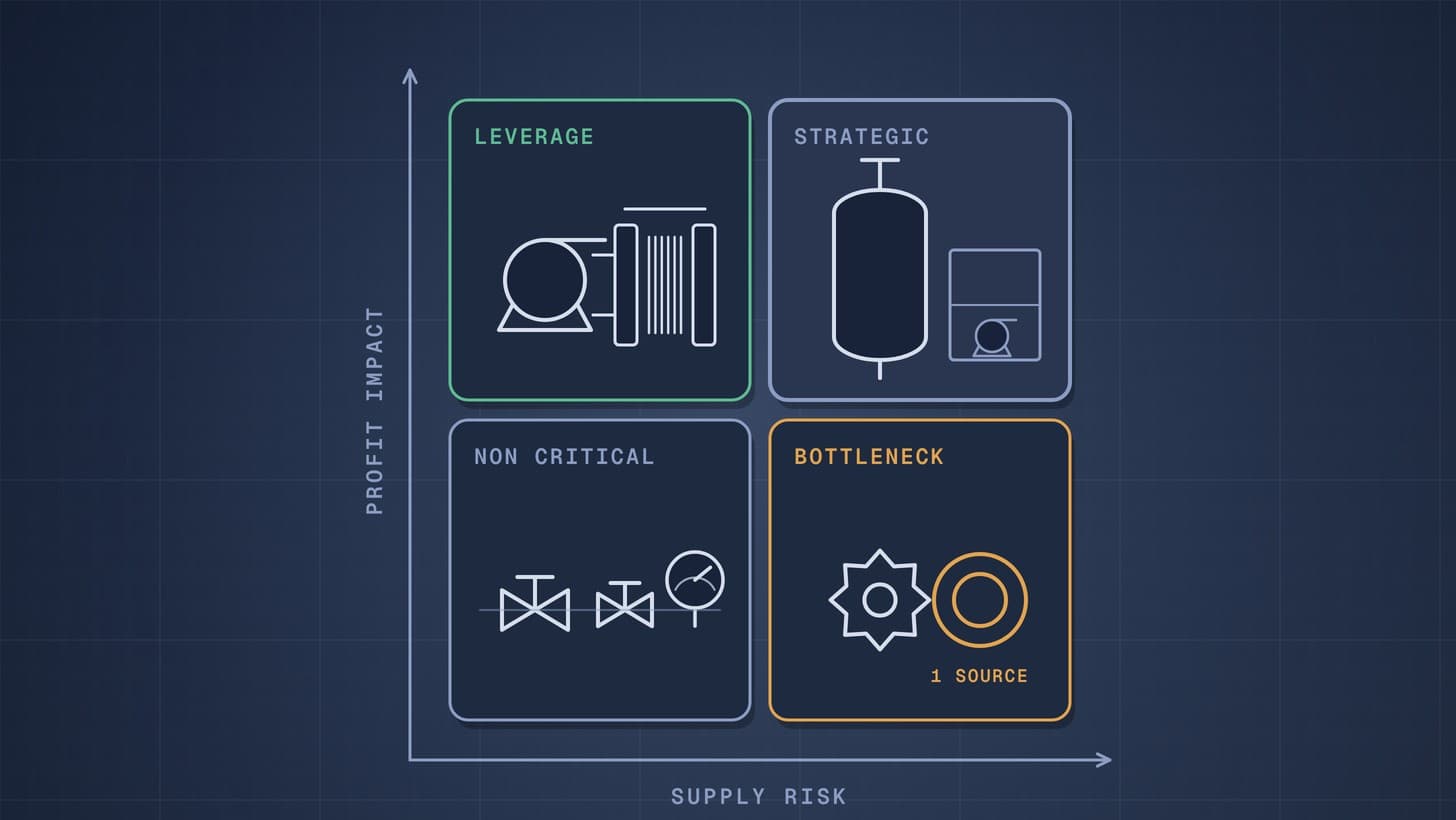
Kraljic's 1983 article in the Harvard Business Review sorted purchases on two axes: their importance to profit, and the complexity of the supply market. That gives four groups, each with its own approach [5]:
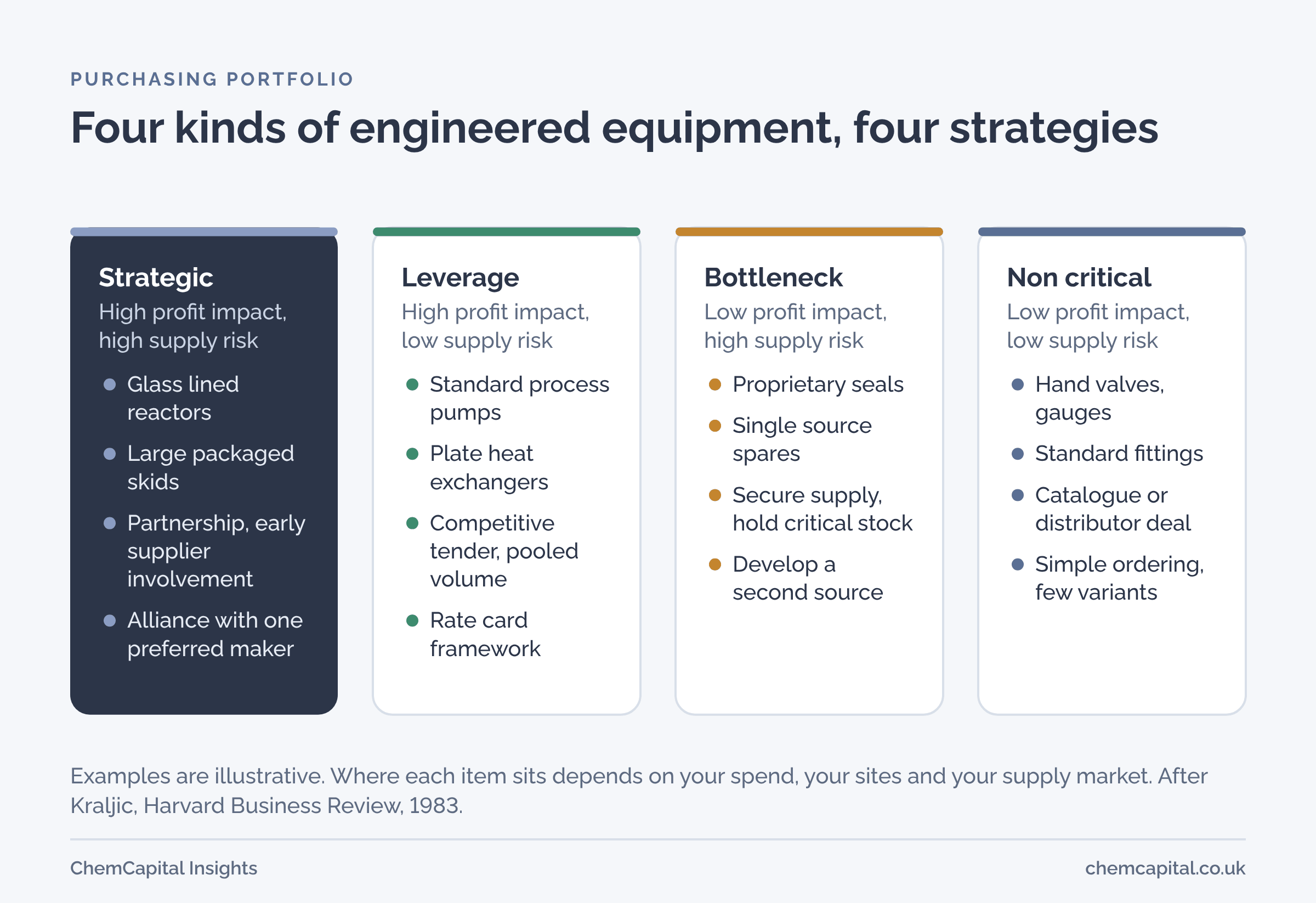
- Strategic items (high impact, high risk): detailed market research, long term relationships, risk analysis and contingency planning, with decisions taken at senior level [5]. In equipment, think of reactors, large packaged systems and anything with very few qualified makers.
- Leverage items (high impact, low risk): use full purchasing power through supplier selection and targeted negotiation [5]. Standard process pumps and plate heat exchangers often sit here because several makers compete.
- Bottleneck items (low impact, high risk): secure supply, even at a premium, with backup plans and stock [5]. Proprietary seals and spares from a single original manufacturer are classic examples.
- Non critical items (low impact, low risk): standardise and simplify ordering [5]. Hand valves, gauges and fittings belong here.
Positions are not permanent. A leverage category can become strategic when two makers merge, or when your standard locks you into one design, because supply risk rises while the spend stays high.
Step 5: Choose the sourcing route
The position points towards a sourcing route. These are the four that matter for engineered equipment:
| Route | How it works | Best for | Watch out for |
|---|---|---|---|
| Competitive tender per project | Each project issues its own RFQ to qualified bidders | Leverage items with infrequent demand; unusual duties | Repeated bid effort; many makes in the installed base |
| Framework agreement | Pre agreed terms, standard specifications and price basis with two or three makers; each order by direct award or a short mini competition | Leverage items with steady demand across projects | Frameworks that are never used because projects were not consulted |
| Alliance with one preferred maker | Long term relationship, early involvement in design, shared performance measures | Strategic items where supplier expertise adds most value | Complacency on price; dependence on one maker |
| Direct from the original manufacturer | Negotiated agreement for proprietary items and spares | Bottleneck items | Single source exposure; secure stock and a second source where you can |
The evidence on alliances is mixed, and worth knowing. A 2003 master's thesis on supplier alliances for engineered equipment in capital projects, based on a survey and interviews with 16 companies, found experts estimated initial price savings of 6 to 10 percent and procurement time savings of up to six months, but valued time and quality gains more than price [6]. The same study cautioned that broader industry studies find most alliances end in failure, and that very few companies measured alliance performance [6]. If you choose an alliance, build the measures in from day one.
BCG adds a practical warning: engage suppliers early, but avoid committing to them before competitive contracting is possible [1]. For deciding which suppliers go on which list, see preferred supplier list vs approved vendor list.
Step 6: Standardise the specification
The strongest lever in engineered categories is often not price but variety. Standard datasheets, a short list of preferred materials and a set of approved designs mean fewer makes in the installed base, interchangeable spares, faster bids and fewer technical queries. BCG lists standardisation of designs, equipment and work packages across projects as a source of economies of scale and reduced engineering effort [1]. JIP33 applies the same idea across an industry: its specifications cover technical, information and quality requirements plus procurement data sheets, and are written to sit alongside international standards rather than replace them [2].
Engineering must own the standard; procurement makes it stick. A good datasheet is the starting point, as in our centrifugal pump datasheet for an RFQ.
Step 7: Write it down on one page
CIPS describes the strategy stage as agreeing sourcing routes, quantifying benefits, costs and risks, and setting out the implementation plan and governance, followed by a gate review [4]. Keep the document short enough that project managers will read it.
| Section | What to write |
|---|---|
| Scope | Subcategories included and excluded; sites and project types covered |
| Fact base | Spend for the last three years; forecast for the next three; makes and models installed |
| Requirements | Codes, standards, materials, documentation and quality expectations |
| Supply market | Qualified makers, concentration, lead times, cost drivers, risks |
| Position | Kraljic group for each subcategory, with the reason |
| Strategy | Sourcing route, number of suppliers, contract form, price adjustment basis |
| Supplier list | Approved and preferred makers per subcategory |
| Risks | Single sources, capacity, raw materials, regulation; the plan for each |
| Measures | On time delivery, first time pass at factory acceptance test, document timeliness, price against index, lead time, number of variants |
| Plan and owners | Actions, dates, owners in procurement and engineering |
| Review | Annual date and the triggers for an early review |
CIPS ends the cycle with measuring performance against KPIs and reviewing whether categories still make sense [4]. A strategy nobody measures quietly turns back into buying project by project.
Practical example
In this illustrative example, a chemical manufacturer with four UK sites reviews its process pumps category.
The fact base shows spend of £2.1m, £2.6m and £2.5m over the last three years, an average of £2.4m a year. The asset registers list 260 installed pumps from 11 makes. Two capital projects in the pipeline will need about 40 pumps over the next two years. Each project has so far run its own tenders, about 18 pump packages a year, each taking roughly 10 weeks from RFQ to award.
The market analysis finds five makers that meet the company's standards for chemical process pumps, with stable lead times, so standard pumps sit in the leverage group. Spare mechanical seals for older installed pumps, available only through the original pump makers, are by contrast a bottleneck.
The strategy chosen:
- A three year framework with two pump makers, using one standard datasheet and a price list by pump size with an agreed index for price adjustment.
- New pumps from the two framework makers only, unless engineering signs off an exception.
- A short competition between the two framework makers for each package, which the team expects to cut the time from RFQ to award from about ten weeks to three on each of the 18 packages a year.
- A spares review across sites, with a target to release about a quarter of the £640,000 spare parts stock, or about £160,000, as older makes are retired.
- A direct agreement with the seal maker behind those seals, to secure the bottleneck spares, with critical seals held in stock.
The measures are on time delivery, first time pass at the factory acceptance test, number of pump makes installed and price against the agreed index. The team reviews them every six months in the first year. These figures are illustrative, not a promise of savings; the value of the exercise is that each project no longer starts from a blank page.
Where ChemCapital fits
A category strategy needs a clear view of the supply market and consistent bid data. ChemCapital's Supplier Discovery turns a plain text description, pasted RFQ or uploaded specification into a structured brief and searches the open web, returning each supplier with the source address and the product parameters it found, which helps when you are counting the makers that could serve a subcategory. Structured RFQs go to several suppliers at once, and the AI quotation comparison puts their quotes side by side on commercial, technical, delivery, compliance and risk, with people making the final call.
Ready to base your next category review on real supplier and bid data? Start a free 14 day ChemCapital trial, with no credit card needed.
Frequently asked questions
What is a category strategy in procurement?
It is a written plan for a group of similar purchases that sets what the organisation needs from that supply market over the next few years and how it will buy. For engineered equipment it combines spend and project pipeline data, supply market analysis and engineering standards into a chosen sourcing route, supplier list and measures.
What is the Kraljic matrix used for?
It sorts purchases by their profit impact and by supply risk into strategic, leverage, bottleneck and non critical items, each with a different buying approach. Peter Kraljic published it in the Harvard Business Review in 1983.
How often should a category strategy be reviewed?
Most organisations review it once a year and after any major change, such as a large new project, a supplier failure or a shift in raw material prices. The CIPS cycle includes a formal review stage for this reason.
Continue reading
Informational only, not procurement or legal advice. Cited names, frameworks, and statistics belong to their respective owners.
Create and manage RFQs in minutes
ChemCapital handles the entire procurement cycle, from structured RFQs and supplier comparisons to formal purchase orders and delivery tracking.
Start for freeRelated articles
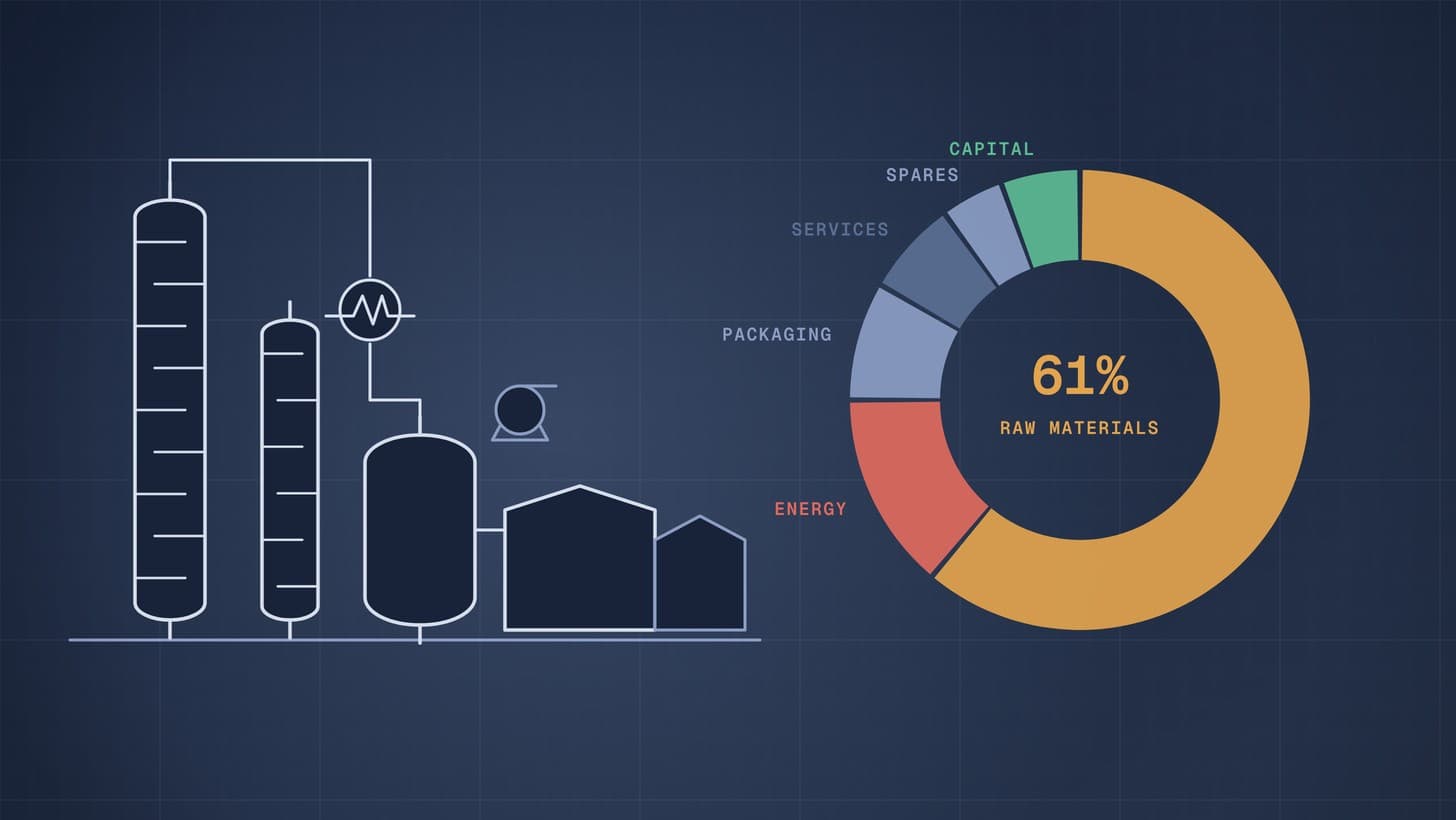
Procurement in the Chemical Industry: Categories, Risks and Capital Equipment
How chemical companies spend, from formula priced feedstocks to spares and capital equipment, where the savings and risks lie in each category, and what leading procurement teams do differently.
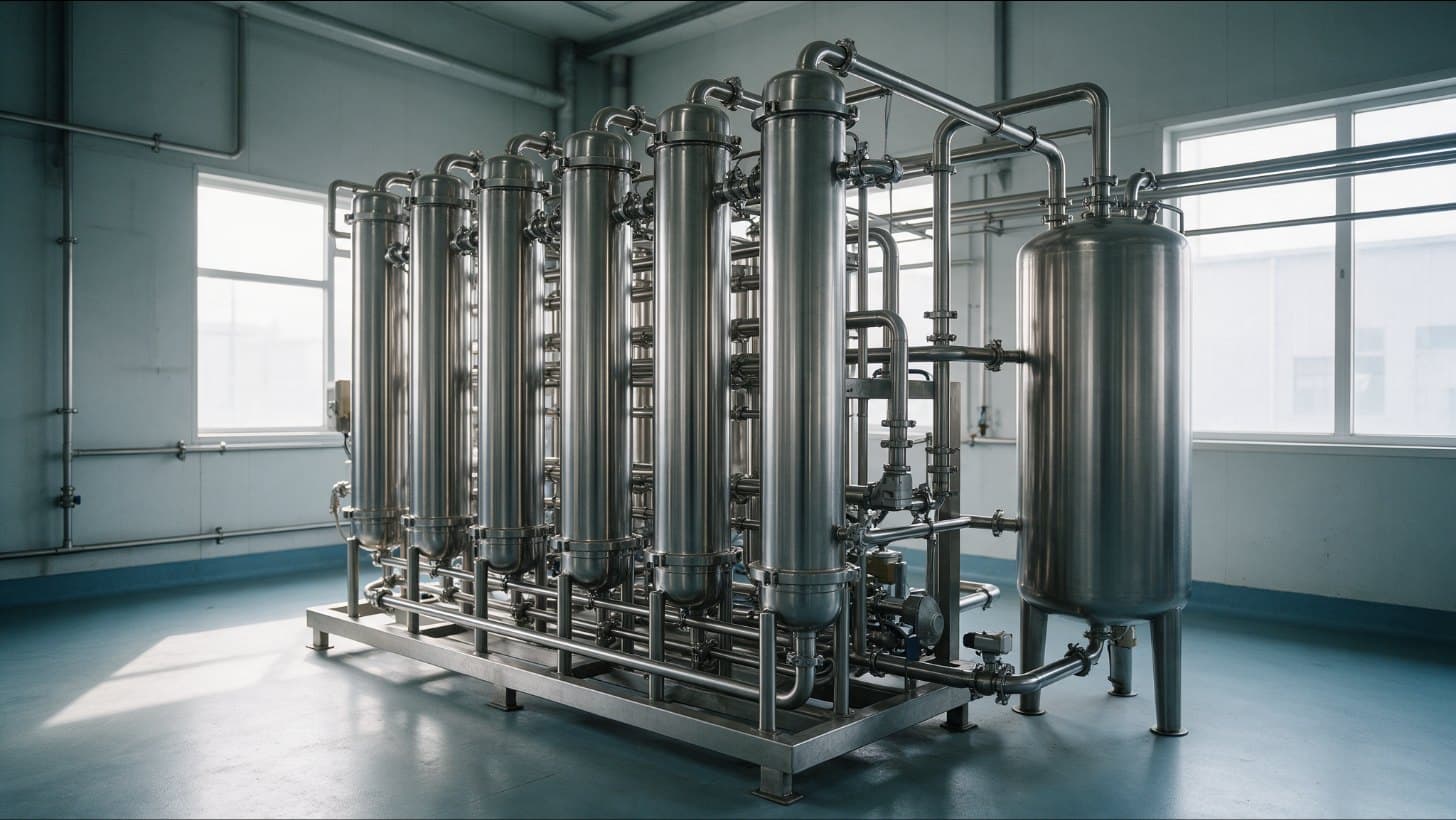
Pharmaceutical Water Systems: Buying Purified Water, WFI and Pure Steam Generation
Which water grade each use needs, how multiple effect distillation, vapour compression and membrane WFI compare on cost and risk, and what Annex 1 expects of the loop.
RABS vs Isolators: Choosing a Barrier System Under EU GMP Annex 1
How restricted access barrier systems and isolators differ on background grade, decontamination, gloves, changeover and cost under the 2022 EU GMP Annex 1, and what to ask suppliers before you choose.