
Single Use vs Stainless Steel Bioprocessing: How to Choose and What to Buy
Where single use beats stainless steel on cost, speed and footprint, where steel still wins, how to compare total cost, and how to buy without supply or leachables surprises.
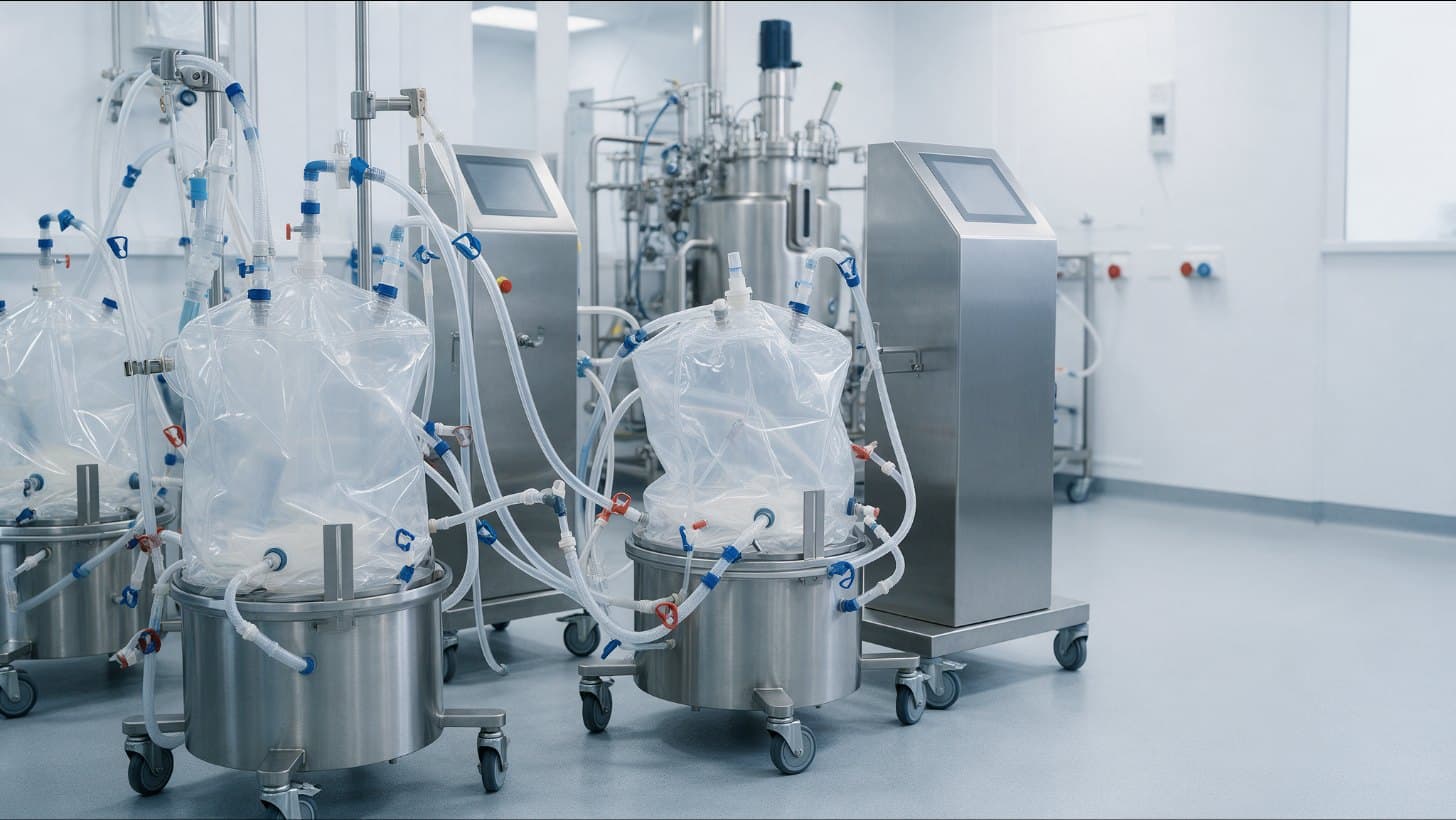
Single use bioprocessing replaces cleaned and steamed stainless steel vessels, pipework and filter housings with presterilised plastic assemblies that are used once and thrown away. It is cheaper to install and faster to bring into service, it removes cleaning in place and steaming in place along with their validation, and it ends carry over between batches. In return you buy consumables every batch, depend on a small number of suppliers, and take on extractables and leachables testing [1] [2].
Stainless steel still tends to win for long running, high volume production of a single product at large scale. One supplier's white paper puts the largest single use bioreactors at typically 2,000 to 5,000 litres per vessel, while stainless steel goes to 10,000 litres and beyond [1]. Single use suits clinical supply, multi product plants and smaller volumes [2]. Many plants end up with both, so the useful question is not which technology is better, but which suits each step of each product.
Why this matters now
Three things have changed the buying decision in the last few years.
Supply. During the pandemic, some suppliers' lead times for single use equipment reached 10, 11 and even 12 months [3]. By 2023 the picture had eased, but end users still expected about 45 weeks for complex single use devices against the 29 weeks suppliers quoted, some manufacturers planned for up to 10 months of safety stock, and more than 71% of end users expected supplier competition to keep increasing [4]. Buyers now split orders and qualify more than one supplier [4].
Regulation. USP chapter 665, on plastic components and systems used to manufacture drug substances and drug products, and chapter 1665, on how to assess their risk, both became official on 1 May 2026 after their effective date was extended [5].
Sustainability. Customers and boards now ask about carbon. The evidence on single use versus steel is more nuanced than either side's marketing suggests, as the section below shows.
Create and manage RFQs in minutes
ChemCapital handles the entire procurement cycle, from structured RFQs and supplier comparisons to formal purchase orders and delivery tracking.
Single use and stainless steel side by side
| Factor | Single use | Stainless steel |
|---|---|---|
| Capital cost | Lower upfront; less infrastructure | Large upfront investment in piping, cleanrooms and structure [1] [2] |
| Time to start up | Significantly shorter | Several years to design, build and qualify a build to suit plant [1] |
| Cleaning | No cleaning or steaming in place to validate | Validated cleaning and steaming, with large volumes of purified water and steam [1] [2] |
| Carry over between batches | None, as product contact parts are new each batch | Controlled by validated cleaning [1] |
| Running cost | Consumables every batch; can overtake the capital saving over several years | Utilities, cleaning chemicals, labour and maintenance [2] |
| Largest vessels | Typically 2,000 to 5,000 litres; by 2020 some vendors offered 6,000 [1] [6] | 10,000 litres and more [1] |
| New validation work | Extractables and leachables; integrity testing | Cleaning validation [2] |
| Waste and water | Large quantities of contaminated plastic to autoclave or incinerate [2] | Water use dominated by the cleaning and steaming system [7] |
| Best fit | Clinical supply, multi product sites, smaller volumes | Long term, high volume, single product [2] |
Labour does not disappear with single use. Hours move from cleaning to manual assembly, tubing set up and integrity checks [2].
The environmental footprint
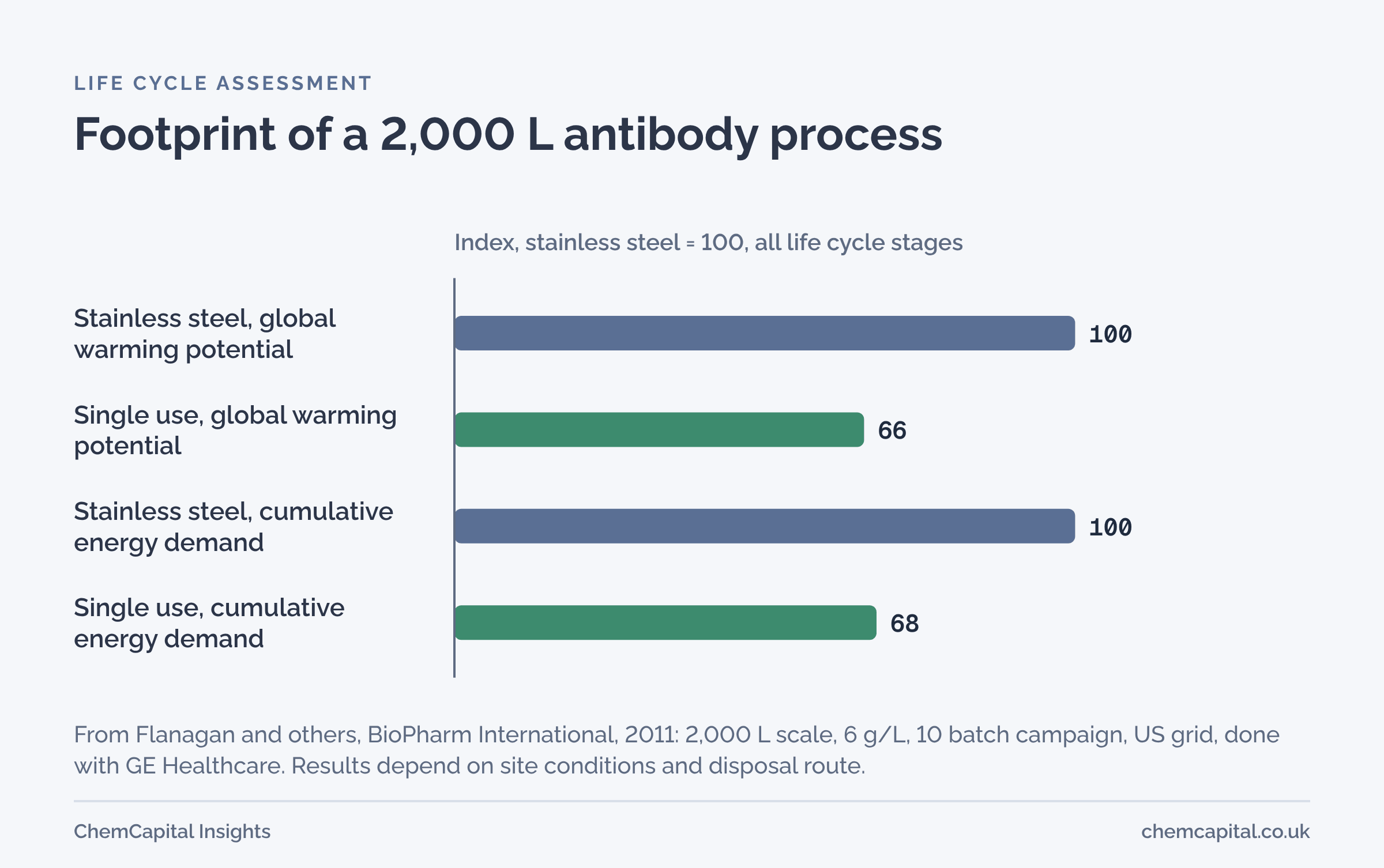
A widely cited study is a life cycle assessment published in 2011 by authors from GE Global Research and BioPharm Services. At 2,000 litre scale, with a titre of 6 g/L and a 10 batch campaign, the single use process had 34% lower global warming potential and 32% lower cumulative energy demand across all life cycle stages. The cleaning and steaming support system accounted for 38% to 40% of both measures, and the main difference between the approaches was the energy needed to make water for injection and steam. Single use was worse for protein A and ion exchange chromatography at that scale, because several columns had to run in parallel [7].
Read it with its caveats. The study was done with GE Healthcare, used GE single use equipment and supplier data, assumed a US electricity mix, and left out yield differences, labour and the effect of a smaller building [7]. A 2023 white paper from another single use supplier summarises later work as showing that results are highly dependent on manufacturing conditions and disposal practices [1]. And single use creates thousands of kilograms of contaminated plastic a year that must be autoclaved or incinerated, often with regional disposal fees [2]. If carbon matters to your decision, ask for an assessment on your own grid, utilities and waste route rather than relying on a published average.
Scale: up or out
For years 2,000 litres was the practical ceiling for a single use bioreactor, and one GE Healthcare specialist called it the commonly accepted maximum for commercial scale. By 2020 some vendors offered up to 6,000 litres, and 4,000 litre units were in operation [6]. Most companies have preferred to scale out, running several identical 2,000 litre lines or smaller 500 and 1,000 litre units, to reduce scale up risk [6].
Bigger bags bring practical issues: mixing, oxygen and carbon dioxide transfer and heat removal become harder; larger units need bigger rooms, higher ceilings, stronger floors and more utilities; and a 2,000 litre unit already takes about two hours to fill or drain [6]. ABEC, which makes large single use bioreactors, argues that larger units roughly double productivity per unit of floor area and cut capital and facility cost [6]. If your commercial demand needs tens of thousands of litres of capacity for one product, model both options.
The buying risks with single use
Supply concentration. Single use often depends on a small number of vendors, and protecting yourself means safety stock that ties up cash [2]. One bioreactor maker described keeping multiple providers of key components so it can switch quickly if one is disrupted [3]. For a buyer, the questions are: which manufacturing sites make your assemblies, whether there is a qualified second site, what stock the supplier holds for you, and whether the bags for your hardware are available from more than one source.
Change control. A film, connector or resin change at a supplier can affect your validated process. Agree in the contract how much notice you get and what data comes with it; our guide to supplier change notification sets out what to ask for.
Extractables and leachables. Plastic contact surfaces can release compounds into the product. USP 665 covers the characterisation of plastic components and systems; USP 1665 sets a two step risk assessment, an initial assessment followed by an application specific one, and says no further characterisation is needed where there is no contact with the process stream under usual production practices [5]. Suppliers may also offer data to the BioPhorum Operations Group (BPOG) standardised extractables protocol, which is largely aligned with USP 665 but uses more replicates and time points; it is industry best practice, not a regulatory document [5]. Ask which standard each supplier's data meets, and whether it covers every component in your assembly.
Integrity. Bags and transfer sets can leak. ASTM E3244, published in 2023, is a standard practice for assuring the integrity of single use systems through quality risk management across their life cycle, focused on microbial integrity, bioburden control and loss of liquid product, with separate standards for microbial and physical test methods [8]. Ask how the supplier tests at manufacture, and what you are expected to test before use.
Sterility and handling. Components usually arrive presterilised by gamma irradiation [2], so the supplier's sterilisation validation becomes part of your evidence. EU GMP Annex 1 includes vendor approval for the sterilisation of components and single use systems in the contamination control strategy, and lists assembly of closed, sterilised single use systems using intrinsic sterile connection devices among operations that can be carried out in grade D [9].
Compare total cost, not purchase price
A single use quote and a stainless steel quote are not comparable on their face. One is mostly capital; the other is mostly consumables. Put both on the same multi year basis, as Lab Manager recommends, to find the point where recurring costs overtake the capital saved [2]:
- Capital: equipment, installation, utilities and the share of cleaning and steam systems each option needs.
- Per batch costs: bags, sensors, filters and connectors for single use; water, steam, chemicals and cleaning time for steel.
- Labour: assembly and integrity checks against cleaning and changeover.
- Validation: extractables and leachables and integrity testing against cleaning validation.
- Waste and disposal fees.
- Supply cover: the cash tied up in safety stock.
- Product life: how many batches a year, for how many years, and how certain that forecast is.
Practical example
In this illustrative example, a biotech company is planning the production bioreactor for an antibody moving into late stage trials. It expects about 20 batches a year at 2,000 litres. The figures below are illustrative, not market prices.
| Illustrative | Stainless steel | Single use |
|---|---|---|
| Installed cost, including its share of cleaning, steam and utilities | £4.2 million | £1.6 million |
| Cost per batch: consumables, utilities, cleaning, labour, disposal | £6,000 | £28,000 |
Single use saves £2.6 million up front and costs £22,000 more per batch. The break even point is £2.6 million divided by £22,000, about 118 batches. At 20 batches a year that is roughly six years, before discounting; at 40 batches a year it would be about three.
For a product whose demand after approval is uncertain, six years is a long time, so the company chooses single use for the production bioreactor and keeps the option to add stainless steel capacity if the product succeeds. It writes its RFQ to cover the risks above: consumable prices fixed for three years and then adjusted by an agreed escalation formula, a named second manufacturing site, six months of dedicated stock, 12 months' notice of material changes, and extractables data to USP 665 for every component.
What to put in the RFQ
- Process duty: working volumes, oxygen demand, mixing, temperature control and the range of products.
- Consumable pricing: price per assembly and per batch, validity, escalation and minimum order quantities, quoted separately from hardware.
- Supply: lead times, manufacturing sites, second sources, stock held for you and shelf life.
- Change notification: notice period and data provided for material or process changes.
- Extractables: which standard the data meets (USP 665, BPOG) and which components it covers.
- Integrity and sterility: tests at manufacture, recommended tests before use, and sterilisation validation.
- Waste: the recommended disposal route and any take back scheme.
- For stainless steel options: cleaning and steaming design, utility demands and cleaning validation support. Our guide to CIP skid design covers the cleaning side.
Where ChemCapital fits
Single use and stainless steel bids arrive in different shapes: one heavy on capital, one heavy on consumables. ChemCapital sends one structured RFQ with line items and attachments, so you can ask every supplier for hardware, consumables and services as separate lines. The AI quotation comparison extracts price, lead time, materials, certifications and scope from each quote, keeps the source text beside every field, and flags missing fields, unit mismatches and scope differences. Project Costing keeps a library of past quotes and reprices them with exchange rates, CEPCI and other indices, showing every adjustment, which helps when you compare a new single use offer with stainless steel you bought years ago. And when you need a second source, Supplier Discovery turns a short description into a structured brief and searches the open web, showing each supplier with its source address; certifications are shown as the supplier claims them, not verified. See how ChemCapital supports biotech.
Ready to compare capital and consumables on one basis? Start a free 14 day ChemCapital trial, with no credit card needed.
Frequently asked questions
Is single use cheaper than stainless steel?
It is cheaper to install and faster to bring into service, because it avoids the piping, cleaning and steam systems that stainless steel needs. But consumables are bought every batch, and over several years of steady production their cost can overtake the capital saved. The answer depends on scale, batches per year and how long the product will run.
How large can a single use bioreactor be?
One supplier puts the largest single use bioreactors at typically 2,000 to 5,000 litres per vessel, and by 2020 some vendors offered up to 6,000 litres. Many companies scale out with several 2,000 litre units rather than scale up. Stainless steel bioreactors of 10,000 litres and more remain common for the largest volume products.
What is USP 665?
USP chapter 665 sets expectations for characterising plastic components and systems used to manufacture drug substances and drug products, and the informational chapter 1665 gives the risk assessment approach. Both became official on 1 May 2026, and they matter most for products supplied to the US market. Ask single use suppliers for extractables data that meets them.
Informational only, not procurement or legal advice. Cited names, frameworks, and statistics belong to their respective owners.
Create and manage RFQs in minutes
ChemCapital handles the entire procurement cycle, from structured RFQs and supplier comparisons to formal purchase orders and delivery tracking.
Start for freeRelated articles
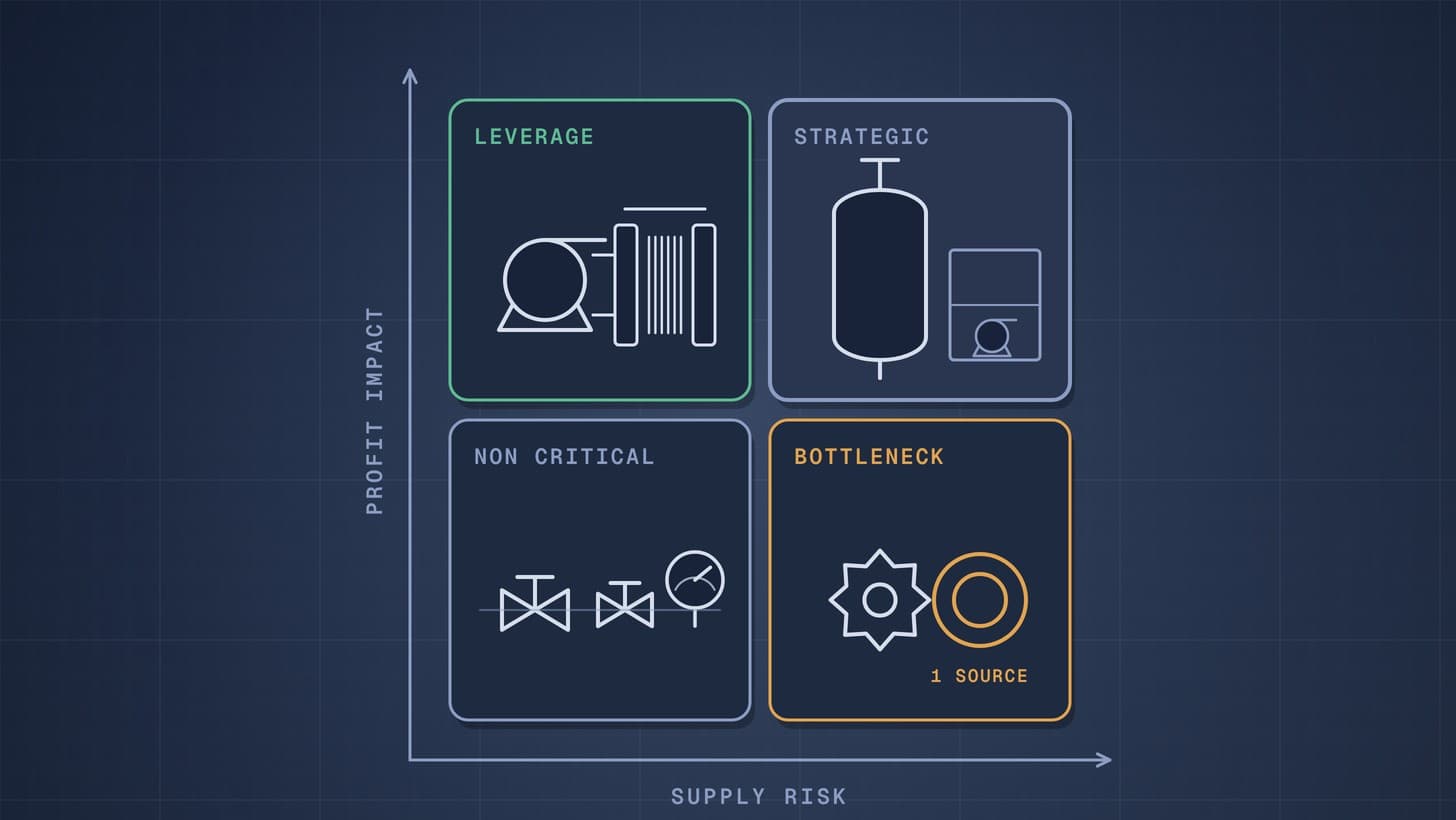
Category Strategy for Engineered Process Equipment: A Step by Step Method
How to build a category strategy for pumps, heat exchangers, vessels, valves and skids: spend and pipeline data, market analysis, Kraljic positioning, sourcing routes and a one page template.
Pharmaceutical Water Systems: Buying Purified Water, WFI and Pure Steam Generation
Which water grade each use needs, how multiple effect distillation, vapour compression and membrane WFI compare on cost and risk, and what Annex 1 expects of the loop.
Procurement in the Chemical Industry: Categories, Risks and Capital Equipment
How chemical companies spend, from formula priced feedstocks to spares and capital equipment, where the savings and risks lie in each category, and what leading procurement teams do differently.