
Vendor Document Requirement List (VDRL): What to Ask For and When
What a vendor document requirement list is, which documents to ask for at each stage from bid to data book, review codes, and how to put it in the RFQ so it gets priced.

A vendor document requirement list (VDRL) lists every document a supplier must provide for an order: drawings, calculations, procedures, certificates, test records, manuals and spare parts lists. For each one it states when it is due (with the bid, for review, for manufacture, or final), the format, and whether the buyer reviews it or simply keeps it. Some companies call it a supplier document requirement list or schedule. It belongs in the RFQ, because documents cost suppliers engineering and quality time, and bidders can only price what they can see.
Get it right and the vendor data book, the final indexed set of documents, arrives complete. Get it wrong and the equipment arrives without the records you need to commission, qualify or maintain it.
Why this matters now
Industry is standardising what suppliers deliver. IOGP's JIP33 programme publishes equipment specifications in sets of four documents, one of which, the information requirements specification, lists the predefined documents and data the supplier must deliver [1]. NORSOK Z 018, revised in 2019, sets out the documentation process and deliverables for equipment across bidding, engineering, installation, operation and maintenance [2]. And the CFIHOS handover specification aims to make the information handed over at the end of a project consistent and machine readable [3]. Buyers outside oil and gas can borrow the same discipline.
Join ChemCapital to streamline sourcing and connect with verified partners
Whether you're buying or supplying, ChemCapital gives you the tools to manage the complete procurement cycle in one platform.
Document stages
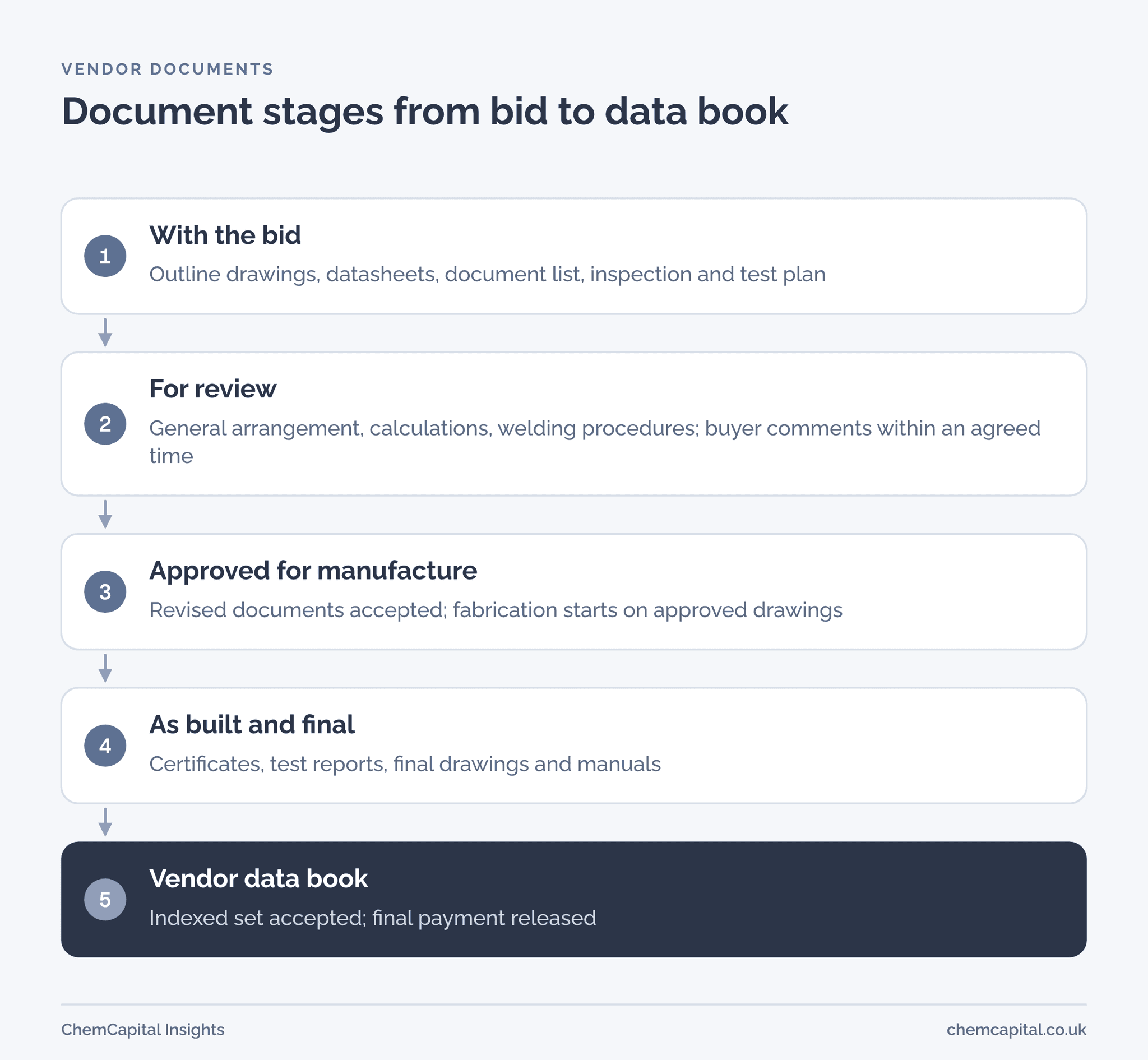
Most VDRLs use four stages: with the bid, for review, approved for manufacture, and final. Many also use review codes, for example:
| Code | Meaning | Supplier action |
|---|---|---|
| 1 | Accepted | Proceed |
| 2 | Accepted with comments | Proceed and incorporate the comments |
| 3 | Not accepted | Revise and resubmit before proceeding |
| 4 | For information only | No review; file |
Agree the codes and the buyer's review time in the order. A supplier waiting three weeks for comments on a drawing has a fair claim if delivery slips.
VDRL template
| Code | Document | With bid | For review, weeks after order | Final | Buyer action |
|---|---|---|---|---|---|
| D01 | General arrangement drawing | Outline | 3 | As built | Review |
| D02 | P&ID of the package scope | Draft | 3 | As built | Review |
| D03 | Datasheets, completed by supplier | Yes | 3 | As built | Review |
| D04 | Pressure part calculations | 4 | Final | Review | |
| D05 | Welding procedures and qualifications | 4 | Final | Review | |
| D06 | Inspection and test plan | Draft | 2 | Final | Review |
| D07 | Material certificates | Final | File | ||
| D08 | Non destructive testing reports | Final | File | ||
| D09 | Factory acceptance test procedure and report | 6 | Final | Review | |
| D10 | Pressure test certificate | Final | File | ||
| D11 | Declaration of conformity and instructions | Final | File | ||
| D12 | Spare parts list | Recommended list | 8 | Final | Review |
| D13 | Operation and maintenance manual | 10 | Final | Review | |
| D14 | Vendor data book index | 10 | Final | Review |
For material certificates, state the type you need; our guide to EN 10204 3.1 and 3.2 certificates explains the difference. For inspection and test plans, see our ITP template.
Putting the VDRL in the RFQ
The Journal of Petroleum Technology notes that the vendor data requirement schedule is issued as part of the vessel enquiry, and lists drawings, welding procedures and manufacturer data reports among its contents [4]. Clients set out deliverables in tenders for the same reason; one 2025 licensor deliverable list in a public tender, for example, specifies what the equipment list must contain for each type of equipment [5]. In practice:
- Attach the VDRL to the RFQ and ask bidders to confirm they will meet it, or list exceptions.
- State formats: native files for drawings you may modify, PDF for certificates.
- Tie part of the final payment to an accepted data book.
- Write down your own review time, so obligations run both ways.
The vendor data book
The data book is the as built record of the equipment: final drawings, datasheets, calculations, material certificates, welding and inspection records, test reports, the declaration of conformity, manuals and spare parts lists, with an index. For pressure equipment placed on the GB market, the manufacturer must keep the technical documentation and declaration of conformity for ten years and supply instructions and safety information in English [6]. You will need your copy for the life of the plant.
Practical example
In this illustrative example, a pump package order carries a VDRL of 14 documents, 10 of them for review. The general arrangement drawing goes to the buyer in week 3, and the order allows the buyer two weeks for comments. Engineering takes four weeks. The supplier records the late comments, and when delivery slips by two weeks, the buyer cannot reasonably claim delay damages for that part of the delay.
At the end, 10% of the order value is held until the data book is accepted. The supplier submits it with two certificates missing; the buyer returns it with code 3, the supplier completes it within a week, and the final payment is released. Clear rules on both sides turned a common dispute into a routine step.
Where ChemCapital fits
ChemCapital's RFQs carry structured line items and attachments, so the VDRL goes to every bidder with the specification and is priced up front. Suppliers send quotes with line items, assumptions and attachments, and after award they post milestone and delivery updates that the buyer sees as they happen. Each purchase order has its own message thread, which keeps document comments and approvals with the order they belong to.
Ready to send RFQs where the documents are priced, not argued about later? Start free with ChemCapital.
Frequently asked questions
What is a vendor document requirement list?
It is a list of every document a supplier must provide for an order, such as drawings, calculations, procedures, certificates, test reports and manuals, with when each is due, in what format, and whether the buyer reviews it or only keeps it. It is also called a supplier document requirement list or schedule.
When should the VDRL be issued?
With the RFQ. Documents take engineering and quality time, so bidders can only price them if they see the list before they bid. A list sent after award usually leads to extra cost or missing documents.
What goes in a vendor data book?
The final, as built set of documents for the equipment: drawings, datasheets, calculations, material certificates, welding and inspection records, test reports, declarations of conformity, manuals and spare parts lists, with an index.
Continue reading
Informational only, not procurement or legal advice. Cited names, frameworks, and statistics belong to their respective owners.
Join ChemCapital to streamline sourcing and connect with verified partners
Whether you're buying or supplying, ChemCapital gives you the tools to manage the complete procurement cycle in one platform.
Get started freeRelated articles
EPC vs EPCM: Who Buys the Equipment?
How EPC and EPCM contracts differ, who places equipment orders under each, where cost and schedule risk sit, and what it means for owners, suppliers and long lead items.

Change Orders and Variations on Equipment Orders
How changes happen on engineered equipment orders after award, how to request, price and approve them, and how buyers and suppliers both stay protected.

PMI Testing: When to Require It on a Purchase Order
What positive material identification can and cannot detect, when to require it, how much to test, and how to write PMI into a purchase order and inspection plan.