
Aftermarket and Spare Parts Revenue for Equipment Makers: Five Levers
Why spares, service and upgrades earn equipment makers higher margins than new machines, and five levers to capture more: installed base data, spares lists, service agreements, value pricing and response times.
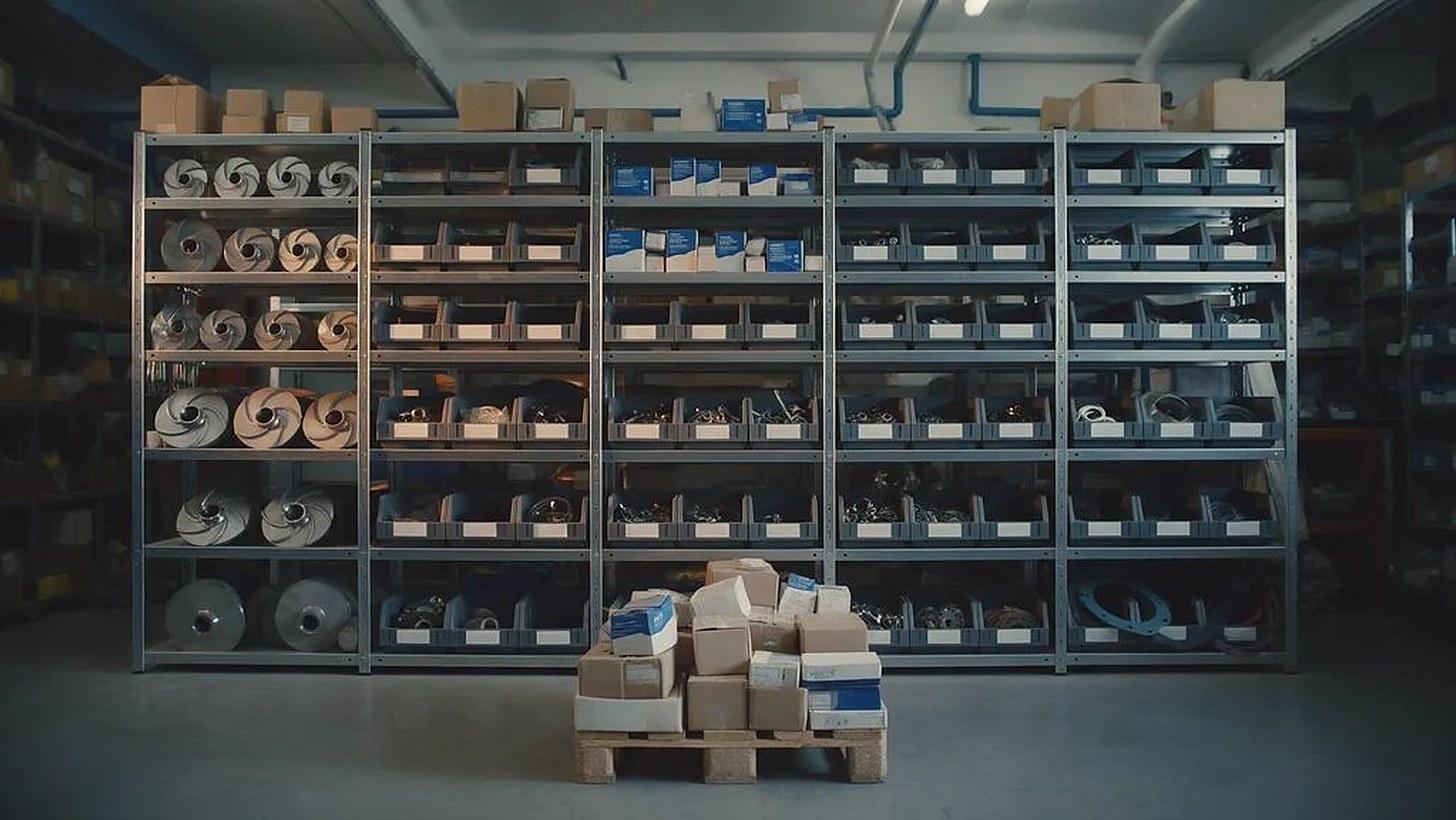
For an equipment maker, the machines you have already sold are your most reliable source of future revenue. Spares, repairs, service contracts and upgrades usually earn higher margins than new equipment and keep coming when new orders slow down. To capture them, know your installed base, make it easy for customers to buy the right parts from you, offer service agreements at the point of sale, price parts by their value rather than by a flat markup, and commit to response times you can keep.
Why this matters now
The numbers are consistent across studies. A McKinsey analysis across 30 industries found aftermarket services earning a 25% EBIT margin against 10% for new equipment, with parts sales typically earning gross margins above 30% [1]. BCG's 2025 survey of about 100 industrial machinery companies found service gross margins roughly twice the 15 to 25% typical of equipment sales, spare parts and consumables averaging about 50% gross margin, and service revenue growing 10% in 2023 [2]. For most of those companies, service growth now exceeds new equipment growth [2].
The prize is also large relative to the original sale. McKinsey measured aftermarket lifetime value, the aftermarket revenue an asset generates over its life as a share of its original price, at about 30% for heavy trucks and about 75% for gas turbines [1]. A process pump or skid running for 20 years can generate a similar stream of seals, bearings, impellers and service visits.
Yet much of it goes elsewhere. Parts brokers, low cost repair shops and digital providers chip away at the original maker's share [3]. Smaller makers often have no clear view of how much of their customers' spending on their equipment they actually win.
Access real procurement opportunities from global buyers
Join ChemCapital to get discovered by verified procurement teams across pharmaceutical, chemical, and industrial manufacturing.
Five levers that make the difference
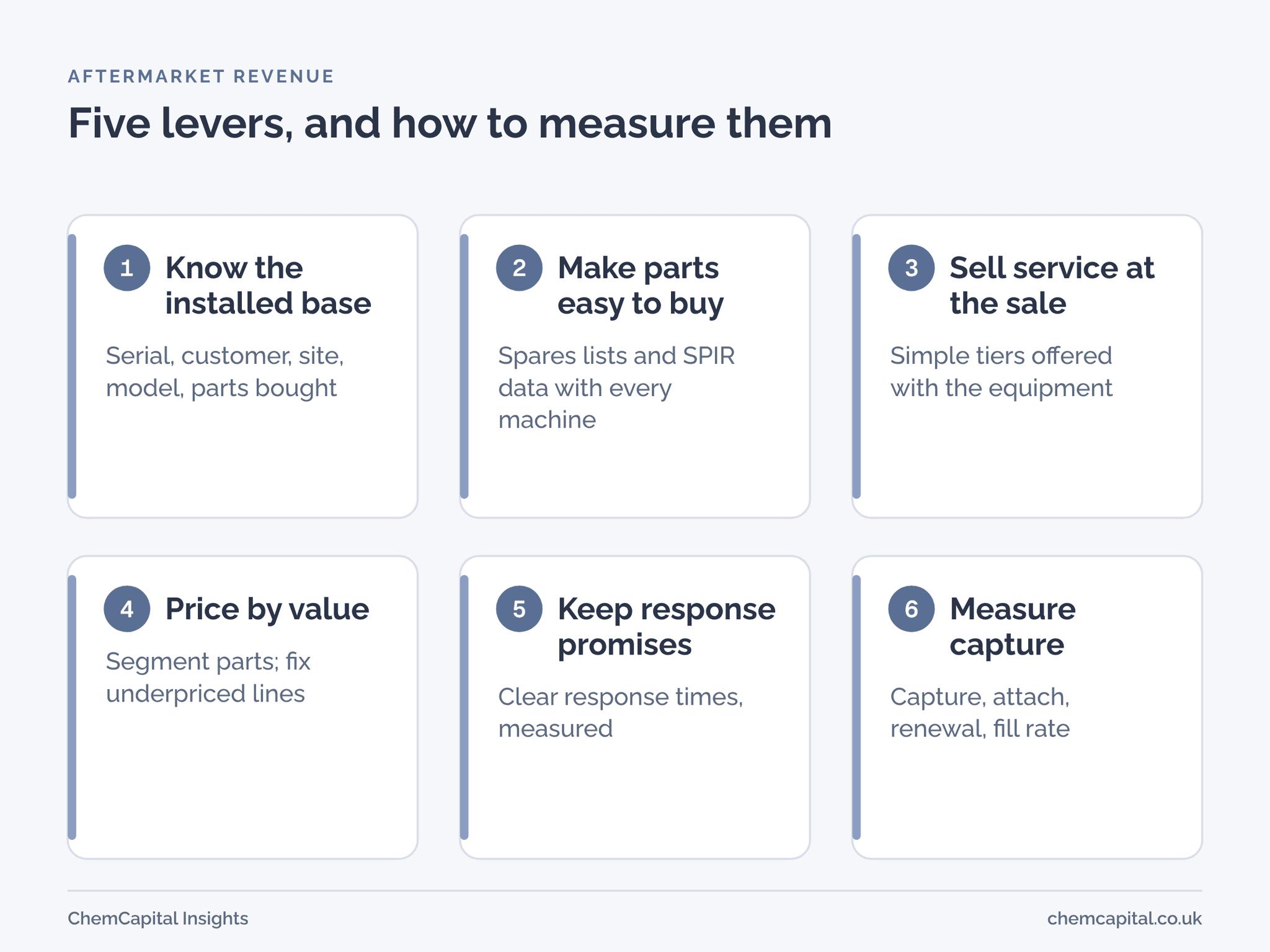
1. Know your installed base
You cannot sell to equipment you cannot find. McKinsey points out that OEMs typically know how many units they have sold and to whom, even if the data is scattered, and that a short analysis can rebuild it [3]. Build a simple register: serial number, customer, site, model, materials, commissioning date, and the parts and service bought since. Then you can work out the "gap to entitlement" McKinsey describes: the aftermarket spend your customers have that you are not capturing [3].
The data is usually already in the business, just scattered: sales order files, commissioning reports, warranty claims, service visit sheets and past spares orders. Start with the last ten years of orders, match each machine to a site and a contact, and update the record every time a part is sold or an engineer visits. Ask customers to tell you when equipment moves or is retired, so the register stays honest.
2. Make the right parts easy to buy
Customers buy spares when equipment is down or a shutdown is near, and they buy from whoever answers fastest with the right part. Supply a clear recommended spares list with every machine, and complete the buyer's SPIR form accurately, so their stores system holds your part numbers. Keep drawings and bills of materials by serial number so you can quote a part in minutes.
3. Sell service agreements at the point of sale
The best time to sell a service contract is with the equipment. BCG found that top performers sign 31% more customers to maintenance contracts at the time of purchase [2]. Offer simple tiers: an annual inspection, a planned maintenance agreement with a set spares kit, or a full service contract with guaranteed response. Our guide to equipment warranty terms explains how warranty and service agreements fit together.
4. Price parts by value, not a flat markup
Many makers price spares at cost plus a fixed percentage. Implement Consulting Group argues that applying uniform cost plus logic "simply amplifies inconsistency" and margin leakage, and recommends segmenting parts, anchoring to the market where competition exists, and cleaning up underpriced low value parts [4]. It reports foundational moves can deliver 5 to 15 percentage points of margin within months [4]. Syncron notes that parts for current models often face no third party competition, and that customers are less sensitive to price when equipment is down [5]. McKinsey cites an industrial machinery maker that gained 2 percentage points of EBIT margin in one year by re pricing 100,000 spare parts lines [1].
Value pricing does not mean exploiting a breakdown. Customers remember. Price critical, proprietary parts for the value of uptime, keep commodity parts competitive, and publish a consistent price list so buyers trust it.
5. Commit to response times you can keep
A service agreement is only as good as its response. State clearly what you will do and how fast: telephone support within hours, a technician on site within a set number of working days, critical spares dispatched the same day from stock. Then measure it. Buyers increasingly score suppliers on this, as our guide to the supplier scorecard shows.
Channels matter
Direct relationships capture more. McKinsey found attach rates of about 70 to 100% for direct sales against about 30 to 50% for distributor or mixed channels, and lifetime penetration 1.5 to 2 times higher for direct or franchise channels [1]. BCG found service revenue at about 33% of total for equipment makers with direct customer access, against 17% for component and subsystem makers [2]. If you sell through distributors or EPC contractors, make sure the end user knows who you are, and that your nameplate, manuals and contact details lead back to you.
Upgrades and retrofits
Spares and service are not the whole aftermarket. Plants keep equipment far longer than its original controls, seals or motors stay current, and upgrades are a natural next sale: a new control panel, a more efficient motor and drive, a seal upgrade, or a materials change for a new duty. BCG reports that manufacturers expect nearly a third of customers to contract for modernisation and upgrade kits by 2027 [2]. Your installed base register tells you which machines are approaching the age when these make sense, and the customer's maintenance history tells you which ones are costing them most.
Measure what you capture
Pick a few measures and review them each quarter:
- Capture rate: your aftermarket revenue as a share of the estimated spend on your installed base.
- Attach rate: the share of new machines sold with a service agreement or spares package.
- Contract renewal rate: how many agreements renew at the end of their term.
- Parts fill rate: the share of parts orders shipped complete from stock on the promised date.
- Response time achieved: against what your agreements promise.
McKinsey recommends a live view of aftermarket sales by product, salesperson and customer segment, reviewed weekly [3]. Even a simple spreadsheet updated monthly shows whether the levers are working.
Practical example
Illustrative figures. A pump skid maker has 400 units in service. It estimates that each unit consumes about £2,500 a year in parts and service, so its customers' total spend on its equipment is about £1,000,000 a year. Today it captures 40%.
| Measure | Today | After a year of work on the five levers |
|---|---|---|
| Customer spend on its installed base | £1,000,000 | £1,000,000 |
| Share captured | 40% | 60% |
| Aftermarket revenue | £400,000 | £600,000 |
| Extra gross profit at an assumed 50% margin | £100,000 |
The extra £100,000 of gross profit comes from customers the company already has, without winning a single new order. The levers that moved the share were simple: an installed base register, spares lists issued with every machine, and service agreements offered with each new sale.
Common mistakes
- No installed base record, so nobody knows which customers to call.
- Selling the machine and walking away, then waiting for the phone to ring.
- Flat markup pricing, leaving money on critical parts and losing sales on commodity ones.
- Overpromising response times the service team cannot meet.
- Hiding behind distributors, so end users cannot find you when they need a part.
Where ChemCapital fits
Buyers looking for spares and service often search for the maker of equipment already on their site. A free ChemCapital profile on Supplier Discovery makes sure they can find you, and shows the service you offer alongside the equipment you build. See what suppliers get from ChemCapital.
Ready to be found by the buyers who already run your equipment? List your company on ChemCapital. It is free to start.
Frequently asked questions
Why is aftermarket revenue important for equipment makers?
It usually earns higher margins than new equipment and continues for the life of the installed base. Studies report service gross margins around twice those of equipment sales, and spare parts gross margins averaging about 50%.
How can an equipment maker increase spare parts sales?
Build an installed base register, issue recommended spares lists with every machine, offer service agreements at the point of sale, price parts by value and segment, and commit to response times you can meet.
How should spare parts be priced?
Segment them. Price critical, proprietary parts for the value of uptime, keep commodity parts competitive with the market, fix underpriced low value parts, and keep a consistent price list.
What is an aftermarket capture rate?
The share of the spending on your installed equipment that you win, rather than brokers, repair shops or competitors.
Informational only, not procurement or legal advice. Cited names, frameworks, and statistics belong to their respective owners.
Access real procurement opportunities from global buyers
Join ChemCapital to get discovered by verified procurement teams across pharmaceutical, chemical, and industrial manufacturing.
List your companyRelated articles
AMP8 for Equipment Suppliers: How Water Companies Buy, 2025 to 2030
AMP8 is the 2025 to 2030 investment period for water companies in England and Wales, with £104bn approved. Here is how the money is spent, how water companies buy through frameworks and delivery partners, and how equipment suppliers get in.
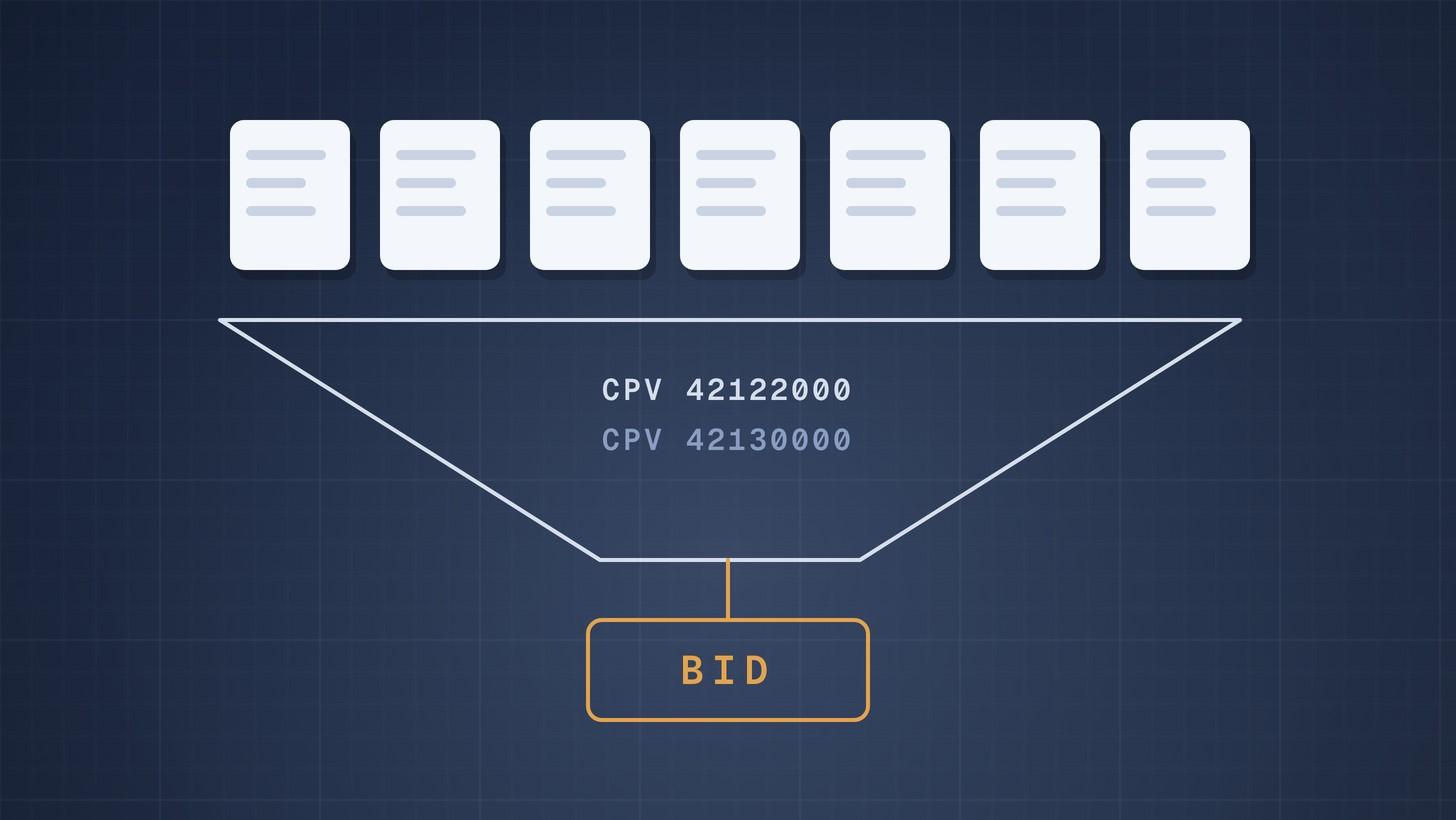
How to Find Tenders for Pumps, Valves and Process Equipment
Public tenders for process equipment are published free on Find a Tender in the UK, TED in the EU and SAM.gov in the US. Here is how to set alerts with the right CPV codes and where utility frameworks fit.

Framework Agreements for Pumps, Valves and Instruments: When They Beat Project Buying
A frame agreement for pumps, valves or instruments pays off when you buy the same types repeatedly. Here is when it beats project by project buying, what to put in it, and a worked example.