
Equipment Warranty Terms: 12 Months From Start Up or 18 From Delivery
How engineered equipment warranties are structured, what counts as start, warranty on repaired parts, exclusions, process guarantees, and what UK law adds when the contract is silent.
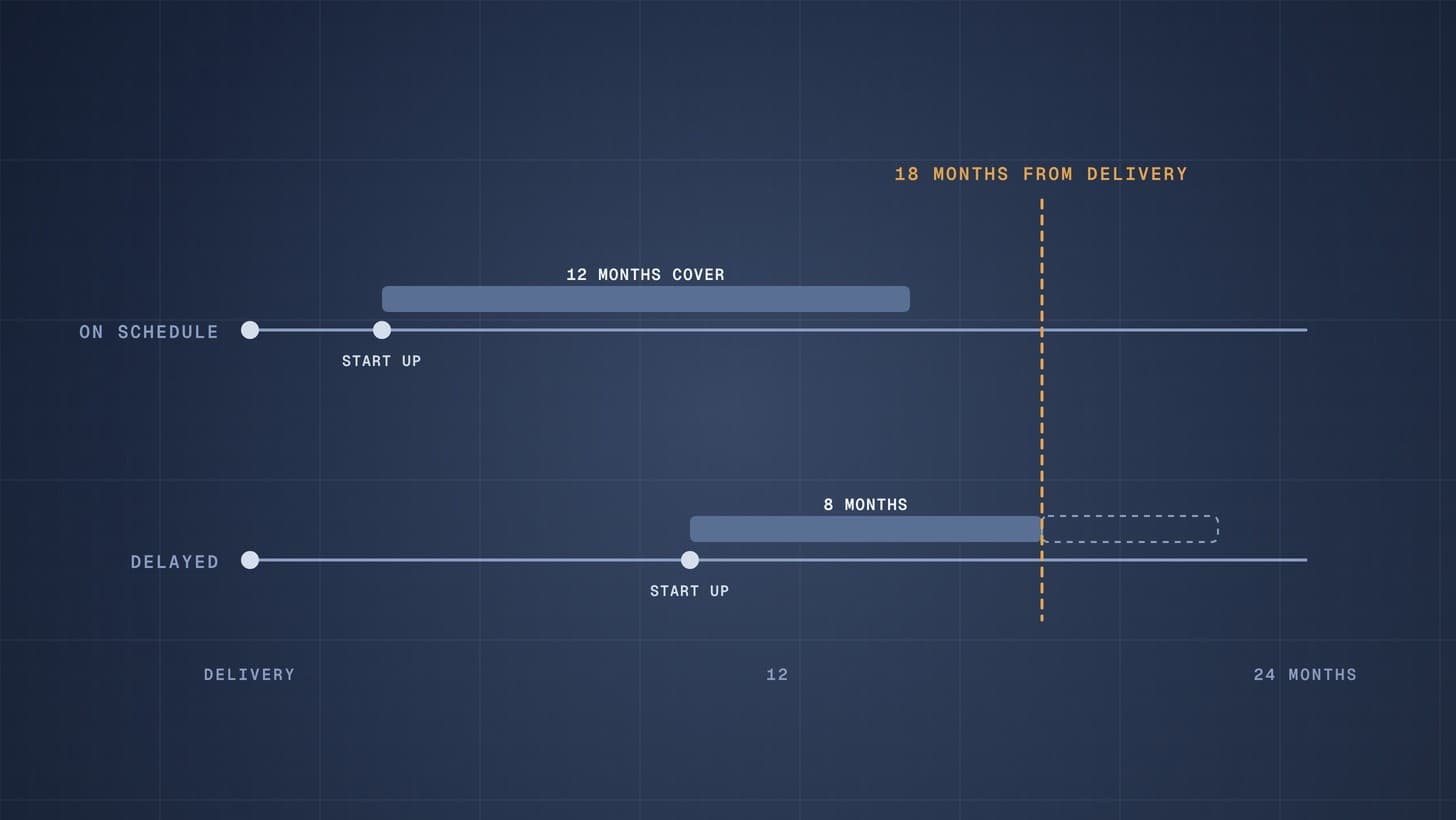
The usual warranty on engineered process equipment is 12 months from start up or 18 months from delivery, whichever comes first. During that period the supplier repairs or replaces parts that fail through defective design, materials or workmanship. The phrase "whichever comes first" is the one to read twice. If installation slips, the 18 month clock can run out long before you have had 12 months of operation.
This guide covers the common structures, what counts as start, warranty on repaired parts, exclusions, how a mechanical warranty differs from a process guarantee, and what the law adds in the UK when the contract is silent.
Why this matters now
Warranty terms are often agreed in the last hour of a negotiation, as boilerplate. They are then tested two years later, when a seal fails and the plant has run for only a few months. Getting the start event, the long stop and the repaired parts rule right costs nothing at award and can be worth a great deal at the first failure.
Create and manage RFQs in minutes
ChemCapital handles the entire procurement cycle, from structured RFQs and supplier comparisons to formal purchase orders and delivery tracking.
The common structures
Equipment supply terms. One major manufacturer's published policy gives 12 months from the date equipment is placed in operation, or 18 months from shipment, whichever comes first. Parts carry 6 months from shipment and reconditioned parts 3 months [1]. That pattern, an operating period capped by a delivery long stop, is the one to look for in any supplier's terms.
Plant and installation contracts. Model forms used for process plant call it a defects liability period. The IChemE Red Book sets 365 days from the take over certificate; MF/1 uses the period in its appendix, with 12 months as the default, running from taking over; FIDIC's Yellow Book defaults to 365 days from completion [2]. A typical defects liability period is 12 months [3].
| Structure | Start | Long stop | Typical length | Where you see it |
|---|---|---|---|---|
| From start up or delivery | Start up, or placing in operation | 18 months from delivery or shipment | 12 months | Equipment suppliers' terms [1] |
| From taking over | Taking over or acceptance certificate | Set in contract | 12 months or 365 days | IChemE, MF/1, FIDIC [2] |
| Parts and spares | Shipment | None | 6 months in one policy [1] | Spares orders |
What counts as start
Define it. "Start up", "commissioning", "placed in operation", "acceptance" and "taking over" are different events, and suppliers prefer the earliest. For a buyer, the strongest start is a signed acceptance after a successful site acceptance test; see our site acceptance test checklist. The weakest is "delivery", because it starts the clock before the equipment has done any work.
Then set the long stop with your real schedule in mind. If equipment will sit in storage for a year before installation, 18 months from delivery leaves six months of operating cover at best. Negotiate a longer long stop or a storage provision. If you do store, follow the maker's preservation instructions, because warranties often require it; see equipment preservation and storage.
Warranty on repaired and replaced parts
When a part fails and is repaired or replaced, does its warranty restart? Under the IChemE Red Book, the defects liability period for a repaired or replaced part restarts from completion of the repair. MF/1 also renews the period for repairs, but caps it at two years from taking over unless the appendix says otherwise. FIDIC caps extensions at two years [2]. These forms also extend the period while the plant cannot be used because of a defect [2].
Equipment suppliers' own terms may say nothing on the point; one major policy states no separate period for replacement parts [1]. If yours is silent, ask for a restart on repaired or replaced parts with a cap, for example 12 months from repair, capped at 24 months from start up.
Exclusions and conditions
Read these as carefully as the period. One published policy excludes abuse or misuse, negligent repairs, corrosion or erosion, normal wear and tear, unauthorised modifications, and failure to follow the recommended operating and maintenance procedures. It also makes the warranty void unless service uses authorised providers and genuine parts [1].
For process equipment, three exclusions deserve negotiation:
- Corrosion and erosion. If the supplier selected the materials for your stated process conditions, a blanket corrosion exclusion shifts their material choice onto you. Narrow it to conditions outside the datasheet.
- Wear parts and consumables. Agree a list, for example seals, gaskets, filters and packing, so there is no argument later. Our recommended spares list helps define them.
- Authorised service only. Reasonable for complex machines, but make sure an approved service provider actually exists near your site.
Watch for exclusive remedy wording. The same policy says that correcting a nonconformity within the period is the supplier's full liability for it [1]. Model forms do similar things after the defects period. MF/1 Revision 6 limited later liability to latent defects notified within three years of taking over. Revision 7, the 2024 edition, lets the parties set that period in the appendix [4] [2]. IChemE ends the contractor's remedial obligations at the final certificate [2].
When bids arrive, ChemCapital's AI quotation comparison puts each bid's warranty period, start event and exclusions side by side, so a short or narrow warranty does not hide behind a low price.
Mechanical warranty versus process guarantee
A mechanical warranty covers defects in design, materials and workmanship: a cracked casing, a failed bearing. A process guarantee covers performance: throughput, product quality, utility consumption, efficiency. They are different promises with different remedies. Process guarantees are proved in a performance test, with remedies such as liquidated damages or an obligation to cure written into the contract; see liquidated damages in equipment contracts. Do not assume a 12 month warranty also guarantees performance. Ask for both, in separate clauses.
What the law adds in the UK
Where goods are sold in the course of a business, the Sale of Goods Act 1979 implies that they are of satisfactory quality, including fitness for the purposes such goods are commonly supplied for, freedom from minor defects, safety and durability. Where the buyer makes a particular purpose known and relies on the seller's skill, the goods must also be reasonably fit for that purpose [5].
Suppliers' terms often try to replace these with their own warranty. Between businesses, the Unfair Contract Terms Act 1977 allows that only so far as the term is reasonable [6]. In a 2023 Court of Appeal case about coaches, a blanket clause excluding all implied conditions and warranties was indicated to be unreasonable, given the parties' unequal bargaining position on terms and the clause's practical effect [7].
A defects period is also not automatically your only remedy; unless the contract clearly says so, the contractor remains liable for breach of contract [3]. Check whether your contract does say so.
This is general information, not legal advice; check the current text before you rely on it.
Practical example
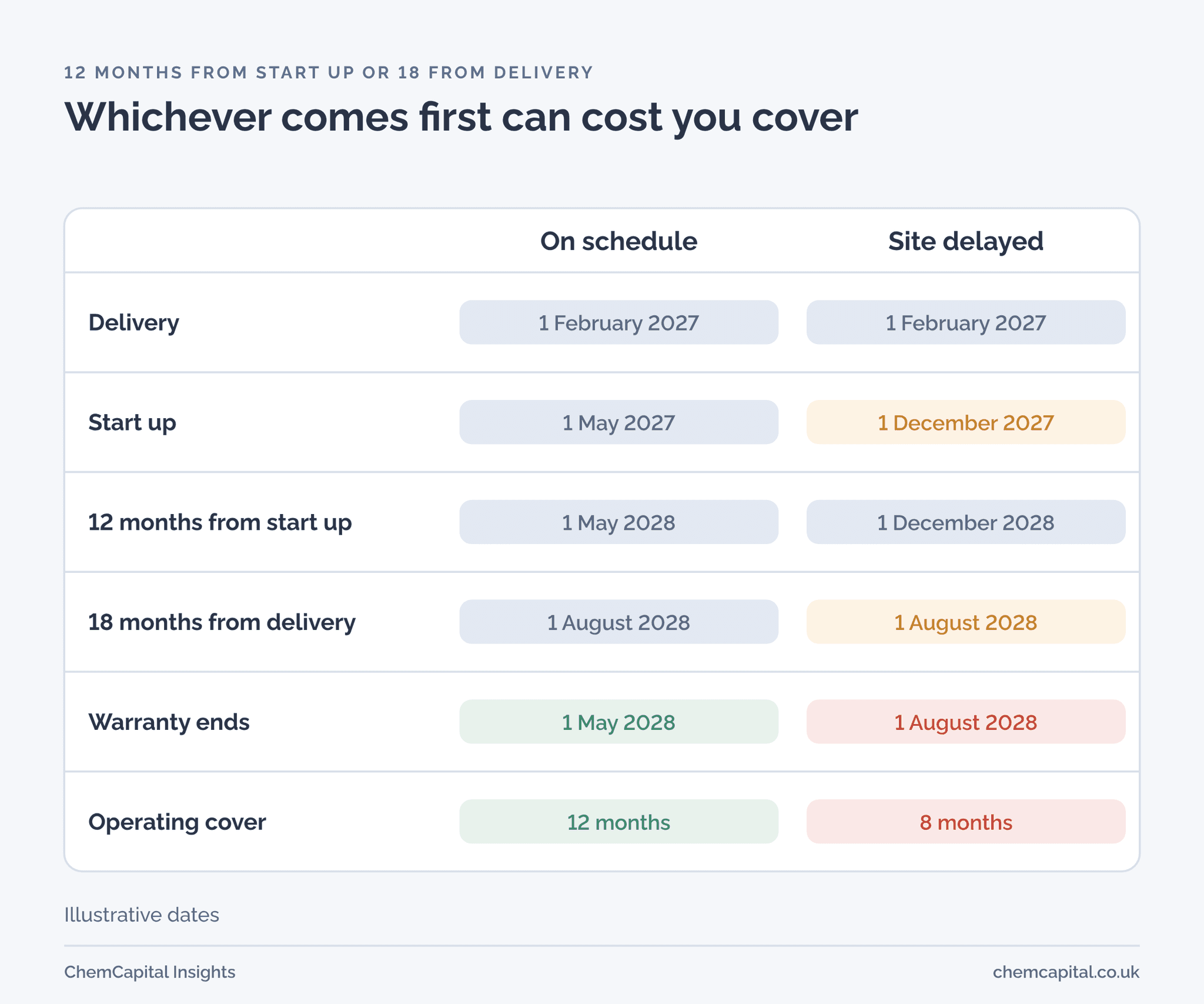
Illustrative dates. A pump package is delivered on 1 February 2027 under "12 months from start up or 18 months from delivery, whichever first".
| Case | Start up | 12 months from start up | 18 months from delivery | Warranty ends | Operating cover |
|---|---|---|---|---|---|
| On schedule | 1 May 2027 | 1 May 2028 | 1 August 2028 | 1 May 2028 | 12 months |
| Site delayed | 1 December 2027 | 1 December 2028 | 1 August 2028 | 1 August 2028 | 8 months |
In the delayed case, a seal failure in October 2028 falls outside warranty. The buyer could have negotiated 24 months from delivery as the long stop, or an extension for storage under preservation conditions. With a 24 month long stop the warranty would have run to 1 December 2028, the full 12 months of operation.
If you are the supplier
Be clear about start, long stop and exclusions, and offer a sensible repaired parts rule. A buyer comparing three bids will favour the one whose warranty they can understand, and a reasonable warranty is easier to defend than a blanket exclusion.
Where ChemCapital fits
Warranty is part of the price. Compare it alongside cost and delivery, and write the terms into the purchase order; see purchase order terms for capital equipment.
Ready to compare bids on warranty as well as price? Start a free 14 day ChemCapital trial, with no credit card needed.
Frequently asked questions
What is the typical warranty period for industrial equipment?
Commonly 12 months from start up or 18 months from delivery, whichever comes first. Plant contracts on model forms such as IChemE, MF/1 and FIDIC usually use a 12 month or 365 day defects liability period from taking over or completion.
What does 12 months from commissioning or 18 months from delivery whichever is earlier mean?
The warranty ends at whichever date comes first. If start up is delayed by more than six months after delivery, the 18 month date arrives first and you get less than 12 months of operating cover.
Does the warranty restart on a replaced part?
Only if the contract says so. The IChemE Red Book restarts the period for repaired or replaced parts, MF/1 renews it subject to a two year cap from taking over, and FIDIC caps extensions at two years. Many suppliers' terms are silent, so negotiate it.
What is the difference between a defects liability period and a warranty?
In practice both describe a period during which the supplier must repair or replace defective work. Defects liability period is the term used in plant and construction contracts, usually running from taking over. Warranty is the usual term in equipment supply terms, often running from start up with a delivery long stop.
Can a supplier exclude the implied terms of the Sale of Goods Act?
Between businesses, only so far as the exclusion is reasonable under the Unfair Contract Terms Act 1977. A 2023 Court of Appeal case indicated that a blanket exclusion of all implied terms was unreasonable on its facts.
Continue reading
Informational only, not procurement or legal advice. Cited names, frameworks, and statistics belong to their respective owners.
Create and manage RFQs in minutes
ChemCapital handles the entire procurement cycle, from structured RFQs and supplier comparisons to formal purchase orders and delivery tracking.
Start for freeRelated articles
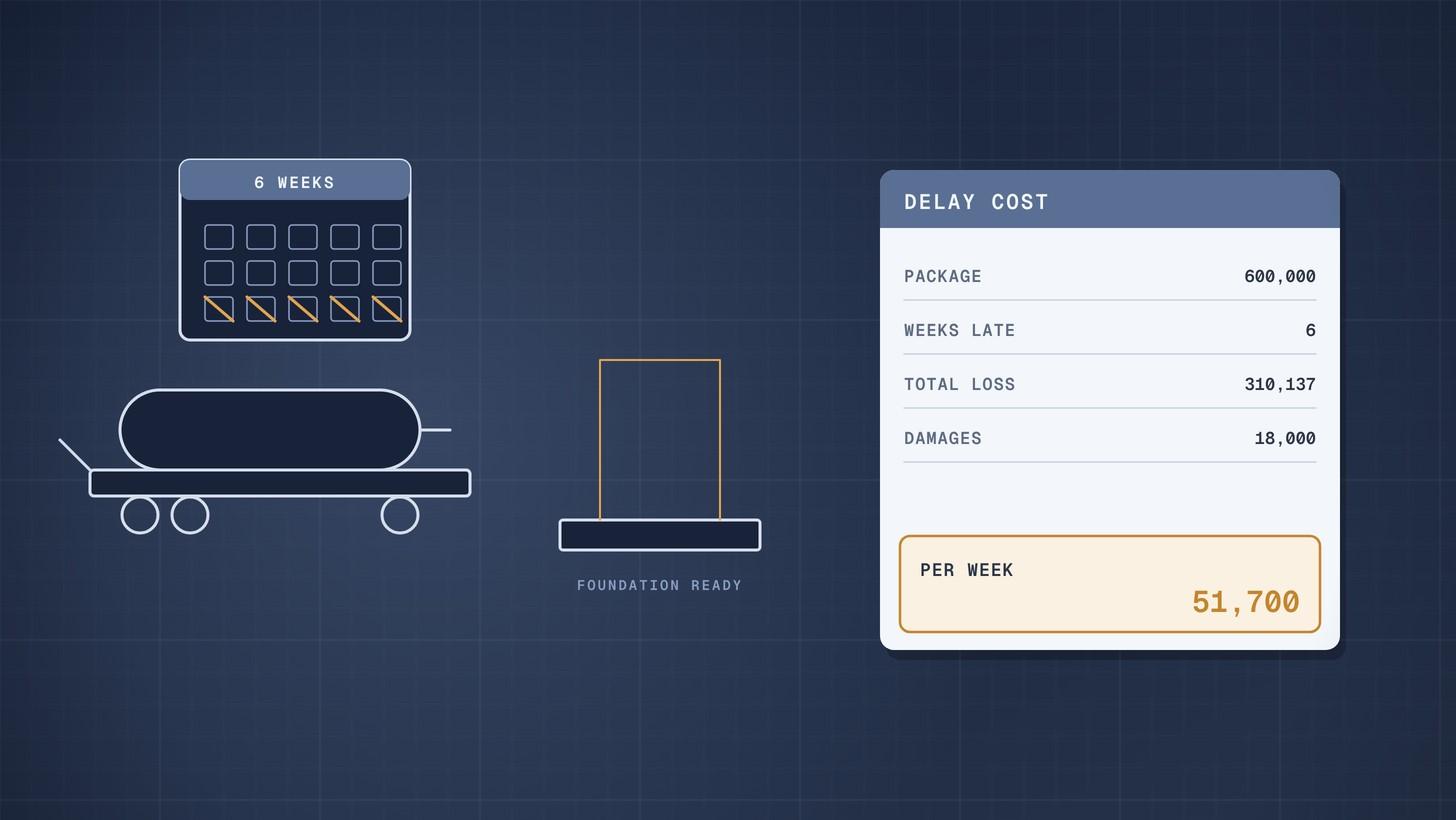
Cost of Late Equipment Delivery: Worked Example
How to calculate the weekly cost of late equipment delivery, compare it with liquidated damages and use it to set a damages rate a supplier can accept.
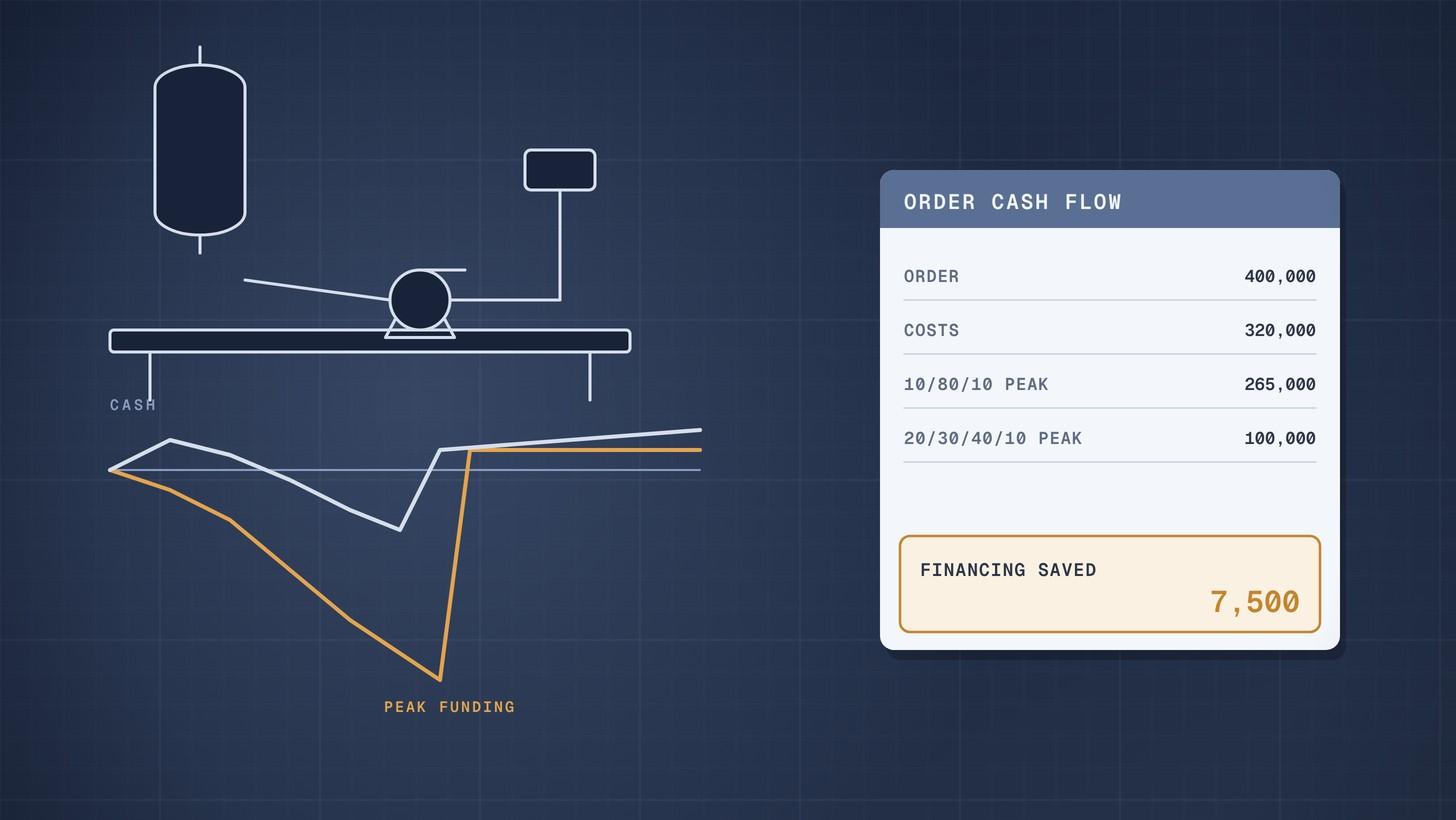
Payment Milestones and Supplier Cash Flow: Worked Example
How payment milestones, bonds and retention shape an equipment supplier's cash curve, with a worked example comparing two schedules on a £400,000 order.
Performance Guarantees and Performance Tests for Process Packages
What a process package supplier should guarantee, how the performance test is run, and what happens when the plant falls short, with a worked example of performance liquidated damages.