
SPIR Form: The Spare Parts Interchangeability Record Explained
The SPIR is the supplier's list of every spare part for the equipment you bought, tag by tag, with interchangeability, prices and lead times. Here is how to use it.
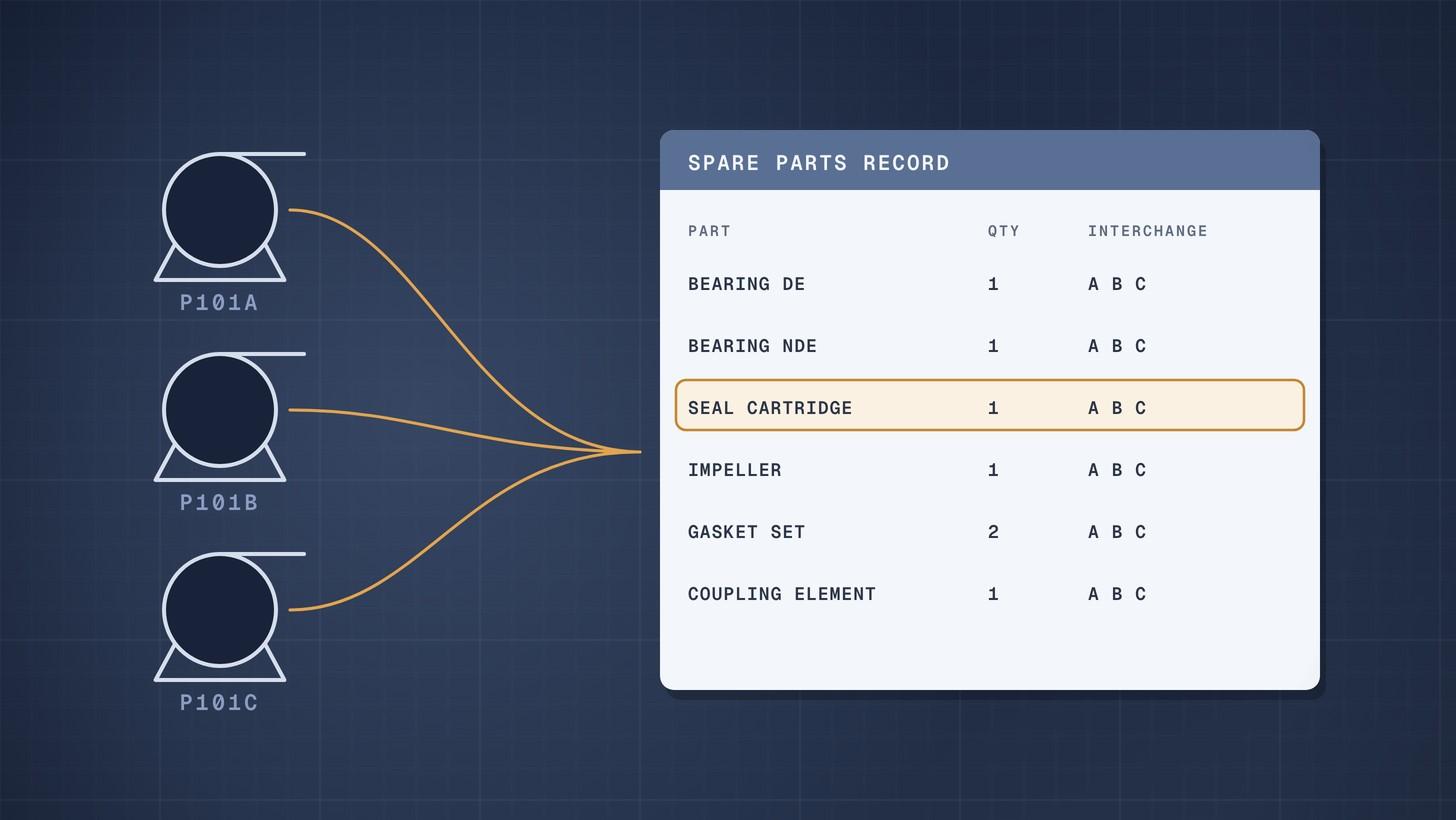
A SPIR, or spare parts interchangeability record, is the form an equipment supplier fills in after award to list every spare part for the equipment you bought, tag by tag, with part numbers, quantities installed, which tags share the same part, recommended quantities for commissioning and operation, prices and lead times. The buyer uses it to decide which spares to order and to set up the spare parts in the plant's stores and maintenance system.
Free download: SPIR form with interchangeability summary (Excel). Ready to fill in, free to use, no sign up needed.
Why this matters now
Spares are usually ordered late, after the main equipment, and often from incomplete data. One master data specialist describes the SPIR as the manufacturer's recommendation of the spares the owner should buy, used as the basis for material master data in the ERP system. The same presentation notes that manufacturer data is often not good enough to identify items correctly, and that problems surface only at handover, causing extensive rework [1]. A well run SPIR process fixes that while the supplier is still engaged and paid.
Create and manage RFQs in minutes
ChemCapital handles the entire procurement cycle, from structured RFQs and supplier comparisons to formal purchase orders and delivery tracking.
What a SPIR records
Operators set their own format, but the content is consistent. One large operator's supplier guide, updated in June 2026, asks for a separate SPIR for each original equipment purchase order, and for a complete list of spare parts, including parts not recommended for the first two years [2]. NORSOK's rationale, recorded in an industry reference data library, is that a SPIR should be provided for all parts potentially needing replacement or repair [3].
Want this as a file? Download the SPIR form with interchangeability summary (Excel).
A practical template:
| Column | What goes in it |
|---|---|
| Tag number | Exactly as on the purchase order, for example P101A |
| Equipment description and serial number | From the nameplate |
| Part description | Specific enough to buy, for example bearing designation or gasket dimensions |
| Original manufacturer and part number | The maker of the part, not only the packager's code |
| Quantity installed per unit | How many are fitted in one item of equipment |
| Interchangeable with | Other tags that use the identical part |
| Commissioning quantity | Spares for construction and commissioning, including special tools |
| Initial operation quantity | Spares for the first period of operation, often two years |
| Capital or insurance spare | Major assemblies held against a long outage |
| Unit price and currency | List price, valid for a stated period |
| Lead time | Valid for the stated delivery terms |
The supplier guide above asks for bought out items to carry identifying details such as bearing designations and gasket dimensions, and for the original manufacturer's name and part number, precisely so that duplicates can be found across different SPIRs [2]. It also splits recommended quantities into commissioning spares, initial spares for the first two years after start up, and normal operation spares [2].
Who fills it in, and when
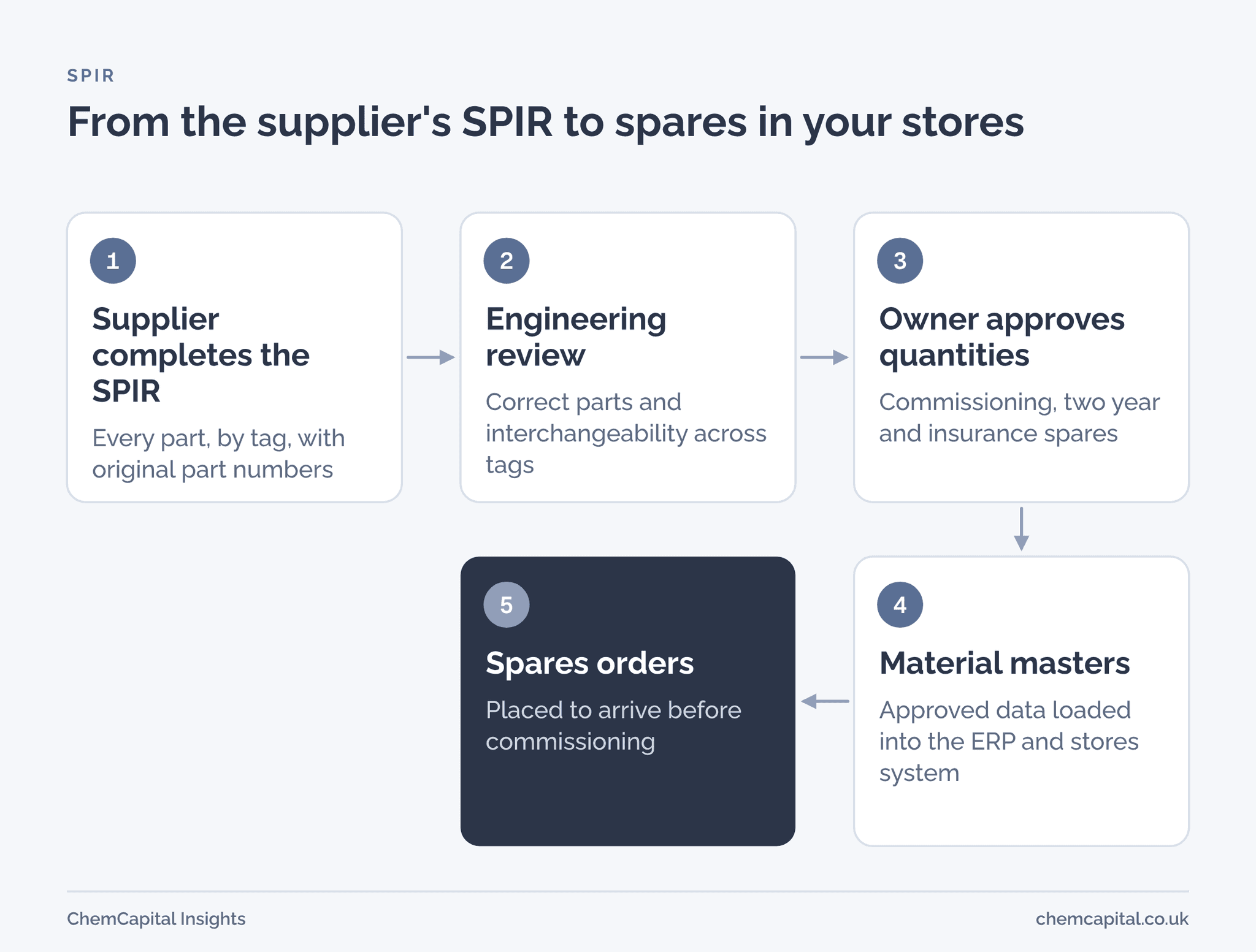
The supplier fills it in; the buyer defines the format and reviews it. In a typical EPC flow, the manufacturer completes the SPIR and returns it to the contractor, the owner sets the data requirements, and a data team turns the approved records into material masters and bills of material for the owner's ERP system [1].
One published project procedure shows the timing. Capital and commissioning spares are priced with the bid. A blank SPIR form goes out with the purchase order, the supplier returns the completed package after award, and procurement logs and expedites it. Engineers review it, the client approves quantities, and first year spares are ordered to arrive three months before the related equipment is commissioned [4].
Interchangeability is the point
The "I" in SPIR is where the money is. Identical parts across tags, or across different suppliers' equipment, mean you can hold fewer spares. The same project procedure reviews the consolidated master file to identify duplicate and interchangeable parts so that fewer spares are bought [4]. That only works if part data is precise: a bearing designation, not "bearing, drive end".
Criticality decides the quantities. A SPIR does not hold criticality or maintenance strategy [1]; those come from the owner's maintenance engineering. NORSOK Z 008, revised in 2024, sets out risk based maintenance and consequence classification, including how to use consequence classes for spare parts decisions [5]. Our article on the recommended spares list explains commissioning, critical and insurance spares in more detail.
Practical example
Illustrative figures. Three identical pumps, P101A, P101B and P101C, run two duty and one standby. The supplier's SPIR, filled tag by tag, recommends one mechanical seal cartridge per pump for the first two years, at £2,400 each with a 10 week lead time.
| Approach | Seals ordered | Cost |
|---|---|---|
| Tag by tag, interchangeability ignored | 3 | £7,200 |
| Interchangeability recognised, two held for the set | 2 | £4,800 |
| Saving | 1 | £2,400 |
The judgement on two versus one belongs to maintenance, based on the pumps' criticality and failure history. The SPIR's job is to make the shared part visible so that judgement can be made.
Getting a good SPIR from suppliers
- Put it in the RFQ. Name the SPIR format in the vendor document list, and ask for commissioning and capital spares priced with the bid. Our vendor document requirement list article shows how.
- Ask for original manufacturer part numbers. Packager codes alone lock you into one source.
- Fix price validity. Spares prices often expire before you order; agree how long they hold.
- Link a payment milestone. Final documentation, including the SPIR, is easier to get while money is still due.
- Check before you load. Review descriptions and part numbers before they become material masters. Errors in the ERP system cost far more to clear later.
ChemCapital's RFQ to purchase order workflow keeps spares requests, prices and lead times tied to the original order, so the spares you approve can be ordered and tracked against the same supplier record.
Where ChemCapital fits
A SPIR turns into real orders: commissioning spares, two year spares and insurance spares, each with a lead time that matters. Tracking them alongside the main equipment stops spares becoming the item that delays start up.
Ready to order the right spares on time? Start a free 14 day ChemCapital trial, with no credit card needed.
Frequently asked questions
What is a SPIR form?
A spare parts interchangeability record: the supplier's list of every spare part for the equipment on one purchase order, by tag, with part numbers, quantities installed, which tags share each part, recommended spares quantities, prices and lead times.
Who fills in the SPIR?
The equipment supplier, in the format the buyer or owner specifies. Engineering reviews it, the owner approves quantities, and the data is used to set up spare parts in the stores and maintenance system.
What does interchangeability mean in a SPIR?
That the same part, with the same original manufacturer's part number, is used in more than one tag or item of equipment. Recognising it lets you hold fewer spares for the whole set.
When should the SPIR be submitted?
Commonly after award, with commissioning and capital spares priced at bid stage. The completed SPIR should come early enough for spares to be ordered and delivered before commissioning.
Continue reading
Informational only, not procurement or legal advice. Cited names, frameworks, and statistics belong to their respective owners.
Create and manage RFQs in minutes
ChemCapital handles the entire procurement cycle, from structured RFQs and supplier comparisons to formal purchase orders and delivery tracking.
Start for freeRelated articles
Recommended Spares List: Commissioning, Operating and Insurance Spares
What a recommended spares list should hold: commissioning, two year operating and insurance spares, criticality, what to ask in the RFQ, and a pump and vessel template.
Cost of Late Equipment Delivery: Worked Example
How to calculate the weekly cost of late equipment delivery, compare it with liquidated damages and use it to set a damages rate a supplier can accept.
Payment Milestones and Supplier Cash Flow: Worked Example
How payment milestones, bonds and retention shape an equipment supplier's cash curve, with a worked example comparing two schedules on a £400,000 order.