
Supplier Scorecard for Engineered Equipment Suppliers (Free Template)
Generic retail KPIs do not fit a supplier who builds one skid a year. Here is a scorecard built for engineered equipment, with weights, scoring rules and a worked example.
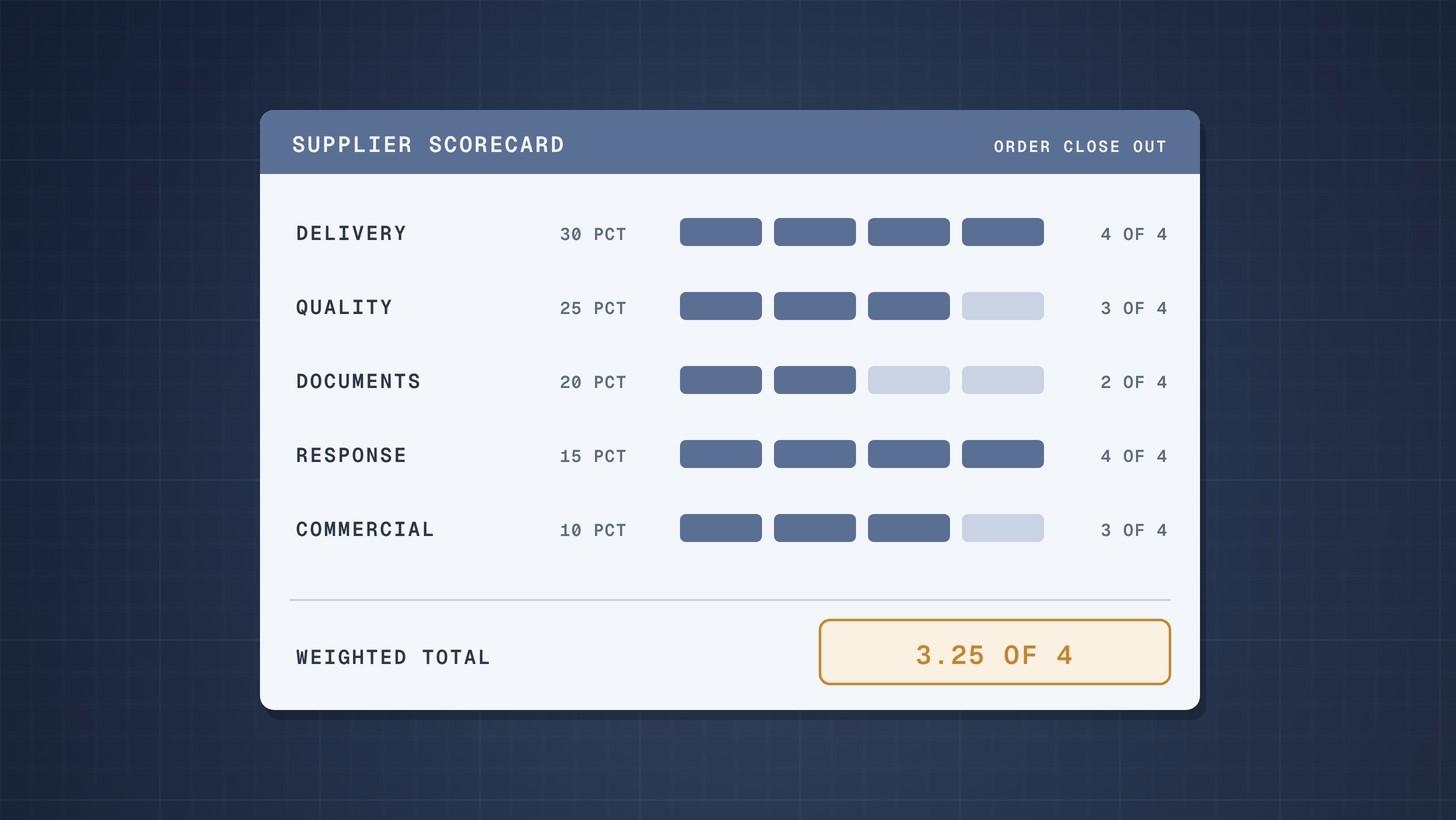
A supplier scorecard for engineered equipment rates each supplier after award on five things that matter for one off, made to order items: on time delivery against milestones, document quality, nonconformances, responsiveness and commercial behaviour, each weighted and scored on a fixed scale. Reviewed at order close out and at least once a year, it tells you who to invite next time and gives the supplier a fair, specific basis for improvement.
Free download: supplier scorecard (Excel). Ready to fill in, free to use, no sign up needed.
Below is a template you can copy, the scoring rules that make it fair, and a worked example.
Why this matters now
ISO 9001 asks organisations to set and apply criteria for evaluating, selecting and monitoring external providers, and for evaluating them again over time, based on their ability to meet requirements, and to keep records of the results and the actions taken [1]. Many buyers do the selection part well and the monitoring part badly.
Public buyers in the UK now have to do it in the open. Under the Procurement Act 2023, a contracting authority must generally set at least three KPIs for a contract worth more than £5 million, assess performance at least once every twelve months and on termination, and publish the results using a fixed scale: good, approaching target, requires improvement or inadequate [2]. Private buyers are not bound by that, but the discipline is worth copying.
Create and manage RFQs in minutes
ChemCapital handles the entire procurement cycle, from structured RFQs and supplier comparisons to formal purchase orders and delivery tracking.
Pre award evaluation versus post award scorecard
They are different tools. The supplier evaluation matrix compares bidders before award on what they promise. The scorecard measures one supplier after award on what they delivered.
| Pre award evaluation matrix | Post award scorecard | |
|---|---|---|
| Question | Who should we award to? | How did they perform, and should we use them again? |
| Evidence | Bids, references, audits, presentations | Dates, document reviews, NCRs, correspondence |
| Timing | Once, before award | During the order, at close out, then yearly |
| Output | A ranked award recommendation | A rating, actions, and an input to the approved list |
The scorecard feeds the next evaluation. A supplier's past score becomes evidence in the next bid evaluation, and can move them up or down your preferred supplier and approved vendor lists.
The five measures for engineered equipment
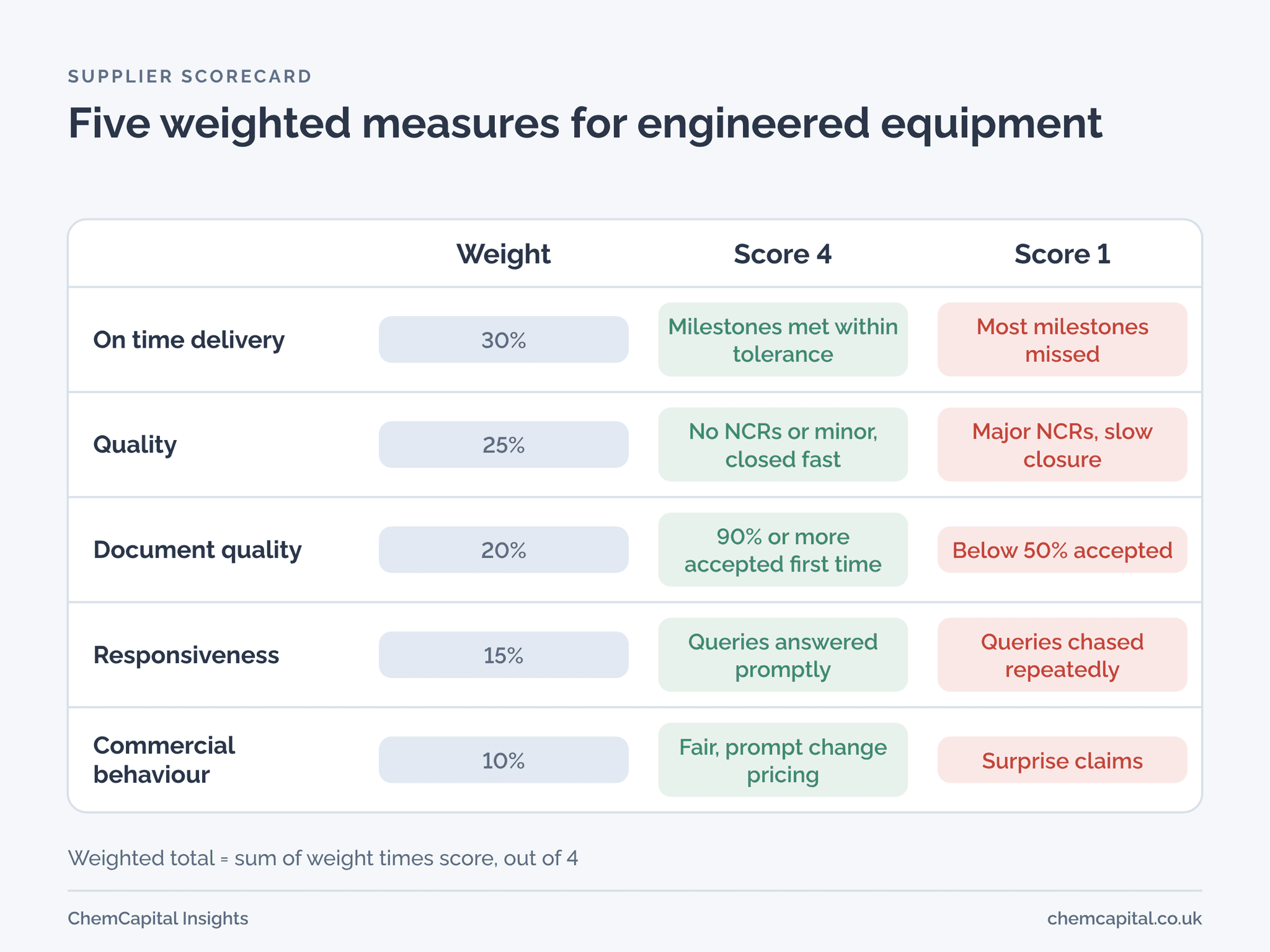
Retail style KPIs, such as order fill rate, do not fit a supplier who builds one skid a year. CIPS lists hard measures such as quality, rejects, delivery accuracy, warranty claims and lead times, alongside relationship measures such as account management and ethics [3]. Adapted for engineered equipment:
| Measure | How to measure it | Weight |
|---|---|---|
| On time delivery | Key milestones (drawings issued, FAT, ready to ship) met within an agreed tolerance, for example 5 working days | 30% |
| Document quality | Share of vendor documents accepted at first issue, and data book accepted at first submission | 20% |
| Quality | Nonconformance reports raised, weighted by severity, and how quickly they were closed | 25% |
| Responsiveness | Median working days to answer technical queries and change requests | 15% |
| Commercial behaviour | Change orders priced fairly and promptly, invoices correct, no surprise claims | 10% |
Adjust the weights to the category. For pharma skids you may lift document quality; for long lead pumps, delivery. Our guide to expediting equipment orders explains how to collect milestone dates as the order runs, which makes the delivery score factual rather than a feeling.
Collect the data as you go
A scorecard filled in from memory at the end of the year is an opinion. One filled in from records is evidence. Four habits make the difference:
- Log milestones on the purchase order. Promised date, forecast date and actual date for each key milestone. The delivery score then calculates itself.
- Use the document register. Your vendor document register already records each submission and its review code. First issue acceptance is a count, not a judgement.
- Raise NCRs formally. An issue sorted out by phone never reaches the scorecard. Record it with a severity, even if it closes the same day.
- Time stamp technical queries. A query log with sent and answered dates gives you response times without anyone keeping a separate spreadsheet.
If three people on the project hold these records in three places, agree one place before the order starts. The scorecard is only as good as the data under it, and the supplier will ask to see that data the first time a score is low.
Score on a fixed scale
Use four levels with written descriptors, so two buyers score the same evidence the same way. A published CIPS example scorecard uses red, amber, green and exceeded levels, with a plain description for each measure, such as delivery completed in accordance with the contract for green [4]. The Procurement Act scale works equally well [2]:
Want this as a file? Download the supplier scorecard (Excel).
| Score | Rating | Example for document quality |
|---|---|---|
| 4 | Good | 90% or more accepted at first issue |
| 3 | Approaching target | 75 to 89% |
| 2 | Requires improvement | 50 to 74% |
| 1 | Inadequate | Below 50%, or data book rejected twice |
Write similar bands for every measure before the order starts, and share them with the supplier. CIPS advises that suppliers should have access to the same information used to evaluate them, and that you ask for their view of working with you too, since your own process may be causing the problem [3].
Review rhythm
- During the order. Track milestones, document returns and NCRs as they happen. Do not reconstruct them at the end.
- At close out. Score the order, discuss it with the supplier, and agree actions.
- Every year. Combine order scores for suppliers you use often. That is your ISO 9001 record of evaluating them again [1].
- For frameworks. Monthly or quarterly reviews may suit. The government's model performance schedule, for example, sets monthly review meetings within a week of each performance report, with minutes agreed at the next meeting [5].
Service credits, where a missed KPI reduces the next invoice, are common in service contracts [5] but rare for one off equipment, where liquidated damages for delay do that job. Keep the scorecard about improvement and future awards, not as a second penalty.
Practical example
Illustrative scores. Two suppliers delivered similar heat exchanger packages this year.
| Measure | Weight | Supplier A score | Supplier A weighted | Supplier B score | Supplier B weighted |
|---|---|---|---|---|---|
| On time delivery | 30% | 4 | 1.20 | 3 | 0.90 |
| Document quality | 20% | 2 | 0.40 | 4 | 0.80 |
| Quality | 25% | 3 | 0.75 | 4 | 1.00 |
| Responsiveness | 15% | 4 | 0.60 | 2 | 0.30 |
| Commercial behaviour | 10% | 3 | 0.30 | 4 | 0.40 |
| Total out of 4 | 3.25 | 3.40 | |||
| As a percentage | 81% | 85% |
The totals are close, but the detail is not. Supplier A ships on time but its documents need rework; the action is a document review step before submission. Supplier B builds well but is slow to answer queries; the action is a named contact and a response time target. Both stay on the list with specific improvements, which is the scorecard's real job.
Using the score in the next award
Past performance is legitimate evidence in a later evaluation, as long as you tell bidders in advance how you will use it. A simple approach is to make delivered performance one criterion in the technical evaluation, for example 10% of the technical score, using the supplier's average scorecard result over its last few orders. A supplier with no history scores on references and audit instead, so new entrants are not shut out.
Be consistent. If one buyer counts a late FAT and another forgives it, the scores stop meaning anything and suppliers will rightly challenge them.
Common mistakes
- Too many measures. Twelve KPIs means nobody collects eight of them. Five is enough for engineered equipment.
- Scoring the buyer's delays against the supplier. If your drawing approval took three weeks, the supplier's late FAT is partly yours. Note it.
- Never sharing the result. A score the supplier never sees cannot improve anything.
- Using it only to punish. The best suppliers want the feedback. Use the review to agree two or three specific actions, then check them at the next review.
Where ChemCapital fits
ChemCapital's supplier performance tracking records delivery, documents and issues against each order as it runs, so the scorecard builds itself from the order history rather than from memory at the end of the year.
Ready to score suppliers on what they actually delivered? Start a free 14 day ChemCapital trial, with no credit card needed.
Frequently asked questions
What should a supplier scorecard include?
For engineered equipment: on time delivery against milestones, document quality, nonconformances, responsiveness to technical queries and commercial behaviour, each weighted and scored against written bands.
What is the difference between a supplier evaluation matrix and a supplier scorecard?
The evaluation matrix compares bidders before award on what they offer. The scorecard measures one supplier after award on what it delivered, and feeds the next evaluation.
How often should supplier performance be reviewed?
Score each order at close out and combine scores at least once a year for regular suppliers. Framework suppliers may need monthly or quarterly reviews. UK public contracts over £5 million need KPI assessments at least every twelve months.
What are good KPIs for equipment suppliers?
Milestones met within an agreed tolerance, the share of documents accepted at first issue, NCRs by severity and time to close, median days to answer technical queries, and how fairly change orders are priced.
Continue reading
Informational only, not procurement or legal advice. Cited names, frameworks, and statistics belong to their respective owners.
Create and manage RFQs in minutes
ChemCapital handles the entire procurement cycle, from structured RFQs and supplier comparisons to formal purchase orders and delivery tracking.
Start for freeRelated articles
AMP8 for Equipment Suppliers: How Water Companies Buy, 2025 to 2030
AMP8 is the 2025 to 2030 investment period for water companies in England and Wales, with £104bn approved. Here is how the money is spent, how water companies buy through frameworks and delivery partners, and how equipment suppliers get in.
How to Find Tenders for Pumps, Valves and Process Equipment
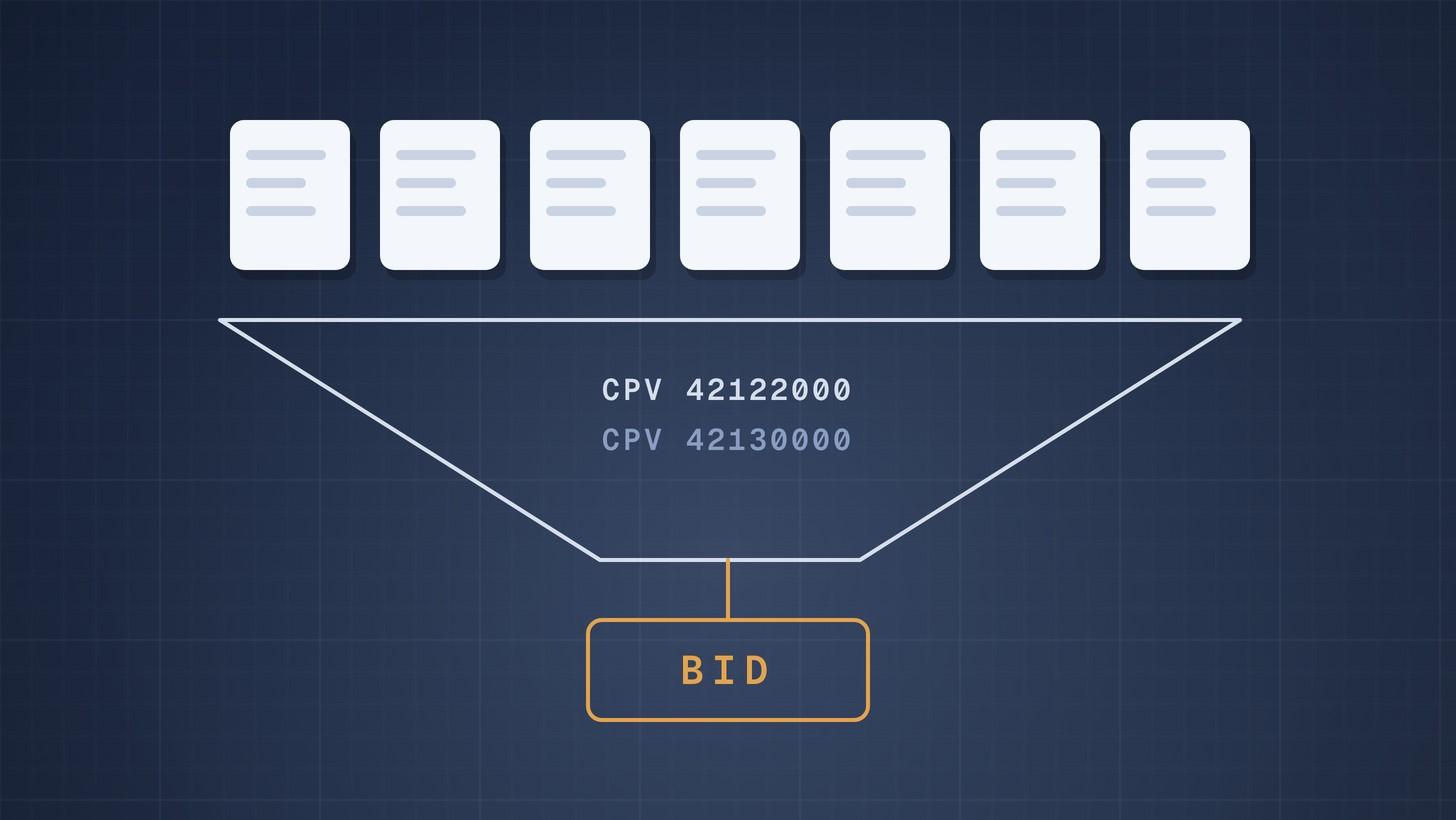
Public tenders for process equipment are published free on Find a Tender in the UK, TED in the EU and SAM.gov in the US. Here is how to set alerts with the right CPV codes and where utility frameworks fit.

Framework Agreements for Pumps, Valves and Instruments: When They Beat Project Buying
A frame agreement for pumps, valves or instruments pays off when you buy the same types repeatedly. Here is when it beats project by project buying, what to put in it, and a worked example.