
Agitator Power Calculation: Worked Example
How to calculate agitator power and torque from power number, speed and impeller diameter, how Reynolds number changes the answer, and what it means for the drive.
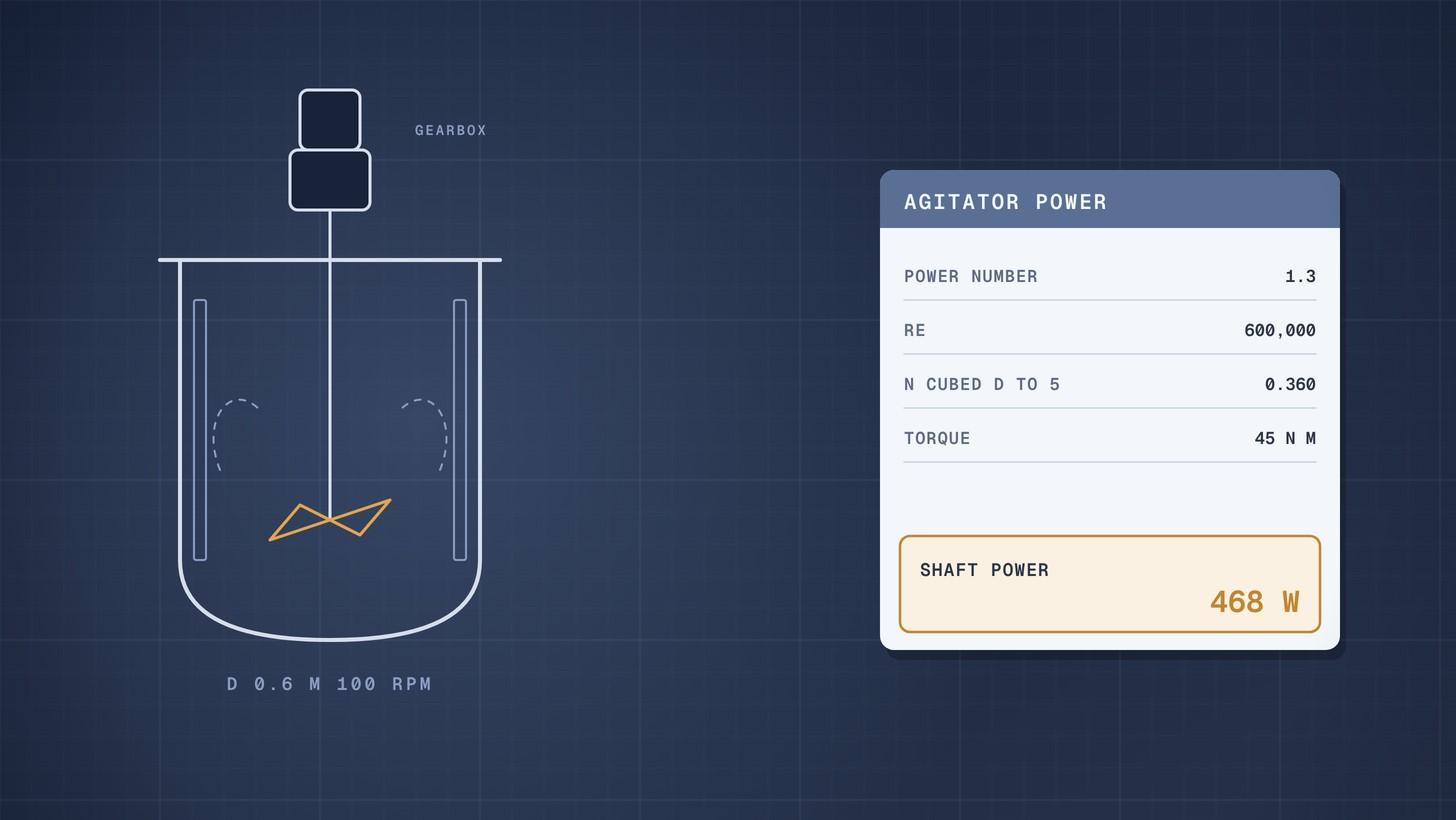
Agitator power is P = Np × ρ × N³ × D⁵, where Np is the impeller's power number, ρ the liquid density, N the shaft speed in revolutions per second and D the impeller diameter. In the worked example below, a 0.6 m pitched blade turbine at 100 rpm in water draws about 470 W; the same impeller in a 50 Pa·s liquid draws about 1.3 kW, because the power number rises in laminar flow.
The power number depends on the impeller and on the flow regime, which the impeller Reynolds number tells you. Get those two right and the rest is arithmetic.
Why this matters now
Agitator offers are hard to compare. One supplier quotes a 1.5 kW drive, another 4 kW, for what looks like the same duty. The difference is usually the impeller type, the speed or the viscosity each assumed. A quick power calculation shows which assumption is driving the price.
Torque matters as much as power. A Chemineer presentation on mixer selection notes that motor power relates mainly to operating cost, while torque relates to capital cost, because the gearbox is sized on torque [1]. A slow, large impeller and a fast, small one can draw the same power with very different gearboxes.
Create and manage RFQs in minutes
ChemCapital handles the entire procurement cycle, from structured RFQs and supplier comparisons to formal purchase orders and delivery tracking.
Reynolds number first
The impeller Reynolds number is Re = D² × N × ρ ÷ μ, with μ the viscosity. An AIChE article on laminar mixing sets out the regimes [2]:
- Laminar: fully laminar below Re of 10, and below about 40 it can be treated as laminar. The power number is inversely proportional to Re, so Np = K_L ÷ Re, where K_L is a constant for the impeller.
- Turbulent: above about 10,000. The power number is constant.
- Transitional: in between. Use the maker's power curve.
The same article gives laminar constants of 27.4 for a typical hydrofoil and 43.2 for a pitched blade turbine [2].
The power number itself is just P ÷ (ρ × N³ × D⁵), the definition used in research on stirred tanks [3]. It assumes a baffled vessel. In an unbaffled tank the liquid swirls and forms a vortex, and the same study notes the power number keeps falling as Re rises [3], so the turbulent values below do not apply.
Power numbers for common impellers
Turbulent power numbers vary widely with impeller shape. The Chemineer presentation lists these values for its own impellers in turbulent flow [1]:
| Impeller type | Example | Turbulent power number Np |
|---|---|---|
| High efficiency hydrofoil | HE 3 | 0.28 |
| Curved blade axial | SC 3 | 0.55 |
| Wide blade hydrofoil | Maxflo W | 0.85 |
| Pitched blade turbine | P 4 | 1.3 |
| Straight blade turbine | S 4 | 2.88 |
| Disc turbine, Rushton style | D 6 | 5.0 |
Other makers' impellers of the same family have similar, but not identical, numbers. SPX FLOW's Lightnin range, for example, offers a low solidity hydrofoil for low viscosity blending and solids suspension, a high solidity hydrofoil for viscous blending and a Rushton turbine for high shear duties [4]. The choice follows the duty; the power follows the choice.
Worked example: blending in a 4 m³ vessel
A baffled vessel holds 4 m³ of a water like liquid. The agitator is a 0.6 m pitched blade turbine at 100 rpm. Vessel, speed and impeller are illustrative.
Step 1: speed in revolutions per second. N = 100 ÷ 60 = 1.667 rev/s.
Step 2: Reynolds number. With water at about 998 kg/m³ and 1.0 mPa·s [5]: Re = 0.6² × 1.667 × 998 ÷ 0.001 = about 600,000. Fully turbulent, so Np is constant.
Step 3: power. P = 1.3 × 1,000 × 1.667³ × 0.6⁵ = 1.3 × 1,000 × 4.63 × 0.0778 = 468 W at the shaft, about 0.12 kW per m³.
Step 4: torque. Torque = P ÷ (2π × N) = 468 ÷ 10.47 = 45 N·m.
Chemineer's own power formula in horsepower, using rpm and impeller diameter in inches, gives the same 468 W [1].
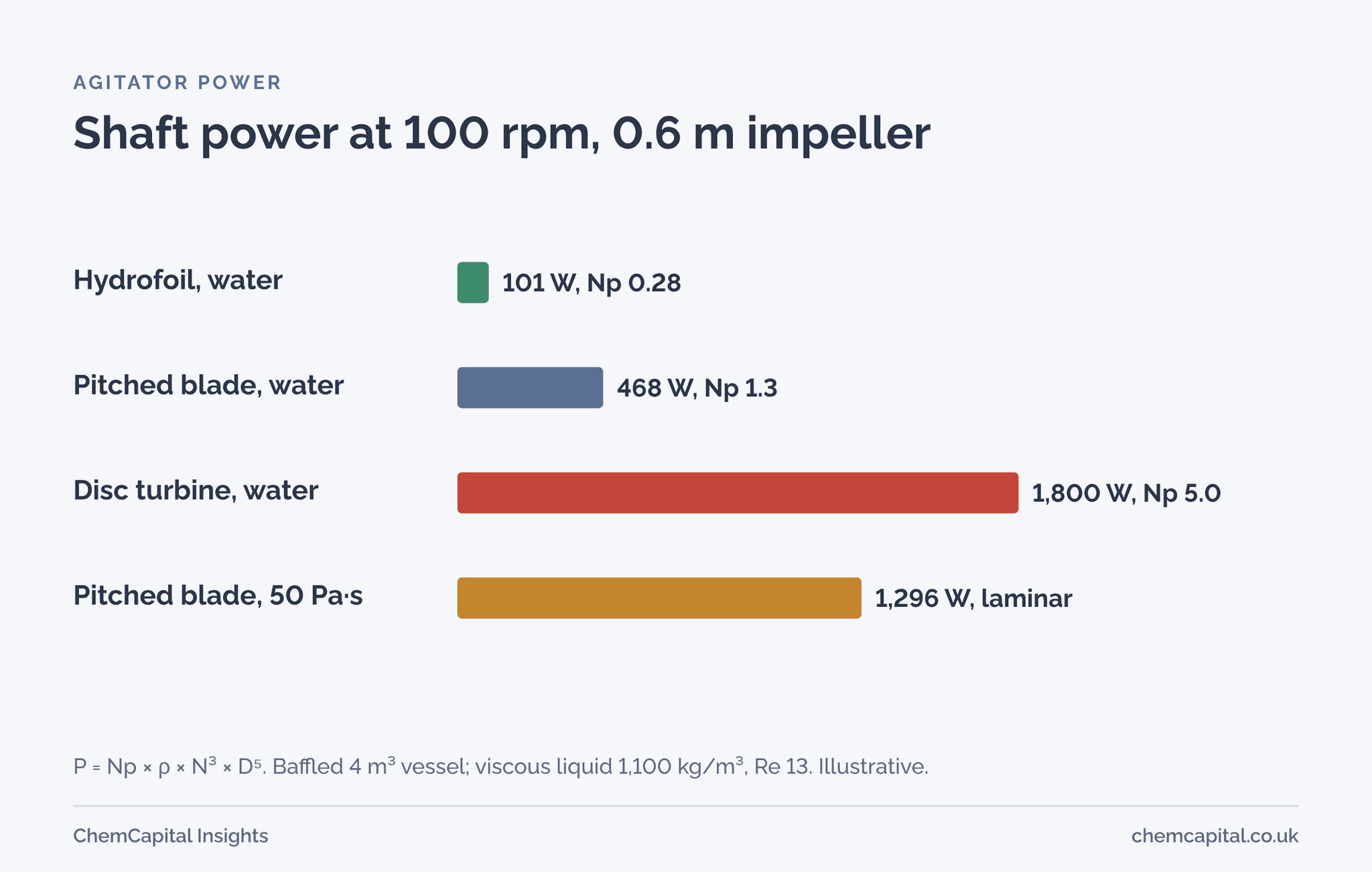
Same speed, other impellers.
| Impeller at 100 rpm, D = 0.6 m | Np | Shaft power | Torque |
|---|---|---|---|
| High efficiency hydrofoil | 0.28 | 101 W | 9.6 N·m |
| Pitched blade turbine | 1.3 | 468 W | 45 N·m |
| Disc turbine | 5.0 | 1,800 W | 172 N·m |
The disc turbine draws 18 times the power of the hydrofoil at the same speed and size. It is the right choice for high shear or gas dispersion, not for simple blending.
Speed matters most. Because power goes with N³, doubling the pitched blade turbine to 200 rpm raises power eightfold, to about 3.7 kW. Diameter matters even more, with D⁵: a 10% larger impeller at the same speed draws about 61% more power.
When the liquid is viscous
Now give the same pitched blade turbine a liquid with a density of 1,100 kg/m³ and a viscosity of 50 Pa·s, both illustrative.
- Re = 0.6² × 1.667 × 1,100 ÷ 50 = 13.2, effectively laminar [2]
- Np = 43.2 ÷ 13.2 = 3.27 [2]
- P = 3.27 × 1,100 × 4.63 × 0.0778 = 1,296 W, torque 124 N·m
The same impeller at the same speed now needs nearly three times the power and torque. In laminar flow a pitched blade turbine also moves the liquid poorly, which is why viscous duties use high solidity hydrofoils, helical ribbons or anchors. If the viscosity changes during a batch, as in many polymer and food processes, check the power at the highest viscosity.
Scaling up the same blend
Suppose the process moves to a 40 m³ vessel of the same shape, ten times the volume. Every length grows by the cube root of 10, about 2.15, so the impeller becomes 1.29 m. How fast should it turn? That depends on which quantity you keep the same.
| Basis | Speed | Shaft power | Power per m³ | Torque |
|---|---|---|---|---|
| 4 m³ original | 100 rpm | 468 W | 117 W/m³ | 45 N·m |
| 40 m³, same power per m³ | 60 rpm | 4.7 kW | 117 W/m³ | 745 N·m |
| 40 m³, same tip speed (3.1 m/s) | 46 rpm | 2.2 kW | 54 W/m³ | 447 N·m |
Holding power per volume gives a drive ten times bigger in power but more than sixteen times bigger in torque, and torque sets the gearbox price [1]. Holding tip speed halves the power per volume, which may not blend as well. Which basis suits your process is a question for the mixer supplier, ideally backed by trials, but the table shows why scale up quotes can differ so much.
From shaft power to drive size
The motor must cover the shaft power plus gearbox and seal losses, with a margin the supplier sets. The gearbox must carry the torque, including at start up. The Lightnin Compact range, for example, spans 0 to 55 kW and 13 to 155 rpm, though not every speed at every power [4], so the speed you need narrows the gearbox choice.
What to put in an agitator RFQ
- The duty: blending, solids suspension, gas dispersion, heat transfer or a mix, with the required blend time or suspension state.
- Liquid properties: density and viscosity across the batch, including the worst case.
- Vessel geometry: diameter, liquid height, baffles, nozzles and any internals.
- What you want back: impeller type, diameter, speed, power number, shaft power, torque, motor rating and gearbox service factor.
Our guide to agitator and impeller types explains which impeller suits which duty, and jacketed vessel heating time shows how agitation feeds into heat transfer. ChemCapital's structured RFQs send every mixer supplier the same duty and geometry, so power, torque and price come back on the same basis.
Ready to compare agitator quotes on power and torque, not just price? Start a free 14 day ChemCapital trial, with no credit card needed.
Frequently asked questions
How do you calculate agitator power?
Multiply the impeller power number by liquid density, shaft speed in revolutions per second cubed and impeller diameter in metres to the fifth power. A 0.6 m pitched blade turbine with a power number of 1.3 at 100 rpm in water draws about 470 W at the shaft.
What is the power number of a Rushton turbine?
About 5 in turbulent flow in a baffled vessel, compared with roughly 1.3 for a four blade pitched turbine and around 0.3 for a high efficiency hydrofoil. The exact value depends on the maker's design and the impeller to tank diameter ratio.
What Reynolds number is turbulent for an agitator?
The impeller Reynolds number, D squared times N times density over viscosity, is turbulent above about 10,000, where the power number is constant. Below about 10 it is laminar and the power number is inversely proportional to Reynolds number.
Why does a viscous liquid need more agitator power?
In laminar flow the power number rises as Reynolds number falls, so the same impeller at the same speed draws more power. In the worked example, a 50 Pa·s liquid needs nearly three times the power of water.
Continue reading
Informational only, not procurement or legal advice. Cited names, frameworks, and statistics belong to their respective owners.
Create and manage RFQs in minutes
ChemCapital handles the entire procurement cycle, from structured RFQs and supplier comparisons to formal purchase orders and delivery tracking.
Start for freeRelated articles
Pipe Thermal Expansion: Worked Example
How to calculate pipe thermal expansion for carbon and stainless steel, what restrained expansion does, and how loops and expansion joints absorb it.
Horizontal Tank Volume When Partly Filled: Worked Example
How to calculate the volume of a partly filled horizontal tank with dished heads, with a worked example and a full dip table you can rebuild in a spreadsheet.
Cooling Water Flow Calculation: Worked Example
How to calculate cooling water flow from heat duty and temperature rise, then size the cooling tower circulation, evaporation and make up water.